Paper I — Q6
(a) Explain the nature of human attitudes. How is the knowledge of attitude change process helpful in bringing religious harmony…
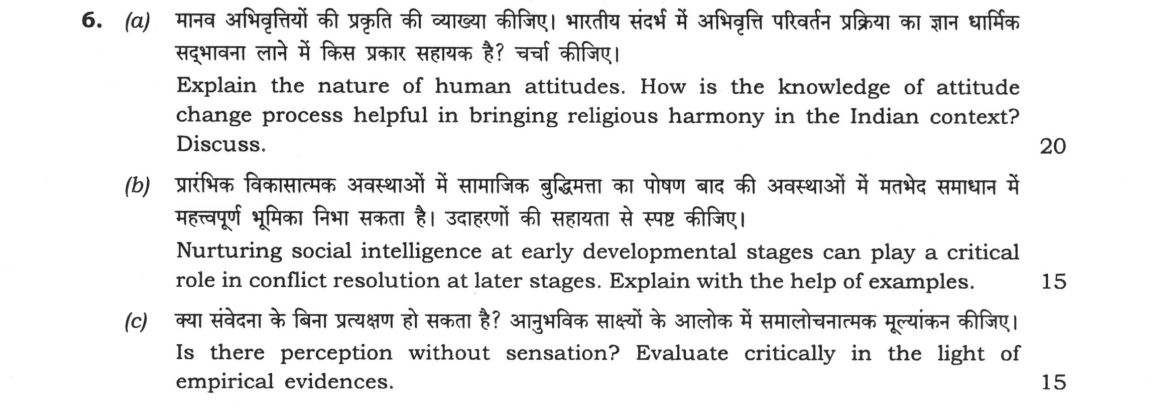
Explain the nature of human attitudes. How is the knowledge of attitude change process helpful in bringing religious harmony in the Indian context? Discuss. 20 marks
Nurturing social intelligence at early developmental stages can play a critical role in conflict resolution at later stages. Explain with the help of examples. 15 marks
Is there perception without sensation? Evaluate critically in the light of empirical evidences. 15 marks
हिंदी में प्रश्न पढ़ें
मानव अभिवृत्तियों की प्रकृति की व्याख्या कीजिए। भारतीय संदर्भ में अभिवृत्ति परिवर्तन प्रक्रिया का ज्ञान धार्मिक सद्भावना लाने में किस प्रकार सहायक है? चर्चा कीजिए। (20 अंक)
प्रारंभिक विकासात्मक अवस्थाओं में सामाजिक बुद्धिमत्ता का पोषण बाद की अवस्थाओं में मतभेद समाधान में महत्वपूर्ण भूमिका निभा सकता है। उदाहरणों की सहायता से स्पष्ट कीजिए। (15 अंक)
क्या संवेदना के बिना प्रत्यक्षण हो सकता है? अनुभविक साक्ष्यों के आलोक में समालोचनात्मक मूल्यांकन कीजिए। (15 अंक)
Model answer
Written by UPSC Answer Check against this question's marking rubric, to the expected length. UPSC does not publish answers for Mains — this is one way to score well, not an official key.
Nature of Attitudes and Religious Harmony in India
Human attitudes are enduring evaluations of people, objects, or ideas, structured around the tri-component ABC model: Affective (emotional responses), Behavioural (action tendencies), and Cognitive (beliefs and stereotypes). Katz identified four primary motivational functions of attitudes: the knowledge function (organizing experience), the utilitarian function (maximizing rewards), the value-expressive function (projecting core identity), and the ego-defensive function (shielding the self from internal conflict or external threat). In pluralistic societies, intergroup prejudices often become entrenched because they serve ego-defensive and value-expressive needs.
Knowledge of attitude change processes provides practical mechanisms for fostering religious harmony in the Indian context. Under Festinger’s Cognitive Dissonance Theory, creating situations where individuals engage in cooperative, counter-attitudinal actions—such as joint community welfare initiatives—induces psychological discomfort that compels a shift in underlying beliefs. Petty and Cacioppo’s Elaboration Likelihood Model (ELM) suggests that lasting change requires the central route, utilizing credible counter-stereotypic facts, critical media literacy, and inclusive educational curricula to stimulate deep cognitive processing, while the peripheral route can deploy respected spiritual leaders and cultural icons to champion pluralism. Furthermore, Allport’s Contact Hypothesis, operationalized through institutions like Mumbai’s Mohalla Committees or joint disaster-management forums, reduces prejudice when groups interact under conditions of equal status, shared superordinate goals, and institutional support.
Nurturing Social Intelligence and Conflict Resolution
Social intelligence encompasses two broad dimensions: social awareness (primal empathy, attunement, and empathic accuracy) and social facility (synchrony, self-presentation, and influence). Its emergence depends heavily on early developmental milestones, specifically the acquisition of Theory of Mind around age four and emotional intelligence, which allow children to infer diverse internal mental states, separate intent from impact, and regulate distress.
Early childhood constitutes a sensitive developmental window for social learning. Interventions such as Socio-Emotional Learning (SEL) modules in Anganwadi centres under Mission Saksham Anganwadi and life-skills programmes in school curricula foster cooperative problem-solving and perspective-taking. Longitudinally, individuals who internalize these skills during early development show a reduced tendency toward attribution errors and reactionary aggression in adulthood. For example, in community resource disputes, individuals with well-developed social intelligence are equipped to de-escalate tension through active listening, non-violent negotiation, and collaborative problem-solving rather than reverting to zero-sum group mobilization.
Perception Without Sensation: An Empirical Evaluation
The relationship between sensation (the transduction of physical energy by receptors) and perception (the cognitive interpretation and organization of sensory data) is viewed differently across theoretical paradigms. Constructivist theories (Helmholtz, Gregory) maintain that perception is an active, inferential process dependent on sensory inputs combined with top-down hypotheses. In contrast, Gibson’s ecological approach posits direct perception, wherein environmental invariant structures and affordances are picked up without complex cognitive mediation.
Empirical neuropsychology demonstrates that the link between sensation and conscious perception can dissociate. In blindsight (Weiskrantz), patients with lesions in the primary visual cortex correctly identify the location or movement of objects without subjective visual sensation, mediated by intact subcortical pathways like the superior colliculus. Conversely, phantom limb phenomena (Ramachandran) demonstrate vivid perceptual experiences occurring in the total absence of peripheral sensation, driven by cortical remapping and neural neuromatrices. Synesthesia further illustrates cross-modal perceptual experiences lacking corresponding direct sensory inputs, while conditions such as visual agnosia and prosopagnosia demonstrate intact sensation coupled with failed perceptual identification.
Way Forward
Perception, early socio-cognitive learning, and adult attitude structures represent an interconnected continuum of human behavior. Bridging basic neurocognitive insights with systematic early socio-emotional interventions and empirically grounded attitude-change strategies provides a comprehensive framework for resolving social fault lines and sustaining communal coexistence.
What "Discuss" is asking you to do
Lay the issue out from more than one side — how it arose, what is claimed for it, what is held against it, and where it now stands. UPSC attaches discuss to broad topics with several live dimensions, so coverage of the dimensions earns more than the strength of your opinion.
Structure that answers it
Set the issue up → the case as it is made → the case against → the dimension both sides leave out → where the balance now lies
Where marks are lost
Listing facts with no thread between them, or arguing one side throughout and calling it a discussion.
How this answer will be evaluated
Approach
Framework: UPSC Psychology Paper 1. (a) discuss: intro > 3-4 dimensions > example > balanced close | (b) explain: definition/context > points in order > small example > short close | (c) critically evaluate: positives > negatives/limits > conditions/safeguards > conclusion Full marks: Precise definitions, named theories/studies, specific Indian context, balanced critical analysis.
Key points expected
- Define attitude components (cognitive, affective, behavioral)
- Explain attitude change models (e.g., Hovland, Festinger)
- Link change process to Indian religious context
- Provide specific examples of harmony initiatives
- Define social intelligence (Goleman/Sternberg)
- Link early development to later conflict skills
- Provide concrete examples of early nurturing
- Show mechanism of conflict resolution
Evaluation rubric
Each sub-part is marked on its own, against the marks and word limit printed on the paper.
- (a) Nature of attitudes and application of attitude change to Indian religious harmony. 20 marks
discuss— intro → 3-4 dimensions → example → balanced close
Must cover
- Define attitude components (cognitive, affective, behavioral)
- Explain attitude change models (e.g., Hovland, Festinger)
- Link change process to Indian religious context
- Provide specific examples of harmony initiatives
Loses marks
- Generalizing without specific Indian examples
- Ignoring the 'change process' aspect
- Vague definitions of attitude
Earns more
- Mention specific Indian social experiments
- Reference specific psychological scales (e.g., Likert)
- Discuss role of media in attitude change
- Mention specific government schemes
Extra mark
- Cite specific Supreme Court judgment on secularism
- Reference specific academic study on Indian prejudice
- (b) Role of early social intelligence in later conflict resolution with examples. 15 marks
explain— definition/context → points in order → small example → short close
Must cover
- Define social intelligence (Goleman/Sternberg)
- Link early development to later conflict skills
- Provide concrete examples of early nurturing
- Show mechanism of conflict resolution
Loses marks
- Confusing social intelligence with general IQ
- Lack of specific examples
- Ignoring the 'early developmental' focus
Earns more
- Mention specific developmental stages
- Reference specific parenting techniques
- Discuss empathy development
- Mention specific school programs
Extra mark
- Cite specific longitudinal study on social skills
- Reference specific psychometric tool for social IQ
- (c) Critical evaluation of perception without sensation using empirical evidence. 15 marks
critically evaluate— positives → negatives/limits → conditions/safeguards → conclusion
Must cover
- Define sensation and perception distinction
- Present arguments for/against perception without sensation
- Cite specific empirical evidence/studies
- Provide a balanced critical judgment
Loses marks
- Ignoring empirical evidence
- Vague definitions of terms
- One-sided argument without critical evaluation
Earns more
- Mention specific sensory deprivation studies
- Reference specific neurological evidence
- Discuss role of past experience
- Mention specific philosophical perspectives
Extra mark
- Cite specific fMRI study on perception
- Reference specific case study of sensory loss
Practice this exact question
Write your answer and it is marked point by point against the model answer above — what you covered, what you missed, what you got wrong.
Evaluate my answer →More from Psychology 2022 Paper I
- Q3 (a) Is problem solving a psychological process? Illustrate your answer with the steps and…
- Q4 (a) Can human beings be fully functioning and self-actualized? Evaluate it from humanisti…
- Q5 Answer the following questions in about 150 words each: (a) Discuss the significance of s…
- Q6 (a) Explain the nature of human attitudes. How is the knowledge of attitude change proces…
- Q7 (a) Is intelligence a univariate or multivariate concept? Discuss in the light of Spearma…
- Q8 (a) "Learning occurs not only through conditioning but also from our observations of othe…