Paper II — Q1
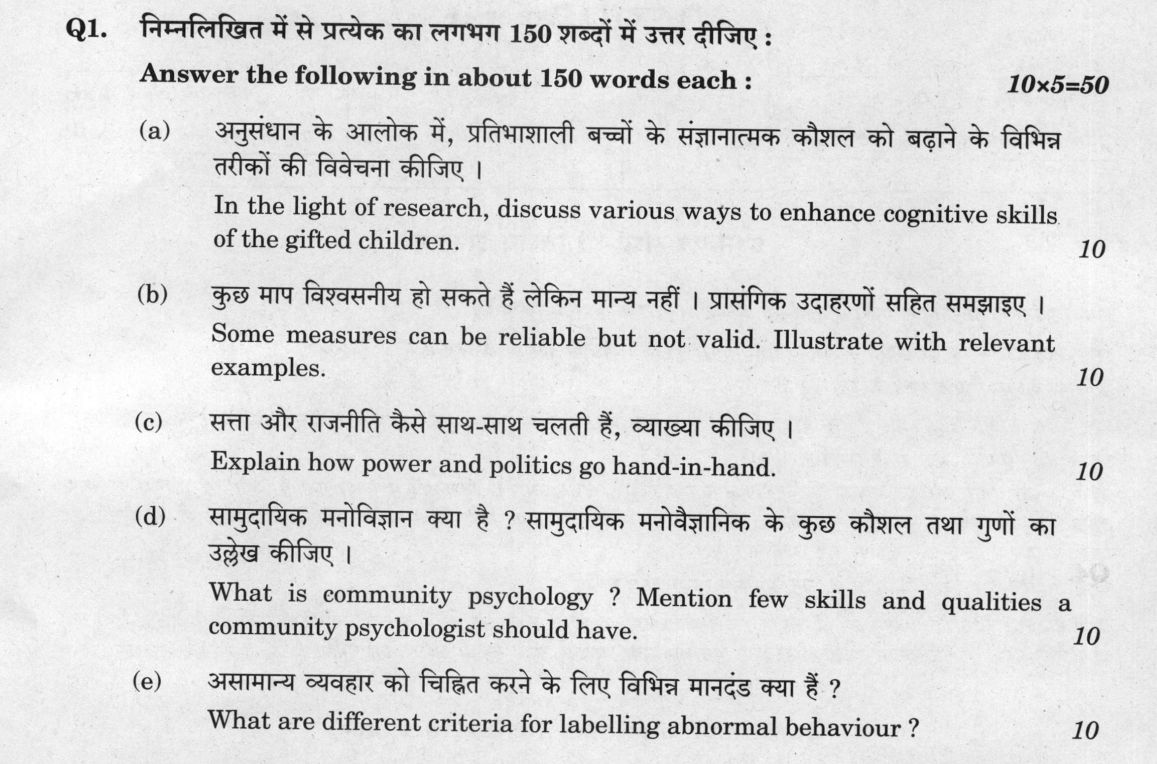
Answer the following in about 150 words each : 10×5=50 (a) In the light of research, discuss various ways to enhance cognitive…
Answer the following in about 150 words each : 10×5=50
In the light of research, discuss various ways to enhance cognitive skills of the gifted children. 10 marks
Some measures can be reliable but not valid. Illustrate with relevant examples. 10 marks
Explain how power and politics go hand-in-hand. 10 marks
What is community psychology ? Mention few skills and qualities a community psychologist should have. 10 marks
What are different criteria for labelling abnormal behaviour ? 10 marks
हिंदी में प्रश्न पढ़ें
निम्नलिखित में से प्रत्येक का लगभग 150 शब्दों में उत्तर दीजिए :
अनुसंधान के आलोक में, प्रतिभाशाली बच्चों के संज्ञानात्मक कौशल को बढ़ाने के विभिन्न तरीकों की विवेचना कीजिए । 10
कुछ माप विश्वसनीय हो सकते हैं लेकिन मान्य नहीं । प्रासंगिक उदाहरणों सहित समझाइए । 10
सत्ता और राजनीति कैसे साथ-साथ चलती हैं, व्याख्या कीजिए । 10
सामुदायिक मनोविज्ञान क्या है ? सामुदायिक मनोवैज्ञानिक के कुछ कौशल तथा गुणों का उल्लेख कीजिए । 10
असामान्य व्यवहार को चिह्नित करने के लिए विभिन्न मानदंड क्या हैं ? 10 marks
Model answer
Written by UPSC Answer Check against this question's marking rubric, to the 150-word length. UPSC does not publish answers for Mains — this is one way to score well, not an official key.
(a) Enhancing Cognitive Skills of Gifted Children
Giftedness involves complex interactions between potential and environment. Joseph Renzulli’s Three-Ring Conception posits that gifted behaviors emerge from the intersection of above-average ability, task commitment, and creativity. Translating this into educational practice through Renzulli’s Schoolwide Enrichment Model (SEM) provides three levels of enrichment: general exploratory activities (Type I), group training in thinking processes (Type II), and individual or small-group investigations of real problems (Type III). Complementing this, Gagné’s Differentiated Model of Giftedness and Talent (DMGT) demonstrates that natural abilities (gifts) transform into competencies (talents) only through systematic learning and environmental catalysts. Effective cognitive interventions require balancing curriculum compacting and vertical acceleration (such as advanced placement) with horizontal enrichment programs and mentorship from domain experts. Concurrently, addressing asynchronous development and socio-emotional needs through counseling is vital to prevent underachievement, as demonstrated in specialized Indian settings like Jawahar Navodaya Vidyalayas.
(b) Reliability and Validity in Psychometrics
Reliability refers to the consistency and repeatability of a measurement, whereas validity reflects the degree to which an instrument truly measures the targeted construct. A psychometric or physical tool can be highly reliable while completely lacking validity.
For instance, a physical weighing scale miscalibrated to consistently add five kilograms will yield identical, highly consistent readings across multiple trials (demonstrating high test-retest reliability), yet it fails to measure actual body weight accurately (lacking criterion validity). In psychological testing, administering an English-language verbal intelligence test with high internal consistency (Cronbach’s alpha) to non-native tribal students in India reliably records their level of English acculturation and vocabulary rather than their fluid cognitive ability (g). Thus, while the instrument produces stable scores, it lacks construct validity for the intended population. Reliability is therefore a necessary, but not sufficient, condition for validity.
(c) The Nexus Between Power and Politics
Power and politics operate in a continuous, reciprocal relationship within institutional systems. French and Raven define power as the latent potential or capacity of an agent to influence others, categorized into five bases: reward, coercive, legitimate, referent, and expert power. Organizational politics represents the active, behavioral conversion of this power into informal influence tactics—such as coalition building, impression management, and bargaining—to achieve objectives outside formal channels.
According to Resource Dependence Theory (Pfeffer and Salancik), individuals or sub-units that control scarce, non-substitutable resources acquire organizational power. This power stimulates political behavior to safeguard resources and negotiate decisions under conditions of ambiguity. Conversely, successful political maneuvers allow actors to expand their jurisdiction, gain control over administrative processes, and augment their legitimate and referent power. Thus, power provides the necessary capital, while organizational politics constitutes the transactional mechanism through which institutional life is navigated.
(d) Community Psychology and Core Competencies
Community psychology moves beyond individual-centric, deficit models to adopt an ecological framework (Bronfenbrenner), prioritizing primary prevention, systemic empowerment, and social justice over tertiary clinical remediation. It analyzes how individual well-being is shaped by macro-level social structures, community norms, and institutional policies.
A community psychologist requires distinct competencies:
- Participatory Action Research (PAR) skills to engage marginalized groups as co-researchers rather than passive subjects.
- Program development, implementation, and evaluation capabilities to design sustainable, preventive community interventions.
- Coalition building and inter-sectoral mobilization to align grassroots organizations, local governance, and community leaders.
- Cultural competence and structural humility to navigate diverse sociocultural realities, such as caste, gender, and linguistic dynamics in India.
- Systems advocacy and policy literacy to challenge structural inequities and influence public health policies affecting community mental health.
(e) Criteria for Labelling Abnormal Behaviour
Psychopathology employs a multi-criterion approach to evaluate abnormal behavior, as no single standard is universally sufficient:
- Statistical Infrequency: Behaviors that fall outside normal distribution parameters. However, this fails to differentiate between desirable rarities (e.g., exceptional genius) and undesirable deviations.
- Violation of Social Norms: Actions that breach explicit or implicit societal rules. This criterion is constrained by cultural relativity; for example, trance states or spirit possession recognized within traditional Indian healing rituals may be pathologized as dissociative states in Western clinical manuals.
- Personal Distress: Subjective psychological suffering experienced by the individual, though some conditions (such as mania or antisocial personality disorder) cause distress to others rather than the patient.
- Maladaptive Behaviour and Dysfunction: Inability to execute basic daily roles and adaptive tasks (Wakefield’s "harmful dysfunction").
Synthesizing these elements within an integrative biopsychosocial framework ensures diagnostic precision while guarding against cultural ethnocentrism.
What "Discuss" is asking you to do
Lay the issue out from more than one side — how it arose, what is claimed for it, what is held against it, and where it now stands. UPSC attaches discuss to broad topics with several live dimensions, so coverage of the dimensions earns more than the strength of your opinion.
Structure that answers it
Set the issue up → the case as it is made → the case against → the dimension both sides leave out → where the balance now lies
Where marks are lost
Listing facts with no thread between them, or arguing one side throughout and calling it a discussion.
How this answer will be evaluated
Approach
Framework: Define > Theory or model > Evidence > Application. (a) discuss: intro > 3-4 dimensions > example > balanced close | (b) explain: definition/context > points in order > small example > short close | (c) explain: definition/context > points in order > small example > short close | (d) define: precise definition > the distinguishing feature > one example | (e) enumerate: list the items in order > one line each > no commentary Full marks: Comprehensive, well-structured, with specific examples and research references.
Key points expected
- Mention specific cognitive enhancement techniques (e.g., metacognition, problem-solving)
- Cite relevant research or studies on gifted education
- Discuss the role of curriculum enrichment or acceleration
- Provide a balanced view of challenges and benefits
- Define reliability and validity clearly
- Provide a concrete example of a reliable but invalid measure
- Explain why the example is reliable (consistency)
- Explain why the example is invalid (lack of accuracy)
Evaluation rubric
Each sub-part is marked on its own, against the marks and word limit printed on the paper.
- (a) Research-based strategies for enhancing cognitive skills in gifted children. 10 marks · 150 words
discuss— intro → 3-4 dimensions → example → balanced close
Must cover
- Mention specific cognitive enhancement techniques (e.g., metacognition, problem-solving)
- Cite relevant research or studies on gifted education
- Discuss the role of curriculum enrichment or acceleration
- Provide a balanced view of challenges and benefits
Loses marks
- General advice without research backing
- Confusing giftedness with general intelligence
Earns more
- Reference to specific psychometric tools for giftedness
- Mention of specific educational models (e.g., Renzulli's model)
Extra mark
- Citing a specific named study (e.g., Terman's study)
- Reference to specific Indian context or policy
- (b) Explanation of reliability vs validity with examples of reliable-but-invalid measures. 10 marks · 150 words
explain— definition/context → points in order → small example → short close
Must cover
- Define reliability and validity clearly
- Provide a concrete example of a reliable but invalid measure
- Explain why the example is reliable (consistency)
- Explain why the example is invalid (lack of accuracy)
Loses marks
- Confusing reliability with validity
- Failing to provide a clear example
Earns more
- Use of a psychometric tool as an example (e.g., a broken scale)
- Clear distinction between internal and external validity
Extra mark
- Reference to specific psychometric properties (e.g., Cronbach's alpha)
- Mention of specific test (e.g., a biased IQ test)
- (c) Explanation of the relationship between power and politics. 10 marks · 150 words
explain— definition/context → points in order → small example → short close
Must cover
- Define power and politics in a psychological context
- Explain how power influences political behavior
- Explain how politics is a mechanism for acquiring power
- Provide a relevant example or scenario
Loses marks
- Vague definitions of power and politics
- Failing to explain the interplay between the two
Earns more
- Reference to specific theories of power (e.g., French & Raven)
- Mention of specific political behaviors (e.g., coalition building)
Extra mark
- Reference to a specific political psychologist (e.g., Janis)
- Mention of specific political event or case study
- (d) Definition of community psychology and skills/qualities of a community psychologist. 10 marks · 150 words
define— precise definition → the distinguishing feature → one example
Must cover
- Provide a clear definition of community psychology
- List at least 3-4 skills of a community psychologist
- List at least 3-4 qualities of a community psychologist
- Briefly explain the application of these skills/qualities
Loses marks
- Confusing community psychology with clinical psychology
- Listing skills without explaining their relevance
Earns more
- Mention of specific community psychology interventions (e.g., empowerment)
- Reference to specific community settings (e.g., schools, hospitals)
Extra mark
- Reference to a specific community psychologist (e.g., Seeman)
- Mention of specific community psychology model (e.g., empowerment model)
- (e) List of different criteria for labelling abnormal behaviour. 10 marks · 150 words
enumerate— list the items in order → one line each → no commentary
Must cover
- List at least 4-5 criteria for abnormal behaviour
- Briefly explain each criterion (e.g., statistical rarity, deviation from social norms)
- Mention the limitations of each criterion
- Provide a brief example for at least one criterion
Loses marks
- Listing criteria without explanation
- Failing to mention limitations of the criteria
Earns more
- Reference to specific diagnostic manuals (e.g., DSM-5)
- Mention of specific criteria (e.g., maladaptiveness, personal distress)
Extra mark
- Reference to a specific case study illustrating a criterion
- Mention of specific cultural considerations in labelling
Practice this exact question
Write your answer and it is marked point by point against the model answer above — what you covered, what you missed, what you got wrong.
Evaluate my answer →More from Psychology 2022 Paper II
- Q1 Answer the following in about 150 words each : 10×5=50 (a) In the light of research, disc…
- Q2 (a) Discuss the various strategies necessary for rehabilitation of mentally ill Indian yo…
- Q3 (a) With reference to the general scenario of our country, elaborate the significance of…
- Q4 (a) Discuss important concepts of Rational Emotive Behaviour Therapy along with its appli…