Paper II — Q2
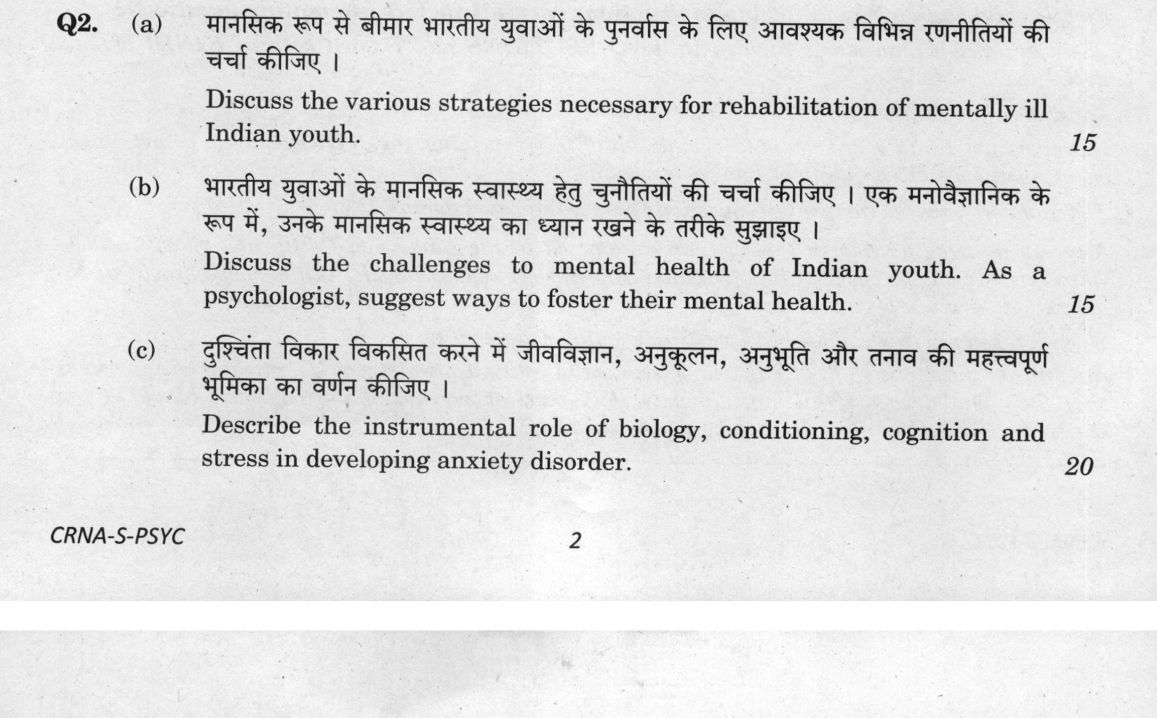
(a) Discuss the various strategies necessary for rehabilitation of mentally ill Indian youth. 15 (b) Discuss the challenges to…
Discuss the various strategies necessary for rehabilitation of mentally ill Indian youth. 15 marks
Discuss the challenges to mental health of Indian youth. As a psychologist, suggest ways to foster their mental health. 15 marks
Describe the instrumental role of biology, conditioning, cognition and stress in developing anxiety disorder. 20 marks
हिंदी में प्रश्न पढ़ें
मानसिक रूप से बीमार भारतीय युवाओं के पुनर्वास के लिए आवश्यक विभिन्न रणनीतियों की चर्चा कीजिए । 15
भारतीय युवाओं के मानसिक स्वास्थ्य हेतु चुनौतियों की चर्चा कीजिए । एक मनोवैज्ञानिक के रूप में, उनके मानसिक स्वास्थ्य का ध्यान रखने के तरीके सुझाइए । 15
दुश्चिंता विकार विकसित करने में जीवविज्ञान, अनुकूलन, अनुभूति और तनाव की महत्वपूर्ण भूमिका का वर्णन कीजिए । 20
Model answer
Written by UPSC Answer Check against this question's marking rubric, to the expected length. UPSC does not publish answers for Mains — this is one way to score well, not an official key.
Rehabilitation Strategies for Mentally Ill Indian Youth
Psychosocial rehabilitation of mentally ill youth in India requires an integrative biopsychosocial framework that balances clinical stabilization with social reintegration. Community-Based Rehabilitation (CBR) serves as the primary vehicle, utilizing local community resources to facilitate functional recovery within familiar sociocultural settings. Tailored vocational training and supported employment programs are essential to restore economic independence and mitigate identity crises.
Given the centrality of the family in Indian society, structured family psychoeducation is crucial to reduce high expressed emotion (EE), correct misconceptions, and alleviate caregiver burden. Concurrently, youth-led peer support networks provide non-judgmental platforms for shared recovery experiences. At the systemic level, decentralizing rehabilitation through the National Mental Health Programme (NMHP) and District Mental Health Programme (DMHP) ensures rural outreach. Digital platforms such as the MANAS app and Tele-MANAS scale up access to telepsychiatry, psychological first aid, and structured rehabilitation follow-ups.
Challenges and Interventions for Indian Youth Mental Health
Indian youth face distinct developmental and systemic pressures. Academic hyper-competitiveness, parental expectations, and high unemployment fuel chronic existential anxiety. Rapid digitization has introduced social media addiction, cyberbullying, and FOMO (fear of missing out), exacerbating depressive symptoms. Furthermore, rapid urban transition generates intergenerational value conflicts within collectivist families, while deep-seated social stigma continues to inhibit early help-seeking.
Psychologists must implement multi-tier preventative strategies: First, institutionalizing school- and college-based Social and Emotional Learning (SEL) programs fosters emotional regulation, distress tolerance, and interpersonal efficacy. Second, standardized career and aptitude counseling counters maladaptive academic distress and parental pressure. Third, evidence-based Mindfulness-Based Stress Reduction (MBSR) programs can be scaled across campuses to regulate autonomic hyperarousal. At the policy level, establishing confidential, youth-friendly mental health services within primary healthcare centers and educational campuses is imperative to bridge the treatment gap.
Etiology of Anxiety Disorders
Anxiety disorders develop through an interplay of biological vulnerabilities, conditioning processes, cognitive distortions, and environmental stressors.
Biological Factors: Genetic predisposition is evident in polymorphisms such as the short allele of the 5-HTTLPR serotonin transporter gene. Neurochemically, gamma-aminobutyric acid (GABA) dysregulation impairs neural inhibition, promoting physiological arousal. Neuroendocrinologically, hyperactivity of the hypothalamic-pituitary-adrenal (HPA) axis results in sustained cortisol secretion. Neuroanatomically, amygdala hyperreactivity combined with impaired top-down inhibitory control from the prefrontal cortex underpins heightened threat sensitivity.
Conditioning Mechanisms: Mowrer’s two-factor theory demonstrates that anxiety is acquired through classical conditioning (associating a neutral stimulus with an unconditioned aversive event) and maintained through operant conditioning (avoidance behavior provides negative reinforcement by reducing acute distress). Seligman’s preparedness theory posits an evolutionary predisposition to acquire fears toward survival-threatening stimuli. Additionally, Bandura's observational learning facilitates the vicarious acquisition of anxiety through modeling anxious parental behaviors.
Cognitive Factors: Beck’s cognitive model posits that hyperactive danger schemas drive attentional bias toward perceived threat cues and catastrophic misinterpretation of benign somatic sensations. Wells’ metacognitive model highlights the role of meta-worry: initial positive metacognitive beliefs (viewing worry as a protective coping mechanism) give way to negative metacognitive beliefs regarding the uncontrollability and dangerousness of worry itself, locking the individual into chronic generalized anxiety.
Stress-Diathesis Interaction: Environmental stressors act as precipitating and maintaining agents. Cumulative life events (e.g., early relational trauma, academic failure) and chronic daily hassles interact with underlying neurobiological and cognitive diatheses, triggering and perpetuating severe anxiety disorders among vulnerable youth.
Way Forward
Addressing the mental health needs of Indian youth requires aligning neurobiological and psychological insights with culturally grounded, community-based care, transitioning policy from reactive psychiatric management to proactive, youth-centric prevention and rehabilitation.
What "Discuss" is asking you to do
Lay the issue out from more than one side — how it arose, what is claimed for it, what is held against it, and where it now stands. UPSC attaches discuss to broad topics with several live dimensions, so coverage of the dimensions earns more than the strength of your opinion.
Structure that answers it
Set the issue up → the case as it is made → the case against → the dimension both sides leave out → where the balance now lies
Where marks are lost
Listing facts with no thread between them, or arguing one side throughout and calling it a discussion.
How this answer will be evaluated
Approach
(a) discuss: intro > 3-4 dimensions > example > balanced close | (b) discuss: intro > 3-4 dimensions > example > balanced close | (c) describe: define > structure or process in order > labelled diagram > significance Full marks: Comprehensive coverage of all 4 factors in (c) with specific theories; (a) and (b) show deep Indian context and professional application.
Key points expected
- Medical/Pharmacological intervention (psychiatry)
- Psychological rehabilitation (CBT, counseling)
- Social reintegration (family, community, stigma)
- Vocational/Educational rehabilitation (skills, employment)
- Academic/Exam pressure (competitive exams)
- Social media/Technology impact
- Stigma and lack of help-seeking
- Psychologist's role: Psychoeducation/Counseling
Evaluation rubric
Each sub-part is marked on its own, against the marks and word limit printed on the paper.
- (a) Strategies for rehabilitating mentally ill Indian youth. 15 marks
discuss— intro → 3-4 dimensions → example → balanced close
Must cover
- Medical/Pharmacological intervention (psychiatry)
- Psychological rehabilitation (CBT, counseling)
- Social reintegration (family, community, stigma)
- Vocational/Educational rehabilitation (skills, employment)
Loses marks
- Generic advice without Indian context
- Ignoring social stigma in India
- Focusing only on medication
Earns more
- Mention of Mental Health Care Act (MHCA) 2017
- Role of NGOs/Community support groups
- Deinstitutionalization strategies
- Prevention of relapse strategies
Extra mark
- Specific Indian government schemes (e.g., KIRAN)
- Reference to specific rehabilitation centers
- (b) Challenges to mental health and psychologist's suggestions. 15 marks
discuss— intro → 3-4 dimensions → example → balanced close
Must cover
- Academic/Exam pressure (competitive exams)
- Social media/Technology impact
- Stigma and lack of help-seeking
- Psychologist's role: Psychoeducation/Counseling
Loses marks
- Listing challenges without solutions
- Solutions not from a psychologist's perspective
- Ignoring the 'Indian youth' context
Earns more
- Family dynamics/Parental expectations
- Career uncertainty/Job market stress
- Promoting resilience and coping skills
- School/College mental health programs
Extra mark
- Reference to specific stressors like JEE/NEET
- Mention of specific therapeutic modalities (ACT, CBT)
- (c) Role of biology, conditioning, cognition, stress in anxiety. 20 marks
describe— define → structure or process in order → labelled diagram → significance
Must cover
- Biology: Genetics/Neurotransmitters (Serotonin, GABA)
- Conditioning: Classical/Operant conditioning (Pavlov/Skinner)
- Cognition: Cognitive distortions/Irational beliefs (Beck)
- Stress: HPA axis/General Adaptation Syndrome (Selye)
Loses marks
- Treating factors in isolation without interaction
- Vague biological terms without mechanism
- Confusing anxiety with depression
Earns more
- Interaction of factors (Diathesis-Stress model)
- Specific brain structures (Amygdala, Prefrontal Cortex)
- Catastrophizing or overgeneralization examples
- Fight-or-flight response mechanism
Extra mark
- Labelled diagram of HPA axis or brain
- Reference to specific studies (e.g., Watson & Rayner)
Practice this exact question
Write your answer and it is marked point by point against the model answer above — what you covered, what you missed, what you got wrong.
Evaluate my answer →More from Psychology 2022 Paper II
- Q1 Answer the following in about 150 words each : 10×5=50 (a) In the light of research, disc…
- Q2 (a) Discuss the various strategies necessary for rehabilitation of mentally ill Indian yo…
- Q3 (a) With reference to the general scenario of our country, elaborate the significance of…
- Q4 (a) Discuss important concepts of Rational Emotive Behaviour Therapy along with its appli…
- Q5 Answer the following in about 150 words each : 10×5=50 (a) Explain the concept of social…