Paper II — Q3
(a) With reference to the general scenario of our country, elaborate the significance of 'out of school' vocational guidance…
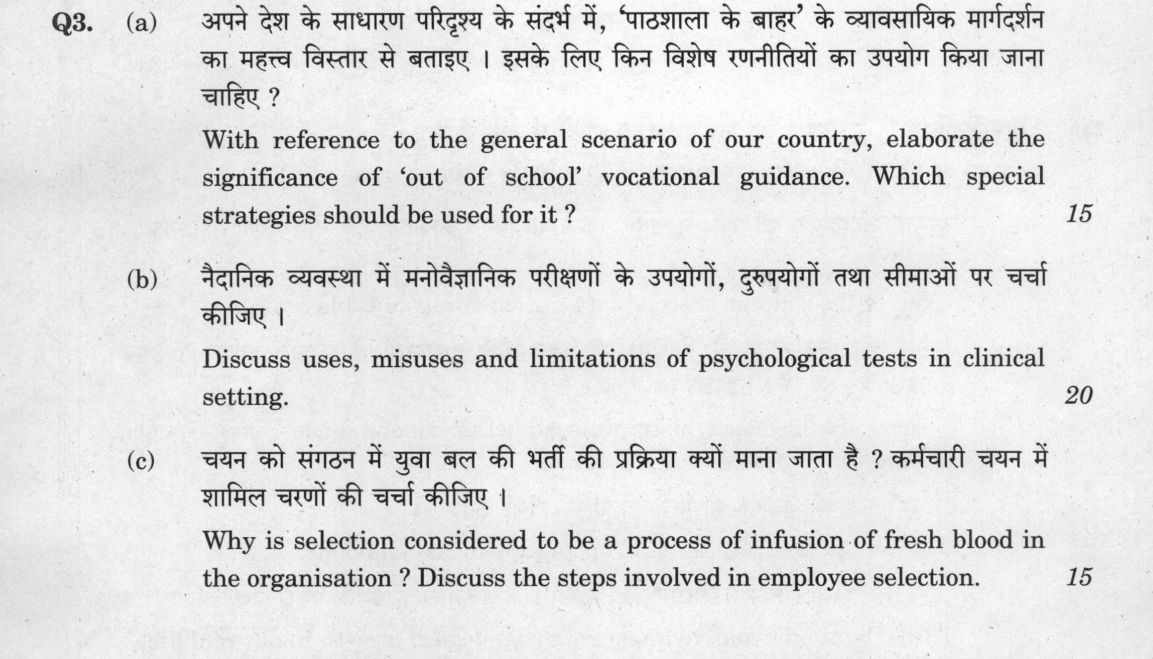
With reference to the general scenario of our country, elaborate the significance of 'out of school' vocational guidance. Which special strategies should be used for it ? 15 marks
Discuss uses, misuses and limitations of psychological tests in clinical setting. 20 marks
Why is selection considered to be a process of infusion of fresh blood in the organisation ? Discuss the steps involved in employee selection. 15 marks
हिंदी में प्रश्न पढ़ें
अपने देश के साधारण परिदृश्य के संदर्भ में, 'पाठशाला के बाहर' के व्यावसायिक मार्गदर्शन का महत्व विस्तार से बताइए । इसके लिए किन विशेष रणनीतियों का उपयोग किया जाना चाहिए ? 15 marks
नैदानिक व्यवस्था में मनोवैज्ञानिक परीक्षणों के उपयोगों, दुरुपयोगों तथा सीमाओं पर चर्चा कीजिए । 20
चयन को संगठन में युवा बल की भर्ती की प्रक्रिया क्यों माना जाता है ? कर्मचारी चयन में शामिल चरणों की चर्चा कीजिए । 15
Model answer
Written by UPSC Answer Check against this question's marking rubric, to the expected length. UPSC does not publish answers for Mains — this is one way to score well, not an official key.
Significance and Strategies of 'Out-of-School' Vocational Guidance
In India, capitalizing on the demographic dividend requires addressing the millions of school dropouts and the substantial youth population Not in Education, Employment, or Training (NEET). Out-of-school vocational guidance is critical for preventing economic marginalisation, reducing occupational mismatch, and mitigating youth alienation. It aligns the latent capabilities of non-formal learners with the demands of the emerging economy, supporting national priorities like the Skill India Mission and the National Skill Development Corporation (NSDC).
Special strategies for out-of-school guidance must depart from traditional classroom-bound models: Community-based guidance centres embedded within Panchayati Raj Institutions and Urban Local Bodies to ensure grassroots accessibility; Mobile career counselling units equipped with assessment tools to reach remote, rural, and tribal belts; ICT-enabled multilingual platforms, such as the National Career Service (NCS) portal, providing self-assessment and vocational mapping via low-bandwidth interfaces; and Partnerships with local NGOs and industry clusters to blend aptitude testing with localized apprenticeships and schemes like Pradhan Mantri Kaushal Vikas Yojana (PMKVY).
Psychological Tests in Clinical Settings: Uses, Misuses, and Limitations
In premier clinical institutions like NIMHANS and AIIMS, psychological tests serve indispensable diagnostic and therapeutic functions.
Uses: Standardised instruments such as the Minnesota Multiphasic Personality Inventory (MMPI), Rorschach Inkblot Test, and cognitive batteries (like WAIS and Bhatia’s Battery) are essential for differential diagnosis, mapping psychopathology against ICD/DSM criteria, baseline assessment, designing individualized psychotherapy, and evaluating therapeutic prognosis and cognitive rehabilitation.
Misuses: A major misuse is over-reliance on psychometric scores at the expense of comprehensive clinical interviews. Inadequately trained administrators frequently misinterpret projective findings. Testing is also misused when Western-normed instruments are applied indiscriminately across diverse socio-cultural groups, generating stigmatising diagnostic labels that create self-fulfilling prophecies and iatrogenic harm.
Limitations: Clinical tests are constrained by response sets (e.g., faking good, malingering, acquiescence) and transient situational factors like acute distress or test anxiety. In India, linguistic heterogeneity, low psychological literacy, and lack of regionally standardized norms impose ethical and diagnostic limitations, necessitating multi-method assessment strategies.
Employee Selection as Infusion of 'Fresh Blood' and the Selection Process
Selection is characterized as the infusion of "fresh blood" because it injects new skills, contemporary technical know-how, and diverse cognitive perspectives into an organization. Bringing in external talent counters organizational stagnation, prevents groupthink, breaks entrenched bureaucratic inertia, and drives innovation and renewal in both public sector undertakings (PSUs) and the private sector.
A scientific, sequential employee selection process involves: First, Job Analysis to identify the specific job description and person specifications (KSAOs). Second, Recruitment to attract a viable pool of candidates. Third, Preliminary Screening to filter out non-qualifying applications. Fourth, Employment and Psychological Testing to objectively measure cognitive abilities, technical aptitude, emotional intelligence, and integrity. Fifth, Comprehensive Selection Interviews (structured, situational, or behavioral) to evaluate cultural fit, interpersonal competence, and problem-solving. Sixth, Reference and Background Verification to confirm candidate credibility and past performance. Seventh, Medical Examination to assess job-specific physical and mental fitness. Eighth, Final Job Offer and Placement, followed by organizational socialization.
Way Forward
Applied psychology serves as an integrative mechanism for human capital optimization. Strengthening ethical test adaptation in clinical setups, extending decentralized vocational guidance to marginalized youth, and institutionalizing objective selection frameworks will ensure that psychological science actively drives individual well-being and national development.
What "Discuss" is asking you to do
Lay the issue out from more than one side — how it arose, what is claimed for it, what is held against it, and where it now stands. UPSC attaches discuss to broad topics with several live dimensions, so coverage of the dimensions earns more than the strength of your opinion.
Structure that answers it
Set the issue up → the case as it is made → the case against → the dimension both sides leave out → where the balance now lies
Where marks are lost
Listing facts with no thread between them, or arguing one side throughout and calling it a discussion.
How this answer will be evaluated
Approach
Framework: null. (a) explain: definition/context > points in order > small example > short close | (b) discuss: intro > 3-4 dimensions > example > balanced close | (c) discuss: intro > 3-4 dimensions > example > balanced close Full marks: Comprehensive coverage of all parts with specific Indian context, named tools, and clear structure.
Key points expected
- Context of Indian scenario (unemployment, skill gap)
- Significance: bridging education-employment gap
- Strategies: community outreach, NGO partnerships
- Strategies: digital platforms, industry collaboration
- Uses: diagnosis, prognosis, treatment planning
- Misuses: over-reliance, ignoring context
- Limitations: cultural bias, test anxiety
- Limitations: static nature of tests
Evaluation rubric
Each sub-part is marked on its own, against the marks and word limit printed on the paper.
- (a) Significance of out-of-school vocational guidance in India and specific strategies. 15 marks
explain— definition/context → points in order → small example → short close
Must cover
- Context of Indian scenario (unemployment, skill gap)
- Significance: bridging education-employment gap
- Strategies: community outreach, NGO partnerships
- Strategies: digital platforms, industry collaboration
Loses marks
- Generic advice without Indian context
- Ignoring the 'out-of-school' specific constraint
Earns more
- Reference to National Skill Development Mission
- Mention of specific target groups (dropouts, rural youth)
- Discussion of 'Make in India' relevance
Extra mark
- Citing specific government schemes (e.g., PMKVY)
- Diagram of out-of-school guidance flow
- (b) Uses, misuses, and limitations of psychological tests in clinical settings. 20 marks
discuss— intro → 3-4 dimensions → example → balanced close
Must cover
- Uses: diagnosis, prognosis, treatment planning
- Misuses: over-reliance, ignoring context
- Limitations: cultural bias, test anxiety
- Limitations: static nature of tests
Loses marks
- Confusing clinical with educational testing
- Listing tests without discussing their specific clinical utility
Earns more
- Mention of specific tests (e.g., MMPI, Rorschach)
- Discussion of ethical issues in clinical use
- Reference to validity and reliability issues
Extra mark
- Citing a specific study on test bias
- Mention of specific clinical populations
- (c) Why selection is 'fresh blood' and the steps in employee selection. 15 marks
discuss— intro → 3-4 dimensions → example → balanced close
Must cover
- Explanation of 'fresh blood' (new ideas, energy)
- Step: Job analysis and description
- Step: Sourcing and screening
- Step: Testing and interviewing
Loses marks
- Skipping the 'fresh blood' explanation
- Listing steps without explaining their purpose
Earns more
- Mention of 'infusion' bringing diversity
- Detailed description of the selection process flow
- Reference to specific selection tools (aptitude tests)
Extra mark
- Diagram of the selection process funnel
- Mention of specific HR theories on selection
Practice this exact question
Write your answer and it is marked point by point against the model answer above — what you covered, what you missed, what you got wrong.
Evaluate my answer →More from Psychology 2022 Paper II
- Q1 Answer the following in about 150 words each : 10×5=50 (a) In the light of research, disc…
- Q2 (a) Discuss the various strategies necessary for rehabilitation of mentally ill Indian yo…
- Q3 (a) With reference to the general scenario of our country, elaborate the significance of…
- Q4 (a) Discuss important concepts of Rational Emotive Behaviour Therapy along with its appli…
- Q5 Answer the following in about 150 words each : 10×5=50 (a) Explain the concept of social…
- Q6 (a) Critically examine the numerous innovations and programmes of the Government in educa…