Paper II — Q8
(a) How does advertising help people to buy intelligently and enable them to take a step in the direction of a higher standard of…
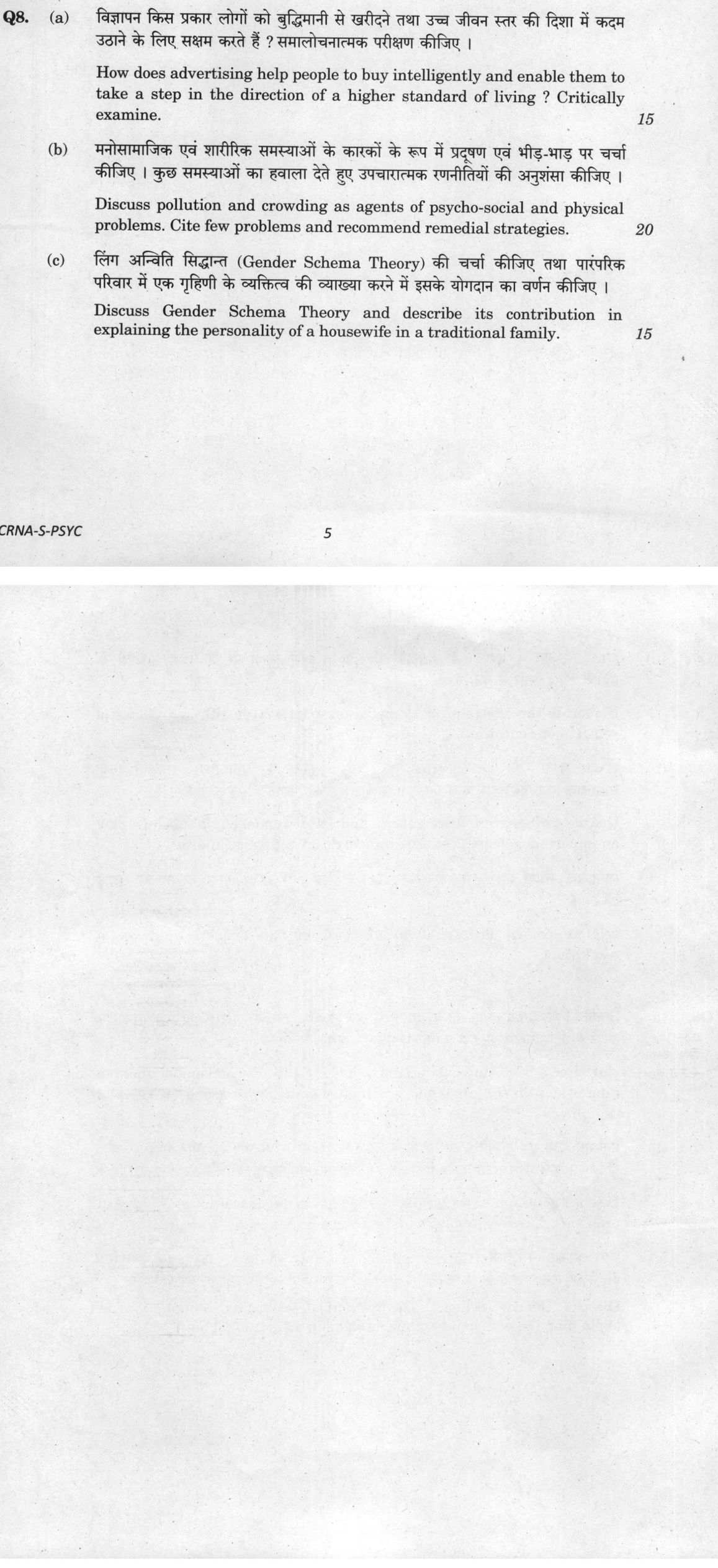
How does advertising help people to buy intelligently and enable them to take a step in the direction of a higher standard of living ? Critically examine. 15 marks
Discuss pollution and crowding as agents of psycho-social and physical problems. Cite few problems and recommend remedial strategies. 20 marks
Discuss Gender Schema Theory and describe its contribution in explaining the personality of a housewife in a traditional family. 15 marks
हिंदी में प्रश्न पढ़ें
विज्ञापन किस प्रकार लोगों को बुद्धिमानी से खरीदने तथा उच्च जीवन स्तर की दिशा में कदम उठाने के लिए सक्षम करते हैं ? समालोचनात्मक परीक्षण कीजिए । 15
मनोसामाजिक एवं शारीरिक समस्याओं के कारकों के रूप में प्रदूषण एवं भीड़-भाड़ पर चर्चा कीजिए । कुछ समस्याओं का हवाला देते हुए उपचारात्मक रणनीतियों की अनुशंसा कीजिए । 20
लिंग अन्विति सिद्धांत (Gender Schema Theory) की चर्चा कीजिए तथा पारंपरिक परिवार में एक गृहिणी के व्यक्तित्व की व्याख्या करने में इसके योगदान का वर्णन कीजिए । 15
Model answer
Written by UPSC Answer Check against this question's marking rubric, to the expected length. UPSC does not publish answers for Mains — this is one way to score well, not an official key.
Advertising and intelligent buying Advertising can help people buy intelligently when it is informational: it supplies price, quality, availability, safety, and comparative attributes, reducing search costs and enabling rational choice. Consumer models—Howard-Sheth and Engel-Kollat-Blackwell—show that accurate information improves problem recognition, search, evaluation and post-purchase satisfaction. Transformational advertising sells feelings, identity and lifestyle; it can raise aspirations toward better products, such as energy-efficient appliances or financial services, nudging households toward a higher standard of living. BIS standards and ASCI’s code of ethics make claims verifiable and protect consumers from misleading advertisements.
However, the claim must be critically examined. Much advertising is persuasive rather than informative; it creates artificial wants, promotes status consumption, and encourages planned obsolescence, where products are designed to be replaced quickly. Deceptive practices—exaggerated health claims, hidden costs, celebrity endorsements without disclosure—can distort intelligent buying, especially among vulnerable consumers. The “higher standard of living” may be materialistic and unsustainable, increasing debt and ecological footprints. Thus, advertising helps only when regulated, transparent, and matched with consumer education; otherwise it can manipulate rather than empower.
Pollution and crowding Pollution and crowding are environmental stressors that produce psycho-social and physical problems. Noise pollution, studied by Cohen and Spacapan, disrupts sleep, raises irritability, and impairs concentration; chronic exposure increases stress hormones and can lead to anxiety, aggression, and learned helplessness when people feel unable to control their environment. CPCB-monitored air pollution is linked in medical and epidemiological research to respiratory illness, cardiovascular strain, and cognitive effects—reduced executive function, neuro-inflammation—especially in children and the elderly. Crowding, per the density-intensity model and Baum and Paulus, is perceived lack of control, privacy and personal space, not mere density. It produces psycho-social problems—social withdrawal, conflict, aggression, and stress—and physical/somatic problems, including hypertension, sleep disruption, weakened immunity, and faster spread of infectious diseases in congested housing.
Remedial strategies must be structural and participatory. Urban green spaces, noise barriers, traffic management and zoning laws reduce heat, noise and stress, separating industrial, residential and commercial areas. Community participation matters: Delhi’s odd-even policy showed demand-side traffic reduction; Mumbai’s Dharavi redevelopment and Smart Cities projects can improve ventilation, sanitation and public space. Swachh Bharat Mission addresses waste and open defecation; CPCB data can guide city action plans. Schools and workplaces can add stress-management, ventilation and green design, reducing physical and psycho-social harm.
Gender Schema Theory and the housewife Bem’s Gender Schema Theory (1981) holds that children learn sex-typed schemas organising perception, memory and self-concept. In a traditional Indian family, a housewife may internalise schemas defining women as caregivers, homemakers and subordinate to male authority. This can produce communal traits—nurturance, self-sacrifice, domestic competence—but also restricted agency, low decision-making power and service-bound identity. Advertising reinforces such schemas when it depicts women only in domestic caregiving roles; pollution and crowding intensify family conflict and burden women’s unpaid care work.
Yet the theory needs critical application: housewives’ personalities are not monolithic; caste, class, region, religion, education and economic participation shape schemas. NFHS-5 data show women’s participation in household decisions and economic activity; education, banking access, Beti Bachao Beti Padhao, MGNREGA and Ujjwala expand agency. A traditional housewife may combine conformity with resilience, negotiation and informal leadership; the theory explains role internalisation but cannot reduce personality to fixed stereotypes.
Conclusion Advertising supports intelligent buying and higher living only when informational, checked by ASCI/BIS and backed by consumer and media literacy. Pollution and crowding require green, low-density, participatory urban planning. Gender schemas can be transformed through education, economic participation and diverse media role models. Consumer protection, environmental psychology and gender equity thus form a way forward for healthier, more autonomous Indian households.
What "Critically examine" is asking you to do
Test the proposition the question puts to you and return a finding on how far it holds. Examine stems carry a claim, or ask whether something has happened, and expect evidence weighed both ways before the extent is stated — often with remedial measures attached. “Critically” is not a section added at the end: name the yardstick you are judging by — the evidence, the stated objective, a constitutional principle, a rival explanation — and let a verdict close each part of the body. Where the question quotes a claim, that verdict must land on the claim itself, accepted, qualified or rejected, and not on the theme in general.
Structure that answers it
Restate the claim as the question frames it → evidence that supports it → evidence that undercuts it → the conditions under which it holds → verdict on how far it stands
Where marks are lost
Merits in one paragraph, demerits in the next, and a conclusion calling for a balanced and holistic approach. That is a survey with the judgement left out and it holds the answer in the middle band. The opposite error is reading “critically” as permission to attack — and with the odd pairings, critically describe or critically explain, the exposition still carries most of the marks, the judgement being a layer on it rather than a substitute for it.
How this answer will be evaluated
Approach
Framework: null. (a) critically evaluate: positives > negatives/limits > conditions/safeguards > conclusion | (b) discuss: intro > 3-4 dimensions > example > balanced close | (c) discuss: intro > 3-4 dimensions > example > balanced close Full marks: Comprehensive, well-structured, with specific examples and critical analysis.
Key points expected
- Define 'intelligent buying' in consumer psychology context
- Explain information provision and brand differentiation
- Critique the 'higher standard of living' claim
- Discuss negative effects like materialism and false needs
- Define pollution and crowding as stressors
- List specific physical health problems (e.g., respiratory)
- List specific psychosocial problems (e.g., aggression, anxiety)
- Provide at least two remedial strategies
Evaluation rubric
Each sub-part is marked on its own, against the marks and word limit printed on the paper.
- (a) Examine the dual role of advertising in consumer intelligence and living standards. 15 marks
critically evaluate— positives → negatives/limits → conditions/safeguards → conclusion
Must cover
- Define 'intelligent buying' in consumer psychology context
- Explain information provision and brand differentiation
- Critique the 'higher standard of living' claim
- Discuss negative effects like materialism and false needs
Loses marks
- Treating advertising only as a positive force
- Ignoring the 'critically examine' instruction
- Vague generalities without specific psychological mechanisms
Earns more
- Reference to 'rational' vs 'irrational' consumer behavior
- Mention of 'consumer sovereignty' or 'market efficiency'
- Cite specific examples of misleading advertising
- Link to 'consumer protection' or 'consumer rights'
Extra mark
- Reference to a specific consumer behavior study
- Mention of a specific regulatory body (e.g., ASCI)
- (b) Analyze pollution and crowding as causes of psychosocial and physical issues with solutions. 20 marks
discuss— intro → 3-4 dimensions → example → balanced close
Must cover
- Define pollution and crowding as stressors
- List specific physical health problems (e.g., respiratory)
- List specific psychosocial problems (e.g., aggression, anxiety)
- Provide at least two remedial strategies
Loses marks
- Focusing only on physical health, ignoring psychosocial
- Vague remedial strategies without specific implementation
- Ignoring the 'agents' aspect (causality)
Earns more
- Reference to 'stress theory' or 'coping mechanisms'
- Mention of 'urban planning' or 'public health policy'
- Cite a specific study on crowding effects
- Link to 'quality of life' or 'well-being'
Extra mark
- Reference to a specific environmental psychology study
- Mention of a specific government initiative or policy
- (c) Explain Gender Schema Theory and its application to a traditional housewife's personality. 15 marks
discuss— intro → 3-4 dimensions → example → balanced close
Must cover
- Define Gender Schema Theory (Bem)
- Explain the formation of gender schemas
- Apply theory to 'traditional housewife' role
- Describe how schemas influence personality traits
Loses marks
- Confusing Gender Schema Theory with other gender theories
- Failing to apply the theory to the specific 'housewife' example
- Vague description of 'personality' without specific traits
Earns more
- Mention of 'cognitive structures' or 'mental frameworks'
- Reference to 'socialization' or 'role modeling'
- Contrast with 'modern' or 'non-traditional' roles
- Link to 'self-concept' or 'identity'
Extra mark
- Reference to a specific study on gender schemas
- Mention of a specific cultural context (e.g., Indian family)
Practice this exact question
Write your answer and it is marked point by point against the model answer above — what you covered, what you missed, what you got wrong.
Evaluate my answer →More from Psychology 2022 Paper II
- Q5 Answer the following in about 150 words each : 10×5=50 (a) Explain the concept of social…
- Q6 (a) Critically examine the numerous innovations and programmes of the Government in educa…
- Q7 (a) Elaborate the effects of mass media on emotional health and values of youth in our cu…
- Q8 (a) How does advertising help people to buy intelligently and enable them to take a step…