Paper II — Q6
(a) Critically examine the numerous innovations and programmes of the Government in educating and motivating disadvantaged…
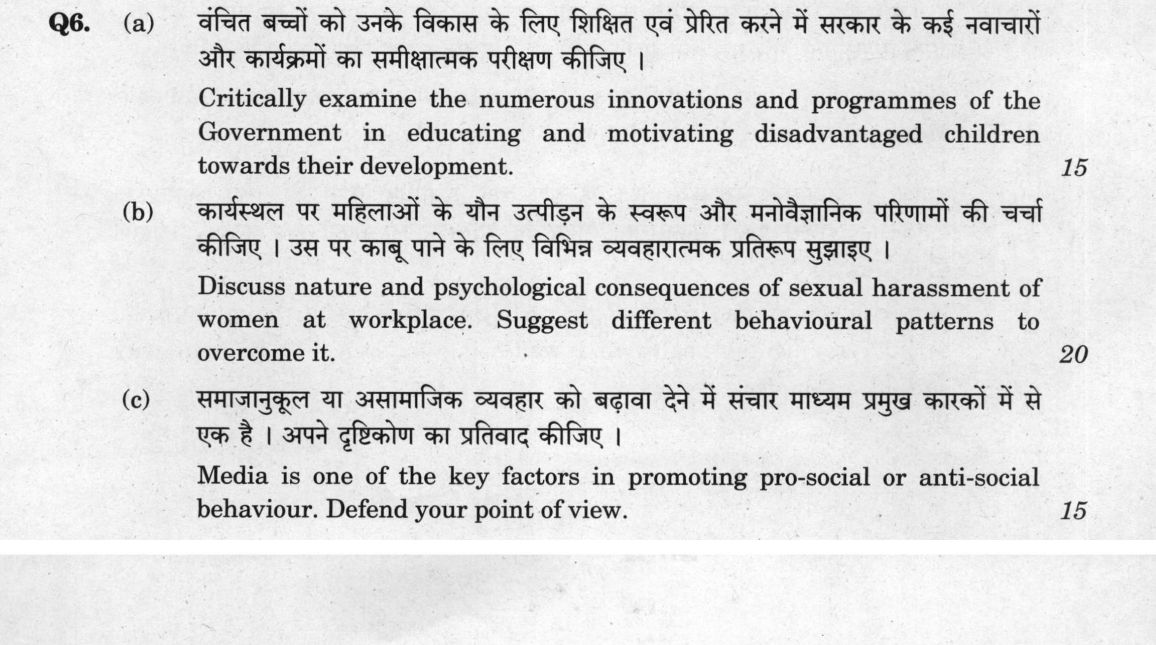
Critically examine the numerous innovations and programmes of the Government in educating and motivating disadvantaged children towards their development. 15 marks
Discuss nature and psychological consequences of sexual harassment of women at workplace. Suggest different behavioural patterns to overcome it. 20 marks
Media is one of the key factors in promoting pro-social or anti-social behaviour. Defend your point of view. 15 marks
हिंदी में प्रश्न पढ़ें
वंचित बच्चों को उनके विकास के लिए शिक्षित एवं प्रेरित करने में सरकार के कई नवाचारों और कार्यक्रमों का समीक्षात्मक परीक्षण कीजिए । 15
कार्यस्थल पर महिलाओं के यौन उत्पीड़न के स्वरूप और मनोवैज्ञानिक परिणामों की चर्चा कीजिए । उस पर काबू पाने के लिए विभिन्न व्यवहारात्मक प्रतिरूप सुझाइए । 20
समाजानुकूल या असामाजिक व्यवहार को बढ़ावा देने में संचार माध्यम प्रमुख कारकों में से एक है । अपने दृष्टिकोण का प्रतिवाद कीजिए । 15
Model answer
Written by UPSC Answer Check against this question's marking rubric, to the expected length. UPSC does not publish answers for Mains — this is one way to score well, not an official key.
Educating and Motivating Disadvantaged Children
Government initiatives such as Samagra Shiksha (subsuming Sarva Shiksha Abhiyan), PM POSHAN (Mid-Day Meal Scheme), Kasturba Gandhi Balika Vidyalayas (KGBVs), and Beti Bachao Beti Padhao target structural inequities in education. Psychologically, PM POSHAN addresses Maslow’s foundational physiological and safety needs, acting as a potent extrinsic motivator for school enrollment among impoverished families. Residential schools like KGBVs and targeted bridge courses fulfill the psychological needs for relatedness and competence under Deci and Ryan’s Self-Determination Theory (SDT), mitigating gender and caste disparities. Furthermore, ICT platforms like DIKSHA and SWAYAM foster learner autonomy.
Critically, however, these programmes rely heavily on extrinsic incentives rather than cultivating intrinsic motivation. Structural fault lines such as caste-based classroom discrimination, gendered domestic burdens, and the digital divide limit ICT effectiveness. While these innovations have successfully universalized access and basic retention, they require a shift toward culturally sensitive pedagogical practices and psychological scaffolding to translate physical presence into intrinsic self-efficacy and long-term developmental growth.
Workplace Sexual Harassment: Nature, Consequences, and Behavioral Interventions
Workplace sexual harassment operates along two primary dimensions: quid pro quo harassment, where professional benefits are made contingent on sexual compliance, and the creation of a hostile work environment marked by pervasive intimidating or offensive conduct. Psychologically, this phenomenon is driven by asymmetrical power dynamics (French and Raven), where legitimate, coercive, and reward powers are abused to subjugate individuals. Repeated exposure to unaddressed harassment induces learned helplessness (Seligman), rendering victims passive due to perceived lack of control.
Trauma theory elucidates the severe psychological consequences: survivors frequently experience Post-Traumatic Stress Disorder (PTSD), clinical depression, chronic anxiety, diminished professional self-efficacy, somatic complaints, and organizational cynicism.
Overcoming this requires targeted behavioral patterns and institutional frameworks:
- Individual-level coping: Assertiveness training equips employees with direct communication scripts to establish firm interpersonal boundaries, while cognitive restructuring helps survivors dismantle trauma-induced guilt and self-blame.
- Interpersonal dynamics: Fostering active bystander intervention disrupts harassment through direct confrontation, distraction, or reporting, thereby reshaping group norms.
- Institutional enforcement: Rigid behavioral compliance with the POSH Act (2013) through functioning Internal Committees (ICs) and transparent reporting channels re-establishes institutional trust and psychological safety.
Media as a Determinant of Pro-Social and Anti-Social Behaviour
Media plays a pivotal role in shaping human behavior, as explained by Bandura’s Social Learning Theory: individuals acquire behavioural patterns through observational modeling, vicarious reinforcement, and cognitive imitation. Furthermore, Gerbner’s Cultivation Theory demonstrates that prolonged media exposure shapes individuals' worldviews and perceived social norms, while media's agenda-setting function dictates the cognitive salience of social issues.
On the pro-social front, media functions as an instrument for positive socialization. Programmes like Satyamev Jayate, along with culturally contextualized educational broadcasting, model empathy, gender equality, altruism, and civic awareness.
Conversely, media can elicit anti-social outcomes. Exposure to violent content, sensationalized true-crime shows, and aggressive themes on OTT platforms can lead to desensitization, aggressive scripts, and reduced empathy. In digital spaces, algorithmic amplification of polarizing fake news, online harassment, and cyberbullying reinforces hostile attribution biases.
Therefore, media's influence is bidirectional. Maximizing its constructive potential necessitates fostering media literacy among consumers and promoting rigorous industry self-regulation rather than blunt censorship, steering content toward prosocial modeling.
Conclusion
Human psychological development is shaped by the quality of social institutions. Transforming educational incentives into intrinsic self-worth for marginalized children, dismantling coercive power structures to ensure safe workplaces, and steering media toward positive observational modeling are collective prerequisites for building a safe, equitable, and psychologically resilient society.
What "Critically examine" is asking you to do
Test the proposition the question puts to you and return a finding on how far it holds. Examine stems carry a claim, or ask whether something has happened, and expect evidence weighed both ways before the extent is stated — often with remedial measures attached. “Critically” is not a section added at the end: name the yardstick you are judging by — the evidence, the stated objective, a constitutional principle, a rival explanation — and let a verdict close each part of the body. Where the question quotes a claim, that verdict must land on the claim itself, accepted, qualified or rejected, and not on the theme in general.
Structure that answers it
Restate the claim as the question frames it → evidence that supports it → evidence that undercuts it → the conditions under which it holds → verdict on how far it stands
Where marks are lost
Merits in one paragraph, demerits in the next, and a conclusion calling for a balanced and holistic approach. That is a survey with the judgement left out and it holds the answer in the middle band. The opposite error is reading “critically” as permission to attack — and with the odd pairings, critically describe or critically explain, the exposition still carries most of the marks, the judgement being a layer on it rather than a substitute for it.
How this answer will be evaluated
Approach
Framework: UPSC Psychology Paper II (Social & Applied Psychology). (a) examine: intro > how/why with reasoning > evidence > conclusion | (b) discuss: intro > 3-4 dimensions > example > balanced close | (c) comment: context > arguments both sides > judgment > close Full marks: Comprehensive, critical, and well-structured with specific examples and psychological depth.
Key points expected
- Identify specific schemes (e.g., PM-SHRI, PM POSHAN, ICDS).
- Explain the 'educating' mechanism (infrastructure, curriculum).
- Explain the 'motivating' mechanism (scholarships, mentorship).
- Provide a critical evaluation of implementation gaps.
- Define the nature of workplace sexual harassment.
- Detail specific psychological consequences (e.g., PTSD, anxiety).
- Suggest specific behavioral patterns to overcome it.
- Reference the POSH Act or relevant legal framework.
Evaluation rubric
Each sub-part is marked on its own, against the marks and word limit printed on the paper.
- (a) Critical analysis of government schemes for disadvantaged children's development. 15 marks
examine— intro → how/why with reasoning → evidence → conclusion
Must cover
- Identify specific schemes (e.g., PM-SHRI, PM POSHAN, ICDS).
- Explain the 'educating' mechanism (infrastructure, curriculum).
- Explain the 'motivating' mechanism (scholarships, mentorship).
- Provide a critical evaluation of implementation gaps.
Loses marks
- Listing schemes without critical analysis.
- Ignoring the 'motivating' aspect of the prompt.
- Vague generalities without naming specific programmes.
Earns more
- Reference to specific target groups (SC/ST, girls, rural).
- Mention of specific outcomes or data points.
- Linkage to broader developmental goals (SDGs).
Extra mark
- Citation of a specific government report or audit finding.
- Mention of a specific state-level innovation.
- (b) Nature, psychological impact, and behavioral solutions for workplace sexual harassment. 20 marks
discuss— intro → 3-4 dimensions → example → balanced close
Must cover
- Define the nature of workplace sexual harassment.
- Detail specific psychological consequences (e.g., PTSD, anxiety).
- Suggest specific behavioral patterns to overcome it.
- Reference the POSH Act or relevant legal framework.
Loses marks
- Focusing only on legal aspects, ignoring psychology.
- Vague suggestions for behavioral patterns.
- Failing to address the 'nature' of the harassment.
Earns more
- Use of psychological terms (e.g., learned helplessness).
- Distinction between different types of harassment.
- Practical examples of behavioral interventions.
Extra mark
- Citation of a specific study on workplace harassment.
- Mention of specific psychological support mechanisms.
- (c) Defense of media's role in promoting pro-social or anti-social behavior. 15 marks
comment— context → arguments both sides → judgment → close
Must cover
- Define pro-social and anti-social behavior in media context.
- Provide arguments for media promoting pro-social behavior.
- Provide arguments for media promoting anti-social behavior.
- Offer a balanced judgment or defense of the point.
Loses marks
- Taking an extreme one-sided view without balance.
- Lack of specific examples to support arguments.
- Failing to define the key terms clearly.
Earns more
- Examples of specific media content (e.g., news, social media).
- Reference to psychological theories (e.g., Social Learning Theory).
- Discussion of the role of media literacy.
Extra mark
- Citation of a specific media study or experiment.
- Mention of specific regulatory bodies or guidelines.
Practice this exact question
Write your answer and it is marked point by point against the model answer above — what you covered, what you missed, what you got wrong.
Evaluate my answer →More from Psychology 2022 Paper II
- Q3 (a) With reference to the general scenario of our country, elaborate the significance of…
- Q4 (a) Discuss important concepts of Rational Emotive Behaviour Therapy along with its appli…
- Q5 Answer the following in about 150 words each : 10×5=50 (a) Explain the concept of social…
- Q6 (a) Critically examine the numerous innovations and programmes of the Government in educa…
- Q7 (a) Elaborate the effects of mass media on emotional health and values of youth in our cu…
- Q8 (a) How does advertising help people to buy intelligently and enable them to take a step…