Paper II — Q7
(a) Elaborate the effects of mass media on emotional health and values of youth in our culture. 15 (b) Discuss how environment…
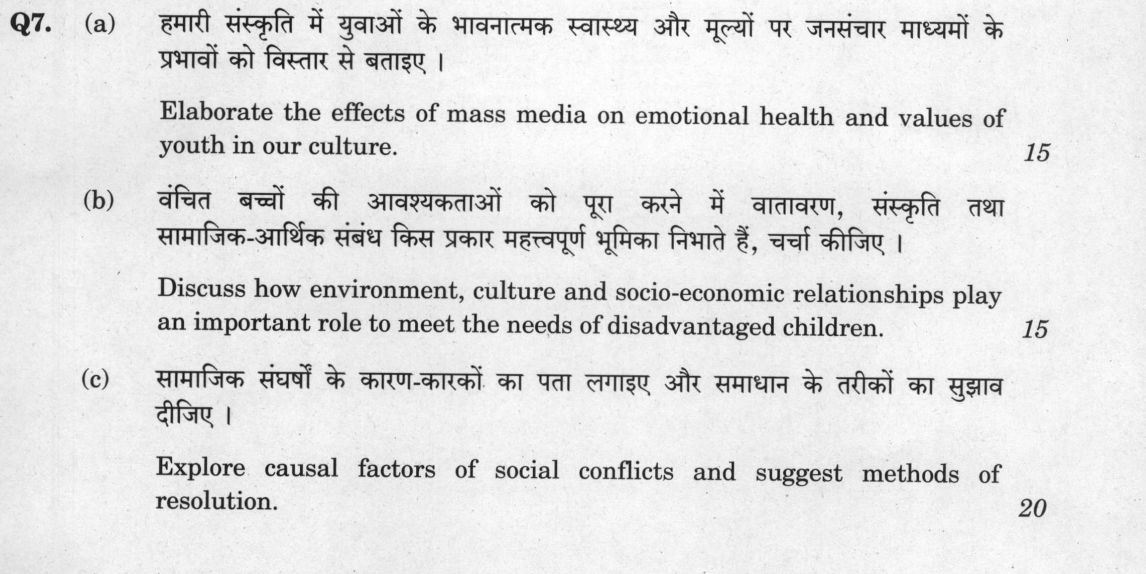
Elaborate the effects of mass media on emotional health and values of youth in our culture. 15 marks
Discuss how environment, culture and socio-economic relationships play an important role to meet the needs of disadvantaged children. 15 marks
Explore causal factors of social conflicts and suggest methods of resolution. 20 marks
हिंदी में प्रश्न पढ़ें
हमारी संस्कृति में युवाओं के भावनात्मक स्वास्थ्य और मूल्यों पर जनसंचार माध्यमों के प्रभावों को विस्तार से बताइए । 15
वंचित बच्चों की आवश्यकताओं को पूरा करने में वातावरण, संस्कृति तथा सामाजिक-आर्थिक संबंध किस प्रकार महत्वपूर्ण भूमिका निभाते हैं, चर्चा कीजिए । 15
सामाजिक संघर्षों के कारण-कारकों का पता लगाइए और समाधान के तरीकों का सुझाव दीजिए । 20
Model answer
Written by UPSC Answer Check against this question's marking rubric, to the expected length. UPSC does not publish answers for Mains — this is one way to score well, not an official key.
Mass Media, Emotional Health, and Youth Values
Mass media profoundly shapes youth cognition, affect, and socio-cultural orientations. Positively, digital platforms foster social connectedness, identity exploration, peer support, and civic awareness. Conversely, excessive immersion generates adverse emotional outcomes, including fear of missing out (FOMO), chronic anxiety, depression, and vulnerability to cyberbullying. Culturally, media accelerates a paradigm shift from traditional Indian collectivist values—rooted in interdependence, family duty, and social cohesion—toward consumerist, individualist orientations emphasizing personal autonomy, self-gratification, and material achievement.
Theoretically, Gerbner’s Cultivation Theory explains how recurrent exposure to westernized, hyper-affluent OTT narratives alters normative expectations and reality perceptions among youth. Bandura’s Social Learning Theory demonstrates that adolescents model behaviors, body image ideals, and lifestyle aggression observed on platforms like Instagram and YouTube. Concurrently, Uses and Gratifications Theory highlights that youth actively seek media to fulfill specific psychological needs—such as identity construction, peer belongingness, and escapism—which mediates the nature and extent of media impact on their psychological well-being.
Ecology, Culture, and Disadvantaged Children
The developmental trajectory of disadvantaged children is shaped by complex socio-cultural transactions, best understood through Bronfenbrenner’s Ecological Systems Model. The microsystem involves immediate, direct interactions within the family, often strained by economic scarcity; the mesosystem encompasses linkages between home, school, and local community; the exosystem includes external contexts like precarious parental employment and welfare policies; and the macrosystem embodies cultural values, social hierarchies, and systemic prejudices.
In India, intersecting forces of chronic poverty, caste discrimination, and urban-rural disparities impose cumulative developmental risk, manifesting in chronic malnutrition, toxic stress, and cognitive deficits. Nonetheless, protective factors mitigate vulnerability through psychological resilience, extended family networks, and indigenous community support systems. Institutional interventions act as vital ecological buffers: the Integrated Child Development Services (ICDS) secures early childhood nutrition and stimulation; the Right to Education (RTE) Act (2009) expands institutional access; and the PM POSHAN (Mid-Day Meal) scheme addresses nutritional deprivation while promoting social integration across caste lines.
Causal Factors and Resolution of Social Conflicts
Social conflicts arise from interacting structural, psychological, and social factors. Structurally, unequal resource allocation, economic scarcity, relative deprivation, and identity politics centered on caste, religion, or ethnicity create deep structural cleavages. Psychologically, the Frustration-Aggression Hypothesis (Dollard et al.) elucidates how blocked economic and social mobility converts into out-group hostility. This is magnified by perceived realistic threats (competition over jobs, land, and political power) and symbolic threats (perceived attacks on cultural, linguistic, or religious identities). Socially, algorithmic echo chambers and targeted digital misinformation intensify group polarization and dehumanizing out-group stereotypes.
Resolving these conflicts requires systematic, multi-level interventions:
At the individual and interpersonal level, operationalizing Allport’s Contact Hypothesis through structured intergroup dialogue, empathy building, and perspective-taking reduces prejudice and dismantles hostile stereotypes.
At the institutional level, restorative justice frameworks, peace education curricula, and institutional arbitration platforms—modeled on Truth and Reconciliation mechanisms—facilitate grievance redressal and psychological healing. In India, district-level Communal Harmony Committees and institutional negotiations like the Naga peace talks exemplify sustained multi-stakeholder dispute resolution.
At the structural level, policy interventions must target the root causes of unrest through inclusive socio-economic policies, constitutional guarantees, affirmative action, and equitable wealth redistribution to eliminate systemic relative deprivation.
Way Forward
Synthesizing these psychological dimensions reveals that human development and social stability require an integrated, ecological approach. Developing critical media literacy enables youth to navigate digital environments constructively, while reinforcing ecological safety nets safeguards vulnerable children. Concurrently, addressing both socio-psychological grievances and structural inequalities provides the necessary foundation for enduring social harmony.
What "Explore" is asking you to do
Open a question that has no settled answer — set out the plausible factors or angles, say what each rests on, and identify which the evidence actually supports while leaving the rest honestly open.
Structure that answers it
Frame the open question → possible factor one → possible factor two → possible factor three → which the evidence supports, and what remains unresolved
Where marks are lost
Settling on one angle in the opening paragraph and dismissing the rest in a line, which is exactly what explore asks you not to do.
How this answer will be evaluated
Approach
Framework: Social Psychology & Developmental Psychology. (a) explain: definition/context > points in order > small example > short close | (b) discuss: intro > 3-4 dimensions > example > balanced close | (c) analyse: intro > causes > effects > stakeholders/linkages > way forward Full marks: Comprehensive, well-structured, with specific examples and theoretical depth.
Key points expected
- Define mass media and its role in socialization
- Effects on emotional health (anxiety, self-esteem)
- Impact on cultural values (secularism, materialism)
- Contextualize within Indian cultural framework
- Define 'disadvantaged children' (SC/ST, OBC, poor)
- Role of physical environment (infrastructure, safety)
- Role of culture (stigma, social exclusion)
- Role of socio-economic factors (poverty, access)
Evaluation rubric
Each sub-part is marked on its own, against the marks and word limit printed on the paper.
- (a) Define mass media impact and detail effects on youth emotional health and values. 15 marks
explain— definition/context → points in order → small example → short close
Must cover
- Define mass media and its role in socialization
- Effects on emotional health (anxiety, self-esteem)
- Impact on cultural values (secularism, materialism)
- Contextualize within Indian cultural framework
Loses marks
- Generalizing without specific examples
- Ignoring the 'Indian culture' context
Earns more
- Mention specific media types (TV, social media)
- Reference to 'Cult of Personality' or 'Consumerism'
- Discussion of 'Cyberbullying' or 'FOMO'
Extra mark
- Cite a specific study on Indian youth media consumption
- Reference to 'Media Literacy' initiatives
- (b) Analyze the role of environment, culture, and socio-economics in meeting needs of disadvantaged children. 15 marks
discuss— intro → 3-4 dimensions → example → balanced close
Must cover
- Define 'disadvantaged children' (SC/ST, OBC, poor)
- Role of physical environment (infrastructure, safety)
- Role of culture (stigma, social exclusion)
- Role of socio-economic factors (poverty, access)
Loses marks
- Focusing only on economic factors
- Ignoring the psychological impact of disadvantage
Earns more
- Mention 'Social Exclusion' or 'Marginalization'
- Reference to 'Right to Education' (RTE) Act
- Discussion of 'Self-Concept' in disadvantaged groups
Extra mark
- Cite a specific government scheme (e.g., PM-SHRI)
- Reference to 'Bronfenbrenner's Ecological Model'
- (c) Identify causal factors of social conflicts and suggest resolution methods. 20 marks
analyse— intro → causes → effects → stakeholders/linkages → way forward
Must cover
- Define social conflict and its types
- Causal factors (economic, political, social, psychological)
- Methods of resolution (negotiation, mediation, arbitration)
- Role of law and social institutions
Loses marks
- Listing causes without analysis
- Suggesting vague or impractical solutions
Earns more
- Mention 'Galtung's Triangle of Conflict'
- Reference to 'Restorative Justice'
- Discussion of 'Conflict Management' vs 'Resolution'
Extra mark
- Cite a specific case study of conflict resolution
- Reference to 'UN Peacekeeping' or 'International Law'
Practice this exact question
Write your answer and it is marked point by point against the model answer above — what you covered, what you missed, what you got wrong.
Evaluate my answer →More from Psychology 2022 Paper II
- Q4 (a) Discuss important concepts of Rational Emotive Behaviour Therapy along with its appli…
- Q5 Answer the following in about 150 words each : 10×5=50 (a) Explain the concept of social…
- Q6 (a) Critically examine the numerous innovations and programmes of the Government in educa…
- Q7 (a) Elaborate the effects of mass media on emotional health and values of youth in our cu…
- Q8 (a) How does advertising help people to buy intelligently and enable them to take a step…