Paper II — Q4
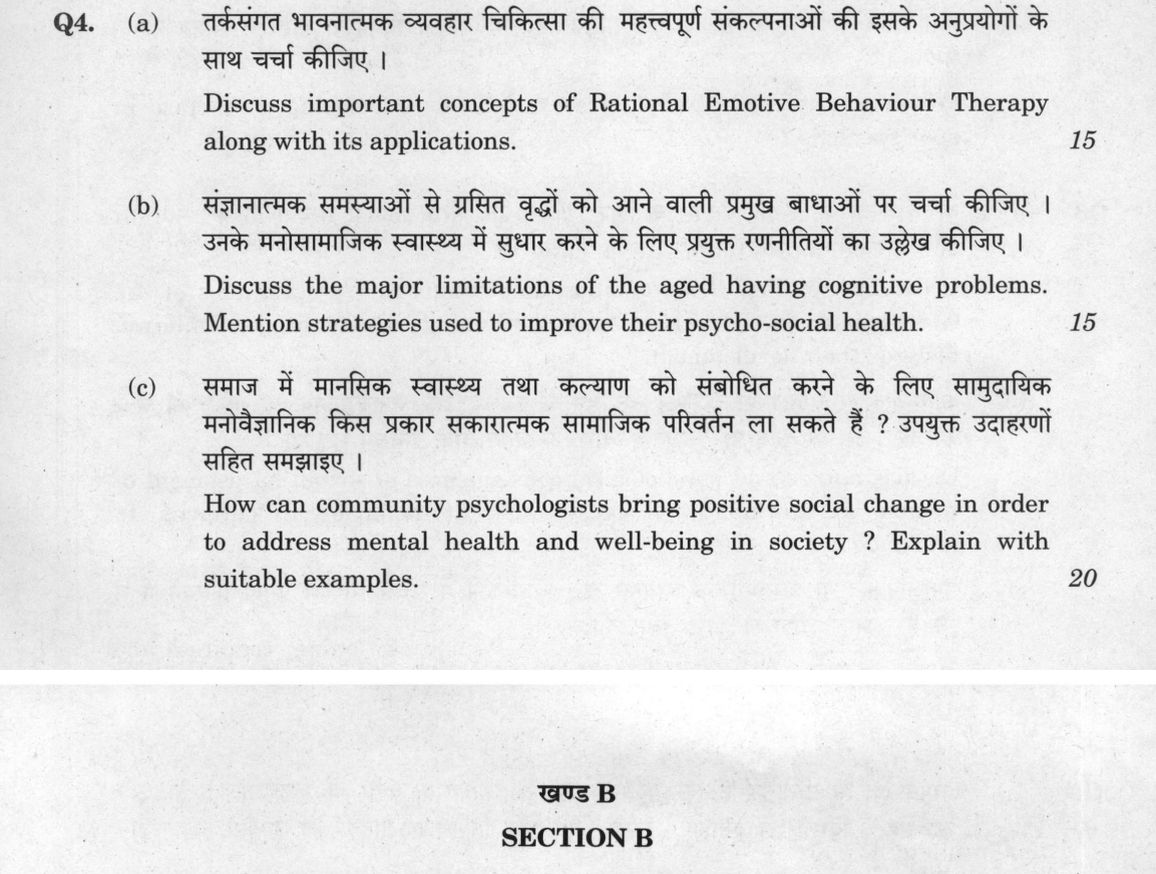
(a) Discuss important concepts of Rational Emotive Behaviour Therapy along with its applications. 15 (b) Discuss the major…
Discuss important concepts of Rational Emotive Behaviour Therapy along with its applications. 15 marks
Discuss the major limitations of the aged having cognitive problems. Mention strategies used to improve their psycho-social health. 15 marks
How can community psychologists bring positive social change in order to address mental health and well-being in society ? Explain with suitable examples. 20 marks
हिंदी में प्रश्न पढ़ें
तर्कसंगत भावनात्मक व्यवहार चिकित्सा की महत्वपूर्ण संकल्पनाओं की इसके अनुप्रयोगों के साथ चर्चा कीजिए । 15
संज्ञानात्मक समस्याओं से ग्रस्त बुजुर्गों को आने वाली प्रमुख बाधाओं पर चर्चा कीजिए । उनके मनोसामाजिक स्वास्थ्य में सुधार करने के लिए प्रयुक्त रणनीतियों का उल्लेख कीजिए । 15
समाज में मानसिक स्वास्थ्य तथा कल्याण को संबोधित करने के लिए सामुदायिक मनोवैज्ञानिक किस प्रकार सकारात्मक सामाजिक परिवर्तन ला सकते हैं ? उपयुक्त उदाहरणों सहित समझाइए । 20
Model answer
Written by UPSC Answer Check against this question's marking rubric, to the expected length. UPSC does not publish answers for Mains — this is one way to score well, not an official key.
Mental health and well-being operate across a continuum ranging from intrapsychic cognitive restructuring to developmental transitions in late adulthood and systemic community-level interventions.
(a) Rational Emotive Behaviour Therapy: Concepts and Applications
Developed by Albert Ellis, Rational Emotive Behaviour Therapy (REBT) posits that emotional and behavioural disturbances stem not directly from activating events (A), but from irrational beliefs (B) about those events, leading to maladaptive consequences (C).
Rational beliefs are flexible, preferential, and reality-congruent, whereas irrational beliefs are rigid and dogmatic. Ellis identified four core irrational belief patterns: demandingness (absolutistic "musts" and "shoulds"), awfulizing (exaggerating negative consequences), low frustration tolerance (believing discomfort is unbearable), and self/other/life-depreciation (global negative evaluations). Philosophically, REBT promotes unconditional self-acceptance (USA), unconditional other-acceptance (UOA), and unconditional life-acceptance (ULA), encouraging individuals to rate actions rather than their total worth.
Therapeutically, REBT employs:
- Cognitive techniques: Disputing irrational beliefs (D) through logical, empirical, and pragmatic questioning to generate an effective new philosophy (E);
- Emotive techniques: Rational emotive imagery, humor, and shame-attacking exercises to build emotional resilience;
- Behavioural techniques: In vivo desensitization, risk-taking tasks, and structured homework.
REBT finds wide application in treating generalized anxiety and depressive disorders, overcoming procrastination, and reducing performance anxiety and exam-related distress in educational settings.
(b) Cognitive Aging: Limitations and Psycho-Social Strategies
Cognitive aging is marked by normative declines in fluid intelligence, information-processing speed, working memory capacity, and episodic memory retrieval, while crystallized intelligence and semantic memory often remain intact. It is critical to differentiate this normative, gradual decline from pathological conditions such as Alzheimer’s disease and vascular dementia, which involve profound neurodegeneration, executive dysfunction, and irreversible loss of autonomy.
To enhance the psycho-social health of older adults, several evidence-based strategies are utilized:
- Cognitive interventions: Cognitive stimulation therapy, memory retraining, and computerized brain-training exercises to leverage neuroplasticity.
- Psychotherapeutic approaches: Reminiscence therapy and life-review interventions, which assist older adults in resolving past conflicts and achieving ego integrity (Erikson).
- Lifestyle and behavioral measures: Structured physical exercise (aerobics, yoga) and mindfulness-based interventions to reduce cognitive fatigue and psychological stress.
- Social and institutional support: Active involvement in Senior Citizen Associations and Day Care Centres to prevent social isolation and combat loneliness.
- Policy frameworks: Implementation of the Maintenance and Welfare of Parents and Senior Citizens Act (2007), which provides socio-legal safeguards and reinforces geriatric mental health infrastructure.
(c) Community Psychology for Social Change and Well-Being
Community psychology shifts the clinical paradigm from individual pathology to Bronfenbrenner’s ecological perspective, emphasizing social justice, empowerment, and prevention (primary, secondary, and tertiary) over curative treatment.
Community psychologists utilize methods such as Participatory Action Research (PAR), community needs assessments, and multi-stakeholder coalition building to dismantle structural barriers. Key applications include:
- Task-shifting and primary care integration: Organizations like Sangath in Goa implement lay-counsellor models (e.g., the MANAS and PREMIUM projects), decentralizing mental health services to underserved populations.
- Destigmatization and rehabilitation: The Banyan in Tamil Nadu addresses severe mental illness among homeless populations by integrating mental healthcare with housing, legal aid, and social reintegration.
- Educational and resilience programs: School-based life-skills interventions train teachers and peer leaders to foster emotional regulation, addressing bullying and adolescent distress.
- Disaster and crisis response: Psychosocial support and psychological first aid deployed during the Kashmir and Kerala floods demonstrated how localized, culturally congruent interventions foster collective resilience.
A comprehensive mental health framework must bridge individual-level cognitive therapies like REBT, targeted geriatric interventions, and macro-level community psychology. Integrating clinical techniques with systemic, community-driven social action ensures that mental health support is both individually transformative and structurally accessible across the lifespan.
What "Discuss" is asking you to do
Lay the issue out from more than one side — how it arose, what is claimed for it, what is held against it, and where it now stands. UPSC attaches discuss to broad topics with several live dimensions, so coverage of the dimensions earns more than the strength of your opinion.
Structure that answers it
Set the issue up → the case as it is made → the case against → the dimension both sides leave out → where the balance now lies
Where marks are lost
Listing facts with no thread between them, or arguing one side throughout and calling it a discussion.
How this answer will be evaluated
Approach
Framework: Rational Emotive Behaviour Therapy (REBT). (a) discuss: intro > 3-4 dimensions > example > balanced close | (b) discuss: intro > 3-4 dimensions > example > balanced close | (c) explain: definition/context > points in order > small example > short close Full marks: Comprehensive coverage of all required concepts, clear examples, and strong analytical depth.
Key points expected
- Define ABC model (Activating event, Beliefs, Consequences)
- Explain the role of irrational beliefs in emotional disturbance
- Describe the D-E process (Disputing, Effective new beliefs)
- Provide specific applications (e.g., anxiety, depression, phobias)
- Identify major cognitive limitations (e.g., memory, processing speed)
- Discuss the impact of these limitations on daily functioning
- Mention specific strategies to improve psycho-social health
- Link strategies to cognitive or social well-being
Evaluation rubric
Each sub-part is marked on its own, against the marks and word limit printed on the paper.
- (a) Explain REBT's core concepts and their practical applications. 15 marks
discuss— intro → 3-4 dimensions → example → balanced close
Must cover
- Define ABC model (Activating event, Beliefs, Consequences)
- Explain the role of irrational beliefs in emotional disturbance
- Describe the D-E process (Disputing, Effective new beliefs)
- Provide specific applications (e.g., anxiety, depression, phobias)
Loses marks
- Confusing REBT with CBT without distinction
- Listing applications without linking to the theoretical model
- Vague definitions of 'irrational beliefs'
Earns more
- Mention Albert Ellis as the founder
- Distinguish between rational and irrational beliefs
- Reference specific therapeutic techniques (e.g., Socratic questioning)
Extra mark
- Cite a specific study or case example of REBT efficacy
- Mention the 'ABCDEF' model extension
- (b) Analyze cognitive limitations in the aged and strategies for psycho-social health. 15 marks
discuss— intro → 3-4 dimensions → example → balanced close
Must cover
- Identify major cognitive limitations (e.g., memory, processing speed)
- Discuss the impact of these limitations on daily functioning
- Mention specific strategies to improve psycho-social health
- Link strategies to cognitive or social well-being
Loses marks
- Focusing only on medical aspects of aging
- Ignoring the psycho-social component of health
- Vague or generic strategies without specific application
Earns more
- Differentiate between normal aging and pathological decline
- Mention specific interventions (e.g., cognitive training, social engagement)
- Reference the concept of 'cognitive reserve'
Extra mark
- Cite a specific study on cognitive interventions in the elderly
- Mention specific psychometric tools used for assessment
- (c) Explain how community psychologists bring positive social change for mental health. 20 marks
explain— definition/context → points in order → small example → short close
Must cover
- Define the role of community psychologists in social change
- Explain specific methods or approaches used (e.g., advocacy, education)
- Provide suitable examples of positive social change
- Link these changes to improved mental health and well-being
Loses marks
- Focusing only on individual therapy rather than community change
- Lack of specific examples to support the explanation
- Ignoring the link between social change and mental health
Earns more
- Mention specific community-based interventions
- Discuss the role of policy advocacy
- Reference specific examples of successful community programs
Extra mark
- Cite a specific policy or program implemented by community psychologists
- Mention specific metrics used to evaluate social change
Practice this exact question
Write your answer and it is marked point by point against the model answer above — what you covered, what you missed, what you got wrong.
Evaluate my answer →More from Psychology 2022 Paper II
- Q1 Answer the following in about 150 words each : 10×5=50 (a) In the light of research, disc…
- Q2 (a) Discuss the various strategies necessary for rehabilitation of mentally ill Indian yo…
- Q3 (a) With reference to the general scenario of our country, elaborate the significance of…
- Q4 (a) Discuss important concepts of Rational Emotive Behaviour Therapy along with its appli…
- Q5 Answer the following in about 150 words each : 10×5=50 (a) Explain the concept of social…
- Q6 (a) Critically examine the numerous innovations and programmes of the Government in educa…
- Q7 (a) Elaborate the effects of mass media on emotional health and values of youth in our cu…