Paper II — Q5
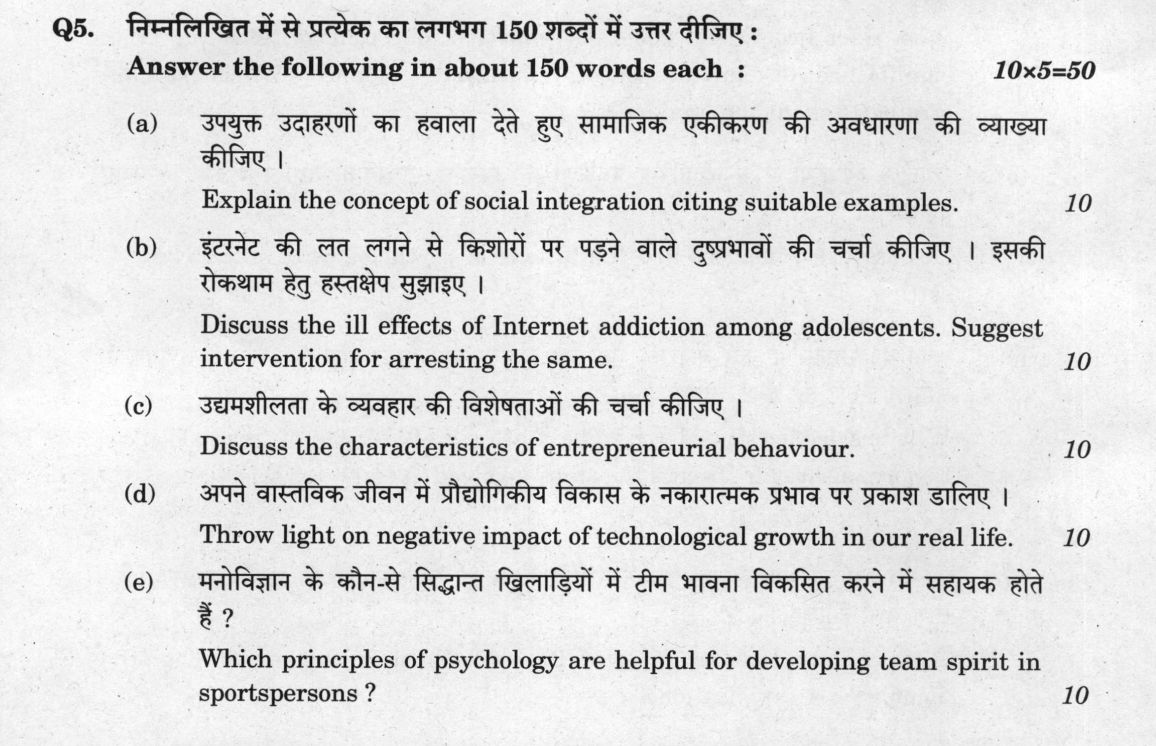
Answer the following in about 150 words each : 10×5=50 (a) Explain the concept of social integration citing suitable examples…
Answer the following in about 150 words each : 10×5=50
Explain the concept of social integration citing suitable examples. 10 marks
Discuss the ill effects of Internet addiction among adolescents. Suggest intervention for arresting the same. 10 marks
Discuss the characteristics of entrepreneurial behaviour. 10 marks
Throw light on negative impact of technological growth in our real life. 10 marks
Which principles of psychology are helpful for developing team spirit in sportspersons ? 10 marks
हिंदी में प्रश्न पढ़ें
निम्नलिखित में से प्रत्येक का लगभग 150 शब्दों में उत्तर दीजिए :
उपयुक्त उदाहरणों का हवाला देते हुए सामाजिक एकीकरण की अवधारणा की व्याख्या कीजिए । 10
इंटरनेट की लत लगने से किशोरों पर पड़ने वाले दुष्प्रभावों की चर्चा कीजिए । इसकी रोकथाम हेतु हस्तक्षेप सुझाइए । 10
उद्यमशीलता के व्यवहार की विशेषताओं की चर्चा कीजिए । 10
अपने वास्तविक जीवन में प्रौद्योगिकीय विकास के नकारात्मक प्रभाव पर प्रकाश डालिए । 10
मनोविज्ञान के कौन-से सिद्धांत खिलाड़ियों में टीम भावना विकसित करने में सहायक होते हैं ? 10 marks
Model answer
Written by UPSC Answer Check against this question's marking rubric, to the 150-word length. UPSC does not publish answers for Mains — this is one way to score well, not an official key.
(a) Concept of Social Integration
Social integration, rooted in Émile Durkheim’s sociological framework, refers to the process through which individuals and disparate groups achieve structural, cultural, and psychological cohesion within a broader social system. Unlike mechanical solidarity, which depends on uniform likeness, integration fosters organic solidarity by accommodating functional diversity while establishing shared values, mutual interdependence, and reciprocal rights.
The mechanism operates through institutional inclusion: when peripheral groups access normative societal channels, structural alienation decreases, fostering social equilibrium. In India, the integration of tribal communities through the Panchayats (Extension to Scheduled Areas) Act (PESA) exemplifies structural integration, allowing indigenous groups to preserve customary practices while participating in decentralized democratic governance. Similarly, rural-to-urban migrants achieve social integration via informal community networks, occupational associations, and inclusive urban public systems, which buffer psychological acculturation stress and prevent social atomization.
(b) Ill Effects of Internet Addiction and Interventions
Kimberly Young conceptualizes Internet Addiction Disorder (IAD) as an impulse-control deficit marked by preoccupation, tolerance, loss of control, and emotional withdrawal. In adolescents, excessive digital engagement over-activates mesolimbic dopamine pathways, impairing prefrontal cognitive control.
This neural dysregulation produces severe ill effects:
- Academic decline due to fragmented attention, impaired memory consolidation, and executive dysfunction.
- Sleep disruption caused by blue-light suppression of nocturnal melatonin synthesis, resulting in chronic circadian fatigue.
- Social withdrawal, where virtual interactions replace physical socialization, precipitating social anxiety, depressive states, and reduced emotional empathy.
Arresting internet addiction requires multi-tiered interventions:
- Cognitive Behavioural Therapy for Internet Addiction (CBT-IA) to restructure cognitive distortions, identify digital triggers, and build coping strategies.
- Parental mediation, utilizing authoritative boundaries, screen-free family zones, and co-viewing practices to regulate usage.
- Structured digital detox protocols paired with behavioural activation, redirecting adolescent energy toward physical sports, creative arts, and real-world peer engagement.
(c) Characteristics of Entrepreneurial Behaviour
Entrepreneurial behaviour represents a distinct psychological construct driven by specific motivational, cognitive, and personality orientations:
- Need for Achievement (n-Ach): As articulated by David McClelland, entrepreneurs possess a high intrinsic drive to accomplish challenging goals, preferring personal responsibility, calculated performance standards, and clear outcome feedback.
- Calculated Risk-Taking and Innovation: Grounded in Joseph Schumpeter’s concept of innovation, entrepreneurs systematically assess uncertainties, avoiding both low-risk trivialities and reckless gambles to introduce novel products or processes.
- Internal Locus of Control: Following Julian Rotter’s theory, they attribute success and failure to personal effort, skill, and agency rather than luck or external constraints.
- Resilience and High Self-Efficacy: Drawing on Albert Bandura’s social cognitive theory, strong self-efficacy allows entrepreneurs to persist through financial setbacks and market volatility.
Indian entrepreneurs like Kiran Mazumdar-Shaw (Biocon) and Deepinder Goyal (Zomato) exemplify these characteristics through continuous technological adaptation, risk navigation, and persistent venture scaling within uncertain emerging markets.
(d) Negative Impact of Technological Growth
While technological expansion accelerates industrial productivity, it exerts several negative psychosocial and systemic impacts:
- Deskilling and Economic Insecurity: Automation and algorithmic systems replace specialized human skills, inducing occupational deskilling and technological unemployment, which triggers chronic status anxiety and economic precarity.
- Social Isolation and Digital Addiction: Pervasive smartphone usage exploits variable-ratio reinforcement schedules, fostering compulsive checking behaviour. This digital immersion displaces face-to-face interaction, deepening subjective loneliness and reducing interpersonal empathy.
- Erosion of Privacy: Pervasive algorithmic surveillance and data harvesting compromise individual psychological autonomy, generating self-censorship and a constant sense of exposure.
- Digital Divide: Unequal access to technological infrastructure exacerbates existing socio-economic inequalities, marginalizing rural and low-income populations from essential services.
- Ecological Externalities: Rapid obsolescence of hardware generates massive electronic waste and energy consumption by large-scale data centres, worsening environmental degradation.
Mitigating these negative externalities requires human-centric technological design and ethical regulatory frameworks that align innovation with psychological and environmental well-being.
(e) Psychological Principles for Developing Team Spirit in Sportspersons
Developing team spirit among sportspersons relies on established principles of sports and social psychology:
- Group Cohesion (Carron’s Model): Building both task cohesion (shared commitment to tactical objectives) and social cohesion (interpersonal trust) minimizes social loafing (the Ringelmann effect) and sustains collective effort under pressure.
- Social Identity Theory (Tajfel & Turner): Shifting athletes' self-concept from personal identity to a superordinate group identity ("we" instead of "I") aligns personal motives with collective team pride, as seen in the unified culture of the Indian Men's Hockey team.
- Goal-Setting Theory (Locke & Latham): Formulating specific, difficult, but attainable collective process goals enhances coordination, sharpens team focus, and builds mutual accountability.
- Transformational Leadership: Leaders who practice individualized consideration, intellectual stimulation, and inspirational motivation—exemplified by captains like M.S. Dhoni—foster collective efficacy and emotional composure during high-stakes competition.
- Psychological Safety and Open Communication: Encouraging non-defensive communication and constructive feedback loops enables rapid in-game tactical adjustments, reduces friction, and solidifies mutual trust among players.
What "Explain" is asking you to do
Make the working of something clear — what sets it off, what follows from what, and what it produces. Explain is the Commission's mechanism word: it dominates the technical papers and the “explain why” stems, where the marks sit in the causal chain and not in the label.
Structure that answers it
State what it is → the initiating condition → the chain of cause, step by step → an instance where it plays out → what the chain produces
Where marks are lost
Describing what something looks like instead of why it works that way. Naming the stages without linking them reads as description too.
How this answer will be evaluated
Approach
Framework: Social Integration (Tönnies/Parsons), Internet Addiction (Cognitive-Behavioral), Entrepreneurial Behaviour (Schumpeter), Technology Impact, Sports Psychology (Group Dynamics). (a) explain: definition/context > points in order > small example > short close | (b) discuss: intro > 3-4 dimensions > example > balanced close | (c) discuss: intro > 3-4 dimensions > example > balanced close | (d) highlight: name the salient points > one line of substance each > close | (e) explain: definition/context > points in order > small example > short close Full marks: Precise definitions, named theories (Tönnies, McClelland), specific examples, balanced view.
Key points expected
- Define social integration (unity/cohesion)
- Cite suitable examples (e.g., festivals, sports)
- Mention role of shared values/norms
- Briefly link to social stability
- List ill effects (physical/psychological/social)
- Suggest specific interventions (CBT/parental control)
- Focus on adolescent context
- Balanced view of problem and solution
Evaluation rubric
Each sub-part is marked on its own, against the marks and word limit printed on the paper.
- (a) Define social integration and illustrate with suitable examples. 10 marks · 150 words
explain— definition/context → points in order → small example → short close
Must cover
- Define social integration (unity/cohesion)
- Cite suitable examples (e.g., festivals, sports)
- Mention role of shared values/norms
- Briefly link to social stability
Loses marks
- Vague definition without examples
- Confusing integration with assimilation
Earns more
- Reference to Tönnies (Gemeinschaft/Gesellschaft)
- Reference to Parsons (AGIL scheme)
- Distinction between primary/secondary groups
Extra mark
- Reference to specific Indian context (e.g., Swachh Bharat)
- (b) Discuss ill effects of Internet addiction and suggest interventions. 10 marks · 150 words
discuss— intro → 3-4 dimensions → example → balanced close
Must cover
- List ill effects (physical/psychological/social)
- Suggest specific interventions (CBT/parental control)
- Focus on adolescent context
- Balanced view of problem and solution
Loses marks
- General advice without psychological basis
- Ignoring the 'intervention' part of the question
Earns more
- Mention specific symptoms (insomnia, withdrawal)
- Reference to 'Digital Detox' strategies
- Role of schools/parents in intervention
Extra mark
- Reference to specific study on adolescent screen time
- (c) Discuss the characteristics of entrepreneurial behaviour. 10 marks · 150 words
discuss— intro → 3-4 dimensions → example → balanced close
Must cover
- Identify key traits (risk-taking, innovation)
- Explain 'need for achievement' (McClelland)
- Mention locus of control
- Link traits to business success
Loses marks
- Listing traits without explanation
- Confusing entrepreneur with investor
Earns more
- Reference to Schumpeter's 'Creative Destruction'
- Distinction between entrepreneur and manager
- Mention of 'self-efficacy'
Extra mark
- Reference to specific Indian entrepreneur example
- (d) Highlight negative impacts of technological growth in real life. 10 marks · 150 words
highlight— name the salient points → one line of substance each → close
Must cover
- Identify negative impacts (unemployment, isolation)
- Focus on 'real life' (social/psychological)
- Mention specific examples (social media, AI)
- Briefly mention the 'double-edged sword' nature
Loses marks
- Focusing only on economic impacts
- Ignoring the 'real life' (personal) aspect
Earns more
- Mention 'Technostress' or 'Digital Divide'
- Impact on mental health (anxiety/depression)
- Erosion of privacy
Extra mark
- Reference to specific technology (e.g., Deepfakes)
- (e) Explain psychological principles for developing team spirit in sports. 10 marks · 150 words
explain— definition/context → points in order → small example → short close
Must cover
- Identify principles (cohesion, motivation)
- Explain 'Group Dynamics' (Tuckman's stages)
- Mention role of leadership
- Link to sports performance
Loses marks
- General advice without psychological principles
- Ignoring the 'sportspersons' context
Earns more
- Reference to 'Social Identity Theory'
- Mention of 'Shared Goals' (Locke & Latham)
- Role of communication
Extra mark
- Reference to specific sports team example (e.g., Indian Cricket Team)
Practice this exact question
Write your answer and it is marked point by point against the model answer above — what you covered, what you missed, what you got wrong.
Evaluate my answer →More from Psychology 2022 Paper II
- Q2 (a) Discuss the various strategies necessary for rehabilitation of mentally ill Indian yo…
- Q3 (a) With reference to the general scenario of our country, elaborate the significance of…
- Q4 (a) Discuss important concepts of Rational Emotive Behaviour Therapy along with its appli…
- Q5 Answer the following in about 150 words each : 10×5=50 (a) Explain the concept of social…
- Q6 (a) Critically examine the numerous innovations and programmes of the Government in educa…
- Q7 (a) Elaborate the effects of mass media on emotional health and values of youth in our cu…
- Q8 (a) How does advertising help people to buy intelligently and enable them to take a step…