Paper I — Q1
Answer the following questions in about 150 words each: (a) Why did behaviourists avoid the topics of thought and knowledge ?…
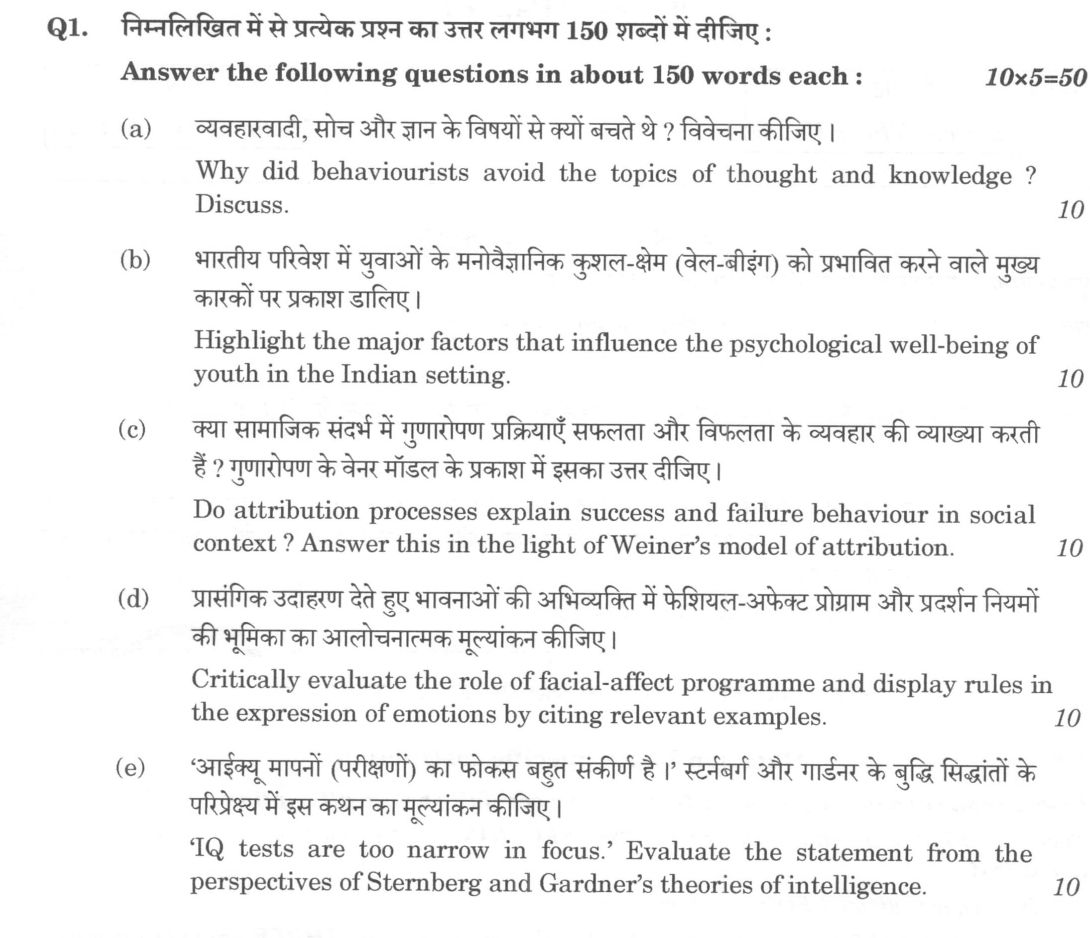
Answer the following questions in about 150 words each:
Why did behaviourists avoid the topics of thought and knowledge ? Discuss. 10 marks
Highlight the major factors that influence the psychological well-being of youth in the Indian setting. 10 marks
Do attribution processes explain success and failure behaviour in social context ? Answer this in the light of Weiner's model of attribution. 10 marks
Critically evaluate the role of facial-affect programme and display rules in the expression of emotions by citing relevant examples. 10 marks
'IQ tests are too narrow in focus.' Evaluate the statement from the perspectives of Sternberg and Gardner's theories of intelligence. 10 marks
हिंदी में प्रश्न पढ़ें
निम्नलिखित में से प्रत्येक प्रश्न का उत्तर लगभग 150 शब्दों में दीजिए :
व्यवहारवादी, सोच और ज्ञान के विषयों से क्यों बचते थे ? विवेचना कीजिए । (10 अंक)
भारतीय परिवेश में युवाओं के मनोवैज्ञानिक कुशल-क्षेम (वेल-बीइंग) को प्रभावित करने वाले मुख्य कारकों पर प्रकाश डालिए । (10 अंक)
क्या सामाजिक संदर्भ में गुणारोपण प्रक्रियाएँ सफलता और विफलता के व्यवहार की व्याख्या करती हैं ? गुणारोपण के वेनर मॉडल के प्रकाश में इसका उत्तर दीजिए । (10 अंक)
प्रासंगिक उदाहरण देते हुए भावनाओं की अभिव्यक्ति में फेशियल-अफेक्ट प्रोग्राम और प्रदर्शन नियमों की भूमिका का आलोचनात्मक मूल्यांकन कीजिए । (10 अंक)
'आईक्यू मापनों (परीक्षणों) का फोकस बहुत संकीर्ण है ।' स्टर्नबर्ग और गार्डनर के बुद्धि सिद्धांतों के परिप्रेक्ष्य में इस कथन का मूल्यांकन कीजिए । (10 अंक)
Model answer
Written by UPSC Answer Check against this question's marking rubric, to the 150-word length. UPSC does not publish answers for Mains — this is one way to score well, not an official key.
(a) Behaviourist Avoidance of Thought and Knowledge
Early behaviourism deliberately excluded internal cognitive phenomena such as thought, knowledge, and consciousness to establish psychology as an objective, empirical natural science. J.B. Watson pioneered methodological behaviourism by rejecting the structuralist and functionalist method of introspection, arguing that mental states are private, subjective, and fundamentally unamenable to direct observation and verification. Watson posited that scientific psychology must restrict its domain exclusively to observable, measurable stimulus-response (S-R) relationships.
Subsequently, B.F. Skinner advanced radical behaviourism, which did not deny the existence of private events like thinking, but treated them strictly as covert behaviours rather than autonomous causal agents of action. Behaviourists considered the mind a "black box" and rejected mentalism, viewing internal mental constructs as pseudo-explanations or epiphenomena that lead to circular reasoning. By prioritizing environmental determinism, operational definitions, and experimental rigor through classical and operant conditioning paradigms, behaviourists prioritized predictive utility and replicability, deliberately avoiding cognitive constructs until the advent of the cognitive revolution.
(b) Factors Influencing Psychological Well-being of Indian Youth
The psychological well-being of youth in contemporary India is shaped by a complex interplay of systemic, socio-cultural, and developmental stressors:
Academic and Competitive Pressure: High-stakes competitive examinations (e.g., NEET, JEE, UPSC) combined with systemic coaching hub cultures create severe chronic stress, anxiety, and performance burnout.
Family Expectations and Intergenerational Conflict: Filial piety and parental hyper-involvement in career choices clash with emerging youth aspirations for individual autonomy, generating familial friction and guilt.
Digital Connectivity and Social Media: Pervasive digital exposure fosters social comparison, Fear of Missing Out (FOMO), validation-seeking behaviour, cyberbullying, and sleep deprivation, exacerbating depressive symptoms.
Economic Precarity and Employment Anxiety: The gap between educational attainment and formal employment opportunities induces pervasive career anxiety and feelings of learned helplessness.
Cultural Identity Ambivalence: Rapid urbanization and globalization create cognitive dissonance as youth navigate traditional collectivist obligations alongside Westernized individualistic ideals, straining self-concept and emotional resilience.
(c) Attribution Processes and Weiner’s Model in Social Contexts
Bernard Weiner’s cognitive theory of attribution explains achievement behaviour through three causal dimensions: Locus of Causality (internal vs. external), Stability (stable vs. unstable), and Controllability (controllable vs. uncontrollable). In social contexts, individuals actively interpret their own and others’ successes and failures, which directly regulates future expectancies, emotional reactions, and motivated behaviour.
When failure is attributed to internal, stable, and uncontrollable factors such as lack of innate ability, it triggers feelings of shame, decreases self-efficacy, and leads to learned helplessness and behavioral withdrawal. Conversely, attributing failure to internal, unstable, and controllable factors like effort fosters guilt, adaptive persistence, and renewed goal pursuit.
Attribution processes in social settings are also subject to cognitive biases. The self-serving bias leads individuals to attribute personal success internally (ability) to protect self-esteem, while externalizing failure to situational constraints (task difficulty, unfair evaluation). Social evaluations also depend on these dimensions; observers display empathy toward individuals whose failure stems from uncontrollable causes (illness), but express anger and stigma toward failures attributed to controllable deficits (lack of effort). Thus, Weiner’s framework effectively bridges cognitive evaluation and motivated social behaviour.
(d) Facial-Affect Programme and Display Rules in Emotional Expression
The expression of emotion operates at the intersection of evolutionary biology and socio-cultural learning, as conceptualized in Paul Ekman’s Neurocultural Theory. The facial-affect programme represents an innate, biologically hardwired universal mechanism that automatically triggers specific muscular configurations corresponding to primary emotions (such as fear, anger, joy, and sadness), irrespective of cultural background.
However, the outward manifestation of these innate patterns is mediated by culturally learned display rules. These social conventions dictate when, where, and how emotions should be expressed, amplified, de-intensified, neutralized, or masked. In hierarchical Indian social environments, junior individuals often neutralize or de-intensify expressions of anger or frustration toward elders and teachers as a sign of respect (maryada). Conversely, at traditional funerals, cultural norms prescribe overt and heightened amplification of grief to signal solidarity. Furthermore, in collectivist Indian workplaces, employees frequently mask negative emotions with polite smiles to preserve interpersonal harmony (samanvaya).
Biologically driven facial programmes initiate baseline emotional responses, but culturally internalized display rules ultimately govern overt social expressions.
(e) IQ Tests: Perspectives of Sternberg and Gardner
The contention that standard IQ tests are excessively narrow is substantiated when evaluated against the multidimensional frameworks of Robert Sternberg and Howard Gardner. Traditional psychometric instruments primarily measure Spearman’s general factor (g), heavily over-representing linguistic and logical-mathematical proficiencies.
Robert Sternberg’s Triarchic Theory of Successful Intelligence posits that psychometric tests assess only Analytical Intelligence (componential problem-solving), while completely overlooking Creative Intelligence (handling novelty and synthetic thinking) and Practical Intelligence (tacit knowledge and contextual adaptation to real-world environments). Sternberg argues that practical and creative competencies are often better predictors of vocational and life success than standard IQ scores.
Similarly, Howard Gardner’s Theory of Multiple Intelligences invalidates the unitary construct of IQ by proposing at least eight autonomous intelligences: Linguistic, Logical-Mathematical, Spatial, Musical, Bodily-Kinesthetic, Interpersonal, Intrapersonal, and Naturalistic. Standard IQ tests systematically marginalize bodily, musical, and socio-emotional intelligences, which are critical for diverse occupations.
Standard IQ tests suffer from an academic and socio-cultural bias; hence, adopting broader, multi-modal assessment paradigms is essential for an equitable understanding of human cognitive competence.
What "Critically evaluate" is asking you to do
Judge how well something has performed against the standard it set for itself — its stated aim, mandate or promise — and commit to a verdict. Name the yardstick before you judge; an unanchored judgement reads as opinion. “Critically” is not a section added at the end: name the yardstick you are judging by — the evidence, the stated objective, a constitutional principle, a rival explanation — and let a verdict close each part of the body. Where the question quotes a claim, that verdict must land on the claim itself, accepted, qualified or rejected, and not on the theme in general.
Structure that answers it
Name the yardstick — stated aim, mandate or benchmark → performance against it → shortfall against it → why the gap exists → verdict
Where marks are lost
Merits in one paragraph, demerits in the next, and a conclusion calling for a balanced and holistic approach. That is a survey with the judgement left out and it holds the answer in the middle band. The opposite error is reading “critically” as permission to attack — and with the odd pairings, critically describe or critically explain, the exposition still carries most of the marks, the judgement being a layer on it rather than a substitute for it.
How this answer will be evaluated
Approach
Framework: UPSC Psychology Paper 1. (a) discuss: intro > 3-4 dimensions > example > balanced close | (b) highlight: name the salient points > one line of substance each > close | (c) explain: definition/context > points in order > small example > short close | (d) critically evaluate: positives > negatives/limits > conditions/safeguards > conclusion | (e) evaluate: criteria > evidence > balanced judgment Full marks: Precise definitions, named theories (Weiner/Ekman/Sternberg), and specific Indian context where required.
Key points expected
- Mention the 'black box' concept of the mind
- Cite the demand for objective, observable data
- Reference the rejection of introspection as unscientific
- Name a key figure (Watson or Skinner)
- Mention academic pressure and competitive exams (JEE/NEET)
- Discuss the role of family expectations and social stigma
- Reference the impact of social media or digital connectivity
- Mention the lack of mental health infrastructure
Evaluation rubric
Each sub-part is marked on its own, against the marks and word limit printed on the paper.
- (a) Explain the methodological and philosophical reasons for the behaviorist exclusion of mental processes. 10 marks · 150 words
discuss— intro → 3-4 dimensions → example → balanced close
Must cover
- Mention the 'black box' concept of the mind
- Cite the demand for objective, observable data
- Reference the rejection of introspection as unscientific
- Name a key figure (Watson or Skinner)
Loses marks
- Confusing behaviorism with psychoanalysis
- Failing to link the avoidance to scientific rigor
Earns more
- Mention the 'S-R' (Stimulus-Response) paradigm
- Reference the 'Behaviorist Manifesto' (1913)
- Contrast with the 'cognitive revolution' later
Extra mark
- Cite specific experiments (Pavlov/Skinner) as evidence of the method
- (b) Identify specific socio-cultural and academic factors affecting youth mental health in India. 10 marks · 150 words
highlight— name the salient points → one line of substance each → close
Must cover
- Mention academic pressure and competitive exams (JEE/NEET)
- Discuss the role of family expectations and social stigma
- Reference the impact of social media or digital connectivity
- Mention the lack of mental health infrastructure
Loses marks
- Generic advice without specific Indian context
- Ignoring the cultural aspect of stigma
Earns more
- Reference the 'National Mental Health Survey' (NMHS)
- Mention the 'Kiran' helpline or government initiatives
- Discuss the 'sandwich generation' pressure
Extra mark
- Cite specific statistics on youth suicide or depression rates
- (c) Apply Weiner's attribution theory to explain how people interpret success and failure. 10 marks · 150 words
explain— definition/context → points in order → small example → short close
Must cover
- Define the three dimensions: Locus, Stability, Controllability
- Explain the impact on 'expectancy' (Stability)
- Explain the impact on 'emotion' (Locus/Controllability)
- Provide a specific example of a success/failure attribution
Loses marks
- Confusing attribution with general motivation
- Failing to link dimensions to specific outcomes
Earns more
- Mention the 'self-esteem' dimension (Locus)
- Contrast internal vs external attributions
- Mention the 'learned helplessness' link
Extra mark
- Reference a specific study by Weiner on student performance
- (d) Assess the biological and social mechanisms of emotional expression using Ekman's concepts. 10 marks · 150 words
critically evaluate— positives → negatives/limits → conditions/safeguards → conclusion
Must cover
- Define the 'Facial Action Coding System' (FACS) or Facial-Affect Programme
- Define 'Display Rules' and their cultural function
- Provide an example of a display rule (e.g., hiding grief)
- Critically evaluate the universality vs cultural variation debate
Loses marks
- Treating emotions as purely subjective without biological basis
- Ignoring the social regulation of expression
Earns more
- Mention Paul Ekman's cross-cultural studies
- Reference the 'micro-expression' concept
- Discuss the 'cultural display rules' in India (e.g., respect for elders)
Extra mark
- Cite the 'FACS' manual or specific Ekman studies
- (e) Critique the limitations of IQ tests using Sternberg's and Gardner's alternative theories. 10 marks · 150 words
evaluate— criteria → evidence → balanced judgment
Must cover
- State the limitation of standard IQ tests (narrow focus)
- Explain Sternberg's 'Triarchic Theory' (Analytical, Creative, Practical)
- Explain Gardner's 'Multiple Intelligences' (e.g., Musical, Kinesthetic)
- Conclude on the need for a broader assessment
Loses marks
- Failing to contrast with the 'g-factor' or standard IQ
- Listing intelligences without explaining their relevance
Earns more
- Mention 'Street Smarts' (Sternberg)
- List specific intelligences from Gardner (e.g., Interpersonal)
- Reference the 'g-factor' as the narrow focus
Extra mark
- Cite specific tests like 'Torrance Tests' for creativity
Practice this exact question
Write your answer and it is marked point by point against the model answer above — what you covered, what you missed, what you got wrong.
Evaluate my answer →More from Psychology 2025 Paper I
- Q1 Answer the following questions in about 150 words each: (a) Why did behaviourists avoid t…
- Q2 (a) 'Personality is all in our genes.' Evaluate the statement in the context of different…
- Q3 (a) Discuss the role of biological, cognitive and learning influences on gender identity…
- Q4 (a) Describe social cognitive theory and its applications to solve large scale societal p…