Paper I — Q2
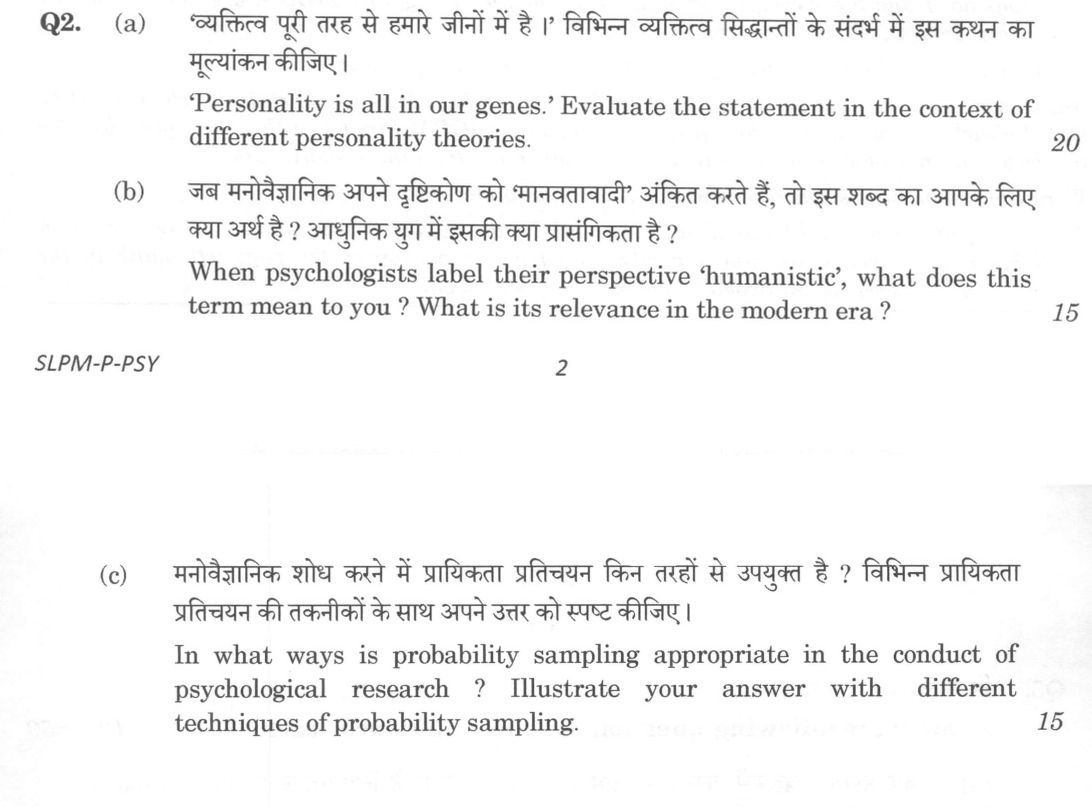
(a) 'Personality is all in our genes.' Evaluate the statement in the context of different personality theories. (20 marks) (b)…
'Personality is all in our genes.' Evaluate the statement in the context of different personality theories. 20 marks
When psychologists label their perspective 'humanistic', what does this term mean to you ? What is its relevance in the modern era ? 15 marks
In what ways is probability sampling appropriate in the conduct of psychological research ? Illustrate your answer with different techniques of probability sampling. 15 marks
हिंदी में प्रश्न पढ़ें
'व्यक्तित्व पूरी तरह से हमारे जीनों में है ।' विभिन्न व्यक्तित्व सिद्धांतों के संदर्भ में इस कथन का मूल्यांकन कीजिए । (20 अंक)
जब मनोवैज्ञानिक अपने दृष्टिकोण को 'मानवतावादी' अंकित करते हैं, तो इस शब्द का आपके लिए क्या अर्थ है ? आधुनिक युग में इसकी क्या प्रासंगिकता है ? (15 अंक)
मनोवैज्ञानिक शोध करने में प्रायिकता प्रतिचयन किन तरहों से उपयुक्त है ? विभिन्न प्रायिकता प्रतिचयन की तकनीकों के साथ अपने उत्तर को स्पष्ट कीजिए। (15 अंक)
Model answer
Written by UPSC Answer Check against this question's marking rubric, to the expected length. UPSC does not publish answers for Mains — this is one way to score well, not an official key.
Biological Determinism vs. Personality Theories
The assertion that personality is exclusively genetic is an oversimplification of complex developmental processes. Behavioral genetics indicates that personality exhibits moderate heritability (roughly 40 to 50 percent), substantiated by Thomas Bouchard’s Minnesota Twin Study of monozygotic twins reared apart. Molecular genetic research identifies specific markers, such as the 5-HTT serotonin transporter gene linked to neuroticism, yet contemporary epigenetics demonstrates that gene expression depends heavily on environmental triggers, functioning through gene-environment (G × E) interactions.
Major personality theories reflect varying positions along this nature-nurture continuum. Hans Eysenck’s PEN model provides the strongest biological account, anchoring Extraversion, Neuroticism, and Psychoticism in physiological mechanisms like the ascending reticular activating system and limbic excitability. Sigmund Freud’s psychodynamic framework posits biologically rooted instinctual drives (Eros and Thanatos), yet argues that adult personality structure is shaped by early psychosexual conflicts within the family environment. Albert Bandura’s social-cognitive theory rejects genetic determinism through reciprocal determinism, arguing that personality develops from continuous bi-directional interactions between internal cognitive-biological factors, overt behavior, and environmental feedback. Carl Rogers’ humanistic theory recognizes an innate actualizing tendency, but maintains that healthy personality integration requires socio-environmental conditions of unconditional positive regard. Thus, empirical evidence indicates that genes establish a reaction range rather than a fixed outcome.
The Humanistic Perspective and Modern Relevance
To label a perspective humanistic means shifting focus away from reductionist, deterministic paradigms toward viewing individuals as conscious, agentic beings. It emphasizes subjective phenomenological experience, personal agency, free will, self-actualization, and holistic personal growth.
In the modern era, this perspective underpins Martin Seligman’s positive psychology, redirecting clinical attention from pathology toward psychological resilience, character strengths, and subjective well-being. In organizational settings, humanistic models inform employee well-being, intrinsic motivation, and empathetic leadership. In India, humanistic approaches provide a non-judgmental framework essential for destigmatizing mental health issues and strengthening community-based interventions under the District Mental Health Programme. Nonetheless, its modern application faces limitations in collectivist settings like India, where self-concept is deeply relational and familial rather than purely autonomous and individualistic.
Appropriateness and Techniques of Probability Sampling
Probability sampling is essential in psychological research to ensure that every member of a defined population has a known, non-zero chance of selection. This eliminates investigator selection bias, satisfies the assumptions required for parametric statistical inference, and ensures high external validity and generalizability of findings.
Four primary probability sampling techniques serve distinct research contexts:
Simple Random Sampling gives every individual an equal selection probability, operationalized through random number generators or lottery methods, suitable for homogeneous populations in baseline cognitive experiments.
Stratified Random Sampling divides a heterogeneous population into distinct, non-overlapping strata and draws random samples proportionally from each. This is vital in Indian educational and developmental research to ensure proportional representation across diverse socioeconomic status (SES), caste, and gender strata.
Systematic Sampling involves selecting every k-th individual from an ordered sampling frame after a random starting point between 1 and k, frequently used in clinical settings to sample patient admissions.
Cluster and Multistage Sampling is employed when complete population lists are unavailable across expansive geographic areas. Researchers randomly sample intact natural groups (such as districts, then villages, then households), as utilized in large-scale epidemiological studies like the National Mental Health Survey (NMHS) of India.
Verdict
The claim that personality is entirely genetic is empirically untenable. Rigorous probability sampling consistently demonstrates that personality emerges from dynamic, epigenetic interactions between biological predispositions and environmental contexts. Methodological precision enables researchers to map these determinants, while humanistic principles preserve an appreciation for individual agency, ensuring that psychological science balances empirical measurement with the holistic human capacity for self-determination.
What "Evaluate" is asking you to do
Judge how well something has performed against the standard it set for itself — its stated aim, mandate or promise — and commit to a verdict. Name the yardstick before you judge; an unanchored judgement reads as opinion.
Structure that answers it
Name the yardstick — stated aim, mandate or benchmark → performance against it → shortfall against it → why the gap exists → verdict
Where marks are lost
Presenting both sides and then declining to decide, or delivering a verdict against a standard you never stated, which makes it look arbitrary.
How this answer will be evaluated
Approach
(a) evaluate: criteria > evidence > balanced judgment | (b) explain: definition/context > points in order > small example > short close | (c) explain: definition/context > points in order > small example > short close Full marks: Comprehensive theoretical coverage with specific evidence and balanced judgment.
Key points expected
- Contrast biological (e.g., Eysenck) vs. psychodynamic theories
- Cite evidence for nature vs. nurture (e.g., twin studies)
- Discuss interactionist or social-cognitive perspectives
- Provide a balanced judgment on the 'all in genes' claim
- Define humanistic perspective (self-actualization, free will)
- Identify key figures (Maslow, Rogers)
- Explain relevance to modern mental health (holistic care)
- Connect to contemporary issues (well-being, therapy)
Evaluation rubric
Each sub-part is marked on its own, against the marks and word limit printed on the paper.
- (a) Critique the genetic determinism claim using multiple personality theories. 20 marks
evaluate— criteria → evidence → balanced judgment
Must cover
- Contrast biological (e.g., Eysenck) vs. psychodynamic theories
- Cite evidence for nature vs. nurture (e.g., twin studies)
- Discuss interactionist or social-cognitive perspectives
- Provide a balanced judgment on the 'all in genes' claim
Loses marks
- Presenting only one theoretical perspective
- Ignoring environmental factors entirely
Earns more
- Mention specific genetic markers or heritability stats
- Reference specific theorists (e.g., Freud, Bandura)
Extra mark
- Cite specific twin study (e.g., Minnesota Twin Study)
- Mention specific psychometric tool (e.g., Eysenck Personality Questionnaire)
- (b) Define humanistic psychology and justify its modern relevance. 15 marks
explain— definition/context → points in order → small example → short close
Must cover
- Define humanistic perspective (self-actualization, free will)
- Identify key figures (Maslow, Rogers)
- Explain relevance to modern mental health (holistic care)
- Connect to contemporary issues (well-being, therapy)
Loses marks
- Vague definition without specific theorists
- Ignoring the 'modern era' relevance aspect
Earns more
- Mention specific concepts like 'unconditional positive regard'
- Contrast with behaviorist or psychoanalytic views
Extra mark
- Cite specific modern application (e.g., positive psychology)
- Reference specific therapy technique (e.g., Person-Centered Therapy)
- (c) Explain the utility of probability sampling in research with examples. 15 marks
explain— definition/context → points in order → small example → short close
Must cover
- Define probability sampling and its role in generalizability
- Explain Simple Random Sampling with an example
- Explain Stratified or Cluster Sampling with an example
- Link sampling method to reducing bias in psychological data
Loses marks
- Confusing probability with non-probability sampling
- Listing techniques without explaining their appropriateness
Earns more
- Mention specific context (e.g., clinical vs. field research)
- Discuss sample size considerations
Extra mark
- Provide a specific calculation or formula for sample size
- Mention specific software used for sampling
Practice this exact question
Write your answer and it is marked point by point against the model answer above — what you covered, what you missed, what you got wrong.
Evaluate my answer →More from Psychology 2025 Paper I
- Q1 Answer the following questions in about 150 words each: (a) Why did behaviourists avoid t…
- Q2 (a) 'Personality is all in our genes.' Evaluate the statement in the context of different…
- Q3 (a) Discuss the role of biological, cognitive and learning influences on gender identity…
- Q4 (a) Describe social cognitive theory and its applications to solve large scale societal p…
- Q5 Answer the following questions in about 150 words each: (a) Do correlational studies cont…