Paper I — Q3
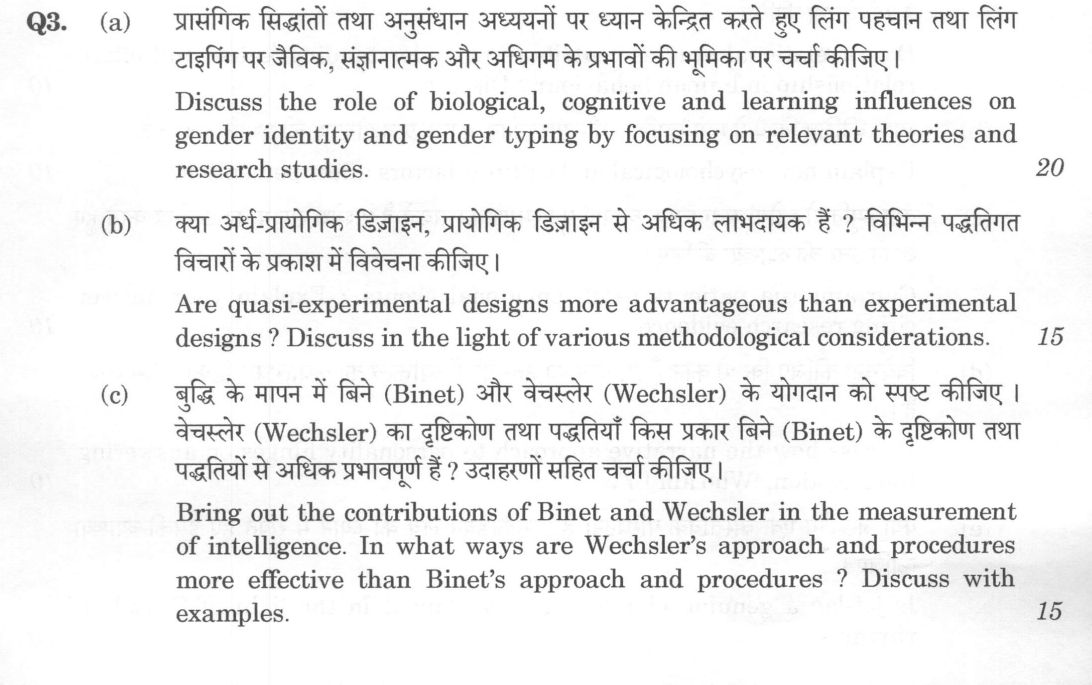
(a) Discuss the role of biological, cognitive and learning influences on gender identity and gender typing by focusing on…
Discuss the role of biological, cognitive and learning influences on gender identity and gender typing by focusing on relevant theories and research studies. 20 marks
Are quasi-experimental designs more advantageous than experimental designs ? Discuss in the light of various methodological considerations. 15 marks
Bring out the contributions of Binet and Wechsler in the measurement of intelligence. In what ways are Wechsler's approach and procedures more effective than Binet's approach and procedures ? Discuss with examples. 15 marks
हिंदी में प्रश्न पढ़ें
प्रासांगिक सिद्धांतों तथा अनुसंधान अध्ययनों पर ध्यान केंद्रित करते हुए लिंग पहचान तथा लिंग टाइपिंग पर जैविक, संज्ञानात्मक और अधिगम के प्रभावों की भूमिका पर चर्चा कीजिए। (20 अंक)
क्या अर्ध-प्रायोगिक डिजाइन, प्रायोगिक डिजाइन से अधिक लाभदायक है ? विभिन्न पद्धतिगत विचारों के प्रकाश में विवेचना कीजिए। (15 अंक)
बुद्धि के मापन में बिने (Binet) और वेचस्लेर (Wechsler) के योगदान को स्पष्ट कीजिए। वेचस्लेर (Wechsler) का दृष्टिकोण तथा पद्धतियां किस प्रकार बिने (Binet) के दृष्टिकोण तथा पद्धतियों से अधिक प्रभावपूर्ण हैं ? उदाहरणों सहित चर्चा कीजिए। (15 अंक)
Model answer
Written by UPSC Answer Check against this question's marking rubric, to the expected length. UPSC does not publish answers for Mains — this is one way to score well, not an official key.
Biological, Cognitive, and Learning Influences on Gender
Gender identity and gender typing arise from a dynamic interplay of biological predispositions, cognitive constructions, and social learning mechanisms.
Biologically, Money and Ehrhardt’s biosocial theory posits that prenatal biological events interact with postnatal social labeling. Research on females with Congenital Adrenal Hyperplasia (CAH) demonstrates that prenatal androgen exposure increases male-typed spatial preferences and rough-and-tumble play, while neuroimaging links sex differences to hemispheric lateralization. However, modern psychology rejects deterministic biological essentialism, treating biology as providing behavioral predispositions rather than unalterable destinies.
Cognitively, Kohlberg’s cognitive-developmental model highlights active self-socialization across stages: gender identity (labeling), gender stability (consistency over time), and gender constancy (invariance across situations). Once constancy is achieved, children actively seek gender-typed models. Martin and Halverson’s gender schema theory and Sandra Bem’s schema theory further explain how children construct cognitive networks (in-group/out-group schemas) that filter self-concept and perception. In India, culturally rigid patriarchal schemas transmit traditional domestic and occupational roles across generations through familial norms and language.
Learning perspectives, formulated by Bandura and Mischel, emphasize observational learning, vicarious reinforcement, and differential direct reinforcement—such as Indian families rewarding compliance in daughters and assertiveness in sons. Bussey and Bandura’s social cognitive theory integrates these domains, demonstrating that personal cognitive factors, biological capabilities, and environmental feedback operate through reciprocal determinism to construct gender typing.
Methodological Trade-offs: Quasi-Experimental versus Experimental Designs
Quasi-experimental designs are not universally superior to experimental designs; rather, they present trade-offs dictated by ecological validity and ethical feasibility.
The main advantage of quasi-experimental designs lies in their naturalistic applicability. In field settings where random assignment is unethical or impossible—such as evaluating policy interventions like the Beti Bachao Beti Padhao scheme or studying occupational burnout across corporate hierarchies—quasi-experiments preserve high external validity. However, they suffer from compromised internal validity. Lacking random assignment, they are susceptible to selection bias, maturation, history effects, and regression artifacts, which weaken causal inferences.
Conversely, true experimental designs maximize internal validity and causal precision through manipulation of independent variables and random assignment. Yet, their constraints include artificial laboratory settings, demand characteristics, and strict ethical limits when studying trauma, deprivation, or classroom dynamics in Indian educational psychology. Thus, methodological appropriateness depends on the objective: true experiments excel in theoretical causal verification, whereas quasi-experiments provide practical, ecologically grounded insights in applied field settings.
Measurement of Intelligence: Binet and Wechsler
Alfred Binet developed the first practical intelligence scales (1905, 1908, 1911) to identify French school children needing remedial education, introducing the concept of Mental Age (MA). Lewis Terman standardized this into the Stanford-Binet scale, introducing the ratio IQ formula: (MA/CA) × 100.
David Wechsler transformed psychometric assessment by introducing the Deviation IQ, a standardized score (M=100, SD=15) based on normal distribution, eliminating the arithmetic distortion of ratio IQ in adults whose chronological age advances while mental age stabilizes. Wechsler introduced a point-scale format over Binet's age-scale format, developed adult batteries (WAIS), and separated abilities into Verbal and Performance scales.
Wechsler’s approach proves more clinically effective than Binet’s original framework. Subtest profile analysis (scatter analysis) enables clinicians to detect specific cognitive deficits—such as distinguishing working memory deficits from perceptual reasoning impairments—which is widely utilized in Indian neuropsychological assessments at institutions like NIMHANS. Furthermore, Wechsler’s balanced verbal-performance structure mitigates cultural and linguistic bias, making it applicable across a wider lifespan.
Advances across psychometric testing and research methodology demonstrate a continuous shift from rigid, single-dimension models toward multidimensional, ecologically valid, and clinically nuanced frameworks across psychological science.
What "Discuss" is asking you to do
Lay the issue out from more than one side — how it arose, what is claimed for it, what is held against it, and where it now stands. UPSC attaches discuss to broad topics with several live dimensions, so coverage of the dimensions earns more than the strength of your opinion.
Structure that answers it
Set the issue up → the case as it is made → the case against → the dimension both sides leave out → where the balance now lies
Where marks are lost
Listing facts with no thread between them, or arguing one side throughout and calling it a discussion.
How this answer will be evaluated
Approach
Framework: UPSC Psychology Paper 1. (a) discuss: intro > 3-4 dimensions > example > balanced close | (b) comment: context > arguments both sides > judgment > close | (c) compare: paired headings or table > key differences > significance > conclusion Full marks: Comprehensive coverage of all dimensions with named theories, studies, and specific examples.
Key points expected
- Biological factors: hormones, prenatal development, genetic sex
- Cognitive theories: Kohlberg's stages, gender schema theory
- Learning theories: social learning, reinforcement, modeling
- Integration of theories with specific research studies
- Definition of experimental vs. quasi-experimental design
- Internal validity: control of extraneous variables
- External validity: ecological validity and generalizability
- Methodological constraints: randomization and ethics
Evaluation rubric
Each sub-part is marked on its own, against the marks and word limit printed on the paper.
- (a) Analyze biological, cognitive, and learning influences on gender identity and typing. 20 marks
discuss— intro → 3-4 dimensions → example → balanced close
Must cover
- Biological factors: hormones, prenatal development, genetic sex
- Cognitive theories: Kohlberg's stages, gender schema theory
- Learning theories: social learning, reinforcement, modeling
- Integration of theories with specific research studies
Loses marks
- Generalizing without specific theoretical names
- Ignoring the 'learning' or 'cognitive' dimension
- Providing everyday advice instead of academic theory
Earns more
- Mention of specific researchers (e.g., Bandura, Kohlberg)
- Comparison of nature vs. nurture perspectives
- Reference to cross-cultural studies on gender
Extra mark
- Specific named experiment (e.g., Bobo doll study)
- Reference to specific psychometric tool for gender typing
- (b) Compare quasi-experimental and experimental designs regarding their advantages. 15 marks
comment— context → arguments both sides → judgment → close
Must cover
- Definition of experimental vs. quasi-experimental design
- Internal validity: control of extraneous variables
- External validity: ecological validity and generalizability
- Methodological constraints: randomization and ethics
Loses marks
- Failing to define the two design types
- Ignoring the trade-off between internal/external validity
- Vague statements without methodological specifics
Earns more
- Discussion of specific designs (e.g., pretest-posttest)
- Mention of 'real-world' applicability of quasi-experiments
- Reference to specific methodological considerations
Extra mark
- Specific named study using quasi-experimental design
- Diagram illustrating the difference in randomization
- (c) Compare Binet and Wechsler's contributions and evaluate Wechsler's effectiveness. 15 marks
compare— paired headings or table → key differences → significance → conclusion
Must cover
- Binet's contribution: mental age, 1905/1908 scales
- Wechsler's contribution: WAIS/WISC, IQ formula (RA/CA)
- Wechsler's advantages: broader age range, verbal/performance
- Specific examples of Wechsler's superior procedures
Loses marks
- Confusing Binet's original work with later revisions
- Failing to explain *why* Wechsler is more effective
- Lack of specific examples of procedures
Earns more
- Mention of 'Mental Age' vs 'Ratio IQ' vs 'Deviation IQ'
- Reference to specific subtests (e.g., Digit Span)
- Discussion of the 'g' factor in Wechsler's model
Extra mark
- Specific named subtest from WISC/WAIS
- Reference to specific psychometric properties (reliability)
Practice this exact question
Write your answer and it is marked point by point against the model answer above — what you covered, what you missed, what you got wrong.
Evaluate my answer →More from Psychology 2025 Paper I
- Q1 Answer the following questions in about 150 words each: (a) Why did behaviourists avoid t…
- Q2 (a) 'Personality is all in our genes.' Evaluate the statement in the context of different…
- Q3 (a) Discuss the role of biological, cognitive and learning influences on gender identity…
- Q4 (a) Describe social cognitive theory and its applications to solve large scale societal p…
- Q5 Answer the following questions in about 150 words each: (a) Do correlational studies cont…
- Q6 (a) How would you justify the use of factor analysis in psychological research ? Answer w…