Paper I — Q4
(a) Describe social cognitive theory and its applications to solve large scale societal problems. (20 marks) (b) 'Meditation…
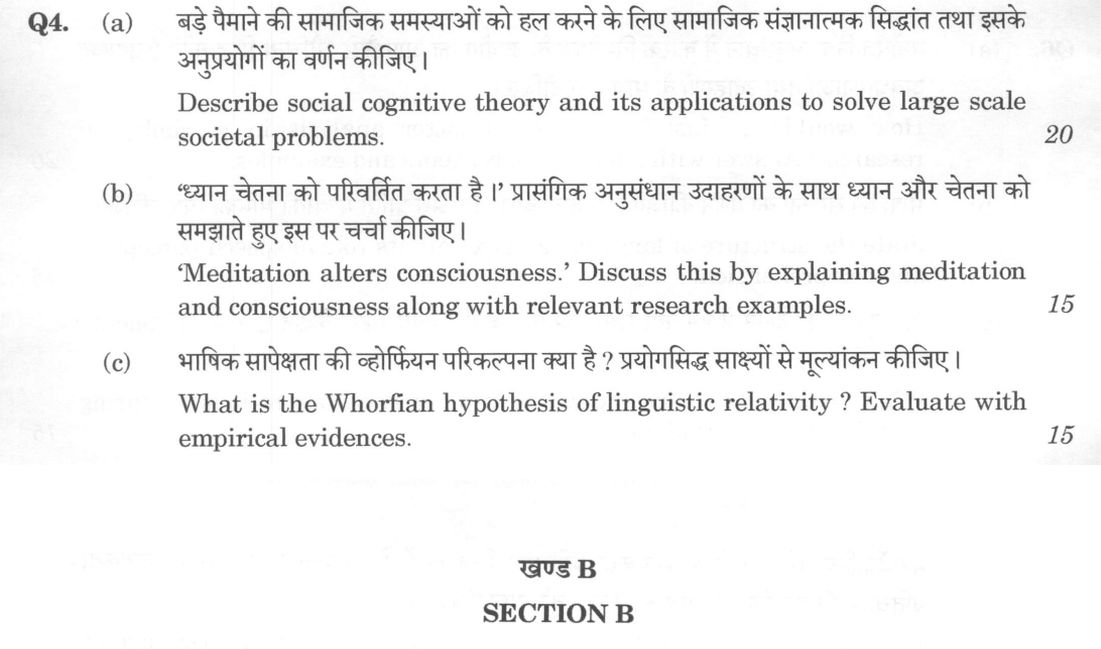
Describe social cognitive theory and its applications to solve large scale societal problems. 20 marks
'Meditation alters consciousness.' Discuss this by explaining meditation and consciousness along with relevant research examples. 15 marks
What is the Whorfian hypothesis of linguistic relativity ? Evaluate with empirical evidences. 15 marks
हिंदी में प्रश्न पढ़ें
बड़े पैमाने की सामाजिक समस्याओं को हल करने के लिए सामाजिक संज्ञानात्मक सिद्धांत तथा इसके अनुप्रयोगों का वर्णन कीजिए। (20 अंक)
'ध्यान चेतना को परिवर्तित करता है।' प्रासांगिक अनुसंधान उदाहरणों के साथ ध्यान और चेतना को समझाते हुए इस पर चर्चा कीजिए। (15 अंक)
भाषिक सापेक्षता की व्होर्फियन परिकल्पना क्या है ? प्रयोगसिद्ध साक्ष्यों से मूल्यांकन कीजिए। (15 अंक)
Model answer
Written by UPSC Answer Check against this question's marking rubric, to the expected length. UPSC does not publish answers for Mains — this is one way to score well, not an official key.
Social cognitive theory, meditation and language all show that human change is not merely stimulus-response; it involves agency, attention and conceptual framing.
Part (a) Bandura’s social cognitive theory describes learning and behaviour as products of reciprocal determinism among person, behaviour and environment. Its core constructs are observational learning, self-efficacy, outcome expectations and personal agency. Unlike behaviourism, which emphasises external reinforcement, SCT treats people as active agents who set goals, model others, anticipate consequences and regulate action. SCT also emphasises self-regulation: people observe, encode, store and retrieve models, then act on them when motivated. It also distinguishes self-efficacy from outcome expectations: people may expect a result but still doubt their capacity to perform. For large-scale societal problems, this matters because change can be scaled through media, peers and institutions. In India’s polio eradication, media campaigns and community mobilisation used visible role models, success stories and collective efficacy to alter vaccination norms. In environmental conservation, Chipko’s tree-hugging provided powerful observational models of non-violent resistance, strengthening villagers’ efficacy and outcome expectations. In education, Diksha enables vicarious learning through teacher demonstrations, peer examples and digital resources. SCT’s agentic perspective and collective efficacy are especially useful for climate change and communal harmony, where individuals must believe that group action can produce meaningful outcomes. This makes SCT a practical framework for policy.
Part (b) Consciousness is usually defined as wakefulness plus awareness of self and world; it is not simply arousal. Meditation includes focused attention and open monitoring practices that train attention, reduce reactivity and alter subjective experience. Research shows meditation can change brain function and structure. Davidson’s EEG studies with Tibetan monks found sustained attention, emotional regulation and asymmetrical frontal activity associated with long-term practice. Lazar’s structural MRI study reported greater cortical thickness in experienced meditators; however, because it was cross-sectional, it cannot prove that meditation induces cortical thickening or counteracts age-related thinning. Meditation may produce altered states through de-automatization, where habitual perception is loosened, and in some traditions through transcendental consciousness, a non-dual awareness beyond ordinary object-focused thought. These altered states may be temporary during practice or become stable traits with sustained training. Indian research, including NIMHANS studies on Vipassana and Sudarshan Kriya, has documented effects on brain-wave patterns and physiological regulation, supporting the view that meditation changes consciousness rather than merely relaxing the body.
Part (c) The Whorfian hypothesis has a strong form, linguistic determinism, which claims language determines thought, and a weak form, linguistic relativity, which claims language influences habitual perception and cognition. Strong determinism is largely rejected because people can think in ways not fully captured by their language and can learn new categories. Weak relativity receives partial support. The weak version is especially plausible in domains tightly coupled to language, such as colour, space and time, while cross-linguistic transfer limits its scope. Berlin and Kay’s basic colour-term research challenged strong Whorfianism by showing a broadly universal sequence of colour terms, yet later work shows language can affect colour discrimination. Boroditsky’s spatial cognition studies, such as comparisons involving Maya and Dutch speakers, suggest that spatial language can shape how people encode and remember space. Indian evidence is more indirect: Gumperz’s Hindi-English code-switching work shows how language choice frames social meaning and identity, but it is sociolinguistic rather than direct cognitive Whorfian evidence. Danziger’s Malayalam work on spatial frames, rather than temporal orientation, illustrates language-specific spatial cognition. Overall, empirical evidence supports a modest, domain-specific linguistic relativity, not strong determinism.
Together, SCT, meditation and linguistic relativity point to complementary pathways for societal transformation: social learning builds collective agency, meditation alters attention and consciousness, and language shapes the categories through which communities interpret reality.
What "Describe" is asking you to do
Give a full, ordered account of the thing named — its parts, stages or mechanism — in the sequence in which it actually exists or occurs. Most describe questions come from the science optionals, where the marks sit in correct technical detail and, where the stem says so, a labelled diagram.
Structure that answers it
One-line identification of the subject → the parts or stages in their real order, each with its defining detail → labelled diagram where the subject is structural → closing line on function or significance
Where marks are lost
Loose general prose where the examiner is ticking named parts, correct terminology and their sequence; and in the General Studies papers, turning to evaluation before the description is finished.
How this answer will be evaluated
Approach
Framework: UPSC Psychology Paper 1. (a) describe: define > structure or process in order > labelled diagram > significance | (b) discuss: intro > 3-4 dimensions > example > balanced close | (c) evaluate: criteria > evidence > balanced judgment Full marks: Comprehensive, well-structured, with specific examples and research.
Key points expected
- Define Social Cognitive Theory (Bandura)
- Explain core mechanisms (reciprocal determinism, self-efficacy)
- Link theory to specific societal problems (health, education)
- Provide concrete application examples (e.g., smoking cessation)
- Define meditation and consciousness
- Explain how meditation alters consciousness
- Provide relevant research examples
- Discuss specific changes in cognitive states
Evaluation rubric
Each sub-part is marked on its own, against the marks and word limit printed on the paper.
- (a) Define SCT and detail its application to large-scale societal problems. 20 marks
describe— define → structure or process in order → labelled diagram → significance
Must cover
- Define Social Cognitive Theory (Bandura)
- Explain core mechanisms (reciprocal determinism, self-efficacy)
- Link theory to specific societal problems (health, education)
- Provide concrete application examples (e.g., smoking cessation)
Loses marks
- Theory without application to societal problems
- Confusing SCT with general social learning theory
- Vague examples without specific mechanisms
Earns more
- Mention observational learning and modeling
- Discuss self-regulation and self-efficacy in detail
- Reference specific large-scale intervention programs
- Include a diagram of reciprocal determinism
Extra mark
- Cite specific Bandura studies or meta-analyses
- Mention specific Indian context applications
- (b) Explain meditation and consciousness, linking them with research. 15 marks
discuss— intro → 3-4 dimensions → example → balanced close
Must cover
- Define meditation and consciousness
- Explain how meditation alters consciousness
- Provide relevant research examples
- Discuss specific changes in cognitive states
Loses marks
- Vague definitions without scientific basis
- No research examples provided
- Confusing meditation with general relaxation
Earns more
- Mention specific meditation types (e.g., mindfulness)
- Reference neuroimaging studies (fMRI, EEG)
- Discuss flow states or altered states of consciousness
- Mention specific researchers (e.g., Kabat-Zinn)
Extra mark
- Cite specific studies with findings
- Mention specific psychometric tools used
- (c) Define Whorfian hypothesis and evaluate with empirical evidence. 15 marks
evaluate— criteria → evidence → balanced judgment
Must cover
- Define Whorfian hypothesis of linguistic relativity
- Distinguish strong vs weak versions
- Provide empirical evidence for/against
- Offer balanced evaluation of the hypothesis
Loses marks
- Confusing linguistic relativity with linguistic determinism
- No empirical evidence provided
- One-sided evaluation without balance
Earns more
- Mention specific languages studied (e.g., Hopi, Russian)
- Reference specific experiments (e.g., color perception)
- Discuss cognitive implications of language
- Mention specific researchers (e.g., Sapir, Whorf)
Extra mark
- Cite specific studies with clear findings
- Mention specific psycholinguistic tools
Practice this exact question
Write your answer and it is marked point by point against the model answer above — what you covered, what you missed, what you got wrong.
Evaluate my answer →More from Psychology 2025 Paper I
- Q1 Answer the following questions in about 150 words each: (a) Why did behaviourists avoid t…
- Q2 (a) 'Personality is all in our genes.' Evaluate the statement in the context of different…
- Q3 (a) Discuss the role of biological, cognitive and learning influences on gender identity…
- Q4 (a) Describe social cognitive theory and its applications to solve large scale societal p…
- Q5 Answer the following questions in about 150 words each: (a) Do correlational studies cont…
- Q6 (a) How would you justify the use of factor analysis in psychological research ? Answer w…
- Q7 (a) 'Motivation is a complex process and cannot be explained by a single approach.' Evalu…