Paper I — Q6
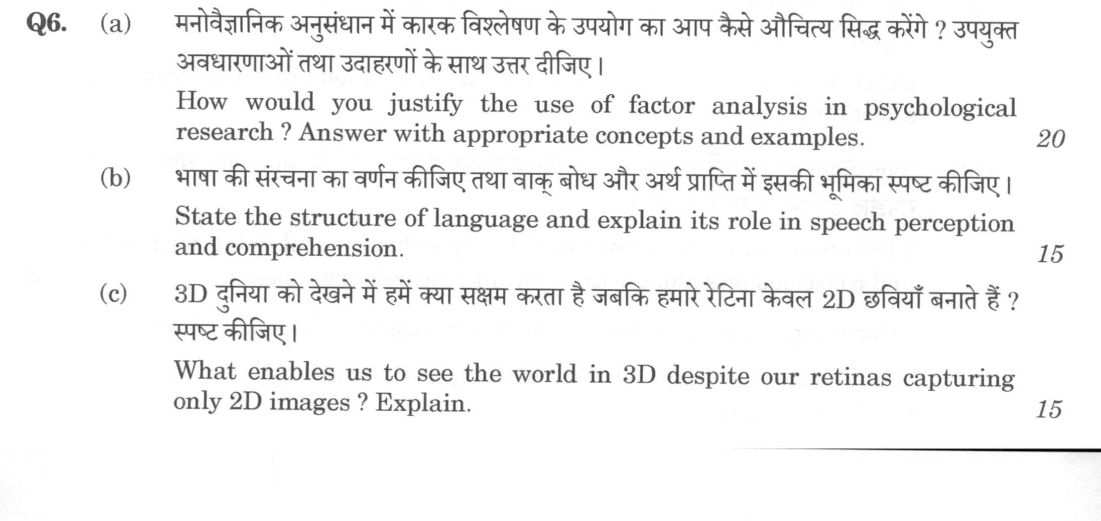
(a) How would you justify the use of factor analysis in psychological research ? Answer with appropriate concepts and examples…
How would you justify the use of factor analysis in psychological research ? Answer with appropriate concepts and examples. 20 marks
State the structure of language and explain its role in speech perception and comprehension. 15 marks
What enables us to see the world in 3D despite our retinas capturing only 2D images ? Explain. 15 marks
हिंदी में प्रश्न पढ़ें
मनोवैज्ञानिक अनुसंधान में कारक विश्लेषण के उपयोग का आप कैसे औचित्य सिद्ध करेंगे ? उपयुक्त अवधारणाओं तथा उदाहरणों के साथ उत्तर दीजिए। (20 अंक)
भाषा की संरचना का वर्णन कीजिए तथा वाक् बोध और अर्थ प्राप्ति में इसकी भूमिका स्पष्ट कीजिए। (15 अंक)
3D दुनिया को देखने में हमें क्या सक्षम करता है जबकि हमारे रेटिना केवल 2D छवियाँ बनाते हैं ? स्पष्ट कीजिए। (15 अंक)
Model answer
Written by UPSC Answer Check against this question's marking rubric, to the expected length. UPSC does not publish answers for Mains — this is one way to score well, not an official key.
Factor Analysis in Psychological Research
Factor analysis (FA) is indispensable in psychological research for operationalising unobservable latent constructs through mathematical data reduction. By identifying underlying covariance patterns among observed variables, FA establishes parsimony and structural validity in psychometric scale construction.
Methodologically, FA operates across two paradigms: Exploratory Factor Analysis (EFA) uncovers latent dimensions without a priori constraints, as exemplified by Cattell reducing thousands of trait adjectives to the 16 Personality Factor (16PF) model. Conversely, Confirmatory Factor Analysis (CFA) statistically tests whether an empirical dataset conforms to a hypothesized theoretical model. In Indian psychometrics, FA has justified the structural development and cross-cultural adaptation of indigenous instruments, such as the Jodhpur Multidimensional Personality Inventory (JMPI) and Indian adaptations of the NEO-PI, ensuring cultural equivalence across linguistically diverse cohorts.
Objections against FA focus on factor indeterminacy, subjectivity in selecting extraction and rotation techniques (e.g., orthogonal Varimax versus oblique Promax), and the tension between statistical reification and psychological theory. However, the use of FA remains fully justified when mathematical derivation is constrained by theoretical frameworks, sample-to-variable adequacy checks (e.g., KMO and Bartlett’s test), and subsequent CFA replication, preventing purely data-driven artifacts.
Structure of Language in Perception and Comprehension
Language is organized hierarchically across five structural levels: phonology (discrete speech sounds or phonemes), morphology (minimal units of meaning or morphemes), syntax (rules governing phrase and sentence formation), semantics (meaning of words and combinations), and pragmatics (context-dependent communicative intent).
In speech perception, this structural hierarchy interacts with top-down and bottom-up cognitive mechanisms. Continuous acoustic signals are converted into discrete perceptual units through categorical perception, while the McGurk effect demonstrates that visual speech cues integrate with auditory inputs during phonemic decoding.
Comprehension operates via syntactic parsing, rapid retrieval from the mental lexicon, and pragmatic context modulation. Indian multilingual research (e.g., Hindi-English code-switching and bilingual lexical access) demonstrates that shared syntactic representations and semantic networks allow cognitive flexibility, where top-down sentence context resolves ambiguous phonemes and facilitates rapid lexical selection across dual linguistic codes.
Depth Perception: Translating 2D Retinal Images to 3D Vision
The visual system reconstructs a 3D perception from flat 2D retinal projections by integrating binocular and monocular depth cues.
Binocular cues depend on binocular coordination: retinal disparity (the slight horizontal offset between the images projected onto each eye) generates stereoscopic depth, processed by disparity-tuned binocular neurons in the primary visual cortex (V1) and routed through the occipito-parietal dorsal stream for spatial localization. Convergence provides neuromuscular kinesthetic feedback as the eyes rotate inward to fixate on near targets.
Monocular cues yield depth even with one eye. Pictorial cues include linear perspective, texture gradients, interposition (occlusion), relative size, and aerial perspective; dynamic cues include motion parallax, where closer objects appear to move faster in the opposite direction than distant ones. These cues are central to Indian environmental psychology studies examining spatial orientation, visual crowding, and perceptual navigation in dense urban environments.
This 3D reconstruction illustrates the classic theoretical debate between Richard Gregory’s *constructivist theory*—viewing depth as top-down cognitive hypotheses resolving ambiguous 2D sensations—and J.J. Gibson’s ecological approach, which posits that invariant patterns in the optic array provide direct, unmediated depth information.
Together, computational data reduction (factor analysis), hierarchical representations (language), and cue-integration systems (depth perception) reflect the fundamental cognitive strategy of transforming complex, ambiguous inputs into coherent psychological structures.
What "Justify" is asking you to do
Defend a position with reasons that carry evidence, and show why the contrary view does not hold. Where the stem runs as a question and asks you to justify your answer, the position is yours to choose and the marks lie wholly in the defence.
Structure that answers it
Position stated plainly → reason 1 with evidence → reason 2 with evidence → strongest objection, met → position restated as qualified
Where marks are lost
Reasons stated and none of them evidenced. The other standard loss is fence-sitting — an answer that finds merit on both sides and commits to neither has justified nothing.
How this answer will be evaluated
Approach
Framework: Psychology Paper 1: Define > Theory/Model > Evidence > Application. (a) justify: claim > 3-4 reasons > evidence > conclusion | (b) explain: definition/context > points in order > small example > short close | (c) explain: definition/context > points in order > small example > short close Full marks: Precise definitions, named theories/models, specific examples, clear logical flow, and correct application of psychological concepts.
Key points expected
- Define factor analysis as a statistical reduction technique
- Explain the concept of latent variables or constructs
- Provide a specific example (e.g., Eysenck's PEN model or Big Five)
- Justify utility in identifying underlying dimensions of behavior
- Outline the hierarchy: phoneme, morpheme, word, sentence
- Explain the role of phonemes in speech perception
- Explain the role of syntax/semantics in comprehension
- Link structure to cognitive processing (e.g., top-down vs bottom-up)
Evaluation rubric
Each sub-part is marked on its own, against the marks and word limit printed on the paper.
- (a) Claim that factor analysis is essential for reducing complexity, supported by 3-4 reasons and evidence. 20 marks
justify— claim → 3-4 reasons → evidence → conclusion
Must cover
- Define factor analysis as a statistical reduction technique
- Explain the concept of latent variables or constructs
- Provide a specific example (e.g., Eysenck's PEN model or Big Five)
- Justify utility in identifying underlying dimensions of behavior
Loses marks
- Treating it as a simple correlation table
- Lack of specific psychological examples
- Confusing factor analysis with regression
Earns more
- Mention specific psychometric tools (e.g., 16PF, MMPI)
- Distinguish between exploratory and confirmatory factor analysis
- Reference specific researchers (e.g., Spearman, Thurstone)
Extra mark
- Cite a specific named study or dataset
- Include a simple diagram of factor loadings
- (b) Define language structure (levels) and explain how these levels facilitate speech perception and comprehension. 15 marks
explain— definition/context → points in order → small example → short close
Must cover
- Outline the hierarchy: phoneme, morpheme, word, sentence
- Explain the role of phonemes in speech perception
- Explain the role of syntax/semantics in comprehension
- Link structure to cognitive processing (e.g., top-down vs bottom-up)
Loses marks
- Focusing only on grammar without perception
- Ignoring the hierarchical structure of language
- Vague description of 'understanding' without mechanism
Earns more
- Mention Chomsky's Universal Grammar or generative grammar
- Reference specific models of speech perception (e.g., TRACE model)
- Discuss the role of context in disambiguation
Extra mark
- Reference a specific named experiment on speech perception
- Mention specific psycholinguistic tools or tests
- (c) Explain the physiological and cognitive mechanisms that allow 3D perception from 2D retinal images. 15 marks
explain— definition/context → points in order → small example → short close
Must cover
- Explain binocular cues (stereopsis, retinal disparity)
- Explain monocular cues (perspective, occlusion, motion parallax)
- Mention the role of the visual cortex in depth processing
- Explain the concept of 'constancy' (size, shape, light)
Loses marks
- Focusing only on binocular cues, ignoring monocular
- Ignoring the cognitive/constructive aspect of perception
- Vague description of 'seeing depth' without mechanism
Earns more
- Reference specific visual illusions (e.g., Ponzo, Müller-Lyer)
- Mention specific brain areas (e.g., V1, V2, V5/MT)
- Discuss the role of accommodation and convergence
Extra mark
- Reference a specific named experiment on depth perception
- Include a simple diagram of retinal disparity
Practice this exact question
Write your answer and it is marked point by point against the model answer above — what you covered, what you missed, what you got wrong.
Evaluate my answer →More from Psychology 2025 Paper I
- Q3 (a) Discuss the role of biological, cognitive and learning influences on gender identity…
- Q4 (a) Describe social cognitive theory and its applications to solve large scale societal p…
- Q5 Answer the following questions in about 150 words each: (a) Do correlational studies cont…
- Q6 (a) How would you justify the use of factor analysis in psychological research ? Answer w…
- Q7 (a) 'Motivation is a complex process and cannot be explained by a single approach.' Evalu…
- Q8 (a) Why do human beings form attitudes and prejudices ? Discuss the role of psychosocial…