Paper I — Q5
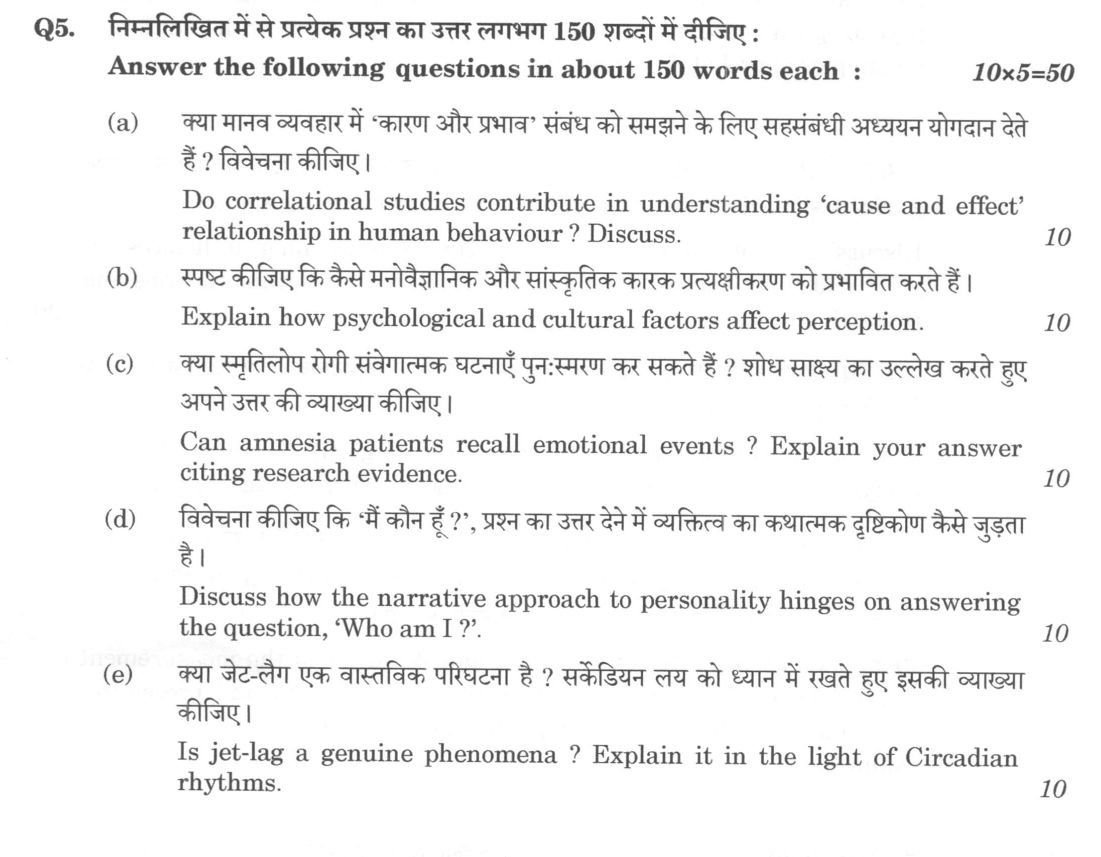
Answer the following questions in about 150 words each: (a) Do correlational studies contribute in understanding 'cause and…
Answer the following questions in about 150 words each:
Do correlational studies contribute in understanding 'cause and effect' relationship in human behaviour ? Discuss. 10 marks
Explain how psychological and cultural factors affect perception. 10 marks
Can amnesia patients recall emotional events ? Explain your answer citing research evidence. 10 marks
Discuss how the narrative approach to personality hinges on answering the question, 'Who am I ?'. 10 marks
Is jet-lag a genuine phenomena ? Explain it in the light of Circadian rhythms. 10 marks
हिंदी में प्रश्न पढ़ें
निम्नलिखित में से प्रत्येक प्रश्न का उत्तर लगभग 150 शब्दों में दीजिए :
क्या मानव व्यवहार में 'कारण और प्रभाव' संबंध को समझने के लिए सहसंबंधी अध्ययन योगदान देते हैं ? विवेचना कीजिए। (10 अंक)
स्पष्ट कीजिए कि कैसे मनोवैज्ञानिक और सांस्कृतिक कारक प्रत्यक्षीकरण को प्रभावित करते हैं। (10 अंक)
क्या स्मृतिलोप रोगी संवेगात्मक घटनाएँ पुनःस्मरण कर सकते हैं ? शोध साक्ष्य का उल्लेख करते हुए अपने उत्तर की व्याख्या कीजिए। (10 अंक)
विवेचना कीजिए कि 'मैं कौन हूँ ?', प्रश्न का उत्तर देने में व्यक्तित्व का कथात्मक दृष्टिकोण कैसे जुड़ता है। (10 अंक)
क्या जेट-लैग एक वास्तविक परिघटना है ? सर्केडियन लय को ध्यान में रखते हुए इसकी व्याख्या कीजिए। (10 अंक)
Model answer
Written by UPSC Answer Check against this question's marking rubric, to the 150-word length. UPSC does not publish answers for Mains — this is one way to score well, not an official key.
(a) Correlational studies Correlational studies can contribute to understanding cause and effect, but only indirectly. A correlation shows that two variables vary together; it does not by itself establish that one produces the other. The directionality problem remains: does unemployment cause depression, or does depression cause unemployment? The third-variable problem also matters: income, stress, or genetics may influence both. Nevertheless, correlation is valuable because it generates hypotheses, identifies risk factors, and is often the only ethical or practical method. Longitudinal designs, dose-response patterns, and control of confounds strengthen causal inference. The smoking–lung cancer link began with epidemiological correlations and was later supported by experimental and physiological evidence. In Indian public health, correlations between poverty, nutrition and mental health guide policy before trials are possible, especially where ethical review limits field experimentation. Thus, correlational studies do not prove causation alone, but they are indispensable for causal reasoning in human behaviour and public policy work.
(b) Psychological and cultural factors Perception is not a passive recording; it is shaped by psychological states and cultural learning. Psychological factors include perceptual set, motivation, needs, emotions and expectations. A hungry person may see food more readily; anxiety can sharpen threat detection. These top-down influences support Gregory’s constructivist view that perception uses hypotheses. Cultural factors show that even basic depth cues are not interpreted identically everywhere. Müller-Lyer illusion studies report weaker effects in some non-Western or rural groups, suggesting architectural and environmental learning. Hudson’s 1960 South African study, with African and European schoolchildren, found differences in pictorial depth perception, supporting Gibson’s emphasis on learned ecological experience. In India, exposure to crowded markets, road signs and religious iconography trains selective attention and pattern recognition. This makes perception both personal and socially learned in daily life. The debate between Gregory and Gibson is therefore not absolute: perception is biological, but its organisation is shaped by culture.
(c) Amnesia and emotional memory Amnesia patients often cannot consciously recall emotional events, yet emotional memory may survive in implicit forms. Explicit or declarative memory depends heavily on the hippocampus, while emotional learning and affective conditioning involve the amygdala. This amygdala–hippocampus dissociation explains why a patient may fail to report a frightening event but still show fear, avoidance or physiological arousal. Claparède’s pinprick study is classic: an amnesic patient, after being pricked, later flinched when his hand was approached, indicating unconscious emotional memory. Korsakoff patients similarly may not narrate the event accurately, but can display preserved emotional responses or implicit priming. Flashbulb memory research adds caution: emotional arousal can make memories vivid and confident, but vividness does not guarantee accurate explicit recall. In clinical settings, this distinction helps therapists work with trauma survivors who cannot verbalise experiences. Thus, amnesia does not erase all emotional memory; it mainly disrupts conscious, detailed recall and meaning over time.
(d) Narrative approach to personality The narrative approach treats personality as a story the person tells about himself or herself. The question “Who am I?” is central because identity is not only a list of traits; it is a meaningful account of one’s past, present and future. McAdams’ life story model organises personality into three levels: dispositional traits, characteristic adaptations, and the integrative life narrative. Traits describe what a person is like; adaptations describe how they cope; the narrative integrates these into a coherent self. In this view, answering “Who am I?” involves selecting events, assigning themes, and constructing a sense of continuity and purpose. Indian oral traditions, family life stories and community memories show that identity is often socially authored, not merely individual. It thus complements trait psychology by explaining why similar traits can produce different life meanings. The narrative approach is powerful because it captures meaning, but it must be balanced with behavioural and biological evidence.
(e) Jet-lag and circadian rhythms Jet-lag is a genuine phenomenon because the body contains internal clocks that do not instantly match a new time zone. The suprachiasmatic nucleus (SCN) in the hypothalamus acts as the master circadian pacemaker, regulating sleep, temperature, hormones and alertness over roughly 24 hours. Light is the main zeitgeber, or synchroniser, that entrains the SCN. Siffre’s cave studies showed that isolated humans maintain free-running rhythms, proving that circadian timing is endogenous. When travellers cross time zones, the SCN and peripheral clocks become misaligned. Eastward travel is usually harder because it requires phase advance, while westward travel requires phase delay and is often easier. Shift-work research shows similar disruption in workers whose schedules conflict with daylight. Melatonin, timed light exposure, and gradual schedule adjustment help adaptation. For Indian pilots, railway staff and shift workers, jet-lag is not imagined fatigue but a measurable circadian mismatch. It therefore has real health and safety consequences.
What "Discuss" is asking you to do
Lay the issue out from more than one side — how it arose, what is claimed for it, what is held against it, and where it now stands. UPSC attaches discuss to broad topics with several live dimensions, so coverage of the dimensions earns more than the strength of your opinion.
Structure that answers it
Set the issue up → the case as it is made → the case against → the dimension both sides leave out → where the balance now lies
Where marks are lost
Listing facts with no thread between them, or arguing one side throughout and calling it a discussion.
How this answer will be evaluated
Approach
Framework: Define > Theory or model > Evidence > Application. (a) discuss: intro > 3-4 dimensions > example > balanced close | (b) explain: definition/context > points in order > small example > short close | (c) explain: definition/context > points in order > small example > short close | (d) discuss: intro > 3-4 dimensions > example > balanced close | (e) explain: definition/context > points in order > small example > short close Full marks: Comprehensive, evidence-based, and well-structured answers with specific examples and theoretical depth.
Key points expected
- Define correlation and its statistical nature
- Explain the 'third variable' problem
- Discuss the directionality problem
- Mention experimental control as the alternative
- Define perception as an active process
- Explain psychological factors (expectancy, motivation)
- Explain cultural factors (acculturation, norms)
- Provide a specific example (e.g., Müller-Lyer illusion)
Evaluation rubric
Each sub-part is marked on its own, against the marks and word limit printed on the paper.
- (a) Evaluate the utility of correlational studies in establishing causality in human behaviour. 10 marks · 150 words
discuss— intro → 3-4 dimensions → example → balanced close
Must cover
- Define correlation and its statistical nature
- Explain the 'third variable' problem
- Discuss the directionality problem
- Mention experimental control as the alternative
Loses marks
- Confusing correlation with causation
- Ignoring the limitations of correlational data
Earns more
- Cite specific correlational studies (e.g., IQ and income)
- Mention partial correlation or regression
- Reference 'correlation does not imply causation' principle
Extra mark
- Mention specific statistical indices (Pearson's r)
- (b) Elucidate the role of psychological and cultural factors in shaping perception. 10 marks · 150 words
explain— definition/context → points in order → small example → short close
Must cover
- Define perception as an active process
- Explain psychological factors (expectancy, motivation)
- Explain cultural factors (acculturation, norms)
- Provide a specific example (e.g., Müller-Lyer illusion)
Loses marks
- Treating perception as purely passive reception
- Ignoring the interaction between factors
Earns more
- Mention Gestalt principles
- Reference specific cross-cultural studies
- Discuss top-down processing
Extra mark
- Name specific researchers (e.g., Dinesh D'Souza)
- (c) Assess the ability of amnesia patients to recall emotional events with evidence. 10 marks · 150 words
explain— definition/context → points in order → small example → short close
Must cover
- Define amnesia and its types
- Explain the role of the amygdala in emotional memory
- Cite specific research evidence (e.g., patient H.M.)
- Distinguish between declarative and procedural memory
Loses marks
- Generalizing without specific evidence
- Confusing amnesia with other memory disorders
Earns more
- Mention the role of the hippocampus
- Reference specific studies on emotional priming
- Discuss the 'flashbulb memory' concept
Extra mark
- Name specific patients (e.g., H.M., K.C.)
- (d) Analyze the narrative approach to personality through the 'Who am I?' question. 10 marks · 150 words
discuss— intro → 3-4 dimensions → example → balanced close
Must cover
- Define the narrative approach to personality
- Explain the concept of the 'self' as a story
- Discuss the role of identity in narrative
- Mention the 'Who am I?' question as a central theme
Loses marks
- Ignoring the narrative aspect of personality
- Treating personality as purely trait-based
Earns more
- Reference specific theorists (e.g., Dan McAdams)
- Discuss the 'life story' model
- Mention the role of culture in narrative
Extra mark
- Name specific narrative models (e.g., Redemptive narrative)
- (e) Explain jet-lag as a genuine phenomenon in the context of circadian rhythms. 10 marks · 150 words
explain— definition/context → points in order → small example → short close
Must cover
- Define jet-lag and its symptoms
- Explain the circadian rhythm system
- Describe the role of the suprachiasmatic nucleus (SCN)
- Explain the mechanism of circadian disruption
Loses marks
- Treating jet-lag as a psychological issue
- Ignoring the biological basis of circadian rhythms
Earns more
- Mention the role of melatonin
- Discuss the 'internal clock' concept
- Reference specific studies on jet-lag
Extra mark
- Name specific circadian genes (e.g., CLOCK, BMAL1)
Practice this exact question
Write your answer and it is marked point by point against the model answer above — what you covered, what you missed, what you got wrong.
Evaluate my answer →More from Psychology 2025 Paper I
- Q2 (a) 'Personality is all in our genes.' Evaluate the statement in the context of different…
- Q3 (a) Discuss the role of biological, cognitive and learning influences on gender identity…
- Q4 (a) Describe social cognitive theory and its applications to solve large scale societal p…
- Q5 Answer the following questions in about 150 words each: (a) Do correlational studies cont…
- Q6 (a) How would you justify the use of factor analysis in psychological research ? Answer w…
- Q7 (a) 'Motivation is a complex process and cannot be explained by a single approach.' Evalu…
- Q8 (a) Why do human beings form attitudes and prejudices ? Discuss the role of psychosocial…