Paper I — Q7
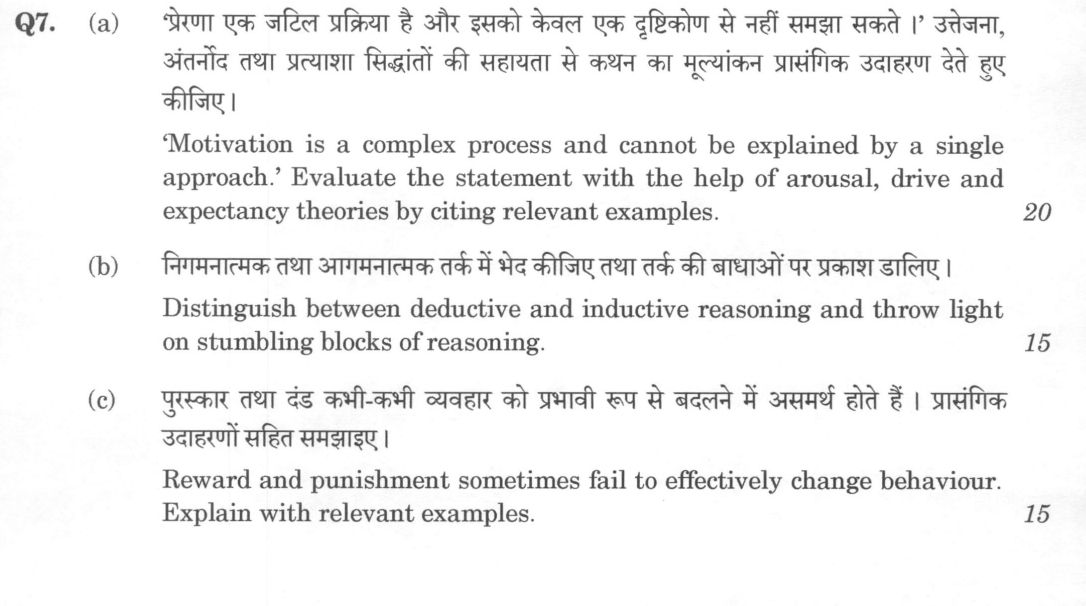
(a) 'Motivation is a complex process and cannot be explained by a single approach.' Evaluate the statement with the help of…
'Motivation is a complex process and cannot be explained by a single approach.' Evaluate the statement with the help of arousal, drive and expectancy theories by citing relevant examples. 20 marks
Distinguish between deductive and inductive reasoning and throw light on stumbling blocks of reasoning. 15 marks
Reward and punishment sometimes fail to effectively change behaviour. Explain with relevant examples. 15 marks
हिंदी में प्रश्न पढ़ें
'प्रेरणा एक जटिल प्रक्रिया है और इसको केवल एक दृष्टिकोण से नहीं समझा सकते।' उत्तेजना, अंतर्नोद तथा प्रत्याशा सिद्धांतों की सहायता से कथन का मूल्यांकन प्रासंगिक उदाहरण देते हुए कीजिए। (20 अंक)
निगमनात्मक तथा आगमनात्मक तर्क में भेद कीजिए तथा तर्क की बाधाओं पर प्रकाश डालिए। (15 अंक)
पुरस्कार तथा दंड कभी-कभी व्यवहार को प्रभावी रूप से बदलने में असमर्थ होते हैं। प्रासंगिक उदाहरणों सहित समझाइए। (15 अंक)
Model answer
Written by UPSC Answer Check against this question's marking rubric, to the expected length. UPSC does not publish answers for Mains — this is one way to score well, not an official key.
Complexity of Motivation: Evaluation of Theories
Human motivation is a multidimensional construct spanning biological homeostasis, neuro-physiological activation, and cognitive forecasting. Clark Hull’s Drive-Reduction Theory conceptualizes motivation as the reduction of biological tensions arising from tissue deficits (such as hunger or thirst) to restore homeostasis. While drive theory effectively accounts for primary survival needs, it fails to explain non-homeostatic, sensation-seeking behaviours such as mountaineering or aesthetic pursuits.
To explain such stimulation-seeking actions, Donald Hebb and the Yerkes-Dodson Law proposed the Arousal Theory, positing that individuals are motivated to maintain an optimal level of physiological arousal. For instance, in elite sports performance, such as an Olympic javelin thrower, moderate arousal optimizes motor coordination, whereas under-arousal causes lethargy and hyper-arousal leads to choking. Nonetheless, arousal theory remains largely biological and fails to address long-term, goal-directed human choices.
Victor Vroom’s Expectancy Theory fills this cognitive void by formulating motivation as a product of Expectancy, Instrumentality, and Valence (M = E × I × V), complemented by Julian Rotter’s concept of internal locus of control. An Indian civil services aspirant, for example, endures years of arduous study not due to biological drives, but because of a cognitive calculation: the belief that rigorous effort leads to selection (Expectancy) and that the administrative post fulfills their aspirations for public service and prestige (Valence).
Evaluatively, single-model approaches are inadequate. Drive theory explains biological restoration, arousal theory addresses physiological activation, and expectancy theory accounts for conscious, long-term decision-making. A holistic understanding necessitates an integrated paradigm.
Deductive vs. Inductive Reasoning and Stumbling Blocks
Deductive reasoning is a top-down logical process moving from universal premises to specific conclusions with absolute certainty; if the premises are true, the conclusion must be true (e.g., syllogisms such as: All IAS officers clear the UPSC exam; Priya is an IAS officer; therefore, Priya cleared the UPSC exam). Conversely, inductive reasoning is a bottom-up process that constructs probabilistic generalizations from specific empirical observations (e.g., observing regular monsoon arrivals in June to infer seasonal weather models), yielding conclusions that are probable rather than certain.
Reasoning is frequently derailed by cognitive stumbling blocks:
- Confirmation Bias and Belief Perseverance: Individuals selectively seek supportive evidence while ignoring contradictory facts, clinging to disproven ideas—evident in superstitious reasoning such as adhering to rahu-kaal or astrological compatibility (Kundali) despite contradictory outcomes.
- Mental Set: The tendency to persist in using previously successful problem-solving strategies even when they no longer apply.
- Availability Heuristic: Estimating event frequency based on how easily examples come to mind, such as overestimating the danger of flight travel relative to road transport.
- Framing Effects: Drawing different conclusions from the same information depending on how it is presented.
Failure of Reward and Punishment in Behavioural Modification
Operant conditioning principles frequently fail to produce enduring behavioural change due to psychological complexities.
Rewards fail primarily due to the overjustification effect, where external incentives erode intrinsic interest. In developmental initiatives like the PM POSHAN (Mid-Day Meal Scheme), free food significantly enhances attendance and enrollment, but fails to organically foster intrinsic academic engagement or curiosity. Furthermore, in token economies within Public Sector Undertakings (PSUs), performance bonuses often lead to temporary compliance; once incentives plateau or cease, productivity regresses because the behaviour was never internalized.
Punishment fails because it merely suppresses the unwanted behaviour temporarily without teaching desirable alternatives. It elicits negative emotional side-effects like conditioned fear and hostility, prompts escape or avoidance behaviours, and models aggression. Despite Section 17 of the Right to Education (RTE) Act, 2009 strictly prohibiting corporal punishment in Indian schools, punitive discipline historically resulted in student alienation, school phobia, and heightened defiance rather than genuine moral development.
In verdict, human action is not a mere product of mechanistic reinforcement or biological equilibrium. Lasting behavioural change and motivation require addressing intrinsic psychological needs, cognitive evaluations, and supportive socio-emotional environments alongside basic physiological mechanisms.
What "Evaluate" is asking you to do
Judge how well something has performed against the standard it set for itself — its stated aim, mandate or promise — and commit to a verdict. Name the yardstick before you judge; an unanchored judgement reads as opinion.
Structure that answers it
Name the yardstick — stated aim, mandate or benchmark → performance against it → shortfall against it → why the gap exists → verdict
Where marks are lost
Presenting both sides and then declining to decide, or delivering a verdict against a standard you never stated, which makes it look arbitrary.
How this answer will be evaluated
Approach
Framework: Psychology Paper 1 (UPSC). (a) evaluate: criteria > evidence > balanced judgment | (b) compare: paired headings or table > key differences > significance > conclusion | (c) explain: definition/context > points in order > small example > short close Full marks: Precise definitions, named studies, clear synthesis, and relevant examples for all parts.
Key points expected
- Define Arousal theory (Yerkes-Dodson) with example
- Define Drive theory (Hull) with example
- Define Expectancy theory (Vroom) with example
- Synthesize why no single theory explains all motivation
- Define deductive reasoning (general to specific)
- Define inductive reasoning (specific to general)
- List stumbling blocks (e.g., confirmation bias)
- Provide examples for both types
Evaluation rubric
Each sub-part is marked on its own, against the marks and word limit printed on the paper.
- (a) Critique the 'single approach' claim using Arousal, Drive, and Expectancy theories. 20 marks
evaluate— criteria → evidence → balanced judgment
Must cover
- Define Arousal theory (Yerkes-Dodson) with example
- Define Drive theory (Hull) with example
- Define Expectancy theory (Vroom) with example
- Synthesize why no single theory explains all motivation
Loses marks
- Defining theories without examples
- Treating theories as mutually exclusive
- Ignoring the 'complex process' aspect
Earns more
- Mention Maslow or Self-Determination as counterpoint
- Reference specific study (e.g., Deci & Ryan)
Extra mark
- Diagram of Yerkes-Dodson curve
- Mention of specific psychometric tool
- (b) Distinguish deductive/inductive reasoning and identify reasoning stumbling blocks. 15 marks
compare— paired headings or table → key differences → significance → conclusion
Must cover
- Define deductive reasoning (general to specific)
- Define inductive reasoning (specific to general)
- List stumbling blocks (e.g., confirmation bias)
- Provide examples for both types
Loses marks
- Confusing inductive with deductive
- Listing stumbling blocks without explanation
- Lack of concrete examples
Earns more
- Mention 'hasty generalization' or 'post hoc' fallacy
- Reference Wason's 2-4-6 task
Extra mark
- Table comparing the two types
- Mention of specific cognitive bias study
- (c) Explain why reward/punishment fails to change behavior with examples. 15 marks
explain— definition/context → points in order → small example → short close
Must cover
- Explain 'overjustification effect' (intrinsic vs extrinsic)
- Explain 'learned helplessness' or 'extinction'
- Provide relevant examples of failure
- Mention 'punishment' side effects (fear/resentment)
Loses marks
- Treating reward/punishment as always effective
- Ignoring the 'sometimes fail' aspect
- Lack of specific examples
Earns more
- Reference Skinner's operant conditioning
- Mention 'punishment' vs 'negative reinforcement'
Extra mark
- Reference specific study (e.g., Deci & Ryan)
- Mention of 'punishment' in Indian context
Practice this exact question
Write your answer and it is marked point by point against the model answer above — what you covered, what you missed, what you got wrong.
Evaluate my answer →More from Psychology 2025 Paper I
- Q4 (a) Describe social cognitive theory and its applications to solve large scale societal p…
- Q5 Answer the following questions in about 150 words each: (a) Do correlational studies cont…
- Q6 (a) How would you justify the use of factor analysis in psychological research ? Answer w…
- Q7 (a) 'Motivation is a complex process and cannot be explained by a single approach.' Evalu…
- Q8 (a) Why do human beings form attitudes and prejudices ? Discuss the role of psychosocial…