Paper I — Q8
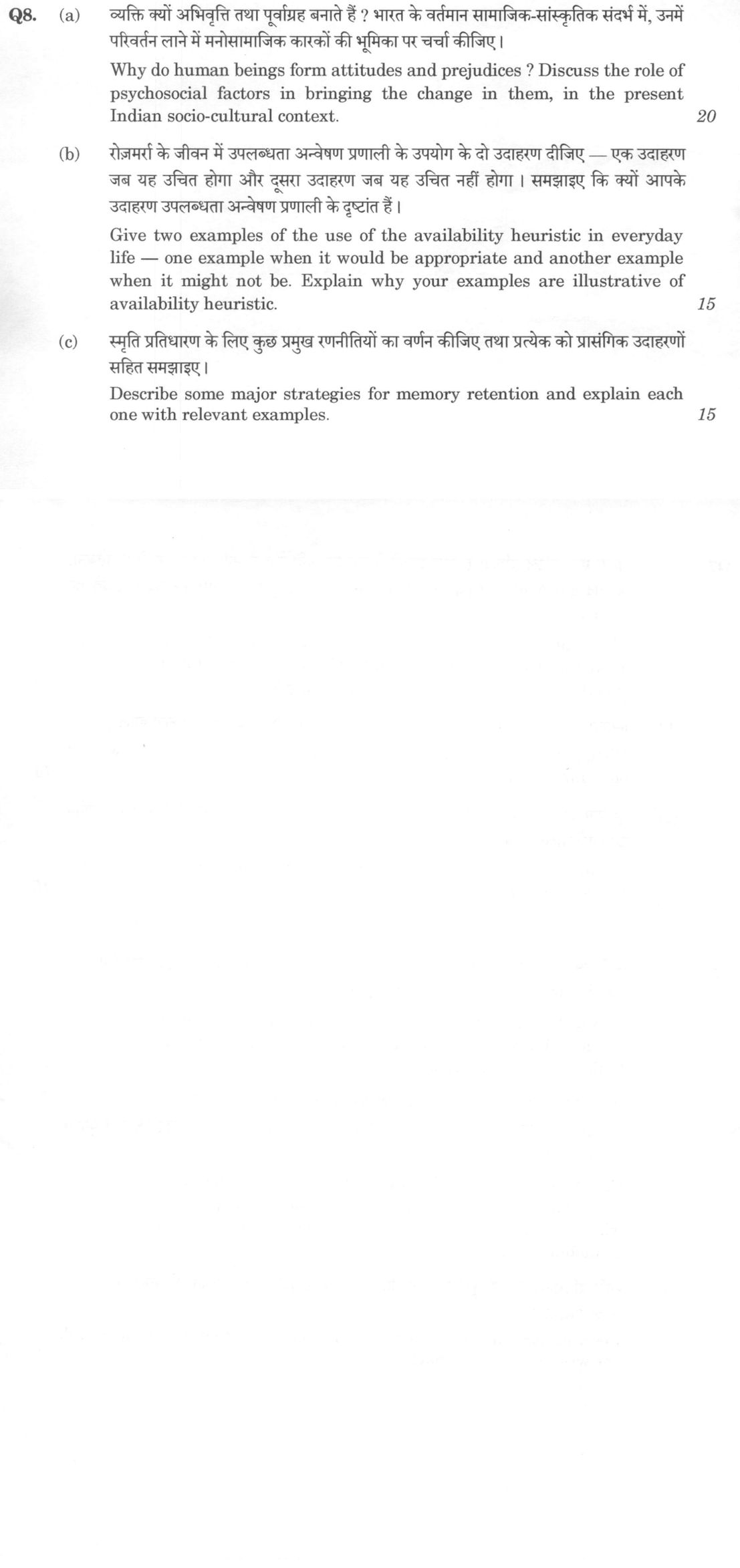
(a) Why do human beings form attitudes and prejudices ? Discuss the role of psychosocial factors in bringing the change in them…
Why do human beings form attitudes and prejudices ? Discuss the role of psychosocial factors in bringing the change in them, in the present Indian socio-cultural context. 20 marks
Give two examples of the use of the availability heuristic in everyday life — one example when it would be appropriate and another example when it might not be. Explain why your examples are illustrative of availability heuristic. 15 marks
Describe some major strategies for memory retention and explain each one with relevant examples. 15 marks
हिंदी में प्रश्न पढ़ें
व्यक्ति क्यों अभिवृत्ति तथा पूर्वाग्रह बनाते हैं ? भारत के वर्तमान सामाजिक-सांस्कृतिक संदर्भ में, उनमें परिवर्तन लाने में मनोसामाजिक कारकों की भूमिका पर चर्चा कीजिए। (20 अंक)
रोजमर्रा के जीवन में उपलब्धता अन्वेषण प्रणाली के उपयोग के दो उदाहरण दीजिए — एक उदाहरण जब यह उचित होगा और दूसरा उदाहरण जब यह उचित नहीं होगा। समझाइए कि क्यों आपके उदाहरण उपलब्धता अन्वेषण प्रणाली के दृष्टांत हैं। (15 अंक)
स्मृति प्रतिधारण के लिए कुछ प्रमुख रणनीतियों का वर्णन कीजिए तथा प्रत्येक को प्रासंगिक उदाहरणों सहित समझाइए। (15 अंक)
Model answer
Written by UPSC Answer Check against this question's marking rubric, to the expected length. UPSC does not publish answers for Mains — this is one way to score well, not an official key.
Formation of Attitudes and Prejudices
Attitudes serve vital psychological needs, as outlined in Daniel Katz’s functional theory. The knowledge function provides cognitive schemas to organize an ambiguous world; the utilitarian function maximizes social rewards and minimizes penalties; the value-expressive function communicates core self-identity; and the ego-defensive function protects the individual from internal anxieties and insecurities.
Prejudices—rigid, negative evaluations of out-groups—arise through both individual and social mechanisms. Henri Tajfel’s Social Identity Theory demonstrates that mere categorization into in-groups and out-groups fosters in-group favoritism and out-group derogation to bolster self-esteem. Muzafer Sherif’s Realistic Group Conflict Theory posits that prejudice intensifies when groups compete for zero-sum, scarce resources. Additionally, Theodor Adorno’s Authoritarian Personality model highlights how strict, punitive upbringing fosters generalized out-group hostility and rigid adherence to hierarchy.
Psychosocial Interventions in the Indian Context
Modifying entrenched attitudes in India requires multifaceted psychosocial strategies:
Education and Institutional Reform: Rights-based frameworks like the Right of Children to Free and Compulsory Education (RTE) Act foster inclusive classroom environments, attenuating caste- and class-based distance from an early age.
Intergroup Contact: Applying Gordon Allport’s Contact Hypothesis, cooperative contact between diverse communities in urban workplaces, universities, and self-help groups reduces prejudice, provided there is equal status, institutional support, and common goals.
Persuasive Communication and Social Movements: Large-scale behavior change campaigns, such as the Swachh Bharat Mission, leverage social norms and credible communicators to transform deep-rooted sanitation attitudes. Progressive regional and national cinema similarly challenges patriarchal and caste stereotypes.
Legislative Action: Enactments such as the Scheduled Castes and Scheduled Tribes (Prevention of Atrocities) Act provide a formal deterrent against discrimination, restructuring the normative framework of social interactions.
Digital Media Dynamics: While digital literacy campaigns aid attitude change, unmonitored digital platforms and viral WhatsApp forwards often exploit cognitive biases, reinforcing communal and regional prejudices.
The Availability Heuristic: Everyday Applications
Formulated by Amos Tversky and Daniel Kahneman, the availability heuristic is a cognitive shortcut whereby individuals judge the frequency, probability, or likelihood of an event based on how easily concrete instances come to mind.
Appropriate Everyday Example: An individual chooses to install flood barriers or avoid driving during severe weather after recently witnessing a localized urban flood. This application is appropriate because the rapid retrieval of recent, salient environmental cues accurately reflects immediate, local risk, prompting adaptive self-preservation.
Inappropriate Everyday Example: An individual develops an intense fear of air travel or overestimates violent crime rates after consuming graphic, 24-hour news coverage of a rare accident. This application is inappropriate because dramatic media exposure inflates subjective probability, leading the person to ignore low objective statistical base rates.
These examples illustrate the heuristic because judgments in both cases are driven by emotional vividness and cognitive ease of retrieval rather than statistical computation. In social settings, this heuristic often reinforces prejudices when vivid, negative anecdotes about an out-group are easily recalled.
Strategies for Memory Retention
Elaborative Encoding: Grounded in Fergus Craik and Robert Lockhart’s levels-of-processing framework, elaborative encoding links new information to existing knowledge structures. For instance, a student learns the concept of classical conditioning not by rote rehearsal, but by connecting Pavlov's stimulus-response pairing to personal experiences of training a pet dog.
The Method of Loci: A visual mnemonic technique that associates items to be remembered with specific landmarks along a well-known mental pathway. For example, an orator mentally places key speech arguments at successive locations in their home—the doorway, hallway, and living room—and retrieves them sequentially during delivery.
Spaced Repetition: Based on Hermann Ebbinghaus’s forgetting curve, distributing study sessions across expanding time intervals consolidates synaptic plasticity. For instance, revising factual syllabus modules at intervals of 1, 3, 7, and 21 days leads to far higher long-term retention than massed cramming.
Chunking: Organizing individual pieces of information into larger, meaningful perceptual units, in accordance with George Miller’s working memory capacity model. For example, memorizing a long numerical sequence by grouping twelve digits into three four-digit blocks reduces cognitive load and enhances recall.
Way Forward
Mitigating biased attitudes and cognitive errors demands an integrated approach. While heuristics like availability bias distort social perception, adopting metacognitive awareness, structured memory strategies, and critical media literacy enables deliberate, evidence-based reasoning, fostering social harmony in a pluralistic society.
What "Discuss" is asking you to do
Lay the issue out from more than one side — how it arose, what is claimed for it, what is held against it, and where it now stands. UPSC attaches discuss to broad topics with several live dimensions, so coverage of the dimensions earns more than the strength of your opinion.
Structure that answers it
Set the issue up → the case as it is made → the case against → the dimension both sides leave out → where the balance now lies
Where marks are lost
Listing facts with no thread between them, or arguing one side throughout and calling it a discussion.
How this answer will be evaluated
Approach
Framework: Psychology Paper 1: Define > Theory > Evidence > Application. (a) discuss: intro > 3-4 dimensions > example > balanced close | (b) explain: definition/context > points in order > small example > short close | (c) describe: define > structure or process in order > labelled diagram > significance Full marks: Comprehensive theoretical grounding, specific Indian context, clear examples, and strong evidence.
Key points expected
- Define attitude and prejudice (e.g., Allport, Tajfel)
- Theories of formation (e.g., Social Identity, Contact Hypothesis)
- Psychosocial factors in change (e.g., education, media, urbanization)
- Application to present Indian socio-cultural context
- Define availability heuristic (Tversky & Kahneman)
- Example 1: Appropriate use (e.g., recent news affecting risk)
- Example 2: Inappropriate use (e.g., overestimating rare events)
- Explanation of why each fits the heuristic
Evaluation rubric
Each sub-part is marked on its own, against the marks and word limit printed on the paper.
- (a) Explain formation of attitudes/prejudices and psychosocial change in Indian context. 20 marks
discuss— intro → 3-4 dimensions → example → balanced close
Must cover
- Define attitude and prejudice (e.g., Allport, Tajfel)
- Theories of formation (e.g., Social Identity, Contact Hypothesis)
- Psychosocial factors in change (e.g., education, media, urbanization)
- Application to present Indian socio-cultural context
Loses marks
- Generalizing without Indian context
- Confusing prejudice with discrimination
- Lack of theoretical framework
Earns more
- Mention of specific Indian studies or data
- Reference to caste/class dynamics in prejudice
- Discussion of cognitive vs affective components
- Balanced view on persistence vs change
Extra mark
- Citing specific Indian sociological surveys (e.g., NSSO)
- Reference to specific government initiatives (e.g., SC/ST acts)
- (b) Provide two examples of availability heuristic (appropriate/inappropriate) with explanation. 15 marks
explain— definition/context → points in order → small example → short close
Must cover
- Define availability heuristic (Tversky & Kahneman)
- Example 1: Appropriate use (e.g., recent news affecting risk)
- Example 2: Inappropriate use (e.g., overestimating rare events)
- Explanation of why each fits the heuristic
Loses marks
- Vague examples not clearly linked to heuristic
- Failing to distinguish appropriate vs inappropriate
- Confusing with other heuristics
Earns more
- Mention of 'vividness' or 'salience' as drivers
- Contrast with representativeness heuristic
- Real-world scenarios (e.g., plane crashes vs car accidents)
- Clear distinction between the two examples
Extra mark
- Citing Tversky & Kahneman (1973) study
- Reference to specific cognitive bias literature
- (c) Describe major memory retention strategies with relevant examples. 15 marks
describe— define → structure or process in order → labelled diagram → significance
Must cover
- Define memory retention
- Strategy 1: Elaborative encoding (e.g., mnemonics)
- Strategy 2: Spaced repetition (e.g., Ebbinghaus curve)
- Strategy 3: Chunking or organization (e.g., grouping)
Loses marks
- Listing strategies without explanation
- Lack of relevant examples
- Confusing retention with recall
Earns more
- Mention of Ebbinghaus forgetting curve
- Reference to cognitive load theory
- Practical examples (e.g., learning languages, exams)
- Distinction between short-term and long-term strategies
Extra mark
- Citing specific memory studies (e.g., Craik & Lockhart)
- Reference to specific mnemonic techniques (e.g., Method of Loci)
Practice this exact question
Write your answer and it is marked point by point against the model answer above — what you covered, what you missed, what you got wrong.
Evaluate my answer →More from Psychology 2025 Paper I
- Q5 Answer the following questions in about 150 words each: (a) Do correlational studies cont…
- Q6 (a) How would you justify the use of factor analysis in psychological research ? Answer w…
- Q7 (a) 'Motivation is a complex process and cannot be explained by a single approach.' Evalu…
- Q8 (a) Why do human beings form attitudes and prejudices ? Discuss the role of psychosocial…