Paper II — Q1
Answer the following questions in about 150 words each: (a) What are the different methods of estimating internal consistency…
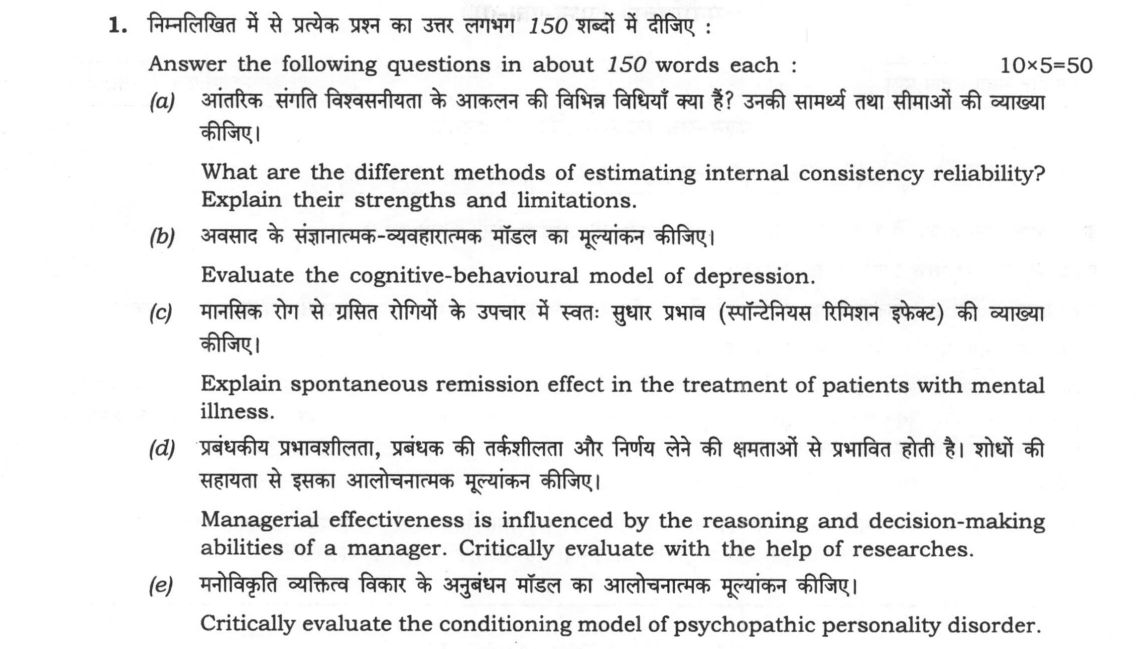
Answer the following questions in about 150 words each:
What are the different methods of estimating internal consistency reliability? Explain their strengths and limitations. 10 marks
Evaluate the cognitive-behavioural model of depression. 10 marks
Explain spontaneous remission effect in the treatment of patients with mental illness. 10 marks
Managerial effectiveness is influenced by the reasoning and decision-making abilities of a manager. Critically evaluate with the help of researches. 10 marks
Critically evaluate the conditioning model of psychopathic personality disorder. 10 marks
हिंदी में प्रश्न पढ़ें
निम्नलिखित में से प्रत्येक प्रश्न का उत्तर लगभग 150 शब्दों में दीजिए :
आंतरिक संगति विश्वसनीयता के आकलन की विभिन्न विधियाँ क्या हैं? उनकी सामर्थ्य तथा सीमाओं की व्याख्या कीजिए। (10 अंक)
अवसाद के संज्ञानात्मक-व्यवहारात्मक मॉडल का मूल्यांकन कीजिए। (10 अंक)
मानसिक रोग से ग्रस्त रोगियों के उपचार में स्वतः सुधार प्रभाव (स्पॉन्टेनियस रेमिशन इफेक्ट) की व्याख्या कीजिए। (10 अंक)
प्रबंधकीय प्रभावशीलता, प्रबंधक की तर्कशीलता और निर्णय लेने की क्षमताओं से प्रभावित होती है। शोधों की सहायता से इसका आलोचनात्मक मूल्यांकन कीजिए। (10 अंक)
मनोविकृति व्यक्तित्व विकार के अनुबंधन मॉडल का आलोचनात्मक मूल्यांकन कीजिए। (10 अंक)
Model answer
Written by UPSC Answer Check against this question's marking rubric, to the 150-word length. UPSC does not publish answers for Mains — this is one way to score well, not an official key.
(a) Methods of Estimating Internal Consistency Reliability
Internal consistency evaluates the degree to which items within a test measure the same construct. The primary methods include:
Split-Half Reliability involves dividing a test into equivalent halves (such as odd-even items). The correlation between the two halves is adjusted using the Spearman-Brown prophecy formula to estimate the reliability of the full-length test.
Kuder-Richardson Formulas evaluate inter-item consistency for dichotomously scored tests. KR-20 evaluates tests with varying item difficulties, whereas KR-21 provides a simplified estimate assuming equal item difficulty across all questions.
Cronbach’s Alpha represents the mathematical mean of all possible split-half coefficients. It is applicable to continuous and multi-point response scales, such as Likert scales.
The main strength of these methods is operational economy; they require only a single test administration, eliminating test-retest concerns such as carryover effects, subject attrition, and memory bias. However, their limitations are notable. They assume item homogeneity and unidimensionality (tau-equivalence). Furthermore, Cronbach’s alpha is sensitive to test length, producing inflated coefficients when redundant items are added. Thus, while indispensable for scale development, internal consistency must be interpreted alongside measures of structural validity.
(b) Evaluation of the Cognitive-Behavioural Model of Depression
Beck’s cognitive model posits that depression is driven by maladaptive schemas, systematic cognitive distortions, and the negative cognitive triad: negative views of the self, the world, and the future. This framework integrates Abramson’s reformulated learned helplessness model, which attributes depression to internal, stable, and global attributions for adverse life events.
Empirically, the model is supported by the therapeutic success of Cognitive Behavioural Therapy (CBT), which matches pharmacotherapy in acute unipolar depression and demonstrates lower relapse rates. Longitudinal studies also show that negative cognitive biases frequently precede depressive episodes.
However, the model has limitations. It does not fully explain endogenous, psychotic, or melancholic depressions, which are characterized by marked psychomotor disturbances and neurochemical abnormalities such as hypothalamic-pituitary-adrenal (HPA) axis dysregulation. Additionally, whether negative cognitions are etiological causes or epiphenomena of neurobiological dysfunction remains debated. Consequently, while CBT is a reliable and evidence-based psychological treatment, the cognitive-behavioural model serves as a partial explanation that requires integration with biological and genetic factors.
(c) Spontaneous Remission in Mental Illness
Spontaneous remission refers to the significant improvement or complete resolution of psychiatric symptoms without formal clinical intervention. Historically raised by Eysenck to evaluate the efficacy of psychoanalysis, remission rates vary across diagnostic categories. Spontaneous remission is common in adjustment disorders, mild-to-moderate anxiety, and unipolar depressive episodes (with recovery rates around 40–50% over one year), but rare in chronic conditions like schizophrenia and bipolar I disorder.
This phenomenon is distinct from the placebo effect, which involves psychological and neurobiological responses driven by expectancy and clinical rituals. Spontaneous remission instead reflects the natural episodic course of certain disorders, homeostatic biological adjustments, changes in environmental stressors, and informal social support.
Methodologically, spontaneous remission is a vital baseline in psychotherapeutic research. Because many patients recover naturally over time, efficacy cannot be inferred solely from pre- and post-treatment symptom reduction. It necessitates randomized controlled trials with waitlist or no-treatment control groups to verify that a therapy produces therapeutic change beyond the disorder's natural recovery trajectory.
(d) Managerial Effectiveness, Reasoning, and Decision-Making
Managerial effectiveness depends on cognitive capabilities, requiring a balance between rational-analytical reasoning and intuitive decision-making under uncertainty. As Simon noted in his bounded rationality framework, managers operate under cognitive and temporal limitations, relying on heuristics that can lead to systematic biases. The Vroom-Yetton-Jago normative model further demonstrates that effectiveness requires matching analytical decision structures to situational variables, such as decision significance and subordinate commitment.
Empirical studies demonstrate that reasoning operates within socio-cultural contexts. In India, T.V. Rao established that analytical decision-making produces optimal organizational results only when paired with a supportive human resource development climate. Similarly, J.B.P. Sinha’s Nurturant-Task (NT) leadership model shows that effective Indian managers blend structured task-oriented reasoning with personal nurturance, accommodating cultural expectations around hierarchy and dependency. Furthermore, emotional intelligence acts as a key moderator, preventing cognitive biases such as escalation of commitment. Thus, while analytical reasoning provides the necessary basis for organizational decisions, managerial effectiveness is ultimately determined by how well those decisions are adapted to human and contextual dynamics.
(e) Conditioning Model of Psychopathic Personality Disorder
Eysenck’s conditioning model explains psychopathic (antisocial) personality disorder as a failure of social conditioning. Due to inherited cortical under-arousal and autonomic hyporeactivity, individuals with psychopathy are hypothesized to have difficulty acquiring conditioned fear responses, leading to deficits in passive avoidance learning and a failure to internalize social norms.
Empirically, Lykken’s classical experiments supported this model by demonstrating that psychopathic individuals exhibited diminished galvanic skin responses (GSR) to conditioned aversive stimuli and struggled with punishment-based avoidance tasks. Robert Hare’s research using the Psychopathy Checklist-Revised (PCL-R) confirmed affective and autonomic hypo-responsiveness to distress cues and threats.
However, the conditioning model has theoretical limitations. Newman’s response modulation hypothesis suggests that psychopaths can process punishment cues when these cues are central to their primary focus of attention, indicating an attentional allocation issue rather than a total conditioning deficit. Moreover, modern neuroimaging highlights structural and functional abnormalities within the amygdala-orbitofrontal circuit, pointing to broader neurodevelopmental impairments. In conclusion, while the conditioning model explains autonomic under-arousal and impaired passive avoidance, psychopathy is more accurately understood as a multi-system neurocognitive disorder rather than a simple failure of conditioning.
What "Critically evaluate" is asking you to do
Judge how well something has performed against the standard it set for itself — its stated aim, mandate or promise — and commit to a verdict. Name the yardstick before you judge; an unanchored judgement reads as opinion. “Critically” is not a section added at the end: name the yardstick you are judging by — the evidence, the stated objective, a constitutional principle, a rival explanation — and let a verdict close each part of the body. Where the question quotes a claim, that verdict must land on the claim itself, accepted, qualified or rejected, and not on the theme in general.
Structure that answers it
Name the yardstick — stated aim, mandate or benchmark → performance against it → shortfall against it → why the gap exists → verdict
Where marks are lost
Merits in one paragraph, demerits in the next, and a conclusion calling for a balanced and holistic approach. That is a survey with the judgement left out and it holds the answer in the middle band. The opposite error is reading “critically” as permission to attack — and with the odd pairings, critically describe or critically explain, the exposition still carries most of the marks, the judgement being a layer on it rather than a substitute for it.
How this answer will be evaluated
Approach
Framework: Psychology Paper II: Define > Theory/Model > Evidence > Application. (a) explain: definition/context > points in order > small example > short close | (b) evaluate: criteria > evidence > balanced judgment | (c) explain: definition/context > points in order > small example > short close | (d) critically evaluate: positives > negatives/limits > conditions/safeguards > conclusion | (e) critically evaluate: positives > negatives/limits > conditions/safeguards > conclusion Full marks: Comprehensive coverage with named studies, balanced evaluation, and clear application
Key points expected
- Define internal consistency reliability
- Name Split-Half (Spearman-Brown) method
- Name Cronbach's Alpha method
- Discuss strengths and limitations of methods
- Explain core concepts (e.g., Beck's triad)
- Present evidence supporting the model
- Discuss limitations or criticisms
- Provide balanced judgment
Evaluation rubric
Each sub-part is marked on its own, against the marks and word limit printed on the paper.
- (a) List methods of internal consistency reliability and evaluate their strengths/limitations. · 150 words
explain— definition/context → points in order → small example → short close
Must cover
- Define internal consistency reliability
- Name Split-Half (Spearman-Brown) method
- Name Cronbach's Alpha method
- Discuss strengths and limitations of methods
Loses marks
- Confusing internal consistency with test-retest
- Listing methods without evaluation
Earns more
- Mention Kuder-Richardson formula
- Reference specific psychometric tools
- Compare methods in a table
Extra mark
- Cite specific study on reliability estimation
- (b) Critically assess the cognitive-behavioural model of depression. · 150 words
evaluate— criteria → evidence → balanced judgment
Must cover
- Explain core concepts (e.g., Beck's triad)
- Present evidence supporting the model
- Discuss limitations or criticisms
- Provide balanced judgment
Loses marks
- Describing model without evaluation
- Ignoring limitations
Earns more
- Mention Beck's Cognitive Triad
- Reference specific CBT studies
- Compare with other models
Extra mark
- Name specific CBT intervention study
- (c) Explain spontaneous remission effect in mental illness treatment. · 150 words
explain— definition/context → points in order → small example → short close
Must cover
- Define spontaneous remission
- Explain its role in treatment context
- Provide examples or evidence
- Discuss implications for treatment
Loses marks
- Confusing with placebo effect
- Lack of specific examples
Earns more
- Mention specific disorders (e.g., schizophrenia)
- Reference relevant studies
- Discuss placebo effect connection
Extra mark
- Cite specific study on remission rates
- (d) Evaluate how reasoning/decision-making affects managerial effectiveness. · 150 words
critically evaluate— positives → negatives/limits → conditions/safeguards → conclusion
Must cover
- Link reasoning to managerial effectiveness
- Present research evidence
- Discuss limitations of current research
- Provide critical judgment
Loses marks
- General statements without research
- Ignoring critical evaluation
Earns more
- Mention specific decision-making models
- Reference organizational psychology studies
- Apply to Indian work context
Extra mark
- Name specific managerial effectiveness study
- (e) Critically assess the conditioning model of psychopathic personality. · 150 words
critically evaluate— positives → negatives/limits → conditions/safeguards → conclusion
Must cover
- Explain conditioning model basics
- Present evidence for the model
- Discuss limitations/criticisms
- Provide critical judgment
Loses marks
- Describing model without critique
- Ignoring empirical evidence
Earns more
- Mention specific conditioning principles
- Reference psychopathy research
- Compare with other models
Extra mark
- Name specific psychopathy study
Practice this exact question
Write your answer and it is marked point by point against the model answer above — what you covered, what you missed, what you got wrong.
Evaluate my answer →More from Psychology 2025 Paper II
- Q1 Answer the following questions in about 150 words each: (a) What are the different method…
- Q2 (a) What are the factors that determine the efficacy of psychological tests? Discuss the…
- Q3 (a) What are the personality qualities to be focused on, for preparing community members…
- Q4 (a) Provide a community-based model for organizing services for rehabilitation of mentall…