Paper II — Q4
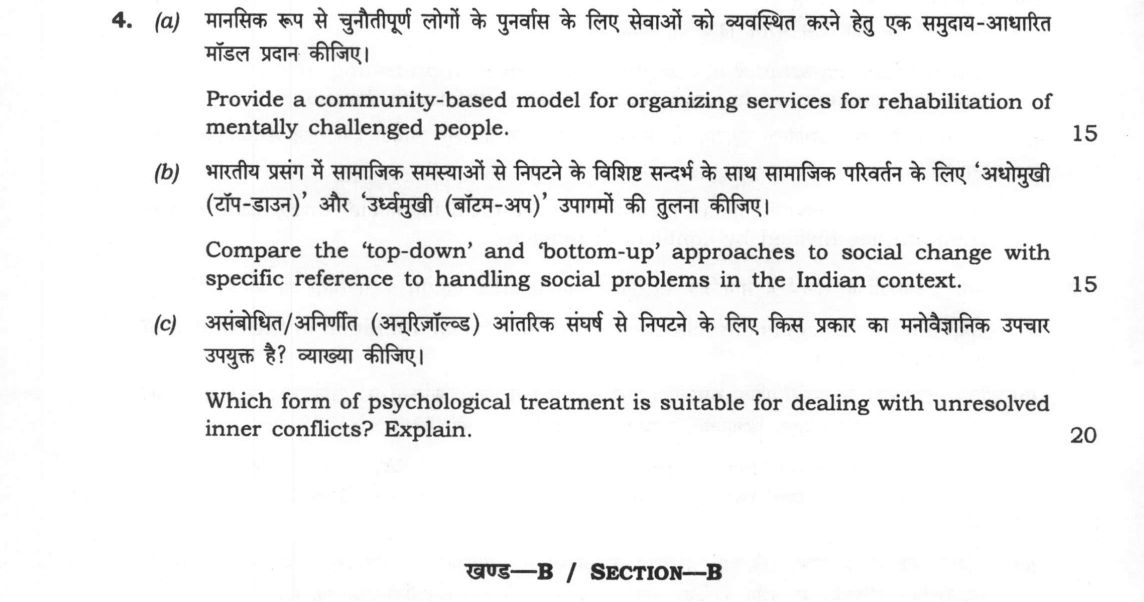
(a) Provide a community-based model for organizing services for rehabilitation of mentally challenged people. (15 marks) (b)…
Provide a community-based model for organizing services for rehabilitation of mentally challenged people. 15 marks
Compare the 'top-down' and 'bottom-up' approaches to social change with specific reference to handling social problems in the Indian context. 15 marks
Which form of psychological treatment is suitable for dealing with unresolved inner conflicts? Explain. 20 marks
हिंदी में प्रश्न पढ़ें
मानसिक रूप से चुनौतीपूर्ण लोगों के पुनर्वास के लिए सेवाओं को व्यवस्थित करने हेतु एक समुदाय-आधारित मॉडल प्रदान कीजिए। (15 अंक)
भारतीय प्रसंग में सामाजिक समस्याओं से निपटने के विशिष्ट संदर्भ के साथ सामाजिक परिवर्तन के लिए 'अधोमुखी (टॉप-डाउन)' और 'ऊर्ध्वमुखी (बॉटम-अप)' उपागमों की तुलना कीजिए। (15 अंक)
असंबोधित/अनिर्णीत (अनरिज़ॉल्व्ड) आंतरिक संघर्ष से निपटने के लिए किस प्रकार का मनोवैज्ञानिक उपचार उपयुक्त है? व्याख्या कीजिए। (20 अंक)
Model answer
Written by UPSC Answer Check against this question's marking rubric, to the expected length. UPSC does not publish answers for Mains — this is one way to score well, not an official key.
Community-Based Rehabilitation for Mentally Challenged Individuals
Community-Based Rehabilitation (CBR), aligned with the WHO CBR matrix and India’s District Mental Health Programme (DMHP), provides a decentralized framework to rehabilitate intellectually and developmentally challenged individuals within their primary social ecology. The model operates across four core functional components: early screening and developmental assessment at Primary Health Centres (PHCs), home-based daily living and sensory-motor intervention, vocational and life-skills training for economic inclusion, and rights advocacy to reduce structural barriers. Multi-sectoral collaboration is central to this model: Accredited Social Health Activists (ASHAs) and multipurpose CBR workers conduct door-to-door identification and family counselling; Panchayati Raj Institutions (PRIs) mobilize local funds and infrastructure; mainstream schools deploy special resource teachers for Individualized Education Programs (IEPs); and apex centers like NIMHANS deliver tele-mentoring, caregiver training, and tertiary referral linkages. By decentralizing therapeutic care to the family and village level, the model minimizes institutionalization and promotes self-reliance.
Top-Down versus Bottom-Up Approaches to Social Change in India
Addressing systemic social problems in the Indian context necessitates evaluating macro-policy and micro-participatory methodologies. The top-down approach is state-led, legislation-driven, and executed through bureaucratic administration. Examples include the Mental Healthcare Act 2017 and the Swachh Bharat Mission. Its strength lies in nationwide scalability, standard-setting, and rapid mobilization of public finance; however, its rigidity often leads to implementation gaps, procedural delays, and a lack of local contextualization.
Conversely, the bottom-up approach relies on grassroots mobilization, conscientization, and community ownership, as demonstrated by the Self Employed Women’s Association (SEWA), the Mazdoor Kisan Shakti Sangathan (MKSS), and village-level mental health volunteer groups. This method excels in building cultural acceptability, sustaining long-term behavioral change, and dismantling localized norms such as domestic violence and psychiatric stigma. However, it faces challenges in horizontal scalability and sustained resource availability. In tackling social problems like substance abuse, a top-down legislative framework (e.g., the NDPS Act) provides the regulatory baseline, but bottom-up community vigilance, family support, and peer de-addiction networks are essential for sustainable social reintegration.
Psychological Treatment for Unresolved Inner Conflicts
Psychoanalytic and psychodynamic psychotherapy is the primary treatment of choice for resolving deep-seated inner conflicts. Under Sigmund Freud’s structural model of personality, unresolved inner conflicts stem from intrapsychic friction among the instinctual drives of the Id, the moral and normative demands of the Superego, and the reality-mediating functions of the Ego. When the ego’s defense mechanisms—such as repression, reaction formation, or displacement—fail to balance these competing forces, the repressed impulses remain active in the unconscious, producing chronic free-floating anxiety, somatic symptoms, or maladaptive relationship patterns.
The therapeutic mechanism works by making unconscious material conscious, allowing the client to achieve affective and cognitive insight. Treatment utilizes free association and dream analysis to bypass conscious ego defenses and access repressed material. As therapy progresses, the client develops transference, projecting unconscious childhood conflicts, unresolved attachment dynamics, and repressed feelings regarding significant figures onto the therapist. The therapist provides neutral, timed interpretations of transference and underlying resistance. Through the subsequent process of 'working through,' the client repeatedly re-examines these unconscious patterns across daily contexts, integrates previously repressed impulses, and restructures ego defenses into mature coping strategies.
While Cognitive Behavioral Therapy (CBT) modifies conscious, maladaptive cognitions and Humanistic Therapy emphasizes unconditional positive self-regard, neither directly resolves unconscious intrapsychic structural conflicts. Contemporary adaptations like Brief Psychodynamic Therapy and Mentalization-Based Therapy (MBT) offer focused, empirically validated interventions, though severe psychopathology requires integrating psychodynamic therapy with pharmacotherapy for stabilization.
Sustainable human development requires bridging individual inner restructuring through psychodynamic insight with community-based, bottom-up rehabilitation models that sustain psychosocial well-being within the broader social system.
What "Explain" is asking you to do
Make the working of something clear — what sets it off, what follows from what, and what it produces. Explain is the Commission's mechanism word: it dominates the technical papers and the “explain why” stems, where the marks sit in the causal chain and not in the label.
Structure that answers it
State what it is → the initiating condition → the chain of cause, step by step → an instance where it plays out → what the chain produces
Where marks are lost
Describing what something looks like instead of why it works that way. Naming the stages without linking them reads as description too.
How this answer will be evaluated
Approach
(a) describe: define > structure or process in order > labelled diagram > significance | (b) compare: paired headings or table > key differences > significance > conclusion | (c) explain: definition/context > points in order > small example > short close Full marks: Comprehensive, well-structured answers with specific Indian examples, named theories, and clear diagrams where appropriate.
Key points expected
- Define community-based rehabilitation (CBR) principles
- Identify key stakeholders (family, ASHA, NGOs, govt)
- Outline service delivery levels (primary, secondary, tertiary)
- Describe specific rehabilitation activities (vocational, social)
- Define top-down approach (state-led, policy-driven)
- Define bottom-up approach (grassroots, community-led)
- Provide specific Indian examples for each (e.g., Green Revolution vs. Self-Help Groups)
- Evaluate effectiveness of each in handling social problems
Evaluation rubric
Each sub-part is marked on its own, against the marks and word limit printed on the paper.
- (a) A structured community-based model for rehabilitating mentally challenged people. 15 marks
describe— define → structure or process in order → labelled diagram → significance
Must cover
- Define community-based rehabilitation (CBR) principles
- Identify key stakeholders (family, ASHA, NGOs, govt)
- Outline service delivery levels (primary, secondary, tertiary)
- Describe specific rehabilitation activities (vocational, social)
Loses marks
- Focusing only on hospital-based care
- Ignoring the role of the family
- Vague generalities without specific service types
Earns more
- Reference to National Mental Health Programme (NMHP)
- Mention of specific schemes (e.g., Swasth Bharat)
- Diagram of the service delivery hierarchy
- Discussion of de-institutionalization
Extra mark
- Citation of specific WHO CBR guidelines
- Reference to specific state-level CBR initiatives
- (b) Comparison of top-down and bottom-up social change in the Indian context. 15 marks
compare— paired headings or table → key differences → significance → conclusion
Must cover
- Define top-down approach (state-led, policy-driven)
- Define bottom-up approach (grassroots, community-led)
- Provide specific Indian examples for each (e.g., Green Revolution vs. Self-Help Groups)
- Evaluate effectiveness of each in handling social problems
Loses marks
- Defining approaches without Indian context
- Treating the two approaches as mutually exclusive
- Lack of specific examples
Earns more
- Reference to specific Indian social movements
- Discussion of the role of NGOs in bottom-up change
- Mention of specific government schemes (e.g., MGNREGA)
- Analysis of the limitations of each approach
Extra mark
- Reference to specific sociological theories of social change
- Citation of specific data on scheme effectiveness
- (c) Explanation of the suitable psychological treatment for unresolved inner conflicts. 20 marks
explain— definition/context → points in order → small example → short close
Must cover
- Identify Psychoanalysis/Psychodynamic therapy as the suitable treatment
- Explain the concept of 'unresolved inner conflicts' (e.g., id-ego-superego)
- Describe key techniques (free association, dream analysis, transference)
- Explain the mechanism of how these techniques resolve conflicts
Loses marks
- Suggesting CBT or behavioral therapy as primary treatment
- Failing to explain the mechanism of conflict resolution
- Vague description of therapy without specific techniques
Earns more
- Reference to Freud's structural model of personality
- Mention of specific defense mechanisms
- Discussion of the therapeutic relationship
- Comparison with other therapies (e.g., CBT)
Extra mark
- Reference to specific case studies (e.g., Little Hans)
- Mention of modern psychodynamic approaches
Practice this exact question
Write your answer and it is marked point by point against the model answer above — what you covered, what you missed, what you got wrong.
Evaluate my answer →More from Psychology 2025 Paper II
- Q1 Answer the following questions in about 150 words each: (a) What are the different method…
- Q2 (a) What are the factors that determine the efficacy of psychological tests? Discuss the…
- Q3 (a) What are the personality qualities to be focused on, for preparing community members…
- Q4 (a) Provide a community-based model for organizing services for rehabilitation of mentall…
- Q5 Answer the following questions in about 150 words each: (a) What are the cultural consequ…
- Q6 (a) Discuss the psychological consequences of prolonged deprivation. What strategies can…
- Q7 (a) Explain the concepts of social facilitation and social inhibition in the context of g…