Paper II — Q3
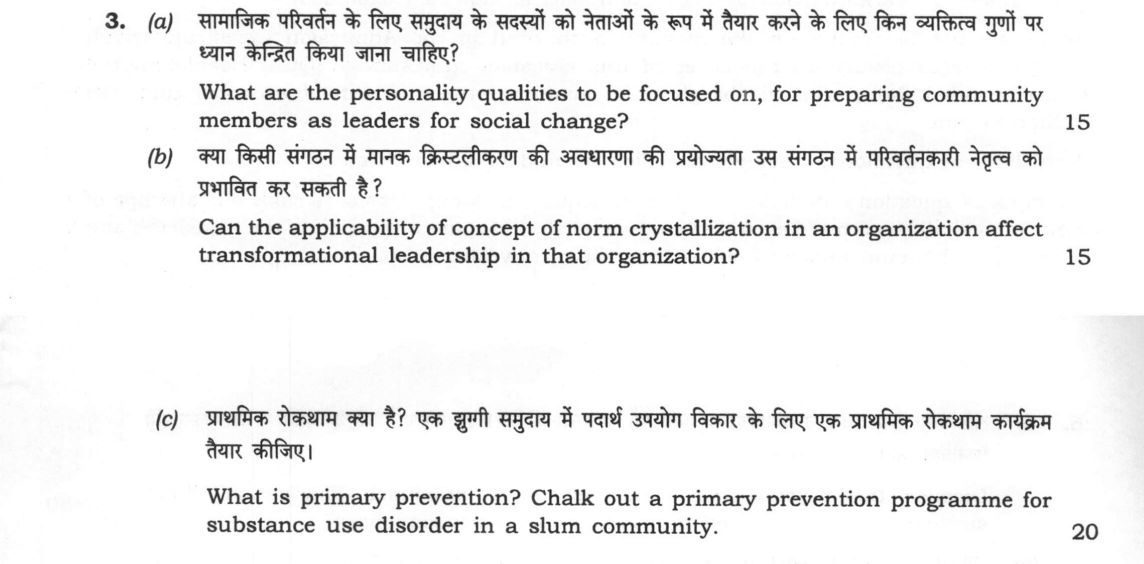
(a) What are the personality qualities to be focused on, for preparing community members as leaders for social change? (15…
What are the personality qualities to be focused on, for preparing community members as leaders for social change? 15 marks
Can the applicability of concept of norm crystallization in an organization affect transformational leadership in that organization? 15 marks
What is primary prevention? Chalk out a primary prevention programme for substance use disorder in a slum community. 20 marks
हिंदी में प्रश्न पढ़ें
सामाजिक परिवर्तन के लिए समुदाय के सदस्यों को नेताओं के रूप में तैयार करने के लिए किन व्यक्तित्व गुणों पर ध्यान केंद्रित किया जाना चाहिए? (15 अंक)
क्या किसी संगठन में मानक क्रिस्टलीकरण की अवधारणा की प्रयोज्यता उस संगठन में परिवर्तनकारी नेतृत्व को प्रभावित कर सकती है? (15 अंक)
प्राथमिक रोकथाम क्या है? एक झुग्गी समुदाय में पदार्थ उपयोग विकार के लिए एक प्राथमिक रोकथाम कार्यक्रम तैयार कीजिए। (20 अंक)
Model answer
Written by UPSC Answer Check against this question's marking rubric, to the expected length. UPSC does not publish answers for Mains — this is one way to score well, not an official key.
Personality Qualities for Community Leadership in Social Change
Preparing grassroots community members as change agents requires cultivating specific, trainable psychological attributes rather than relying on conventional charismatic traits. Grounded in Costa and McCrae’s Five-Factor Model, high Openness to Experience fosters adaptive problem-solving and receptivity to novel social practices; Conscientiousness ensures task persistence and organizational accountability; while Agreeableness facilitates inter-group trust and consensus-building. Furthermore, Goleman’s emotional intelligence framework—particularly empathy and self-regulation—enables emerging leaders to navigate community grievances and resolve interpersonal friction constructively.
According to Bandura’s Social Cognitive Theory, developing self-efficacy and collective efficacy is vital: it empowers marginalized individuals to overcome learned helplessness and believe in their agency to execute social transformation. A prosocial orientation, rooted in altruism and equity, ensures sustained dedication to public welfare. Unlike top-down transformational leaders who often rely on centralized charisma and individualized consideration, community-level social change demands distributed leadership qualities. As highlighted in Julian Rappaport’s community psychology model, distributed leadership requires relational humility, participatory decision-making, and deep contextual embeddedness, allowing power to be shared rather than concentrated.
Norm Crystallization and Transformational Leadership
Norm crystallization, rooted in Muzafer Sherif’s social norm formation and Thibaut and Kelley’s social exchange framework, describes the degree of consensus, clarity, and structural consistency regarding behavioral expectations within a group. It develops through social convergence, polarization of shared attitudes, and the stabilization of collective standards over time.
The relationship between norm crystallization and Bass’s transformational leadership is bidirectional. When norms are moderately crystallized, transformational leaders can more effectively articulate an inspiring shared vision and exercise idealized influence, as followers already share a coherent cognitive baseline. Conversely, transformational leaders actively accelerate and reshape norm crystallization by communicating core organizational values through inspirational motivation, thereby aligning individual behavior with institutional goals.
However, a functional tension emerges when norms become over-crystallized. Excessive crystallization fosters dogmatic rigidity, behavioral conformity, and groupthink. In such environments, the crystallized norms actively resist intellectual stimulation—a core dimension of transformational leadership—because followers perceive critical questioning and innovation as norm violations, thereby impeding organizational adaptability.
Primary Prevention Programme for Substance Use in Slums
Primary prevention refers to proactive, population-level strategies implemented prior to the biological or psychological onset of a disorder. Unlike secondary prevention, which focuses on early detection and screening of early-stage use, or tertiary prevention, which involves clinical rehabilitation and harm reduction, primary prevention eliminates environmental risk factors and enhances psychosocial resilience across universal and selective populations.
To address Substance Use Disorder (SUD) in an urban slum, a community-based programme aligned with the Nasha Mukt Bharat Abhiyaan (NMBA) and NIDA principles involves five integrated components.
First, a participatory needs assessment maps local risk ecologies, such as unregulated supply points and peer networks, using community-based participatory research. Local youth clubs, Mahila Mandals, and Anganwadi workers are mobilized as frontline peer leaders to ensure cultural congruence.
Second, life skills training based on the WHO framework is integrated into local community centres. These modules deliver experiential training in assertiveness, refusal skills against peer pressure, stress management, and emotional coping mechanisms.
Third, structural alternative activities are created to offer constructive engagement. Substance-free youth hubs, sports leagues, and vocational skill workshops provide healthy avenues for sensation-seeking and foster mastery experiences.
Fourth, family and school-based interventions strengthen protective socio-ecological buffers. Parenting workshops focus on mitigating family conflict, preventing neglect, and enhancing parent-child communication, while local schools implement positive school-climate interventions.
Fifth, programme evaluation utilizes standardized resilience scales (such as the Connor-Davidson Resilience Scale), tracking substance initiation rates across longitudinal cohorts and measuring retention in educational or vocational tracks.
Community-level transformation relies on cultivating distributed grassroots competencies, aligning organizational norms with an adaptive vision, and instituting multi-layered primary prevention frameworks that alter structural risk ecologies before maladaptive patterns take root.
What "Explain" is asking you to do
Make the working of something clear — what sets it off, what follows from what, and what it produces. Explain is the Commission's mechanism word: it dominates the technical papers and the “explain why” stems, where the marks sit in the causal chain and not in the label.
Structure that answers it
State what it is → the initiating condition → the chain of cause, step by step → an instance where it plays out → what the chain produces
Where marks are lost
Describing what something looks like instead of why it works that way. Naming the stages without linking them reads as description too.
How this answer will be evaluated
Approach
Framework: Community Psychology & Organizational Behavior. (a) highlight: name the salient points > one line of substance each > close | (b) examine: intro > how/why with reasoning > evidence > conclusion | (c) describe: define > structure or process in order > labelled diagram > significance Full marks: Precise definitions, strong theoretical links, and highly specific, context-appropriate examples.
Key points expected
- Define social change leadership in community context
- List 4-5 core traits (e.g., empathy, resilience, assertiveness)
- Link traits to specific leadership functions (mobilization, conflict resolution)
- Mention role of self-efficacy or locus of control
- Define norm crystallization (rigidity of established norms)
- Define transformational leadership (vision, inspiration, change)
- Explain the conflict: rigid norms vs. need for change
- Discuss how crystallization limits leader's ability to innovate
Evaluation rubric
Each sub-part is marked on its own, against the marks and word limit printed on the paper.
- (a) Identify and explain personality traits essential for community leadership in social change. 15 marks
highlight— name the salient points → one line of substance each → close
Must cover
- Define social change leadership in community context
- List 4-5 core traits (e.g., empathy, resilience, assertiveness)
- Link traits to specific leadership functions (mobilization, conflict resolution)
- Mention role of self-efficacy or locus of control
Loses marks
- Generic personality lists without social change context
- Confusing leadership with management skills
- Lack of connection between trait and outcome
Earns more
- Reference to specific leadership models (e.g., transformational)
- Mention of psychometric tools for trait assessment
- Contextualization to Indian community dynamics
Extra mark
- Citing a specific study on community leader traits
- Diagram of leadership trait hierarchy
- (b) Analyze the impact of norm crystallization on transformational leadership within an organization. 15 marks
examine— intro → how/why with reasoning → evidence → conclusion
Must cover
- Define norm crystallization (rigidity of established norms)
- Define transformational leadership (vision, inspiration, change)
- Explain the conflict: rigid norms vs. need for change
- Discuss how crystallization limits leader's ability to innovate
Loses marks
- Defining terms incorrectly or vaguely
- Ignoring the 'crystallization' aspect (treating as general norms)
- Failing to link the two concepts causally
Earns more
- Reference to organizational culture theories
- Example of a company resisting change due to norms
- Discussion of 'unfreezing' as a counter-measure
Extra mark
- Citing a specific case study of failed transformation
- Reference to Schein's model of organizational culture
- (c) Define primary prevention and design a specific programme for substance use in a slum. 20 marks
describe— define → structure or process in order → labelled diagram → significance
Must cover
- Define primary prevention (pre-empting disorder before onset)
- Identify target population (slum community, e.g., youth)
- Outline specific programme components (education, skill building, community engagement)
- Specify implementation strategy (who delivers, where, how)
Loses marks
- Confusing primary with secondary/tertiary prevention
- Vague programme ideas (e.g., 'just educate them')
- Ignoring the specific 'slum community' context
Earns more
- Inclusion of 'universal' vs 'selective' prevention strategies
- Mention of specific risk factors in slums (poverty, peer pressure)
- Inclusion of evaluation metrics for the programme
Extra mark
- Reference to a specific government scheme (e.g., NCDP)
- Detailed budget or timeline for the programme
Practice this exact question
Write your answer and it is marked point by point against the model answer above — what you covered, what you missed, what you got wrong.
Evaluate my answer →More from Psychology 2025 Paper II
- Q1 Answer the following questions in about 150 words each: (a) What are the different method…
- Q2 (a) What are the factors that determine the efficacy of psychological tests? Discuss the…
- Q3 (a) What are the personality qualities to be focused on, for preparing community members…
- Q4 (a) Provide a community-based model for organizing services for rehabilitation of mentall…
- Q5 Answer the following questions in about 150 words each: (a) What are the cultural consequ…
- Q6 (a) Discuss the psychological consequences of prolonged deprivation. What strategies can…