Paper II — Q5
Answer the following questions in about 150 words each: (a) What are the cultural consequences of being disadvantaged and how…
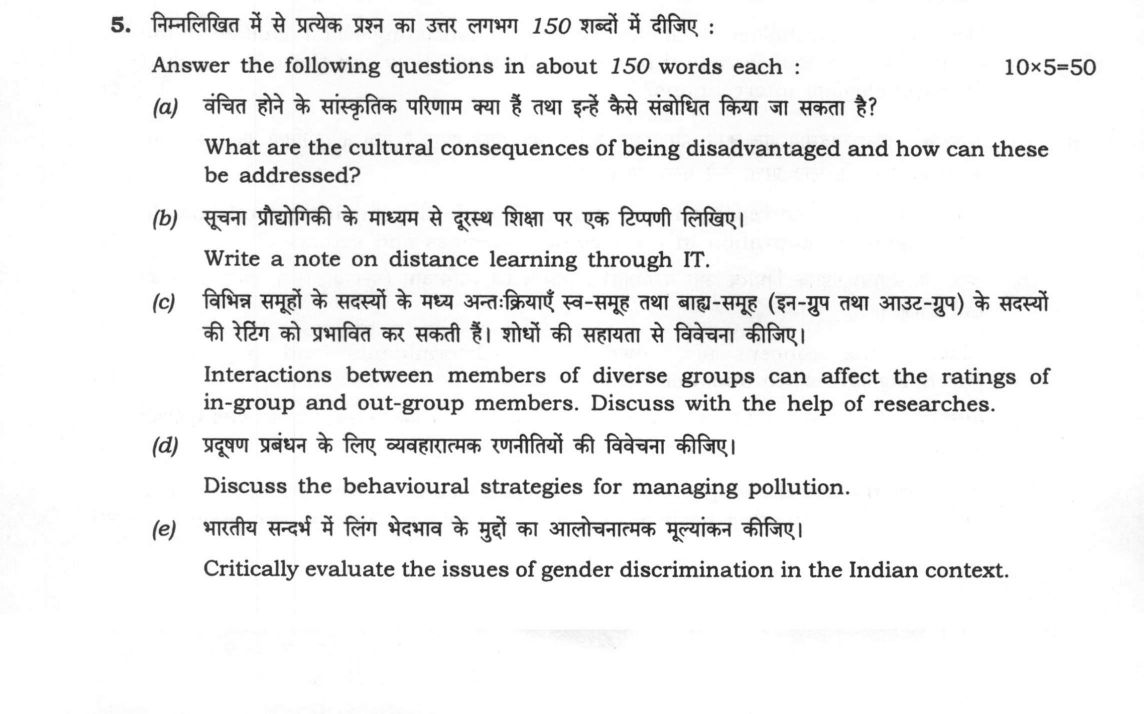
Answer the following questions in about 150 words each:
What are the cultural consequences of being disadvantaged and how can these be addressed? 10 marks
Write a note on distance learning through IT. 10 marks
Interactions between members of diverse groups can affect the ratings of in-group and out-group members. Discuss with the help of researches. 10 marks
Discuss the behavioural strategies for managing pollution. 10 marks
Critically evaluate the issues of gender discrimination in the Indian context. 10 marks
हिंदी में प्रश्न पढ़ें
निम्नलिखित में से प्रत्येक प्रश्न का उत्तर लगभग 150 शब्दों में दीजिए :
वंचित होने के सांस्कृतिक परिणाम क्या हैं तथा इन्हें कैसे संबोधित किया जा सकता है? (10 अंक)
सूचना प्रौद्योगिकी के माध्यम से दूरस्थ शिक्षा पर एक टिप्पणी लिखिए। (10 अंक)
विभिन्न समूहों के सदस्यों के मध्य अंतःक्रियाएँ स्व-समूह तथा बाहु-समूह (इन-ग्रुप तथा आउट-ग्रुप) के सदस्यों की रेटिंग को प्रभावित कर सकती हैं। शोधों की सहायता से विवेचना कीजिए। (10 अंक)
प्रदूषण प्रबंधन के लिए व्यवहारात्मक रणनीतियों की विवेचना कीजिए। (10 अंक)
भारतीय संदर्भ में लिंग भेदभाव के मुद्दों का आलोचनात्मक मूल्यांकन कीजिए। (10 अंक)
Model answer
Written by UPSC Answer Check against this question's marking rubric, to the 150-word length. UPSC does not publish answers for Mains — this is one way to score well, not an official key.
(a) Cultural Consequences of Disadvantage and Remedial Measures
Socio-economic disadvantage imposes severe cultural deficits on marginalized populations, often manifesting as cultural deprivation where individuals are isolated from mainstream cultural and developmental capital. Sociolinguistically, Basil Bernstein highlighted that disadvantaged children often develop restricted language codes, limiting contextual flexibility and abstract communication compared to elaborated codes. Psychologically, prolonged disadvantage leads to lowered aspirations, learned helplessness, and identity erosion, where marginalized groups internalize systemic stigmas and devalue their cultural heritage.
Addressing these consequences requires structural and pedagogical shifts. Educational systems must implement multicultural education and culturally responsive teaching, which integrate learners' indigenous knowledge and linguistic idioms into the curriculum rather than enforcing assimilation. Furthermore, community-based rehabilitation programs are vital to rebuild social agency, restore cultural self-esteem, and facilitate localized developmental support, ensuring long-term empowerment.
(b) Distance Learning Through IT
Information Technology has transformed distance education through synchronous (real-time virtual interactions) and asynchronous (recorded modules, discussion forums) learning modalities. Platforms such as Massive Open Online Courses (MOOCs) and national portals like SWAYAM have broadened educational access across geographical boundaries.
However, IT-enabled learning introduces distinct psychological challenges. Cognitive load management is critical; ill-structured multimedia instructional design can overwhelm working memory and impede conceptual retention. Furthermore, distance education heavily relies on self-regulated learning strategies, requiring students to possess strong metacognitive monitoring, intrinsic motivation, and time-management skills in the absence of physical supervision. Compounding these psychological barriers is the digital divide, where disparities in digital literacy and infrastructural access risk reinforcing existing educational inequities. Blended pedagogies and user-centric learning designs remain essential to mitigate these constraints.
(c) Intergroup Interactions and Ratings of In-group and Out-group Members
Interactions between members of diverse social groups substantially shape the cognitive evaluations and ratings of in-group and out-group members. Gordon Allport’s Contact Hypothesis demonstrated that direct intergroup contact reduces prejudice, provided conditions of equal status, common goals, intergroup cooperation, and institutional support are met. Muzafer Sherif’s Robbers Cave experiment confirmed that introducing superordinate goals significantly reduced hostile out-group ratings and minimized in-group favoritism.
Subsequent research refined these dynamics. Miles Hewstone proposed the mutual intergroup differentiation model, emphasizing that retaining distinct group identities during collaborative tasks allows positive evaluations to generalize to the out-group as a whole. Additionally, crossed categorization—highlighting overlapping social identities—weakens rigid "us versus them" dichotomies. Even without direct contact, the extended contact effect (knowing that an in-group peer has positive out-group friendships) effectively enhances out-group ratings and diminishes intergroup anxiety.
(d) Behavioural Strategies for Managing Pollution
Managing environmental pollution requires targeting human behaviour through structured applied behavioural interventions. Antecedent interventions alter the environment prior to the target behaviour; these include visual prompts (e.g., clear, color-coded waste disposal indicators), public commitments (e.g., written pledges for energy conservation), and nudge techniques such as default green tariffs or automated double-sided printing that make sustainable choices the default path.
Consequence strategies modify actions through post-behavioural mechanisms, such as real-time feedback (e.g., smart energy meters) and tangible incentives or penalties (e.g., bottle-return deposits and plastic levies). At the macro level, social marketing frames pro-environmental practices as desirable social norms, while community-based social marketing (CBSM) directly identifies and eliminates localized behavioural barriers through peer modeling and community engagement, fostering durable environmental stewardship.
(e) Critical Evaluation of Gender Discrimination in the Indian Context
Gender discrimination in India is rooted in patriarchal socialization, which reinforces rigid gender roles and nurtures implicit biases from early childhood. This devaluation manifests critically in adverse sex ratios driven by female foeticide and persistent son preference. In the economic realm, women encounter pervasive horizontal and vertical segregation, reflected in substantial gender wage gaps, low workforce participation, and the glass ceiling that impedes upward mobility into leadership roles.
While statutory protections such as the Sexual Harassment of Women at Workplace (Prevention, Prohibition and Redressal) Act, 2013 exist, implementation is frequently hindered by underreporting, organizational apathy, and secondary victimization. A purely legal approach remains insufficient; sustainable progress requires targeted psychological empowerment interventions, school-based gender sensitization, and collective mobilization through Self-Help Groups to effectively dismantle patriarchal cognitions and achieve substantive gender equality.
What "Discuss" is asking you to do
Lay the issue out from more than one side — how it arose, what is claimed for it, what is held against it, and where it now stands. UPSC attaches discuss to broad topics with several live dimensions, so coverage of the dimensions earns more than the strength of your opinion.
Structure that answers it
Set the issue up → the case as it is made → the case against → the dimension both sides leave out → where the balance now lies
Where marks are lost
Listing facts with no thread between them, or arguing one side throughout and calling it a discussion.
How this answer will be evaluated
Approach
Framework: Social Psychology & Applied Psychology. (a) explain: definition/context > points in order > small example > short close | (b) write short notes: define > 3-4 key features > one example > one-line significance | (c) discuss: intro > 3-4 dimensions > example > balanced close | (d) discuss: intro > 3-4 dimensions > example > balanced close | (e) critically evaluate: positives > negatives/limits > conditions/safeguards > conclusion Full marks: Comprehensive, specific, well-supported with research and examples
Key points expected
- Define 'cultural consequences' of disadvantage
- Identify specific consequences (e.g., low self-esteem, cultural alienation)
- Link consequences to social identity or self-concept
- Suggest specific measures to address these consequences
- Define distance learning through IT
- Identify 3-4 key features (e.g., flexibility, multimedia, online interaction)
- Provide one example of an IT tool or platform
- State one-line significance of IT in distance learning
Evaluation rubric
Each sub-part is marked on its own, against the marks and word limit printed on the paper.
- (a) Define cultural consequences of disadvantage and propose remedial measures. 10 marks · 150 words
explain— definition/context → points in order → small example → short close
Must cover
- Define 'cultural consequences' of disadvantage
- Identify specific consequences (e.g., low self-esteem, cultural alienation)
- Link consequences to social identity or self-concept
- Suggest specific measures to address these consequences
Loses marks
- Vague generalizations without specific consequences
- Measures that are generic (e.g., 'provide education') without cultural context
Earns more
- Reference to 'culture of poverty' or 'learned helplessness'
- Mention of specific remedial programs (e.g., mentoring, cultural sensitivity training)
Extra mark
- Citation of a specific study on cultural disadvantage
- Reference to a specific government policy or scheme
- (b) Define distance learning via IT and list key features. 10 marks · 150 words
write short notes— define → 3-4 key features → one example → one-line significance
Must cover
- Define distance learning through IT
- Identify 3-4 key features (e.g., flexibility, multimedia, online interaction)
- Provide one example of an IT tool or platform
- State one-line significance of IT in distance learning
Loses marks
- Confusing distance learning with traditional correspondence
- Lack of specific IT features or examples
Earns more
- Mention of specific platforms (e.g., MOOCs, LMS)
- Reference to benefits like accessibility and scalability
Extra mark
- Citation of a specific study on IT in education
- Reference to a specific Indian initiative (e.g., SWAYAM, NPTEL)
- (c) Discuss how inter-group interactions affect in/out-group ratings with research. 10 marks · 150 words
discuss— intro → 3-4 dimensions → example → balanced close
Must cover
- Define in-group and out-group
- Explain how interactions affect ratings (e.g., bias, stereotyping)
- Cite at least one relevant study or researcher
- Provide a balanced conclusion on the impact
Loses marks
- Lack of specific research or studies
- Vague discussion without clear link to ratings
Earns more
- Reference to specific theories (e.g., Social Identity Theory, Contact Hypothesis)
- Mention of specific studies (e.g., Tajfel, Allport)
Extra mark
- Citation of a specific experiment with findings
- Reference to a specific psychometric tool used in such studies
- (d) Discuss behavioural strategies for managing pollution. 10 marks · 150 words
discuss— intro → 3-4 dimensions → example → balanced close
Must cover
- Define behavioural strategies in context of pollution
- Identify 3-4 specific strategies (e.g., recycling, conservation, awareness)
- Explain how these strategies manage pollution
- Provide a balanced conclusion on effectiveness
Loses marks
- Generic advice without behavioural focus
- Lack of specific strategies or examples
Earns more
- Reference to specific behavioural theories (e.g., Theory of Planned Behavior)
- Mention of specific campaigns or initiatives
Extra mark
- Citation of a specific study on behavioural change
- Reference to a specific policy or regulation
- (e) Critically evaluate gender discrimination issues in Indian context. 10 marks · 150 words
critically evaluate— positives → negatives/limits → conditions/safeguards → conclusion
Must cover
- Define gender discrimination in Indian context
- Identify positives (e.g., legal protections, awareness)
- Identify negatives/limits (e.g., social norms, economic disparity)
- Provide a balanced conclusion with safeguards
Loses marks
- One-sided evaluation without critical analysis
- Lack of specific Indian context or examples
Earns more
- Reference to specific laws (e.g., Dowry Prohibition Act, Sexual Harassment Act)
- Mention of specific social issues (e.g., dowry, workplace discrimination)
Extra mark
- Citation of a specific study or report on gender discrimination
- Reference to a specific government initiative or policy
Practice this exact question
Write your answer and it is marked point by point against the model answer above — what you covered, what you missed, what you got wrong.
Evaluate my answer →More from Psychology 2025 Paper II
- Q2 (a) What are the factors that determine the efficacy of psychological tests? Discuss the…
- Q3 (a) What are the personality qualities to be focused on, for preparing community members…
- Q4 (a) Provide a community-based model for organizing services for rehabilitation of mentall…
- Q5 Answer the following questions in about 150 words each: (a) What are the cultural consequ…
- Q6 (a) Discuss the psychological consequences of prolonged deprivation. What strategies can…
- Q7 (a) Explain the concepts of social facilitation and social inhibition in the context of g…
- Q8 (a) What motivates entrepreneurs to start and grow their business, and how do they mainta…