Paper II — Q2
(a) What are the factors that determine the efficacy of psychological tests? Discuss the ethical issues in the use of…
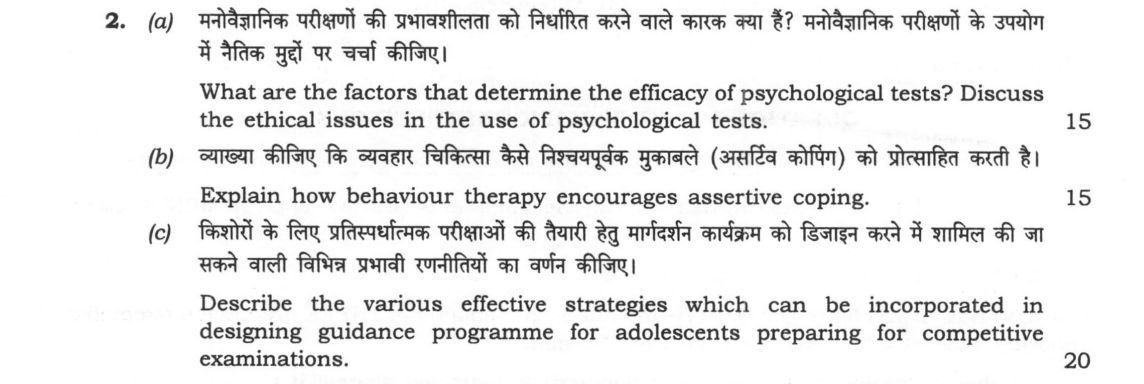
What are the factors that determine the efficacy of psychological tests? Discuss the ethical issues in the use of psychological tests. 15 marks
Explain how behaviour therapy encourages assertive coping. 15 marks
Describe the various effective strategies which can be incorporated in designing guidance programme for adolescents preparing for competitive examinations. 20 marks
हिंदी में प्रश्न पढ़ें
मनोवैज्ञानिक परीक्षणों की प्रभावशीलता को निर्धारित करने वाले कारक क्या हैं? मनोवैज्ञानिक परीक्षणों के उपयोग में नैतिक मुद्दों पर चर्चा कीजिए। (15 अंक)
व्याख्या कीजिए कि व्यवहार चिकित्सा कैसे निश्चयपूर्वक मुकाबले (असर्टिव कोपिंग) को प्रोत्साहित करती है। (15 अंक)
किशोरों के लिए प्रतिस्पर्धात्मक परीक्षाओं की तैयारी हेतु मार्गदर्शन कार्यक्रम को डिजाइन करने में शामिल की जा सकने वाली विभिन्न प्रभावी रणनीतियों का वर्णन कीजिए। (20 अंक)
Model answer
Written by UPSC Answer Check against this question's marking rubric, to the expected length. UPSC does not publish answers for Mains — this is one way to score well, not an official key.
Psychological testing, behaviour therapy, and adolescent guidance are connected by a common aim: to make functioning measurable, modifiable, and supportable. In India’s high-stakes examination culture, where UPSC, JEE, and NEET shape life chances, their responsible use is vital.
(a) Test efficacy and ethics Test efficacy depends on reliability, validity, standardization, norms, and cultural fairness. Reliability means consistency: test-retest checks stability, split-half checks internal balance, and internal consistency, such as Cronbach’s alpha, checks item coherence. Validity includes content validity, whether items represent the domain; criterion validity, whether scores predict outcomes; and construct validity, whether the test behaves theoretically. Standardization fixes administration, scoring, and interpretation; norms give reference groups; cultural fairness ensures language, examples, and response formats do not disadvantage particular communities. Ethics require informed consent, confidentiality, test security, and examiner competence. Test security prevents leakage; competence requires training and supervision; misuse in schools, colleges, and employment can label or exclude students. Confidentiality is not absolute; it may yield to legal duty, risk of serious harm, abuse disclosure, or court order. The APA Ethics Code and Indian Psychological Association (IPA) guidelines frame these duties. In India, test bias against rural and vernacular-medium students in competitive contexts is a serious issue, as English-dominant items may measure schooling rather than ability.
(b) Behaviour therapy and assertive coping Behaviour therapy treats assertiveness as learnable through classical and operant conditioning. Classical conditioning reduces social anxiety through systematic desensitization, pairing relaxation with feared social situations until avoidance decreases. Operant conditioning strengthens assertive responses by arranging reinforcement contingencies: acceptance or success follows assertive requests, while passive or aggressive responses lose reinforcement. Assertiveness training helps adolescents discriminate among passive, aggressive, and assertive responses. Passive responses suppress rights; aggressive responses violate others; assertive responses express needs directly and respectfully. Techniques include modelling, behavioural rehearsal, role-playing, and feedback. Modelling may use a therapist or video model to demonstrate eye contact, tone, and wording. Self-monitoring records situations, emotions, and responses; homework assignments transfer practice to classrooms, coaching centres, and family conversations. Thus assertive coping becomes a stable repertoire for handling pressure.
(c) Guidance programme for adolescents preparing for competitive examinations An effective programme should be described as a sequence of design and delivery strategies. It begins with needs assessment: surveys, interviews, and performance data identify anxiety, time-management gaps, career confusion, family pressure, and digital stress. It then incorporates cognitive restructuring for exam anxiety, replacing catastrophic thoughts with balanced appraisals. Time management and study skills training provides weekly planners, spaced repetition, active recall, past-paper practice, and recovery breaks. Stress inoculation teaches graded exposure, relaxation, and coping statements. Career counselling must address Indian competitive examination patterns—UPSC, JEE, and NEET—while presenting non-competitive alternatives and realistic eligibility, preparation time, and resource constraints. Peer support groups reduce isolation and normalize setbacks; parental involvement teaches parents to monitor without surveillance, manage expectations, and provide emotional support. Digital wellness components address screen fatigue, social-media comparison, online coaching overload, and cyberbullying through usage limits, offline interaction, and digital literacy. Culturally adapted materials use local languages, familiar examples, and gender-sensitive content, especially for rural and vernacular-medium students. Integration with school or coaching-institution structures ensures regular sessions, trained counsellors, and referral pathways. Formative evaluation uses feedback, attendance, and checklists; summative evaluation uses pre-post measures, retention, and outcome data to show whether anxiety, study habits, and decision-making improved.
Conclusion Assessment, intervention, and guidance must therefore be aligned: tests must be valid and ethical, therapy must convert principles into practised assertive coping, and guidance must be structured, culturally responsive, and institutionally embedded. This alignment helps adolescents face competitive examinations with competence, confidence, and well-being.
What "Describe" is asking you to do
Give a full, ordered account of the thing named — its parts, stages or mechanism — in the sequence in which it actually exists or occurs. Most describe questions come from the science optionals, where the marks sit in correct technical detail and, where the stem says so, a labelled diagram.
Structure that answers it
One-line identification of the subject → the parts or stages in their real order, each with its defining detail → labelled diagram where the subject is structural → closing line on function or significance
Where marks are lost
Loose general prose where the examiner is ticking named parts, correct terminology and their sequence; and in the General Studies papers, turning to evaluation before the description is finished.
How this answer will be evaluated
Approach
Framework: Psychological Testing & Assessment; Behavioural Modification; Educational Guidance. (a) discuss: intro > 3-4 dimensions > example > balanced close | (b) explain: definition/context > points in order > small example > short close | (c) describe: define > structure or process in order > labelled diagram > significance Full marks: Precise psychometric/behavioral terminology; specific named techniques; clear program structure.
Key points expected
- Define reliability and validity as core efficacy factors
- Explain standardization and norming requirements
- Discuss confidentiality and informed consent
- Address test bias and cultural fairness
- Define assertive coping in behavioral terms
- Explain systematic desensitization or flooding
- Describe modeling and role-playing techniques
- Discuss reinforcement of assertive responses
Evaluation rubric
Each sub-part is marked on its own, against the marks and word limit printed on the paper.
- (a) Identify psychometric factors for efficacy and analyze ethical constraints in test usage. 15 marks
discuss— intro → 3-4 dimensions → example → balanced close
Must cover
- Define reliability and validity as core efficacy factors
- Explain standardization and norming requirements
- Discuss confidentiality and informed consent
- Address test bias and cultural fairness
Loses marks
- Confusing validity with reliability
- Ignoring the 'test user' competence factor
- Treating ethics as a mere list without application
Earns more
- Mention test-retest or inter-rater reliability
- Reference APA or NCERT ethical guidelines
- Discuss the 'halo effect' or 'practice effect'
Extra mark
- Cite a specific psychometric tool (e.g., Bhatia's BPI)
- Reference a specific legal case on test misuse
- (b) Detail the behavioral mechanisms (conditioning, modeling) that build assertive coping skills. 15 marks
explain— definition/context → points in order → small example → short close
Must cover
- Define assertive coping in behavioral terms
- Explain systematic desensitization or flooding
- Describe modeling and role-playing techniques
- Discuss reinforcement of assertive responses
Loses marks
- Focusing only on cognitive therapy (CBT) without behavior
- Vague advice without specific therapeutic techniques
- Ignoring the 'coping' aspect (stress management)
Earns more
- Mention 'assertive training' or 'social skills training'
- Reference Albert Bandura's social learning theory
- Explain the role of cognitive restructuring in behavior therapy
Extra mark
- Name a specific study on assertiveness training
- Provide a 30-second diagram of the desensitization hierarchy
- (c) Outline specific strategies for a guidance program targeting adolescents in competitive exams. 20 marks
describe— define → structure or process in order → labelled diagram → significance
Must cover
- Include stress management and relaxation techniques
- Address time management and study planning
- Discuss motivation and self-efficacy building
- Mention parental guidance or counseling components
Loses marks
- Generic advice not specific to 'competitive exams'
- Ignoring the 'adolescent' developmental stage
- Lack of structure in the 'program design'
Earns more
- Reference 'test anxiety' reduction strategies
- Include 'career counseling' or 'goal setting' (SMART)
- Mention 'peer support' or 'group counseling' dynamics
Extra mark
- Cite a specific Indian guidance program (e.g., NCERT)
- Reference a specific psychological scale for exam stress
Practice this exact question
Write your answer and it is marked point by point against the model answer above — what you covered, what you missed, what you got wrong.
Evaluate my answer →More from Psychology 2025 Paper II
- Q1 Answer the following questions in about 150 words each: (a) What are the different method…
- Q2 (a) What are the factors that determine the efficacy of psychological tests? Discuss the…
- Q3 (a) What are the personality qualities to be focused on, for preparing community members…
- Q4 (a) Provide a community-based model for organizing services for rehabilitation of mentall…
- Q5 Answer the following questions in about 150 words each: (a) What are the cultural consequ…