Paper II — Q6
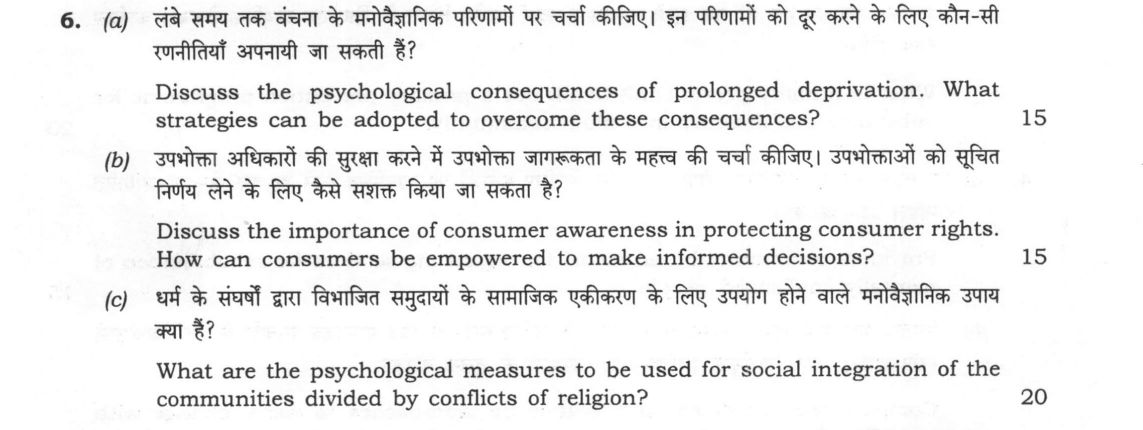
(a) Discuss the psychological consequences of prolonged deprivation. What strategies can be adopted to overcome these…
Discuss the psychological consequences of prolonged deprivation. What strategies can be adopted to overcome these consequences? 15 marks
Discuss the importance of consumer awareness in protecting consumer rights. How can consumers be empowered to make informed decisions? 15 marks
What are the psychological measures to be used for social integration of the communities divided by conflicts of religion? 20 marks
हिंदी में प्रश्न पढ़ें
लंबे समय तक वंचना के मनोवैज्ञानिक परिणामों पर चर्चा कीजिए। इन परिणामों को दूर करने के लिए कौन-सी रणनीतियाँ अपनाई जा सकती हैं? (15 अंक)
उपभोक्ता अधिकारों की सुरक्षा करने में उपभोक्ता जागरूकता के महत्व की चर्चा कीजिए। उपभोक्ताओं को सूचित निर्णय लेने के लिए कैसे सशक्त किया जा सकता है? (15 अंक)
धर्म के संघर्षों द्वारा विभाजित समुदायों के सामाजिक एकीकरण के लिए उपयोग होने वाले मनोवैज्ञानिक उपाय क्या हैं? (20 अंक)
Model answer
Written by UPSC Answer Check against this question's marking rubric, to the expected length. UPSC does not publish answers for Mains — this is one way to score well, not an official key.
Psychological Consequences of Prolonged Deprivation and Mitigation Strategies
Prolonged deprivation—whether economic, nutritional, or psychosocial—imposes severe tolls on cognitive, emotional, and behavioral functioning. Chronically deprived individuals often experience Martin Seligman’s learned helplessness, where perceived lack of control over environmental stressors leads to motivational passivity, fatalism, and diminished self-efficacy. Sustained deprivation also overburdens cognitive bandwidth, impairing executive functions, working memory, and long-term planning. Emotionally, prolonged deprivation manifests as chronic stress, generalized anxiety, apathy, and depressive disorders, frequently leading to socio-behavioral outcomes such as reactive aggression or total social withdrawal.
In India, these psychological scars are evident among marginalized populations residing in urban slums, farmers facing severe agrarian distress and debt traps, and communities displaced by large developmental or natural disasters. Overcoming these consequences necessitates multidimensional interventions: cognitive restructuring to challenge fatalistic schemas and rebuild personal agency; targeted vocational, livelihood, and life-skills training to restore behavioral competence; and community-based rehabilitation (CBR) leveraging self-help groups (SHGs) and local support systems to rebuild social capital and resilience.
Consumer Awareness and Empowerment in Protecting Rights
Consumer awareness directly shapes information processing and counters systematic decision-making biases, such as cognitive overload, anchoring, and heuristic traps exploited by aggressive marketing. Under the Consumer Protection Act 2019, awareness of statutory rights—such as the right to safety, information, choice, and redressal—is essential to protect consumers from unfair trade practices, misleading advertisements, and e-commerce frauds including dark patterns.
Empowering consumers requires behavioral and structural interventions. Enhancing financial and digital literacy equips consumers to evaluate complex digital financial products and algorithmic pricing critically. Furthermore, deploying behavioral nudges—such as standardized front-of-package nutritional labeling, transparent fee disclosures, and opt-in default architectures—reduces cognitive friction during decision-making. In India, institutional efforts such as the Jago Grahak Jago campaign, regulatory actions by the Central Consumer Protection Authority (CCPA), and self-regulatory oversight by the Advertising Standards Council of India (ASCI) against deceptive endorsements play a vital role in translating psychological awareness into market vigilance and assertive grievance redressal.
Psychological Measures for Social Integration Across Religious Conflicts
Religious conflicts deeply entrench out-group derogation and in-group favoritism, processes explained by Henri Tajfel and John Turner’s Social Identity Theory and Self-Categorization Theory. Overcoming these psychological divides demands structured, theory-driven interventions:
Application of Intergroup Theories: Gordon Allport’s Contact Hypothesis establishes that prejudice diminishes when direct contact occurs under four key conditions: equal group status, common goals, intergroup cooperation, and institutional support. Applying Muzafer Sherif’s Realistic Group Conflict Theory, creating superordinate goals—such as collaborative neighborhood disaster management, joint water conservation, or shared community infrastructure—compels conflicting groups to cooperate, recategorizing distinct identities into a single, overarching in-group identity.
Dialogue and Educational Interventions: Institutionalizing structured interfaith dialogues, perspective-taking exercises, and peace education in school curricula directly counters stereotypical social schemas and builds cognitive and affective empathy. The syncretic cultural fabric seen in Kerala’s model of inter-religious coexistence, supported by shared civic spaces and festivals, demonstrates how institutionalized cross-community interactions prevent affective polarization.
Healing Collective Memory: Sustained integration requires processing historical grievances through restorative justice mechanisms, narrative reconstruction, and communal truth-telling. Post-conflict initiatives, such as civil-society-led reconciliation programs following the Godhra riots, highlight how acknowledging shared suffering and replacing polarizing collective memories with unified narratives of mutual resilience can dismantle intergenerational trauma.
Ultimately, addressing the psychological dimensions of deprivation, market exploitation, and communal conflict requires embedding behavioral insights into policy execution. Restoring personal agency, debiasing consumer choices, and fostering superordinate social identities together form the psychological foundation for an equitable, cohesive, and resilient society.
What "Discuss" is asking you to do
Lay the issue out from more than one side — how it arose, what is claimed for it, what is held against it, and where it now stands. UPSC attaches discuss to broad topics with several live dimensions, so coverage of the dimensions earns more than the strength of your opinion.
Structure that answers it
Set the issue up → the case as it is made → the case against → the dimension both sides leave out → where the balance now lies
Where marks are lost
Listing facts with no thread between them, or arguing one side throughout and calling it a discussion.
How this answer will be evaluated
Approach
Framework: Psychology Paper II (Applied Psychology). (a) discuss: intro > 3-4 dimensions > example > balanced close | (b) discuss: intro > 3-4 dimensions > example > balanced close | (c) suggest: the problem in one line > implementable measures > who acts > conclusion Full marks: Comprehensive, well-structured, with specific psychological theories, evidence, and practical applications.
Key points expected
- Define prolonged deprivation (sensory, social, or material)
- List 3-4 specific psychological consequences (e.g., anxiety, depression)
- Propose 3-4 specific strategies to overcome consequences
- Link strategies to psychological mechanisms (e.g., cognitive reframing)
- Define consumer awareness and its link to rights
- Explain how awareness protects specific rights (e.g., safety, information)
- List methods to empower consumers for informed decisions
- Discuss the role of consumer education and literacy
Evaluation rubric
Each sub-part is marked on its own, against the marks and word limit printed on the paper.
- (a) Analyze psychological impact of deprivation and propose coping strategies. 15 marks
discuss— intro → 3-4 dimensions → example → balanced close
Must cover
- Define prolonged deprivation (sensory, social, or material)
- List 3-4 specific psychological consequences (e.g., anxiety, depression)
- Propose 3-4 specific strategies to overcome consequences
- Link strategies to psychological mechanisms (e.g., cognitive reframing)
Loses marks
- Listing consequences without explaining the mechanism
- Providing generic advice without psychological basis
- Confusing deprivation with mere poverty
Earns more
- Reference to Maslow's Hierarchy of Needs
- Mention of specific coping mechanisms (e.g., sublimation)
- Distinction between acute and chronic deprivation
- Reference to sensory deprivation studies (e.g., Sacks)
Extra mark
- Citing a specific study on sensory deprivation
- Mentioning a specific therapeutic intervention (e.g., CBT)
- (b) Explain the role of awareness in consumer rights and empowerment methods. 15 marks
discuss— intro → 3-4 dimensions → example → balanced close
Must cover
- Define consumer awareness and its link to rights
- Explain how awareness protects specific rights (e.g., safety, information)
- List methods to empower consumers for informed decisions
- Discuss the role of consumer education and literacy
Loses marks
- Focusing only on legal aspects without psychological/behavioral angle
- Listing rights without explaining how awareness protects them
- Ignoring the 'informed decision' aspect of the question
Earns more
- Reference to Consumer Protection Act (India)
- Mention of specific consumer rights (e.g., right to be heard)
- Discussion of media's role in consumer awareness
- Reference to consumer forums or commissions
Extra mark
- Citing a specific consumer protection case or judgment
- Mentioning a specific consumer organization (e.g., CCI)
- (c) Propose psychological measures for social integration of religiously divided communities. 20 marks
suggest— the problem in one line → implementable measures → who acts → conclusion
Must cover
- Identify psychological barriers to integration (e.g., prejudice, stereotyping)
- Propose 3-4 specific psychological measures for integration
- Explain how these measures address the identified barriers
- Discuss the role of intergroup contact in reducing prejudice
Loses marks
- Providing only political or social solutions without psychological basis
- Ignoring the specific context of 'religious' conflict
- Listing measures without explaining their psychological mechanism
Earns more
- Reference to Allport's Contact Hypothesis
- Mention of specific psychological techniques (e.g., perspective-taking)
- Discussion of the role of media in shaping intergroup attitudes
- Reference to specific community integration programs
Extra mark
- Citing a specific study on intergroup contact
- Mentioning a specific psychological scale for measuring prejudice
Practice this exact question
Write your answer and it is marked point by point against the model answer above — what you covered, what you missed, what you got wrong.
Evaluate my answer →More from Psychology 2025 Paper II
- Q3 (a) What are the personality qualities to be focused on, for preparing community members…
- Q4 (a) Provide a community-based model for organizing services for rehabilitation of mentall…
- Q5 Answer the following questions in about 150 words each: (a) What are the cultural consequ…
- Q6 (a) Discuss the psychological consequences of prolonged deprivation. What strategies can…
- Q7 (a) Explain the concepts of social facilitation and social inhibition in the context of g…
- Q8 (a) What motivates entrepreneurs to start and grow their business, and how do they mainta…