Paper II — Q7
(a) Explain the concepts of social facilitation and social inhibition in the context of group processes. (15 marks) (b) Prepare…
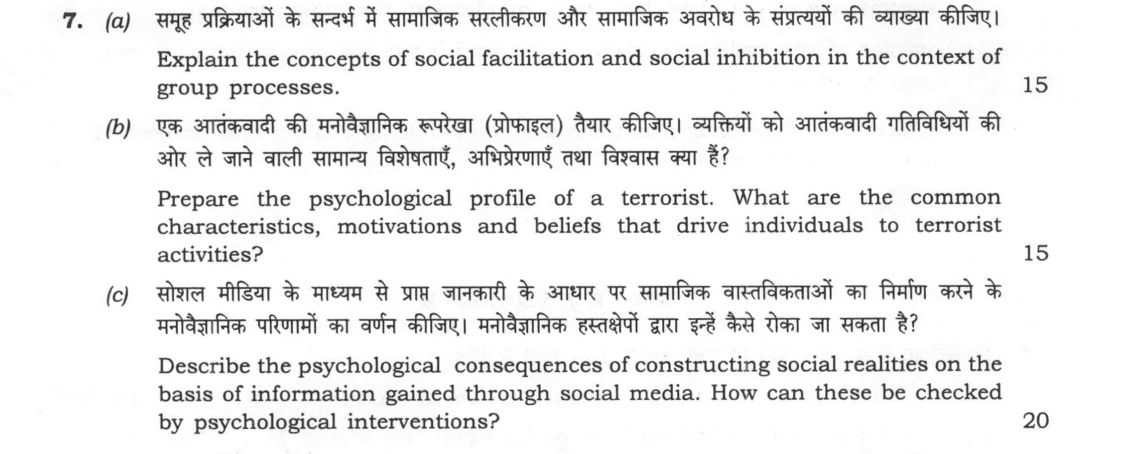
Explain the concepts of social facilitation and social inhibition in the context of group processes. 15 marks
Prepare the psychological profile of a terrorist. What are the common characteristics, motivations and beliefs that drive individuals to terrorist activities? 15 marks
Describe the psychological consequences of constructing social realities on the basis of information gained through social media. How can these be checked by psychological interventions? 20 marks
हिंदी में प्रश्न पढ़ें
समूह प्रक्रियाओं के संदर्भ में सामाजिक सरलीकरण और सामाजिक अवरोध के संप्रत्यों की व्याख्या कीजिए। (15 अंक)
एक आतंकवादी की मनोवैज्ञानिक रूपरेखा (प्रोफाइल) तैयार कीजिए। व्यक्तियों को आतंकवादी गतिविधियों की ओर ले जाने वाली सामान्य विशेषताएँ, अभिप्रेरणाएँ तथा विश्वास क्या हैं? (15 अंक)
सोशल मीडिया के माध्यम से प्राप्त जानकारी के आधार पर सामाजिक वास्तविकताओं का निर्माण करने के मनोवैज्ञानिक परिणामों का वर्णन कीजिए। मनोवैज्ञानिक हस्तक्षेपों द्वारा इन्हें कैसे रोका जा सकता है? (20 अंक)
Model answer
Written by UPSC Answer Check against this question's marking rubric, to the expected length. UPSC does not publish answers for Mains — this is one way to score well, not an official key.
Group presence profoundly influences individual cognition and behavior through the interrelated phenomena of social facilitation and social inhibition. Social facilitation refers to the enhancement of performance on simple or well-learned tasks in the presence of others, whereas social inhibition describes performance impairment on complex, novel, or cognitively demanding tasks. Norman Triplett first identified this in co-action effects, where individuals perform simultaneously alongside peers, which operates alongside audience effects occurring before passive observers.
Robert Zajonc’s Drive Theory explains this dichotomy by positing that the mere presence of conspecifics triggers physiological arousal, which heightens the probability of emitting the organism's dominant response. For simple tasks, the dominant response is typically correct, facilitating performance; for complex tasks, the dominant response is often incorrect, resulting in inhibition. Nickolas Cottrell’s Evaluation Apprehension Model extended this by demonstrating that arousal is not innate to mere presence, but is a learned response driven by the anticipation of social evaluation and judgment. Furthermore, Robert Baron’s Distraction-Conflict Theory accounts for cognitive constraints: the presence of others creates an attentional conflict between focusing on the task and attending to the social environment. This cognitive overload elevates drive while depleting the working memory resources necessary for mastering complex, non-dominant tasks.
Psychological Profile and Radicalization Dynamics
Empirical psychology demonstrates that terrorists rarely present with clinical psychopathology; rather, they demonstrate normative cognitive and emotional baselines shaped by extreme social and ideological environments. Demographically, recruits are predominantly youth, representing varied educational and socioeconomic strata rather than uniform economic deprivation. At the personality level, individuals prone to radicalization often exhibit a high need for cognitive closure, rigid authoritarianism, and intense identity fusion, wherein the boundaries between the personal self and the collective group identity completely dissolve.
Motivations are driven by push-pull dynamics. Push factors encompass perceived relative deprivation, systemic humiliation, and personal grievances that trigger an existential quest for significance. Pull factors provide ideological clarity, sacred values, fraternal camaraderie, and the promise of martyrdom or historical impact. Group-level processes solidify this transition. Marc Sageman’s network analysis emphasizes the "bunch of guys" model, where radicalization progresses horizontally through peer bonding, insular social enclaves, deindividuation, and loyalty to charismatic leaders. In the Indian context, these psychological mechanisms are evident in the identity-fused cadres of the LTTE’s suicide squads, the psychological alienation and selective grievance narratives leveraged in the Kashmir insurgency, and the mobilization of tribal relative deprivation within Left-Wing Extremism (Naxalism).
Social Media Realities and Psychological Interventions
Constructing social realities through social media relies on algorithms that curate content to maximize engagement, engineering insular echo chambers and filter bubbles. This architecture exploits cognitive heuristics: confirmation bias leads users to seek and assimilate information validating pre-existing beliefs, the availability heuristic causes overestimation of sensationalized or threat-laden events, and pluralistic ignorance leads individuals to misjudge minority online sentiments as dominant public norms.
The psychological consequences of these distorted realities manifest as acute affective and political polarization, heightened anxiety and Fear of Missing Out (FOMO), reality distortion through epistemic insularity, and depleted cognitive reflection, which fosters uncritical acceptance of disinformation.
Mitigating these adverse consequences requires structured psychological and systemic interventions. Cognitive debiasing techniques, such as micro-nudges that prompt users to reflect on accuracy before sharing, systematically interrupt reflexive information processing. School-based media literacy curricula strengthen analytical thinking and epistemic vigilance against manipulated content. Digital mindfulness interventions assist users in regulating emotional reactivity and algorithmic dependence. At the systems level, algorithmic transparency and diversified content exposure dismantle echo chambers. These are complemented by community-based counter-narratives and institutional mechanisms, such as the Press Information Bureau (PIB) Fact Check Unit and the Indian Cyber Crime Coordination Centre (I4C) cyber-hygiene frameworks, which restore shared, evidence-based social realities.
Synthesizing Group Dynamics, Extremism, and Digital Spaces
Fundamental group dynamics such as evaluation apprehension and conformity operate with heightened velocity within digital spaces. Algorithmic echo chambers accelerate social polarization, facilitating identity fusion and extremist recruitment through virtual peer networks. Addressing modern behavioral disruptions requires integrating group-level psychological insights into counter-radicalization policies, fostering digital well-being through institutional cognitive debiasing, and promoting algorithmic accountability to safeguard democratic social consensus.
What "Describe" is asking you to do
Give a full, ordered account of the thing named — its parts, stages or mechanism — in the sequence in which it actually exists or occurs. Most describe questions come from the science optionals, where the marks sit in correct technical detail and, where the stem says so, a labelled diagram.
Structure that answers it
One-line identification of the subject → the parts or stages in their real order, each with its defining detail → labelled diagram where the subject is structural → closing line on function or significance
Where marks are lost
Loose general prose where the examiner is ticking named parts, correct terminology and their sequence; and in the General Studies papers, turning to evaluation before the description is finished.
How this answer will be evaluated
Approach
Framework: Social Facilitation and Inhibition (Zajonc's Drive Theory). (a) explain: definition/context > points in order > small example > short close | (b) examine: intro > how/why with reasoning > evidence > conclusion | (c) describe: define > structure or process in order > labelled diagram > significance Full marks: Comprehensive, theoretically grounded, with specific examples and interventions.
Key points expected
- Define social facilitation and social inhibition
- Explain Zajonc's Drive Theory (arousal mechanism)
- Distinguish dominant vs. non-dominant responses
- Contextualize within group processes
- Identify common psychological characteristics
- Analyze motivations (ideological, personal, social)
- Describe core beliefs driving terrorism
- Structure as a psychological profile
Evaluation rubric
Each sub-part is marked on its own, against the marks and word limit printed on the paper.
- (a) Define and distinguish social facilitation and inhibition within group processes. 15 marks
explain— definition/context → points in order → small example → short close
Must cover
- Define social facilitation and social inhibition
- Explain Zajonc's Drive Theory (arousal mechanism)
- Distinguish dominant vs. non-dominant responses
- Contextualize within group processes
Loses marks
- Confusing social facilitation with social loafing
- Failing to mention the role of arousal
- Providing only everyday examples without theory
Earns more
- Mention Triplett's bicycle race study
- Reference Asch's conformity experiments
- Discuss the 'mere presence' effect
- Provide a simple diagram of the drive model
Extra mark
- Cite specific statistics from Triplett's study
- Reference specific modern meta-analyses
- (b) Profile a terrorist's psychology including characteristics, motivations, and beliefs. 15 marks
examine— intro → how/why with reasoning → evidence → conclusion
Must cover
- Identify common psychological characteristics
- Analyze motivations (ideological, personal, social)
- Describe core beliefs driving terrorism
- Structure as a psychological profile
Loses marks
- Generalizing all terrorists as 'crazy' or 'evil'
- Ignoring the role of social context
- Failing to distinguish between characteristics and motivations
Earns more
- Reference the 'radicalization' process
- Mention specific psychometric tools used in profiling
- Discuss the role of group identity
- Reference specific case studies (e.g., 9/11, Mumbai)
Extra mark
- Cite specific psychological scales used in profiling
- Reference specific government reports on radicalization
- (c) Describe psychological consequences of social media reality and interventions. 20 marks
describe— define → structure or process in order → labelled diagram → significance
Must cover
- Define 'constructing social realities' via social media
- Describe specific psychological consequences (e.g., anxiety, polarization)
- Propose psychological interventions to check these
- Link interventions to specific consequences
Loses marks
- Failing to distinguish between 'social reality' and 'objective reality'
- Providing only general advice without psychological grounding
- Ignoring the role of algorithms in shaping reality
Earns more
- Mention 'echo chambers' or 'filter bubbles'
- Reference specific cognitive biases (e.g., confirmation bias)
- Discuss 'digital detox' or 'media literacy' programs
- Reference specific studies on social media and mental health
Extra mark
- Cite specific statistics on social media usage and mental health
- Reference specific government or NGO interventions
Practice this exact question
Write your answer and it is marked point by point against the model answer above — what you covered, what you missed, what you got wrong.
Evaluate my answer →More from Psychology 2025 Paper II
- Q4 (a) Provide a community-based model for organizing services for rehabilitation of mentall…
- Q5 Answer the following questions in about 150 words each: (a) What are the cultural consequ…
- Q6 (a) Discuss the psychological consequences of prolonged deprivation. What strategies can…
- Q7 (a) Explain the concepts of social facilitation and social inhibition in the context of g…
- Q8 (a) What motivates entrepreneurs to start and grow their business, and how do they mainta…