Paper II — Q8
(a) What motivates entrepreneurs to start and grow their business, and how do they maintain motivation in the face of challenges…
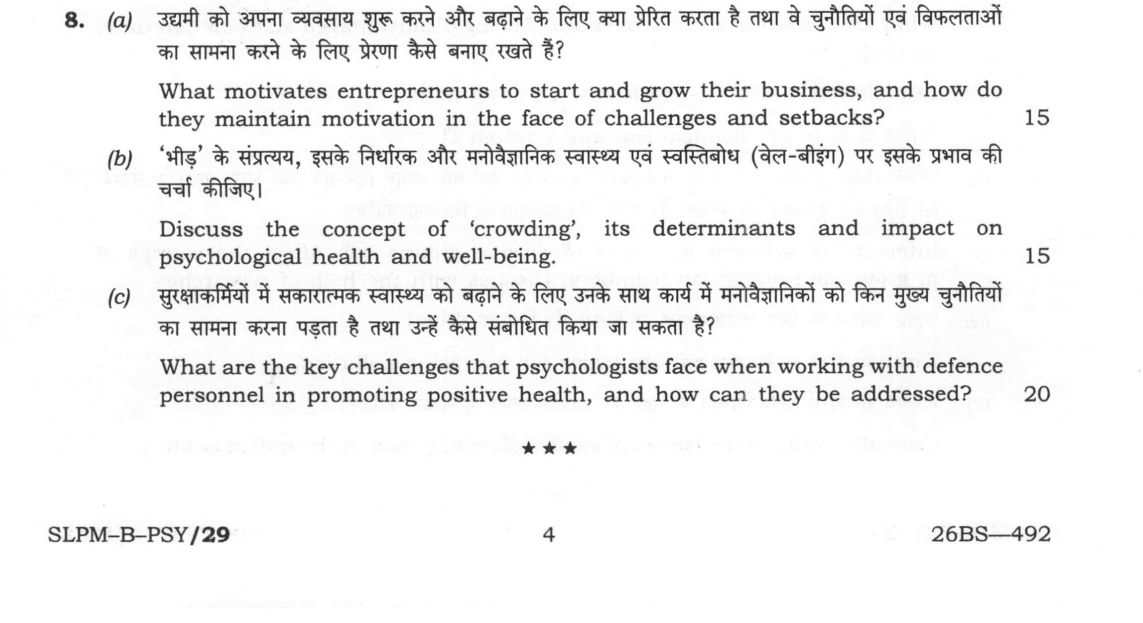
What motivates entrepreneurs to start and grow their business, and how do they maintain motivation in the face of challenges and setbacks? 15 marks
Discuss the concept of 'crowding', its determinants and impact on psychological health and well-being. 15 marks
What are the key challenges that psychologists face when working with defence personnel in promoting positive health, and how can they be addressed? 20 marks
हिंदी में प्रश्न पढ़ें
उद्यमी को अपना व्यवसाय शुरू करने और बढ़ाने के लिए क्या प्रेरित करता है तथा वे चुनौतियों एवं विफलताओं का सामना करने के लिए प्रेरणा कैसे बनाए रखते हैं? (15 अंक)
'भीड़' के संप्रत्यय, इसके निर्धारक और मनोवैज्ञानिक स्वास्थ्य एवं स्वतिबोध (वेल-बीइंग) पर इसके प्रभाव की चर्चा कीजिए। (15 अंक)
सुरक्षाकर्मियों में सकारात्मक स्वास्थ्य को बढ़ाने के लिए उनके साथ कार्य में मनोवैज्ञानिकों को किन मुख्य चुनौतियों का सामना करना पड़ता है तथा उन्हें कैसे संबोधित किया जा सकता है? (20 अंक)
Model answer
Written by UPSC Answer Check against this question's marking rubric, to the expected length. UPSC does not publish answers for Mains — this is one way to score well, not an official key.
Applied psychology provides critical frameworks for understanding human behaviour across diverse contexts, from entrepreneurial ventures and urban environments to high-stress defence establishments.
Entrepreneurial Motivation and Sustained Resilience
Entrepreneurial drive stems from an interplay of intrinsic and extrinsic motivators. Intrinsic factors include the pursuit of autonomy, creative expression, and self-actualisation, whereas extrinsic motivators encompass financial gains, social status, and market recognition. David McClelland’s Theory of Needs highlights that entrepreneurs are primarily driven by a high Need for Achievement (n-Ach), characterised by a preference for moderate risk-taking, personal responsibility, and unambiguous feedback.
To sustain motivation amidst market volatility and setbacks, entrepreneurs employ cognitive reframing, interpreting failures as iterative learning rather than personal defeat. They practice goal recalibration, breaking long-term visions into proximate milestones to preserve self-efficacy and psychological hardiness. In the Indian context, Kiran Mazumdar-Shaw demonstrated sustained persistence against gender bias and severe initial funding deficits to establish Biocon, while N. R. Narayana Murthy navigated pre-liberalisation bureaucratic hurdles and resource constraints through clear value systems and adaptive perseverance to build Infosys.
Concept, Determinants, and Impact of Crowding
In environmental psychology, a fundamental distinction exists between density and crowding (Daniel Stokols). Density is an objective, physical metric representing the number of individuals per unit area. In contrast, crowding is a subjective, experiential state characterised by a negative psychological and physiological reaction to perceived spatial constraint and unwanted social interactions.
The determinants of crowding include:
- Perceived personal space: Violations of individual spatial boundaries amplify feelings of intrusion.
- Perceived control: An individual's perceived inability to regulate interpersonal interactions or modify their immediate environment exacerbates feelings of confinement.
- Duration: Prolonged exposure to high spatial density accelerates sensory overload.
- Cultural and social factors: Collectivist societies often exhibit greater tolerance for high spatial density compared to individualistic cultures, mediated by shared social norms and relational expectations.
Crowding negatively impacts psychological health by elevating physiological arousal and neuroendocrine stress. Chronically crowded environments induce cognitive overload, heightened anxiety, and interpersonal irritability, often manifesting as hostility and aggression. When individuals repeatedly fail to escape or regulate high-density stressors, it can foster learned helplessness and behavioural withdrawal, eroding subjective well-being.
Promoting Positive Health in Defence Personnel: Challenges and Remedies
Psychologists working with armed forces personnel face distinct institutional, environmental, and cultural challenges in fostering positive mental health:
First, a pervasive stigma against psychological vulnerability persists, where seeking mental health support is often misconstrued as professional weakness or a barrier to career progression. Second, rigid hierarchical structures and command barriers hinder spontaneous emotional expression and therapeutic openness. Third, operational secrecy and classified assignments create ethical and practical boundaries around catharsis and cognitive debriefing. Fourth, continuous exposure to operational trauma, combat stress, and prolonged separation from family exacerbates affective and anxiety disorders. Finally, frequent unit relocations disrupt the continuity of longitudinal therapeutic interventions.
Addressing these challenges requires systemic, multi-layered strategies:
- Command-Level Mental Health Integration: Embedding psychological literacy into military doctrine and leadership training normalises mental healthcare and reduces structural stigma.
- Peer Support Systems: Instituting structured 'buddy systems' and peer-support networks enables early detection of emotional distress in frontline operational units.
- Telepsychology for Deployed Units: Secure, encrypted tele-mental health platforms ensure continuous psychological support for troops stationed in remote forward areas, circumventing logistical and posting-related interruptions.
- Culturally Adapted Interventions: Incorporating evidence-based indigenous techniques, such as Yoga, Pranayama, and mindfulness-based stress management (researched by institutions like DIPR/DRDO), enhances autonomic regulation, mental hardiness, and positive psychological capital.
A holistic paradigm linking cognitive resilience in leadership, proactive environmental design in living spaces, and institutionalised psychological support within defence services is essential for optimising human performance and subjective well-being.
What "Discuss" is asking you to do
Lay the issue out from more than one side — how it arose, what is claimed for it, what is held against it, and where it now stands. UPSC attaches discuss to broad topics with several live dimensions, so coverage of the dimensions earns more than the strength of your opinion.
Structure that answers it
Set the issue up → the case as it is made → the case against → the dimension both sides leave out → where the balance now lies
Where marks are lost
Listing facts with no thread between them, or arguing one side throughout and calling it a discussion.
How this answer will be evaluated
Approach
Framework: SLPM-B-PSY/29 (Organizational & Industrial Psychology). (a) explain: definition/context > points in order > small example > short close | (b) discuss: intro > 3-4 dimensions > example > balanced close | (c) challenges: 3-4 challenges > solutions mapped to them > conclusion Full marks: Precise definitions, named theories/studies, and specific application to the context (Entrepreneur/Defence).
Key points expected
- Define entrepreneurial motivation (intrinsic/extrinsic)
- Name specific motivators (e.g., autonomy, achievement, profit)
- Explain coping mechanisms for setbacks (e.g., resilience, reframing)
- Link to a theory (e.g., Maslow, McClelland, or Self-Efficacy)
- Define 'crowding' (distinguish from density)
- List determinants (e.g., population density, lack of control, privacy)
- Explain impact on well-being (e.g., stress, aggression, withdrawal)
- Mention 'Personal Space' or 'Territoriality' concepts
Evaluation rubric
Each sub-part is marked on its own, against the marks and word limit printed on the paper.
- (a) Identify entrepreneurial motivators and strategies for maintaining motivation during setbacks. 15 marks
explain— definition/context → points in order → small example → short close
Must cover
- Define entrepreneurial motivation (intrinsic/extrinsic)
- Name specific motivators (e.g., autonomy, achievement, profit)
- Explain coping mechanisms for setbacks (e.g., resilience, reframing)
- Link to a theory (e.g., Maslow, McClelland, or Self-Efficacy)
Loses marks
- Generic business advice without psychological basis
- Ignoring the 'setbacks' part of the question
- Confusing 'motivation' with 'leadership style'
Earns more
- Reference to 'Growth Mindset' (Dweck)
- Mention of 'Self-Efficacy' (Bandura)
- Distinction between 'Start-up' vs 'Growth' phase motivators
- Reference to 'Entrepreneurial Resilience'
Extra mark
- Citing a specific study on Indian entrepreneurs
- Mentioning a specific psychometric tool (e.g., Entrepreneurial Personality Scale)
- (b) Define 'crowding', identify its determinants, and analyze its impact on psychological health. 15 marks
discuss— intro → 3-4 dimensions → example → balanced close
Must cover
- Define 'crowding' (distinguish from density)
- List determinants (e.g., population density, lack of control, privacy)
- Explain impact on well-being (e.g., stress, aggression, withdrawal)
- Mention 'Personal Space' or 'Territoriality' concepts
Loses marks
- Confusing 'crowding' with simple 'population density'
- Ignoring the 'determinants' aspect
- Focusing only on physical discomfort, ignoring psychological impact
Earns more
- Reference to 'Deprivation' model
- Mention of 'Social Facilitation' vs 'Inhibition'
- Link to 'Urban Stress' or 'Slum conditions'
- Reference to 'Privacy' (Altman)
Extra mark
- Citing a specific study (e.g., on prison overcrowding or slums)
- Mentioning 'Cognitive Load' theory in context of crowding
- (c) Identify key challenges psychologists face with defence personnel and propose solutions for positive health. 20 marks
challenges— 3-4 challenges → solutions mapped to them → conclusion
Must cover
- Identify 3-4 specific challenges (e.g., stigma, deployment stress, PTSD)
- Explain the 'Positive Health' context (resilience, not just treatment)
- Map solutions to the identified challenges
- Address the unique 'Defence' context (hierarchy, secrecy)
Loses marks
- Generic advice applicable to any workplace
- Ignoring the 'positive health' (preventive) aspect
- Failing to address the 'defence' specific constraints
Earns more
- Mention of 'PTSD' or 'Combat Stress'
- Reference to 'Resilience Training' or 'CBT'
- Discussion of 'Stigma' in military culture
- Mention of 'Peer Support' systems
Extra mark
- Reference to specific Indian Army psychological programs
- Mentioning 'Neurofeedback' or 'Biofeedback' as tools
Practice this exact question
Write your answer and it is marked point by point against the model answer above — what you covered, what you missed, what you got wrong.
Evaluate my answer →More from Psychology 2025 Paper II
- Q5 Answer the following questions in about 150 words each: (a) What are the cultural consequ…
- Q6 (a) Discuss the psychological consequences of prolonged deprivation. What strategies can…
- Q7 (a) Explain the concepts of social facilitation and social inhibition in the context of g…
- Q8 (a) What motivates entrepreneurs to start and grow their business, and how do they mainta…