Paper II — Q1
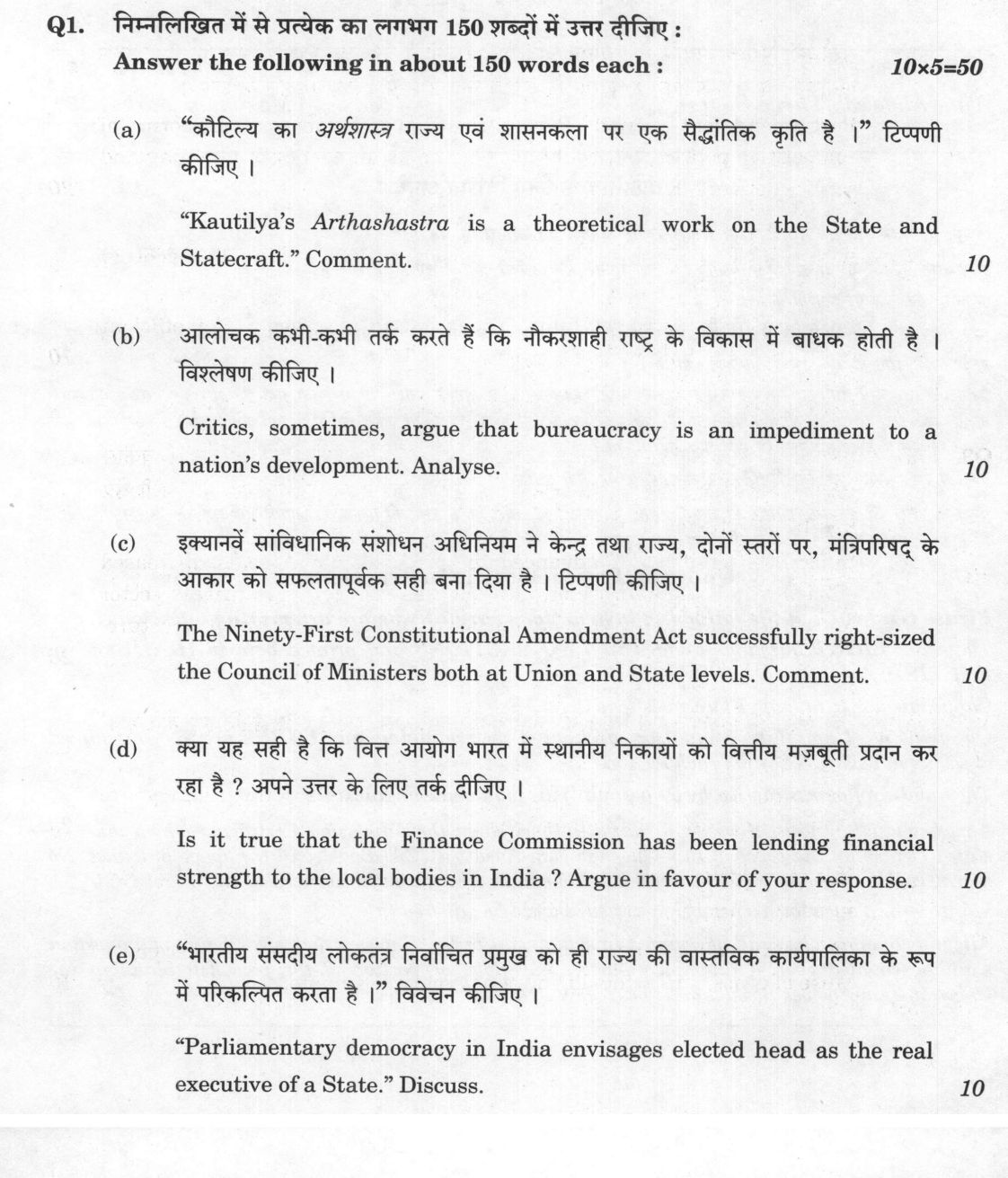
Answer the following in about 150 words each : 10×5=50 (a) "Kautilya's Arthashastra is a theoretical work on the State and…
Answer the following in about 150 words each : 10×5=50
"Kautilya's Arthashastra is a theoretical work on the State and Statecraft." Comment. 10 marks
Critics, sometimes, argue that bureaucracy is an impediment to a nation's development. Analyse. 10 marks
The Ninety-First Constitutional Amendment Act successfully right-sized the Council of Ministers both at Union and State levels. Comment. 10 marks
Is it true that the Finance Commission has been lending financial strength to the local bodies in India ? Argue in favour of your response. 10 marks
"Parliamentary democracy in India envisages elected head as the real executive of a State." Discuss. 10 marks
हिंदी में प्रश्न पढ़ें
निम्नलिखित में से प्रत्येक का लगभग 150 शब्दों में उत्तर दीजिए :
"कौटिल्य का अर्थशास्त्र राज्य एवं शासनकला पर एक सैद्धांतिक कृति है ।" टिप्पणी कीजिए । 10
आलोचक कभी-कभी तर्क करते हैं कि नौकरशाही राष्ट्र के विकास में बाधक होती है । विश्लेषण कीजिए । 10
इक्यानवें संविधानिक संशोधन अधिनियम ने केन्द्र तथा राज्य, दोनों स्तरों पर, मंत्रिपरिषद् के आकार को सफलतापूर्वक सही बना दिया है । टिप्पणी कीजिए । 10
क्या यह सही है कि वित्त आयोग भारत में स्थानीय निकायों को वित्तीय मजबूती प्रदान कर रहा है ? अपने उत्तर के लिए तर्क दीजिए । 10
"भारतीय संसदीय लोकतंत्र निर्वाचित प्रमुख को ही राज्य की वास्तविक कार्यपालिका के रूप में परिकल्पित करता है ।" विवेचन कीजिए । 10
Model answer
Written by UPSC Answer Check against this question's marking rubric, to the 150-word length. UPSC does not publish answers for Mains — this is one way to score well, not an official key.
(a) Kautilya's Arthashastra as a Theoretical Work
Kautilya’s Arthashastra is often viewed as a treatise on political philosophy, yet it transcends pure normative theory to serve as an operational manual of statecraft. At the conceptual level, it articulates enduring frameworks such as the Saptanga theory (the seven organic elements of the state) and the Mandala theory of geopolitical foreign relations. However, Kautilya was fundamentally a political realist rather than a speculative philosopher. The treatise details micro-administrative mechanics, including structured revenue collection, treasury management, civil and criminal law enforcement, internal security, and an extensive espionage network (Gudhapurushas). Unlike Western classical political philosophy focused on an ideal polity, the Arthashastra is anchored in Yogakshema (welfare and security) achieved through pragmatic administrative engineering. Thus, the work is an integrated masterpiece of political realism, where conceptual theories directly support practical governance and state survival.
(b) Bureaucracy as an Impediment to Development
The critique of bureaucracy as anti-developmental derives from Weberian dysfunctions: excessive rule-bound legalism, hierarchy, and procedural rigidity often breed red tape, risk-aversion, and implementation delays. Yet, in developing nations like India, the public bureaucracy remains the indispensable operational spine of socio-economic transformation. From macroeconomic planning and policy coordination through NITI Aayog to ground-level crisis response and welfare delivery led by District Collectors, civil servants function as primary developmental agents. The developmental deficit stems not from the institution of bureaucracy itself, but from structural rigidities unsuited to modern public service delivery. Transforming the civil service requires New Public Management (NPM) reforms—such as mission-mode governance, performance-linked accountability, digital enablement (Mission Karmayogi), and citizen-centric administrative streamlining—to reconcile procedural probity with outcome-oriented execution.
(c) The Ninety-First Constitutional Amendment Act and Right-Sizing
The Ninety-First Constitutional Amendment Act, 2003, made a structural intervention by inserting Articles 75(1A) and 164(1A), capping the Council of Ministers at 15 percent of the total strength of the Lok Sabha and State Legislative Assemblies respectively, with a minimum floor of 12 ministers for smaller States. This effectively curtailed the era of "jumbo cabinets" previously used for unprincipled political accommodation and horse-trading in coalition environments. However, the quantitative rationalisation has faced qualitative circumventions. Governments frequently bypass the spirit of the ceiling by appointing non-ministerial legislators as Parliamentary Secretaries, advisors, or heads of statutory corporations and public sector enterprises endowed with Minister of State (MoS) or Cabinet rank and perks. While the 91st Amendment successfully enforced formal numerical limits, preserving its substantive intent requires institutional checks against parallel channels of ministerial-equivalent patronage.
(d) Finance Commission and Financial Strength of Local Bodies
The Finance Commission (FC) has played an expanding role in strengthening local body finances following the insertion of Article 280(3)(bb) and (c) via the 73rd and 74th Constitutional Amendments. Successive Finance Commissions have progressively augmented the quantum, certainty, and autonomy of resource transfers to Panchayati Raj Institutions (PRIs) and Urban Local Bodies (ULBs). The 13th, 14th, and 15th FCs instituted dedicated untied and tied grants, directing predictable resources toward basic public services like rural drinking water, sanitation, and urban infrastructure maintenance. Nonetheless, the effectiveness of this fiscal support is constrained by state-level structural bottlenecks: the non-implementation of State Finance Commission (SFC) recommendations, delays in the onward release of devolved funds, and persistent stagnation in local bodies' Own Source Revenue (OSR) mobilisation. Genuine fiscal empowerment requires coupling Central FC devolutions with robust local revenue-raising autonomy.
(e) Elected Head as the Real Executive of a State
India’s parliamentary system establishes the elected Chief Minister as the real executive (de facto) of a State, while the Governor serves as the constitutional (de jure) head. Under Articles 163 and 164, executive authority is wielded by the Council of Ministers headed by the Chief Minister, collectively responsible to the directly elected Legislative Assembly. This differs fundamentally from a presidential system, where executive legitimacy vests in a single independent office; here, executive legitimacy derives continuously from legislative confidence. However, operational realities occasionally strain this executive primacy. Coalition instability, fragmented mandates, and the controversial invocation of gubernatorial discretionary powers under Article 163(2) have created political and constitutional frictions. Democratic governance requires adherence to established conventions and judicial precedents like the S.R. Bommai and Nabam Rebia cases, ensuring that real executive power remains firmly anchored in the elected political executive.
What "Comment" is asking you to do
Take a position on the statement and support it. Comment usually attaches to a quoted line in the short slots, so the reasoning must be compressed — an opening view, a few load-bearing reasons, and the limit of the claim.
Structure that answers it
Unpack what the statement asserts → your stance → two or three supporting reasons → the qualification that limits it
Where marks are lost
Neutral summary; a comment without a stance has not answered. Equally costly is accepting the quoted line wholesale and never testing where it fails.
How this answer will be evaluated
Approach
Framework: Concept > Thinker > Indian institutional application > Reform. (a) comment: context > arguments both sides > judgment > close | (b) analyse: intro > causes > effects > stakeholders/linkages > way forward | (c) comment: context > arguments both sides > judgment > close | (d) justify: claim > 3-4 reasons > evidence > conclusion | (e) discuss: intro > 3-4 dimensions > example > balanced close Full marks: Precise, well-structured, with specific Indian examples and references to relevant articles/committees.
Key points expected
- Define Arthashastra's scope (State, Statecraft, Economy)
- Identify Kautilya's core concepts (Mandala, Saptanga)
- Provide Indian administrative instance (e.g., modern foreign policy)
- Offer a balanced judgment on the 'theoretical' claim
- Identify causes (red tape, rigidity, lack of accountability)
- Explain effects on development (delayed projects, corruption)
- Identify stakeholders (citizens, private sector, government)
- Suggest a way forward (e.g., e-governance, performance metrics)
Evaluation rubric
Each sub-part is marked on its own, against the marks and word limit printed on the paper.
- (a) Contextualize Arthashastra and judge its theoretical vs practical nature. 10 marks · 150 words
comment— context → arguments both sides → judgment → close
Must cover
- Define Arthashastra's scope (State, Statecraft, Economy)
- Identify Kautilya's core concepts (Mandala, Saptanga)
- Provide Indian administrative instance (e.g., modern foreign policy)
- Offer a balanced judgment on the 'theoretical' claim
Loses marks
- Treating it purely as an economic text
- Ignoring the 'Statecraft' (policy) aspect
- No Indian administrative anchor
Earns more
- Mention specific chapters (e.g., Maudgalya)
- Reference specific statecraft techniques (Guhya Purusha)
- Compare with Western political theory (Machiavelli)
Extra mark
- Reference 2nd ARC or modern governance reform
- Cite specific historical application (e.g., Chola administration)
- (b) Examine causes and effects of bureaucracy as a development impediment. 10 marks · 150 words
analyse— intro → causes → effects → stakeholders/linkages → way forward
Must cover
- Identify causes (red tape, rigidity, lack of accountability)
- Explain effects on development (delayed projects, corruption)
- Identify stakeholders (citizens, private sector, government)
- Suggest a way forward (e.g., e-governance, performance metrics)
Loses marks
- Ignoring the positive role of bureaucracy
- No Indian administrative anchor
- Vague generalizations without specific examples
Earns more
- Reference Weber's bureaucracy theory
- Mention specific Indian administrative instances (e.g., land acquisition delays)
- Distinguish between 'bureaucratic' and 'bureaucratism'
Extra mark
- Reference 2nd ARC recommendations on bureaucracy
- Cite recent governance reform (e.g., Single Window Clearance)
- (c) Contextualize the 91st Amendment and judge its success in right-sizing Councils. 10 marks · 150 words
comment— context → arguments both sides → judgment → close
Must cover
- State the provision of the 91st Constitutional Amendment Act
- Explain the 'right-sizing' mechanism (10% limit)
- Provide arguments for its success (stability, efficiency)
- Provide arguments against its success (political maneuvering)
Loses marks
- Confusing with other amendments (e.g., 73rd/74th)
- Ignoring the 'State level' aspect
- No judgment on 'success'
Earns more
- Mention the specific percentage limit (10% of total members)
- Reference the impact on Union and State levels
- Discuss the role of the Speaker/Chief Whip
Extra mark
- Reference 2nd ARC recommendations on ministerial strength
- Cite specific examples of states/union exercising the limit
- (d) Argue in favor of the Finance Commission's role in strengthening local bodies. 10 marks · 150 words
justify— claim → 3-4 reasons → evidence → conclusion
Must cover
- State the claim (Finance Commission strengthens local bodies)
- Provide 3-4 reasons (e.g., grants, tax devolution, capacity building)
- Provide evidence (e.g., specific grants, recommendations)
- Conclude with a balanced judgment
Loses marks
- Ignoring the role of State Finance Commissions
- No specific evidence or examples
- Vague generalizations
Earns more
- Reference the 14th/15th Finance Commission reports
- Mention specific grants (e.g., State Finance Commission grants)
- Discuss the role of State Finance Commissions
Extra mark
- Reference 2nd ARC recommendations on local finance
- Cite specific statistics on local body funding
- (e) Discuss the role of the elected head as the real executive in Indian parliamentary democracy. 10 marks · 150 words
discuss— intro → 3-4 dimensions → example → balanced close
Must cover
- Define 'elected head' (Prime Minister/Chief Minister)
- Explain 3-4 dimensions of their executive role (policy, administration, crisis management)
- Provide an example (e.g., PM's role in disaster management)
- Conclude with a balanced view (e.g., role of President/Governor)
Loses marks
- Ignoring the role of the President/Governor
- No specific examples
- Vague generalizations
Earns more
- Reference specific Articles (e.g., Article 74, Article 163)
- Mention the role of the Cabinet
- Discuss the 'real executive' vs 'nominal executive' distinction
Extra mark
- Reference 2nd ARC recommendations on executive accountability
- Cite specific examples of PM/CM decision-making
Practice this exact question
Write your answer and it is marked point by point against the model answer above — what you covered, what you missed, what you got wrong.
Evaluate my answer →More from Public Administration 2023 Paper II
- Q1 Answer the following in about 150 words each : 10×5=50 (a) "Kautilya's Arthashastra is a…
- Q2 (a) "Indian Prime Minister is more empowered than his British counterpart in the Westmins…
- Q3 (a) India has significantly advanced in its development goals, increased efficiency in th…
- Q4 (a) "There shall be Council of Ministers with the Chief Minister at the head to aid and a…