Paper II — Q5
Answer the following in about 150 words each : 10×5=50 (a) The district training component of Induction Training of IAS officers…
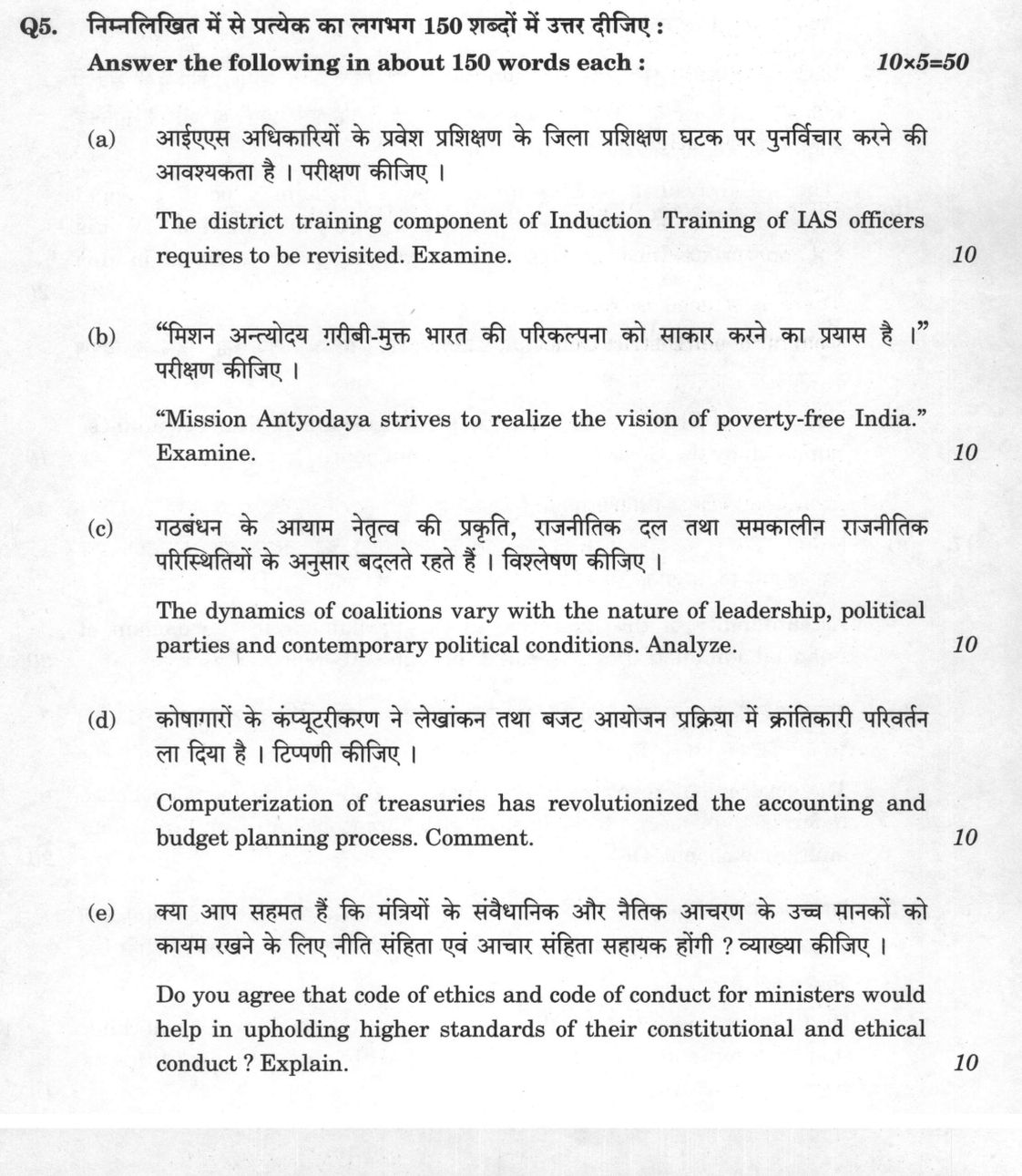
Answer the following in about 150 words each : 10×5=50
The district training component of Induction Training of IAS officers requires to be revisited. Examine. 10 marks
"Mission Antyodaya strives to realize the vision of poverty-free India." Examine. 10 marks
The dynamics of coalitions vary with the nature of leadership, political parties and contemporary political conditions. Analyze. 10 marks
Computerization of treasuries has revolutionized the accounting and budget planning process. Comment. 10 marks
Do you agree that code of ethics and code of conduct for ministers would help in upholding higher standards of their constitutional and ethical conduct ? Explain. 10 marks
हिंदी में प्रश्न पढ़ें
निम्नलिखित में से प्रत्येक का लगभग 150 शब्दों में उत्तर दीजिए :
आईएएस अधिकारियों के प्रवेश प्रशिक्षण के जिला प्रशिक्षण घटक पर पुनर्विचार करने की आवश्यकता है । परीक्षण कीजिए । 10
"मिशन अन्त्योदय गरीबी-मुक्त भारत की परिकल्पना को साकार करने का प्रयास है ।" परीक्षण कीजिए । 10
गठबंधन के आयाम नेतृत्व की प्रकृति, राजनीतिक दल तथा समकालीन राजनीतिक परिस्थितियों के अनुसार बदलते रहते हैं । विश्लेषण कीजिए । 10
कोषागारों के कम्प्यूटरीकरण ने लेखांकन तथा बजट आयोजन प्रक्रिया में क्रांतिकारी परिवर्तन ला दिया है । टिप्पणी कीजिए । 10
क्या आप सहमत हैं कि मंत्रियों के संवैधानिक और नैतिक आचरण के उच्च मानकों को कायम रखने के लिए नीति संहिता एवं आचार संहिता सहायक होगी ? व्याख्या कीजिए । 10
Model answer
Written by UPSC Answer Check against this question's marking rubric, to the 150-word length. UPSC does not publish answers for Mains — this is one way to score well, not an official key.
(a) The district training component of IAS induction needs revision because it still risks treating districts as administrative units rather than living ecosystems. Trainees often receive procedural knowledge but limited sustained exposure to panchayati raj, block bureaucracy, grievance mechanisms, and local political economy. This creates a disconnect between classroom learning and grassroots realities, especially in conflict-prone, tribal, or disaster-affected districts. The component should be rebuilt around experiential learning: longer district immersions, joint problem-solving with district magistrates, block development officers, and gram panchayats, and structured reflection on service delivery. Lessons from the Foundation Course’s Bharat Darshan—field exposure and district engagement—can be adapted, not merely transplanted, into district training. The 2nd ARC’s emphasis on outcome-based training and experiential learning supports this. Without such reform, IAS officers may enter district administration with technical competence but limited contextual judgment, weakening last-mile governance.
(b) Mission Antyodaya sought to make poverty reduction more spatially targeted by converging 34 central schemes around identified poor villages, linking them to Gram Panchayat Development Plans. Its strength was convergence: instead of fragmented departmental delivery, it tried to bring health, water, sanitation, housing, livelihoods, and social protection into a common village-level plan. This aligned with the 73rd Amendment’s local governance logic and the 2nd ARC’s call for integrated service delivery. However, the saturation approach had limits. Identifying villages through poverty data could miss intra-village deprivation; convergence depended on timely fund flow, technical capacity, and political will. If gram panchayats lacked planning or monitoring capacity, GPDPs became paper exercises. The mission also had to balance central scheme conditions with state implementation realities. Thus, while Antyodaya moved India toward a more coherent anti-poverty architecture, it did not by itself guarantee a poverty-free India unless supplemented by robust data, local fiscal capacity, and outcome-based monitoring.
(c) Coalition dynamics are not fixed; they shift with leadership, party composition, and political conditions. In the Deve Gowda era, the United Front was largely transactional: regional parties supported the centre for short-term gains, and the absence of a strong ideological glue made the government fragile. NDA-I under Vajpayee showed a more ideological and strategic coalition, where parties shared a broad consensus on economic reform, national security, and a common opposition to the Congress, enabling stability despite internal differences. UPA-II, by contrast, became survivalist: a broad alliance held together by ministerial allocation, policy compromises, and fear of electoral defeat, but internal contradictions over economic policy and governance weakened it. Leadership matters because a strong prime minister can manage dissent and set a narrative; party variables matter because regionalism, ideology, and size affect bargaining; contemporary conditions—electoral volatility, media scrutiny, and policy expectations—determine whether coalitions become governing platforms or temporary arrangements.
(d) Computerization of treasuries has indeed transformed public financial management. PFMS has enabled real-time tracking of receipts and expenditure, linking scheme funds to bank accounts, and giving governments a clearer view of fund flow. This has improved fiscal transparency, reduced manual delays, and strengthened budget credibility by making commitments visible to legislators and auditors. It also supports outcome-based monitoring, as the 2nd ARC and 15th Finance Commission have urged, by making expenditure data more timely and comparable. Yet the claim of revolution must be qualified. The March rush has not disappeared; it persists because budget lapse rules and cash-based accounting still push departments to spend before financial year-end. Computerization has mitigated the problem by improving visibility and payment speed, but it cannot remove the incentive to exhaust budgets. For real reform, accrual accounting, outcome budgeting, and stronger state-level PFMS integration are needed.
(e) I agree that a code of ethics and conduct for ministers would help raise constitutional and ethical standards. Ministers hold office under the Constitution, but their conduct is governed mainly by the oath of office, parliamentary rules, and political accountability. A statutory or constitutional code could go beyond the oath by defining duties such as selflessness, integrity, objectivity, accountability, openness, honesty, and loyalty, drawing on Nolan principles. The 2nd ARC’s recommendations for ministerial conduct, asset declarations, conflict-of-interest rules, and post-retirement norms are relevant here. Such a code would not replace constitutional responsibility under Article 75 or parliamentary oversight, but it would give clearer standards for cases involving ministerial interference, allocation of contracts, or use of official position. It would also strengthen public trust by making ethical expectations explicit rather than discretionary. Enforcement, however, must be institutional: parliamentary committees, a transparent asset-declaration mechanism, and consistent judicial interpretation are needed. Without enforcement, a code remains symbolic; with it, it becomes a meaningful check on ministerial power.
What "Examine" is asking you to do
Test the proposition the question puts to you and return a finding on how far it holds. Examine stems carry a claim, or ask whether something has happened, and expect evidence weighed both ways before the extent is stated — often with remedial measures attached.
Structure that answers it
Restate the claim as the question frames it → evidence that supports it → evidence that undercuts it → the conditions under which it holds → verdict on how far it stands
Where marks are lost
Stopping at description. An examination has to reach a finding, and “examine with justification” means the extent must be stated, not implied.
How this answer will be evaluated
Approach
Framework: Public Administration Paper II (Indian Administrative Context). (a) examine: intro > how/why with reasoning > evidence > conclusion | (b) examine: intro > how/why with reasoning > evidence > conclusion | (c) analyse: intro > causes > effects > stakeholders/linkages > way forward | (d) comment: context > arguments both sides > judgment > close | (e) explain: definition/context > points in order > small example > short close Full marks: Demonstrates deep understanding of Indian administrative context, specific examples, and critical analysis.
Key points expected
- Identify specific gaps in current district training (e.g., lack of field exposure)
- Link training to ground-level administrative realities
- Propose specific structural or content revisions
- Reference the role of the District Magistrate in training
- Define the core objective of Mission Antyodaya
- Analyze its mechanisms for poverty alleviation
- Assess its impact on the 'poverty-free India' vision
- Identify limitations or challenges in its implementation
Evaluation rubric
Each sub-part is marked on its own, against the marks and word limit printed on the paper.
- (a) Critique the current district training component of IAS induction and propose revisions. 10 marks · 150 words
examine— intro → how/why with reasoning → evidence → conclusion
Must cover
- Identify specific gaps in current district training (e.g., lack of field exposure)
- Link training to ground-level administrative realities
- Propose specific structural or content revisions
- Reference the role of the District Magistrate in training
Loses marks
- Generic praise of training without critique
- Ignoring the 'district' specific context
- No concrete suggestions for revision
Earns more
- Mentioning the 2nd ARC recommendations on training
- Citing specific examples of training failures or successes
- Discussing the 'field immersion' concept
Extra mark
- Reference to specific recent reforms in IAS training
- Mentioning the role of the District Administration in training
- (b) Evaluate Mission Antyodaya's effectiveness in achieving the vision of a poverty-free India. 10 marks · 150 words
examine— intro → how/why with reasoning → evidence → conclusion
Must cover
- Define the core objective of Mission Antyodaya
- Analyze its mechanisms for poverty alleviation
- Assess its impact on the 'poverty-free India' vision
- Identify limitations or challenges in its implementation
Loses marks
- Vague description without critical analysis
- Ignoring the 'poverty-free India' vision
- No discussion of implementation challenges
Earns more
- Comparing it with other poverty alleviation schemes
- Mentioning specific target groups (e.g., BPL, SC/ST)
- Discussing the role of local governance (Panchayati Raj)
Extra mark
- Citing specific data or reports on Mission Antyodaya's outcomes
- Reference to the 2nd ARC recommendations on social justice
- (c) Analyze how leadership, parties, and political conditions influence coalition dynamics. 10 marks · 150 words
analyse— intro → causes → effects → stakeholders/linkages → way forward
Must cover
- Explain the role of leadership in coalition stability
- Analyze the impact of party ideologies and structures
- Discuss the influence of contemporary political conditions
- Provide examples of coalition dynamics in Indian politics
Loses marks
- Generic discussion of coalitions without specific factors
- Ignoring the 'contemporary political conditions'
- No examples or case studies
Earns more
- Mentioning specific leaders (e.g., Vajpayee, Modi)
- Discussing the role of regional parties
- Analyzing the impact of electoral systems
Extra mark
- Reference to specific coalition governments and their outcomes
- Mentioning the role of the President in coalition politics
- (d) Comment on the impact of computerization on treasury accounting and budget planning. 10 marks · 150 words
comment— context → arguments both sides → judgment → close
Must cover
- Describe the pre-computerization process (manual)
- Explain the changes brought by computerization
- Analyze the impact on accounting accuracy and efficiency
- Discuss the impact on budget planning and transparency
Loses marks
- Vague description of computerization
- Ignoring the 'budget planning' aspect
- No discussion of challenges or limitations
Earns more
- Mentioning specific software or systems (e.g., e-Treasury)
- Discussing the role of technology in reducing corruption
- Analyzing the challenges of computerization (e.g., digital divide)
Extra mark
- Reference to specific government initiatives for computerization
- Mentioning the role of the Comptroller and Auditor General (CAG)
- (e) Explain how a code of ethics and conduct for ministers would uphold higher standards. 10 marks · 150 words
explain— definition/context → points in order → small example → short close
Must cover
- Define the current ethical and constitutional standards for ministers
- Explain the proposed code of ethics and conduct
- Analyze how the code would address existing gaps
- Discuss the potential impact on ministerial behavior
Loses marks
- Vague description of the code
- Ignoring the 'constitutional' aspect
- No discussion of implementation challenges
Earns more
- Mentioning specific ethical issues (e.g., conflict of interest)
- Discussing the role of the Lok Sabha in holding ministers accountable
- Analyzing the challenges in implementing such a code
Extra mark
- Reference to specific cases of ministerial misconduct
- Mentioning the role of the Ethics Committee
Practice this exact question
Write your answer and it is marked point by point against the model answer above — what you covered, what you missed, what you got wrong.
Evaluate my answer →More from Public Administration 2023 Paper II
- Q2 (a) "Indian Prime Minister is more empowered than his British counterpart in the Westmins…
- Q3 (a) India has significantly advanced in its development goals, increased efficiency in th…
- Q4 (a) "There shall be Council of Ministers with the Chief Minister at the head to aid and a…
- Q5 Answer the following in about 150 words each : 10×5=50 (a) The district training componen…
- Q6 (a) "Civil Service Reforms along with a transparent transfer policy will go a long way in…
- Q7 (a) Accountability of the Executive to the Parliament in the domain of financial administ…
- Q8 (a) In the context of the Second Administrative Reforms Commission recommendations, evalu…