Paper II — Q8
(a) In the context of the Second Administrative Reforms Commission recommendations, evaluate Public-Private Partnership (PPP) as…
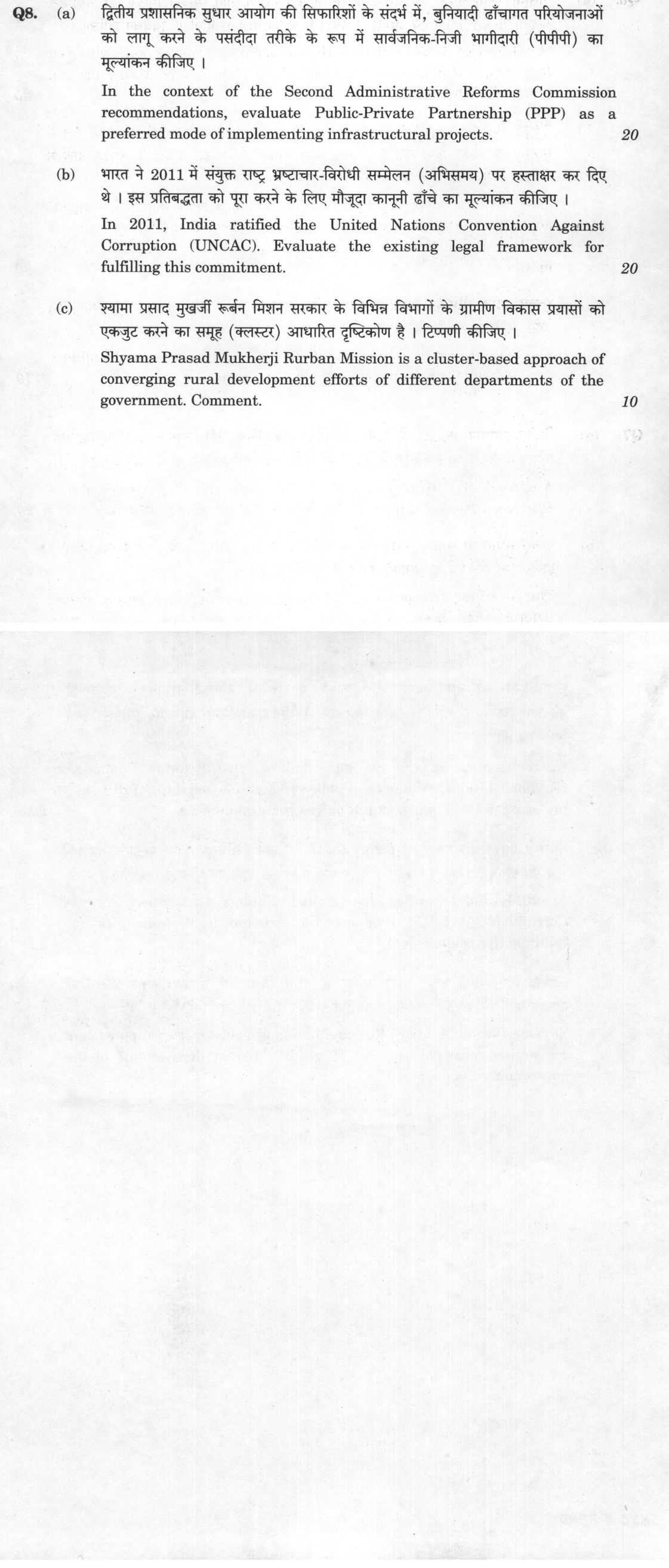
In the context of the Second Administrative Reforms Commission recommendations, evaluate Public-Private Partnership (PPP) as a preferred mode of implementing infrastructural projects. 20 marks
In 2011, India ratified the United Nations Convention Against Corruption (UNCAC). Evaluate the existing legal framework for fulfilling this commitment. 20 marks
Shyama Prasad Mukherji Rurban Mission is a cluster-based approach of converging rural development efforts of different departments of the government. Comment. 10 marks
हिंदी में प्रश्न पढ़ें
द्वितीय प्रशासनिक सुधार आयोग की सिफारिशों के संदर्भ में, बुनियादी ढांचागत परियोजनाओं को लागू करने के पसंदीदा तरीके के रूप में सार्वजनिक-निजी भागीदारी (पीपीपी) का मूल्यांकन कीजिए । 20
भारत ने 2011 में संयुक्त राष्ट्र भ्रष्टाचार-विरोधी सम्मेलन (अभिसमय) पर हस्ताक्षर कर दिए थे । इस प्रतिबद्धता को पूरा करने के लिए मौजूदा कानूनी ढांचे का मूल्यांकन कीजिए । 20
श्यामा प्रसाद मुखर्जी रुर्बन मिशन सरकार के विभिन्न विभागों के ग्रामीण विकास प्रयासों को एकजुट करने का समूह (क्लस्टर) आधारित दृष्टिकोण है । टिप्पणी कीजिए । 10
Model answer
Written by UPSC Answer Check against this question's marking rubric, to the expected length. UPSC does not publish answers for Mains — this is one way to score well, not an official key.
The three instruments—PPP, anti-corruption law and rurban clustering—test whether Indian administration can deliver services, deter corruption and converge rural development.
(a) PPP The 2nd ARC’s service-delivery recommendations, including the 12th Report’s broader administrative-reform agenda, do not make PPP a universal preferred mode; they require citizen-centric, accountable and efficient delivery. PPP is preferred only where private capital, technology or operational efficiency add value, and where risk-sharing, viability gap funding and an independent regulator protect the public interest. PPP should be compared with public works, not treated as an ideological alternative. BOT and BOOT shift construction and operating risk to the private party; HAM shares demand and financing risk through government annuities, making projects bankable but increasing fiscal exposure. Where demand is uncertain, HAM with VGF may be better than BOT, but the state must retain regulatory control and grievance redressal. PPP can mobilise investment and speed implementation, as seen in Mumbai Metro Line 1, a PPP concession, and some airport concessions. But the model is fragile: later reviews, especially the 2015 Kelkar Committee and CAG audits, identified flawed traffic estimates, toll-gate viability failures and post-award renegotiations. Dabhol showed how renegotiation and political risk can destroy bankability, while airport tariff disputes show that even successful concessions can generate public distrust. Thus PPP is preferred for viable, regulated infrastructure, not for high social-risk projects; it needs credible demand assessment, limited VGF linked to milestones, transparent tariff regulation and effective dispute resolution.
(b) UNCAC India ratified UNCAC in 2011. Its Chapter II (Arts. 5–14) requires preventive institutions, public-finance controls and procurement transparency; Chapter III criminalises corruption and strengthens law enforcement; Chapter IV provides international cooperation; Chapter V mandates asset recovery. The domestic framework is substantial but uneven. The PCA 1988 criminalises public-servant bribery; PMLA 2002 tracks and attaches proceeds; RTI 2005 improves transparency; the Lokpal Act 2013 and Whistleblowers Protection Act 2014 address accountability and reporting. PMLA’s attachment powers are useful but must be balanced with due process; RTI and Lokpal are preventive/accountability tools but cannot substitute for a comprehensive anti-corruption code. However, compliance is partial. India has no effective private-sector bribery offence after the Supreme Court struck down Section 7A of the 2018 PCA amendment, and no specific illicit-enrichment offence under Article 20. Preventive mandates under Arts. 5, 6 and 9 are fragmented across public-finance, procurement and administrative rules rather than a single UNCAC-style architecture. Cross-border recovery remains weak because Chapter V is not self-executing and depends on MLATs; the practical limitation is treaty dependence rather than a specific Article 54 reservation. Under the UNCAC Implementation Review Mechanism, these gaps—private-sector bribery, illicit enrichment and asset recovery—would weaken India’s compliance.
(c) SPMRM The Shyama Prasad Mukherji Rurban Mission operationalises the “rurban” idea by clustering 15–20 villages with a population of 25,000–50,000 and delivering 14 mandatory components, including skill training, digital connectivity and sanitation. It is a cluster-based approach of converging rural development efforts of different departments. Its convergence mechanism creates an SPV with the district collector as CEO, pooling 29 schemes such as MGNREGA, SBM and PMAY. This is a sound administrative innovation because it reduces fragmentation and gives one nodal officer outcome responsibility. The cluster approach also helps integrate rural and urban planning, but success depends on local demand, private investment and sustained maintenance. The main challenge is fund flow and PRI integration: if funds are released late or Panchayati Raj institutions remain bypassed, the cluster becomes a top-down project rather than a local growth centre.
Verdict PPP, UNCAC compliance and SPMRM collectively strengthen governance delivery only if PPP is regulated, anti-corruption law fills private-sector and asset-recovery gaps, and rurban convergence is made financially and democratically sustainable.
What "Evaluate" is asking you to do
Judge how well something has performed against the standard it set for itself — its stated aim, mandate or promise — and commit to a verdict. Name the yardstick before you judge; an unanchored judgement reads as opinion.
Structure that answers it
Name the yardstick — stated aim, mandate or benchmark → performance against it → shortfall against it → why the gap exists → verdict
Where marks are lost
Presenting both sides and then declining to decide, or delivering a verdict against a standard you never stated, which makes it look arbitrary.
How this answer will be evaluated
Approach
Framework: Public Administration Paper II: Institutional & Policy Analysis. (a) evaluate: criteria > evidence > balanced judgment | (b) evaluate: criteria > evidence > balanced judgment | (c) comment: context > arguments both sides > judgment > close Full marks: Precise ARC/UNCAC references, strong Indian institutional anchors, clear evaluation criteria, balanced judgment.
Key points expected
- Reference 2nd ARC recommendations on PPP
- Criteria for evaluating PPP (efficiency, cost, risk)
- Evidence of PPP success/failure in India
- Balanced judgment on 'preferred mode' claim
- Key provisions of UNCAC (prevention, investigation, recovery)
- Indian laws aligned with UNCAC (PC Act, ML Act)
- Institutional mechanisms (CVC, CBI, ED)
- Gaps or challenges in fulfilling commitments
Evaluation rubric
Each sub-part is marked on its own, against the marks and word limit printed on the paper.
- (a) Assess PPP as a preferred mode for infrastructure based on 2nd ARC recommendations. 20 marks
evaluate— criteria → evidence → balanced judgment
Must cover
- Reference 2nd ARC recommendations on PPP
- Criteria for evaluating PPP (efficiency, cost, risk)
- Evidence of PPP success/failure in India
- Balanced judgment on 'preferred mode' claim
Loses marks
- Generic PPP definition without ARC context
- Ignoring the 'preferred mode' evaluation aspect
- No Indian institutional examples
Earns more
- Mention of specific infrastructure sectors (roads, power)
- Discussion of risk allocation mechanisms
- Reference to MoHUA or NITI Aayog guidelines
- Comparison with traditional public procurement
Extra mark
- Citing specific 2nd ARC report chapter/number
- Mentioning recent PPP policy reforms (e.g., 2022)
- (b) Assess India's legal framework for fulfilling UNCAC commitments ratified in 2011. 20 marks
evaluate— criteria → evidence → balanced judgment
Must cover
- Key provisions of UNCAC (prevention, investigation, recovery)
- Indian laws aligned with UNCAC (PC Act, ML Act)
- Institutional mechanisms (CVC, CBI, ED)
- Gaps or challenges in fulfilling commitments
Loses marks
- Listing laws without evaluating alignment
- Ignoring the 2011 ratification context
- No discussion of institutional capacity
Earns more
- Mention of 2018 PC Act amendments
- Reference to asset recovery mechanisms
- Discussion of international cooperation (MLAT)
- Role of Lokpal and Lokayukta
Extra mark
- Citing specific UNCAC articles
- Mentioning recent high-profile corruption cases
- (c) Comment on SPM Rurban Mission as a cluster-based convergence approach. 10 marks
comment— context → arguments both sides → judgment → close
Must cover
- Definition of SPM Rurban Mission
- Explanation of 'cluster-based' approach
- How it converges rural development efforts
- Judgment on its effectiveness or potential
Loses marks
- Confusing with other rural missions
- No explanation of 'convergence' mechanism
- Generic rural development discussion
Earns more
- Mention of specific departments involved
- Reference to 'rurban' concept (rural-urban continuum)
- Examples of cluster development
- Linkage to other rural missions (MGNREGA, PMAY-G)
Extra mark
- Citing specific SPM Rurban Mission guidelines
- Mentioning pilot cluster locations
Practice this exact question
Write your answer and it is marked point by point against the model answer above — what you covered, what you missed, what you got wrong.
Evaluate my answer →More from Public Administration 2023 Paper II
- Q5 Answer the following in about 150 words each : 10×5=50 (a) The district training componen…
- Q6 (a) "Civil Service Reforms along with a transparent transfer policy will go a long way in…
- Q7 (a) Accountability of the Executive to the Parliament in the domain of financial administ…
- Q8 (a) In the context of the Second Administrative Reforms Commission recommendations, evalu…