Paper II — Q3
(a) India has significantly advanced in its development goals, increased efficiency in the public sector and unlocked innovation…
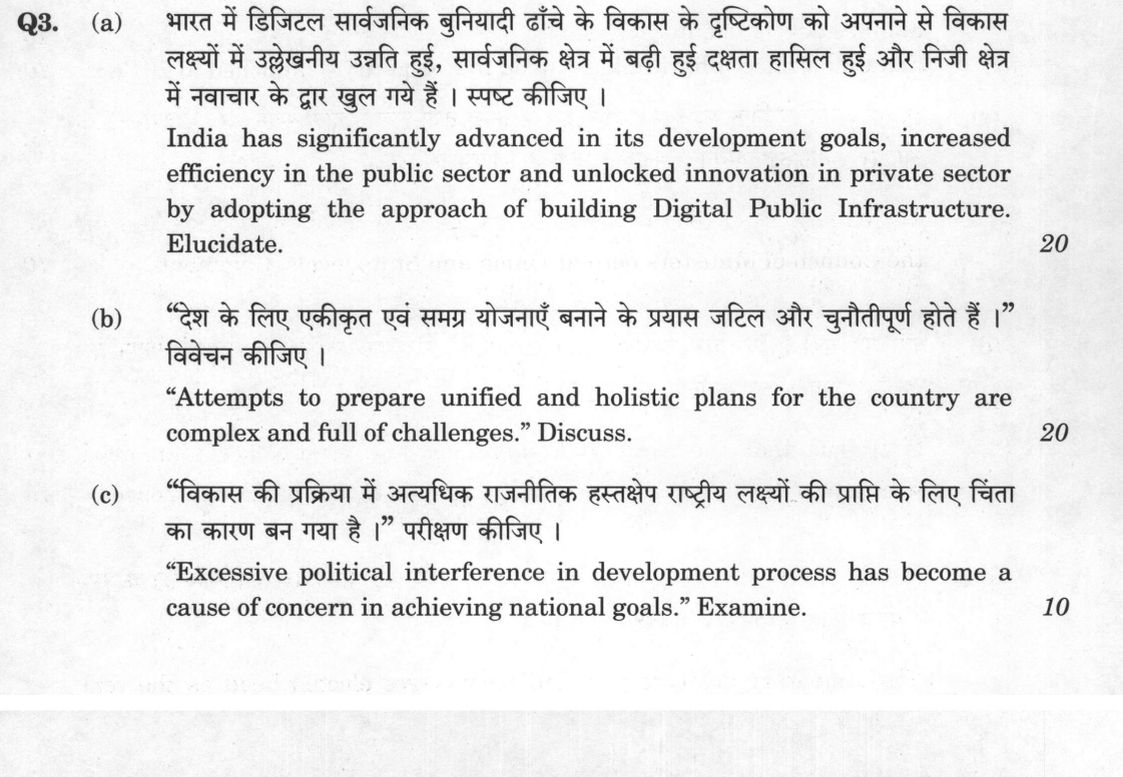
India has significantly advanced in its development goals, increased efficiency in the public sector and unlocked innovation in private sector by adopting the approach of building Digital Public Infrastructure. Elucidate. 20 marks
"Attempts to prepare unified and holistic plans for the country are complex and full of challenges." Discuss. 20 marks
"Excessive political interference in development process has become a cause of concern in achieving national goals." Examine. 10 marks
हिंदी में प्रश्न पढ़ें
भारत में डिजिटल सार्वजनिक बुनियादी ढांचे के विकास के दृष्टिकोण को अपनाने से विकास लक्ष्यों में उल्लेखनीय उन्नति हुई, सार्वजनिक क्षेत्र में बढ़ी हुई दक्षता हासिल हुई और निजी क्षेत्र में नवाचार के द्वार खुल गये हैं । स्पष्ट कीजिए । 20
"देश के लिए एकीकृत एवं समग्र योजनाएं बनाने के प्रयास जटिल और चुनौतीपूर्ण होते हैं।" विवेचन कीजिए । 20
"विकास की प्रक्रिया में अत्यधिक राजनीतिक हस्तक्षेप राष्ट्रीय लक्ष्यों की प्राप्ति के लिए चिंता का कारण बन गया है।" परीक्षण कीजिए । 10
Model answer
Written by UPSC Answer Check against this question's marking rubric, to the expected length. UPSC does not publish answers for Mains — this is one way to score well, not an official key.
Digital Public Infrastructure and Development
Digital Public Infrastructure (DPI) in India represents open, interoperable, and publicly governed digital building blocks—formalized through the India Stack—that democratize service delivery. Foundational identity via Aadhaar (over 1.3 billion enrolments), interoperable transactions via the Unified Payments Interface (UPI processing over 10 billion monthly transactions), DigiLocker, Co-WIN, and the Open Network for Digital Commerce (ONDC) have accelerated Sustainable Development Goals (SDGs). In the public domain, the Jan Dhan-Aadhaar-Mobile (JAM) trinity has streamlined targeted welfare delivery; Direct Benefit Transfer (DBT) mechanisms have curtailed leakages, generating cumulative fiscal savings exceeding ₹2.2 lakh crore. In the private sector, open APIs have unlocked enterprise innovation, allowing fintech unicorns to build low-cost credit, insurance, and logistics solutions atop public rails. However, optimizing DPI requires rectifying structural limitations: the persistent digital divide, last-mile exclusion errors in biometric authentication, and data privacy vulnerabilities, which demand a targeted "DPI+" approach with robust human-centric inclusion layers.
Complexities of Unified and Holistic Planning
Formulating holistic national plans within a diverse, multi-tiered federal framework involves deep structural and administrative friction. Horizontally, entrenched departmental silos hinder cross-sectoral coordination; vertically, Centre-State fiscal discords—frequently visible in GST Council negotiations—strain programmatic alignment. The structural transition from the erstwhile Planning Commission's centralized resource allocation to NITI Aayog’s mandate of cooperative federalism underscores this complexity. NITI Aayog relies on soft persuasion and monitoring mechanisms like the SDG India Index, yet faces challenges of localized data asymmetry, uneven technical capacity across municipal bodies, and divergent state political priorities. Interventions like the Aspirational Districts Programme have improved grassroots convergence, but inter-departmental fragmentation persists. Similarly, while PM Gati Shakti and the National Master Plan attempt integrated infrastructure planning through GIS-based spatial coordination, multi-agency synchronization and uneven sub-national commitment remain operational bottlenecks.
Political Interference in the Development Process
Excessive political interference impairs administrative continuity and rational resource allocation. Frequent, arbitrary transfers of civil servants—reducing the average tenure of district and department heads to under 18 months—erode administrative accountability and institutional memory. The prioritization of short-term populist handouts over durable capital assets, alongside the premature inauguration of incomplete projects for electoral gains, distorts national development priorities. Institutional frictions with regulatory and statutory bodies, including the Reserve Bank of India and market regulators, further strain policy coherence. These interventions generate policy instability, evident in developmental shifts such as the Amaravati capital project redesign, arbitrary re-prioritization of major irrigation networks, and severe interstate variances in implementing statutory schemes like MGNREGA.
Conclusion
Achieving India's long-term development targets demands a synergy between digital public infrastructure, rationalized multi-level planning, and depoliticized governance. Strengthening statutory mechanisms, such as Civil Services Boards for tenure stability, alongside collaborative platforms like the Inter-State Council, is vital to insulate the development process from political volatility while driving inclusive growth.
What "Elucidate" is asking you to do
Make a stated proposition plain and then prove it with instances. Elucidate stems almost always carry a claim or a named concept, and very often the words “with examples” or “with suitable diagrams” — the illustration is part of the directive, not decoration.
Structure that answers it
Plain-language statement of what the proposition means → the part that is obscure, resolved → first illustration → second illustration → why the proposition holds
Where marks are lost
Adding terminology; elucidate rewards removing it. The commoner loss is a clean explanation with no example, when the stem asked for examples.
How this answer will be evaluated
Approach
Framework: Public Administration Paper II: Concept > Thinker > Indian Institutional Application > Reform. (a) explain: definition/context > points in order > small example > short close | (b) discuss: intro > 3-4 dimensions > example > balanced close | (c) examine: intro > how/why with reasoning > evidence > conclusion Full marks: Precise, well-structured, with specific Indian examples and references to committees/reforms.
Key points expected
- Define Digital Public Infrastructure (DPI) components (Aadhaar, UPI, ONDC, DigiLocker).
- Link specific DPI tools to public sector efficiency (e.g., Direct Benefit Transfer).
- Explain how DPI unlocks private sector innovation (e.g., fintech, e-commerce).
- Connect DPI adoption to broader development goals (inclusion, transparency).
- Identify structural challenges (federalism, state autonomy, resource constraints).
- Discuss data and information gaps in planning.
- Analyze the tension between centralization and local needs.
- Explain the difficulty of integrating diverse sectors (health, education, infra).
Evaluation rubric
Each sub-part is marked on its own, against the marks and word limit printed on the paper.
- (a) Explain how DPI adoption has advanced development goals, public sector efficiency, and private sector innovation. 20 marks
explain— definition/context → points in order → small example → short close
Must cover
- Define Digital Public Infrastructure (DPI) components (Aadhaar, UPI, ONDC, DigiLocker).
- Link specific DPI tools to public sector efficiency (e.g., Direct Benefit Transfer).
- Explain how DPI unlocks private sector innovation (e.g., fintech, e-commerce).
- Connect DPI adoption to broader development goals (inclusion, transparency).
Loses marks
- Generic discussion of IT without specific DPI examples.
- Ignoring the private sector innovation aspect.
- Failing to link to public sector efficiency.
Earns more
- Mention specific schemes like PM-KISAN or Ayushman Bharat using DPI.
- Discuss the role of ONDC in market democratization.
- Reference the 'India Stack' concept.
- Mention data privacy safeguards (DPDP Act).
Extra mark
- Cite specific statistics on UPI transaction volume or Aadhaar usage.
- Reference the 2nd ARC recommendations on e-governance.
- (b) Discuss the complexities and challenges in preparing unified and holistic national plans. 20 marks
discuss— intro → 3-4 dimensions → example → balanced close
Must cover
- Identify structural challenges (federalism, state autonomy, resource constraints).
- Discuss data and information gaps in planning.
- Analyze the tension between centralization and local needs.
- Explain the difficulty of integrating diverse sectors (health, education, infra).
Loses marks
- Vague generalities without specific administrative challenges.
- Ignoring the federal dimension of planning.
- Failing to address the 'holistic' aspect of the prompt.
Earns more
- Reference the shift from Five Year Plans to NITI Aayog's approach.
- Mention the role of data analytics in modern planning.
- Discuss the challenge of implementation vs. formulation.
- Reference the 15th Finance Commission's role in resource allocation.
Extra mark
- Cite specific examples of planning failures or successes.
- Reference the 2nd ARC recommendations on planning.
- (c) Examine how excessive political interference hinders the achievement of national development goals. 10 marks
examine— intro → how/why with reasoning → evidence → conclusion
Must cover
- Define political interference in the development process.
- Explain how it distorts policy priorities (short-termism vs. long-term goals).
- Discuss the impact on administrative autonomy and meritocracy.
- Link interference to delays or failures in achieving national goals.
Loses marks
- Generalizing without specific examples of interference.
- Failing to link to 'national goals'.
- Ignoring the administrative perspective.
Earns more
- Mention the role of the Civil Services Act in protecting officers.
- Reference the 2nd ARC recommendations on political-administrative interface.
- Discuss the impact on project implementation (e.g., land acquisition).
- Mention the role of the CVC or Lokpal in curbing interference.
Extra mark
- Cite specific cases of political interference in development projects.
- Reference the 2nd ARC recommendations on the political-administrative interface.
Practice this exact question
Write your answer and it is marked point by point against the model answer above — what you covered, what you missed, what you got wrong.
Evaluate my answer →More from Public Administration 2023 Paper II
- Q1 Answer the following in about 150 words each : 10×5=50 (a) "Kautilya's Arthashastra is a…
- Q2 (a) "Indian Prime Minister is more empowered than his British counterpart in the Westmins…
- Q3 (a) India has significantly advanced in its development goals, increased efficiency in th…
- Q4 (a) "There shall be Council of Ministers with the Chief Minister at the head to aid and a…
- Q5 Answer the following in about 150 words each : 10×5=50 (a) The district training componen…
- Q6 (a) "Civil Service Reforms along with a transparent transfer policy will go a long way in…