Paper II — Q6
(a) "Civil Service Reforms along with a transparent transfer policy will go a long way in insulating civil servants from…
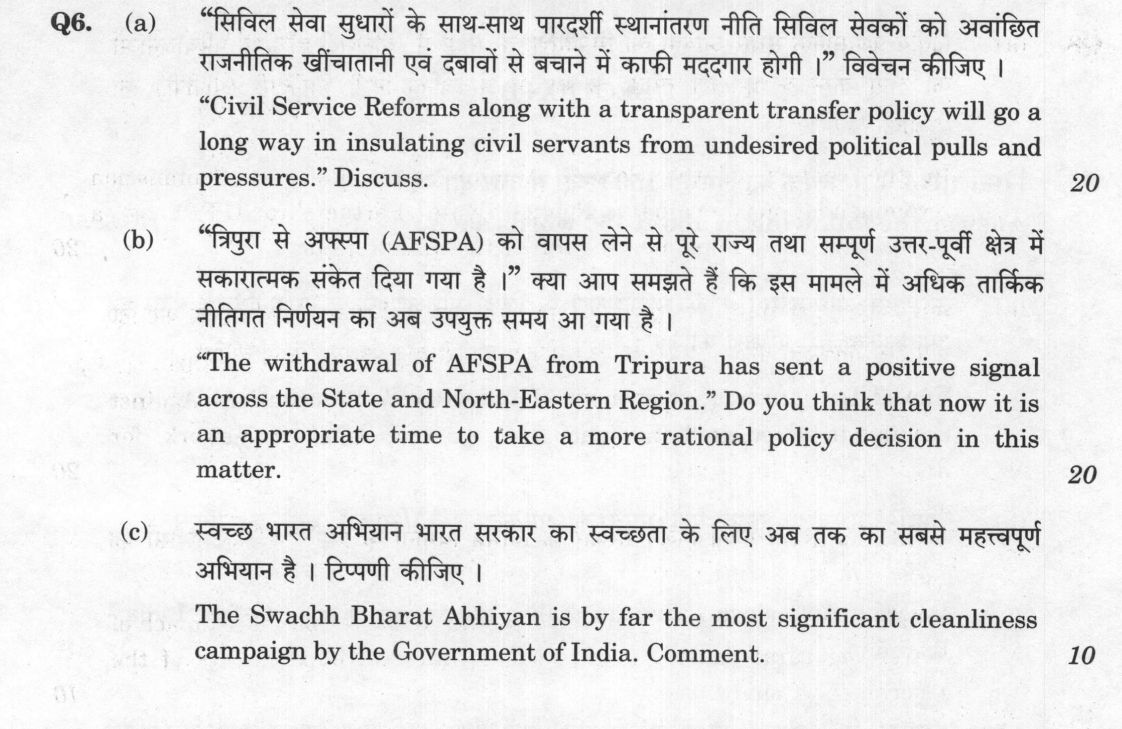
"Civil Service Reforms along with a transparent transfer policy will go a long way in insulating civil servants from undesired political pulls and pressures." Discuss. 20 marks
"The withdrawal of AFSPA from Tripura has sent a positive signal across the State and North-Eastern Region." Do you think that now it is an appropriate time to take a more rational policy decision in this matter. 20 marks
The Swachh Bharat Abhiyan is by far the most significant cleanliness campaign by the Government of India. Comment. 10 marks
हिंदी में प्रश्न पढ़ें
"सिविल सेवा सुधारों के साथ-साथ पारदर्शी स्थानांतरण नीति सिविल सेवकों को अवांछित राजनीतिक खींचतानी एवं दबावों से बचाने में काफी मददगार होगी।" विवेचन कीजिए। 20
"त्रिपुरा से अफ्स्पा (AFSPA) को वापस लेने से पूरे राज्य तथा सम्पूर्ण उत्तर-पूर्वी क्षेत्र में सकारात्मक संकेत दिया गया है।" क्या आप समझते हैं कि इस मामले में अधिक तार्किक नीतिगत निर्णय का अब उपयुक्त समय आ गया है। 20
स्वच्छ भारत अभियान भारत सरकार का स्वच्छता के लिए अब तक का सबसे महत्वपूर्ण अभियान है। टिप्पणी कीजिए। 10
Model answer
Written by UPSC Answer Check against this question's marking rubric, to the expected length. UPSC does not publish answers for Mains — this is one way to score well, not an official key.
Democratic governance in India requires institutional capacity rooted in administrative autonomy, security frameworks sensitive to constitutional morality, and citizen-centric service delivery.
Insulating Civil Servants: Transfer Policies and Structural Reforms
The vulnerability of civil servants to frequent, arbitrary transfers undermines administrative continuity, morale, and institutional memory. As highlighted by the Second Administrative Reforms Commission (2nd ARC), tenure security is indispensable for civil service neutrality and professional competence. In the landmark T.S.R. Subramanian v. Union of India (2013) ruling, the Supreme Court mandated key institutional safeguards: the constitution of Civil Services Boards (CSBs) to regulate transfers, fixed minimum tenures under DoPT rules, and the formal recording of oral instructions from political executives to prevent undue pressure. Complementing these, e-governance solutions—such as online cadre management and automated transfer systems like the PARASTAR portal—reduce discretionary patronage by introducing transparent, rule-based postings.
However, transparent transfer rules alone cannot completely insulate the bureaucracy. State governments frequently bypass CSBs by designating them as purely advisory, resorting to ad-hoc transfers under the guise of "administrative exigencies," or creating non-descript ex-cadre posts as "punishment postings." Political control is also retained through subjective performance appraisals, discretionary vigilance clearances, and empanelment preferences. Therefore, while fixed tenures and digital transfers establish necessary structural safeguards, insulating the civil service requires wider reforms, including objective 360-degree appraisal mechanisms, statutory autonomy for CSBs, and political commitment to the constitutional division between policy formulation and operational administration.
Rationalizing AFSPA Post-Tripura
Tripura’s complete withdrawal of the Armed Forces (Special Powers) Act (AFSPA) in 2015 marked a watershed in internal security management. By combining state police modernization, intelligence-led counter-insurgency, infrastructure development, and political settlements via the Tripura Tribal Areas Autonomous District Council, the state demonstrated that enduring peace is best built on developmental and democratic consolidation rather than prolonged exceptional laws.
Tripura provides a template for a rational review of AFSPA across the North-East and Jammu & Kashmir (post-Article 370). Prolonged military deployment in internal policing strains civil-military relations and creates severe human rights friction, as highlighted by the Justice Jeevan Reddy Committee, the Hegde Commission, and public resistance ranging from Irom Sharmila’s historic fast to protests after the 2021 Mon incident in Nagaland.
Nevertheless, policy rationalization must balance civil liberties with genuine operational concerns of the armed forces facing asymmetric proxy warfare, porous borders, and volatile internal dynamics, exemplified by the 2023 ethnic conflict in Manipur. A rational approach avoids a binary choice between blanket enforcement and sudden total repeal. Instead, it entails:
- Calibrated, phased reduction of "Disturbed Area" notifications to specific vulnerable border districts, as recently initiated in parts of Assam, Nagaland, and Manipur.
- Modernizing state police forces to assume primary law-and-order duties.
- Deepening political accommodation through Sixth Schedule autonomous councils.
- Incorporating statutory safeguards within AFSPA to ensure strict operational accountability.
Swachh Bharat Abhiyan: Significance and Critical Gaps
The Swachh Bharat Abhiyan (SBA) is the most significant sanitation initiative in India’s administrative history because it shifted policy focus from subsidy-driven toilet construction to mass behavioural change (Jan Andolan) using principles of nudge theory. Constructing over 100 million household latrines and achieving universal Open Defecation Free (ODF) declarations catalyzed preventive public health and restored dignity, especially for women.
However, critical implementation deficits persist. The transition to ODF Plus/ODF Sustainability faces severe challenges in scientific waste processing under the Solid Waste Management Rules, 2016. Significant urban-rural disparities exist in fecal sludge management and piped water connectivity needed to sustain toilet usage. Furthermore, the persistent and hazardous practice of manual scavenging, despite the 2013 Prohibition Act, highlights that physical asset creation must be matched by mechanized sanitation infrastructure and social rehabilitation.
Moving forward, institutionalizing administrative neutrality via transparent transfers, balancing operational security needs with constitutional rights through rational AFSPA reforms, and refining citizen-centric initiatives like SBA together form the essential foundation for strengthening state capacity and democratic governance.
What "Discuss" is asking you to do
Lay the issue out from more than one side — how it arose, what is claimed for it, what is held against it, and where it now stands. UPSC attaches discuss to broad topics with several live dimensions, so coverage of the dimensions earns more than the strength of your opinion.
Structure that answers it
Set the issue up → the case as it is made → the case against → the dimension both sides leave out → where the balance now lies
Where marks are lost
Listing facts with no thread between them, or arguing one side throughout and calling it a discussion.
How this answer will be evaluated
Approach
Framework: Public Administration Paper II (Indian Administrative Context). (a) discuss: intro > 3-4 dimensions > example > balanced close | (b) discuss: intro > 3-4 dimensions > example > balanced close | (c) comment: context > arguments both sides > judgment > close Full marks: Comprehensive, well-structured, with specific Indian examples and references to relevant committees or policies.
Key points expected
- Define 'political pulls' and 'pressure' in Indian context
- Explain the mechanism of transparent transfer policy
- Link reforms to insulation from political interference
- Provide examples of political interference in transfers
- Explain the significance of AFSPA withdrawal from Tripura
- Analyze the 'positive signal' for the North-East region
- Assess the current security situation in the region
- Argue for or against a 'rational policy decision' now
Evaluation rubric
Each sub-part is marked on its own, against the marks and word limit printed on the paper.
- (a) Analyze the role of reforms and transfer policy in protecting civil servants from political pressure. 20 marks
discuss— intro → 3-4 dimensions → example → balanced close
Must cover
- Define 'political pulls' and 'pressure' in Indian context
- Explain the mechanism of transparent transfer policy
- Link reforms to insulation from political interference
- Provide examples of political interference in transfers
Loses marks
- Generic discussion without Indian administrative context
- Ignoring the 'transfer policy' aspect of the question
- Failing to distinguish between 'pulls' and 'pressures'
Earns more
- Mention 2nd ARC recommendations on transfers
- Reference specific reform acts or committees
- Discuss the role of the Central Vigilance Commission
- Mention the concept of 'insulation' in administrative theory
Extra mark
- Cite a specific Supreme Court judgment on transfers
- Reference the 2014 or 2019 transfer policy changes
- (b) Evaluate the timing and rationality of a policy decision on AFSPA withdrawal. 20 marks
discuss— intro → 3-4 dimensions → example → balanced close
Must cover
- Explain the significance of AFSPA withdrawal from Tripura
- Analyze the 'positive signal' for the North-East region
- Assess the current security situation in the region
- Argue for or against a 'rational policy decision' now
Loses marks
- Ignoring the 'North-Eastern Region' context
- Failing to address the 'rational policy decision' aspect
- Generic discussion on AFSPA without specific regional focus
Earns more
- Mention the specific date of AFSPA withdrawal from Tripura
- Reference the 2015 or 2016 security situation in the North-East
- Discuss the role of the National Security Advisory Board
- Mention the impact on local governance and civil liberties
Extra mark
- Cite a specific incident or data point on security improvement
- Reference a specific committee report on North-East security
- (c) Comment on the significance of Swachh Bharat Abhiyan as a cleanliness campaign. 10 marks
comment— context → arguments both sides → judgment → close
Must cover
- Define the scope of Swachh Bharat Abhiyan
- Explain why it is considered 'most significant'
- Mention key achievements or targets of the campaign
- Provide a balanced view on its impact
Loses marks
- Generic discussion on cleanliness without specific campaign details
- Ignoring the 'significance' aspect of the question
- Failing to provide a balanced view
Earns more
- Mention the 'Open Defecation Free' (ODF) status
- Reference the role of local self-governments
- Discuss the behavioral change aspect of the campaign
- Mention the 'Swachh Survekshan' index
Extra mark
- Cite a specific statistic on toilet construction
- Reference a specific state or city's success story
Practice this exact question
Write your answer and it is marked point by point against the model answer above — what you covered, what you missed, what you got wrong.
Evaluate my answer →More from Public Administration 2023 Paper II
- Q3 (a) India has significantly advanced in its development goals, increased efficiency in th…
- Q4 (a) "There shall be Council of Ministers with the Chief Minister at the head to aid and a…
- Q5 Answer the following in about 150 words each : 10×5=50 (a) The district training componen…
- Q6 (a) "Civil Service Reforms along with a transparent transfer policy will go a long way in…
- Q7 (a) Accountability of the Executive to the Parliament in the domain of financial administ…
- Q8 (a) In the context of the Second Administrative Reforms Commission recommendations, evalu…