Paper II — Q7
(a) Accountability of the Executive to the Parliament in the domain of financial administration is secured through CAG reports…
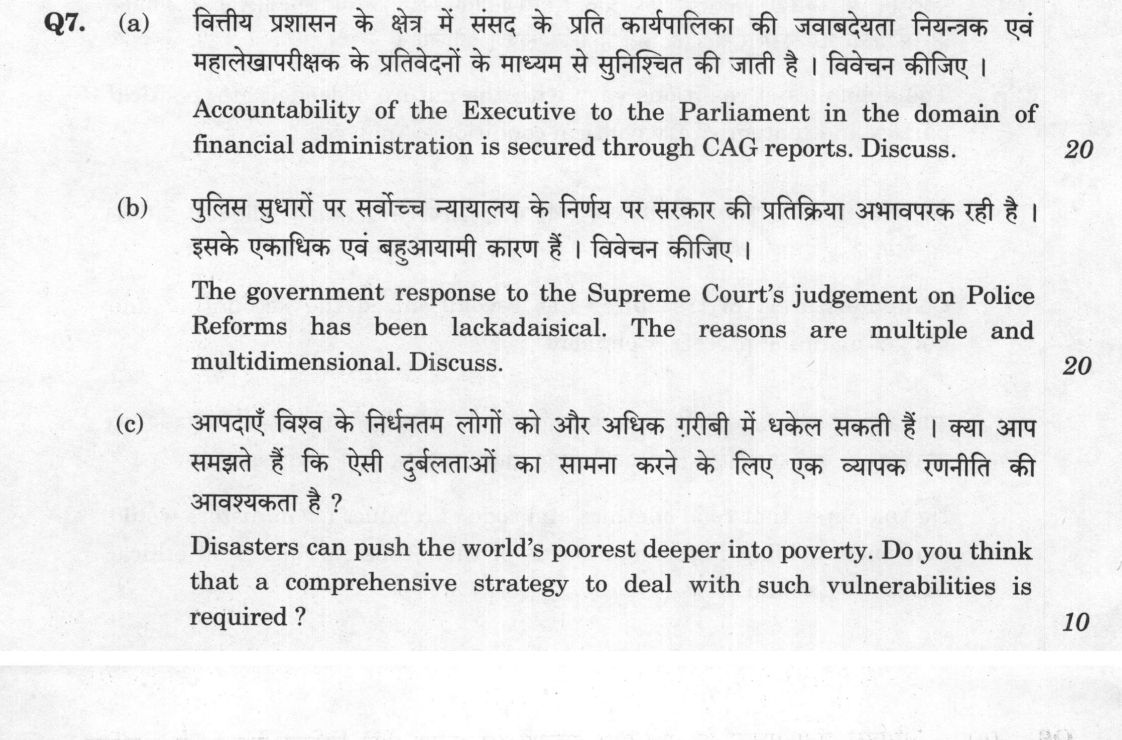
Accountability of the Executive to the Parliament in the domain of financial administration is secured through CAG reports. Discuss. 20 marks
The government response to the Supreme Court's judgement on Police Reforms has been lackadaisical. The reasons are multiple and multidimensional. Discuss. 20 marks
Disasters can push the world's poorest deeper into poverty. Do you think that a comprehensive strategy to deal with such vulnerabilities is required? 10 marks
हिंदी में प्रश्न पढ़ें
वित्तीय प्रशासन के क्षेत्र में संसद के प्रति कार्यपालिका की जवाबदेहिता नियंत्रक एवं महालेखापरीक्षक के प्रतिवेदनों के माध्यम से सुनिश्चित की जाती है। विवेचन कीजिए। 20
पुलिस सुधारों पर सर्वोच्च न्यायालय के निर्णय पर सरकार की प्रतिक्रिया अभावपरक रही है। इसके एकाधिक एवं बहुआयामी कारण हैं। विवेचन कीजिए। 20
आपदाएं विश्व के निर्धनतम लोगों को और अधिक गरीबी में धकेल सकती हैं। क्या आप समझते हैं कि ऐसी दुर्बलताओं का सामना करने के लिए एक व्यापक रणनीति की आवश्यकता है? 10 marks
Model answer
Written by UPSC Answer Check against this question's marking rubric, to the expected length. UPSC does not publish answers for Mains — this is one way to score well, not an official key.
Democratic governance hinges on mechanisms of parliamentary oversight, institutional autonomy under the rule of law, and systemic social protection. Financial accountability through audit, structural police reforms, and vulnerability mitigation against disasters form three vital pillars of citizen-centric public administration in India.
CAG Reports and Financial Accountability
Under Articles 148 to 151 of the Constitution, the Comptroller and Auditor General (CAG) acts as the independent guardian of the public purse. Executive accountability to Parliament in financial administration is anchored in the CAG’s audit mandates. This has evolved from traditional compliance and regularity audits (verifying legal appropriation, sanction, and adherence to financial rules) to comprehensive efficiency, economy, and effectiveness audits—the 3E framework—culminating in outcome-oriented performance auditing.
CAG reports submitted under Article 151 are referred to the Public Accounts Committee (PAC), a parliamentary panel traditionally headed by an opposition leader. The PAC relies on CAG findings to examine department secretaries, cross-examine spending irregularities, and submit remedial reports to Parliament. High-profile CAG reports—such as those concerning 2G spectrum allocation, coal block allocations, and defence procurements—have historically exposed procedural deviations and fiscal leakages, enabling Parliament to hold the political executive publicly accountable.
However, this mechanism operates with clear constraints. The audit is inherently post-facto, conducting an ex-post examination after funds are disbursed. CAG reports and PAC recommendations are purely advisory and non-binding on the executive. Lacking powers of judicial disallowance or surcharge enforcement, the CAG relies on legislative and public pressure rather than direct executive deterrence.
Impediments to Police Reforms
In the landmark Prakash Singh v. Union of India (2006), the Supreme Court issued seven binding directives to insulate the police from illegitimate influence. These included setting up State Security Commissions, guaranteeing fixed two-year tenures for DGPs and operational police chiefs, separating investigation from law and order, and instituting Police Establishment Boards and Police Complaints Authorities. Despite subsequent judicial interventions in 2018 (regulating DGP appointments) and 2022 (mandating compliance monitoring), implementation across states remains lackadaisical.
The causes of this inertia are multidimensional:
First, political executive resistance remains the foremost hurdle, as governments are reluctant to surrender discretionary control over policing, frequently treating the force as an instrument for regime protection rather than autonomous law enforcement. Second, federalism tensions play a central role; because 'Public Order' and 'Police' are State subjects (List II, Seventh Schedule), states perceive binding judicial blueprints as encroachments on legislative autonomy. Third, bureaucratic inertia and a shared reluctance among civil administrative hierarchies perpetuate status-quo arrangements. Finally, a lack of bipartisan political consensus has led states to enact diluted state police legislation or issue temporary executive orders that formally comply while subverting the reform's core intent.
Disaster-Poverty Nexus and Comprehensive Strategy
Disasters aggravate structural poverty by disproportionately affecting the poor, whose dwellings and assets are concentrated in hazard-prone marginal areas. The poor rely on informal livelihoods, possess minimal savings, and lack formal insurance or social security, causing single shock events to destroy productive capital and trigger intergenerational poverty traps.
In line with the Sendai Framework for Disaster Risk Reduction, an effective anti-poverty response necessitates a comprehensive disaster management strategy. Essential components include pre-disaster resilience through strict enforcement of disaster-resilient building codes, land-use zoning, and localized multi-hazard early warning systems. Financially, it requires scalable social protection floors (such as adaptive public works) and parametric disaster micro-insurance to protect informal assets. It also requires integrating disaster risk reduction with climate change adaptation. Although the Disaster Management Act, 2005 established an institutional architecture through NDMA and SDRFs, persistent gaps remain in implementation—notably the failure to mainstream disaster mitigation into local municipal and panchayat-level developmental planning.
Way Forward
Sustaining constitutional democracy requires reinforcing these administrative structures. Strengthening parliamentary follow-up on CAG audit paras, enforcing judicial mandates on police autonomy with institutional teeth, and integrating risk reduction into poverty alleviation frameworks are indispensable steps toward a transparent, legally accountable, and resilient governance ecosystem.
What "Discuss" is asking you to do
Lay the issue out from more than one side — how it arose, what is claimed for it, what is held against it, and where it now stands. UPSC attaches discuss to broad topics with several live dimensions, so coverage of the dimensions earns more than the strength of your opinion.
Structure that answers it
Set the issue up → the case as it is made → the case against → the dimension both sides leave out → where the balance now lies
Where marks are lost
Listing facts with no thread between them, or arguing one side throughout and calling it a discussion.
How this answer will be evaluated
Approach
Framework: Public Administration Paper II (Indian Administrative Context). (a) discuss: intro > 3-4 dimensions > example > balanced close | (b) discuss: intro > 3-4 dimensions > example > balanced close | (c) comment: context > arguments both sides > judgment > close Full marks: Precise statutory references (Art 148, Prakash Singh), clear institutional mechanisms (PAC, 2nd ARC), and strong analytical depth.
Key points expected
- Cite Article 148 and Article 149 of the Constitution
- Explain the role of the Public Accounts Committee (PAC)
- Describe the process of CAG report submission to Parliament
- Link CAG findings to the Executive's financial responsibility
- Cite the Prakash Singh v. Union of India (2006) judgment
- Identify the 6 key directives of the judgment (tenure, transfer, etc.)
- Discuss the conflict between State and Centre on police control
- Analyze the political resistance to professionalization of police
Evaluation rubric
Each sub-part is marked on its own, against the marks and word limit printed on the paper.
- (a) Explain the mechanism of CAG reports in securing Executive accountability to Parliament. 20 marks
discuss— intro → 3-4 dimensions → example → balanced close
Must cover
- Cite Article 148 and Article 149 of the Constitution
- Explain the role of the Public Accounts Committee (PAC)
- Describe the process of CAG report submission to Parliament
- Link CAG findings to the Executive's financial responsibility
Loses marks
- Confusing CAG with the Finance Commission
- Failing to mention the Public Accounts Committee (PAC)
- Treating CAG as a pre-audit body rather than post-audit
Earns more
- Mention the distinction between Audit and Accountability
- Reference the Comptroller and Auditor General's (CAG) Act
- Discuss the 'ex-post' nature of CAG accountability
- Mention the role of the Estimates Committee
Extra mark
- Reference a specific recent CAG report (e.g., on a major scheme)
- Mention the 2nd ARC recommendations on financial accountability
- (b) Analyze the reasons for the government's lackadaisical response to the Supreme Court's Police Reforms judgment. 20 marks
discuss— intro → 3-4 dimensions → example → balanced close
Must cover
- Cite the Prakash Singh v. Union of India (2006) judgment
- Identify the 6 key directives of the judgment (tenure, transfer, etc.)
- Discuss the conflict between State and Centre on police control
- Analyze the political resistance to professionalization of police
Loses marks
- Failing to name the Prakash Singh judgment
- Confusing police reform with general administrative reform
- Ignoring the federal structure (State vs Centre) in police control
Earns more
- Mention the 2nd ARC recommendations on police reform
- Discuss the role of the State Government in police administration
- Reference the Police Act, 1861 as the outdated legal framework
- Mention the lack of a dedicated Police Bill
Extra mark
- Reference the 2019 Supreme Court review of the Prakash Singh judgment
- Mention specific state-level reforms (e.g., Kerala or Rajasthan)
- (c) Provide a judgment on the need for a comprehensive strategy to deal with disaster-induced poverty. 10 marks
comment— context → arguments both sides → judgment → close
Must cover
- Define the link between disasters and poverty (vulnerability)
- Argue for a comprehensive strategy (pre-disaster, during, post)
- Mention the National Disaster Management Act, 2005
- Provide a balanced judgment on the necessity of such a strategy
Loses marks
- Failing to provide a clear judgment (yes/no) on the strategy
- Ignoring the specific impact on the 'poorest' as asked
- Treating it as a general disaster management question without the poverty angle
Earns more
- Mention the Sendai Framework for Disaster Risk Reduction
- Reference the role of NDRF and SDRF
- Discuss the concept of 'Build Back Better'
- Mention the role of insurance and social safety nets
Extra mark
- Reference a specific disaster (e.g., 2004 Tsunami, 2013 Uttarakhand)
- Mention the 2nd ARC recommendations on disaster management
Practice this exact question
Write your answer and it is marked point by point against the model answer above — what you covered, what you missed, what you got wrong.
Evaluate my answer →More from Public Administration 2023 Paper II
- Q4 (a) "There shall be Council of Ministers with the Chief Minister at the head to aid and a…
- Q5 Answer the following in about 150 words each : 10×5=50 (a) The district training componen…
- Q6 (a) "Civil Service Reforms along with a transparent transfer policy will go a long way in…
- Q7 (a) Accountability of the Executive to the Parliament in the domain of financial administ…
- Q8 (a) In the context of the Second Administrative Reforms Commission recommendations, evalu…