Paper II — Q4
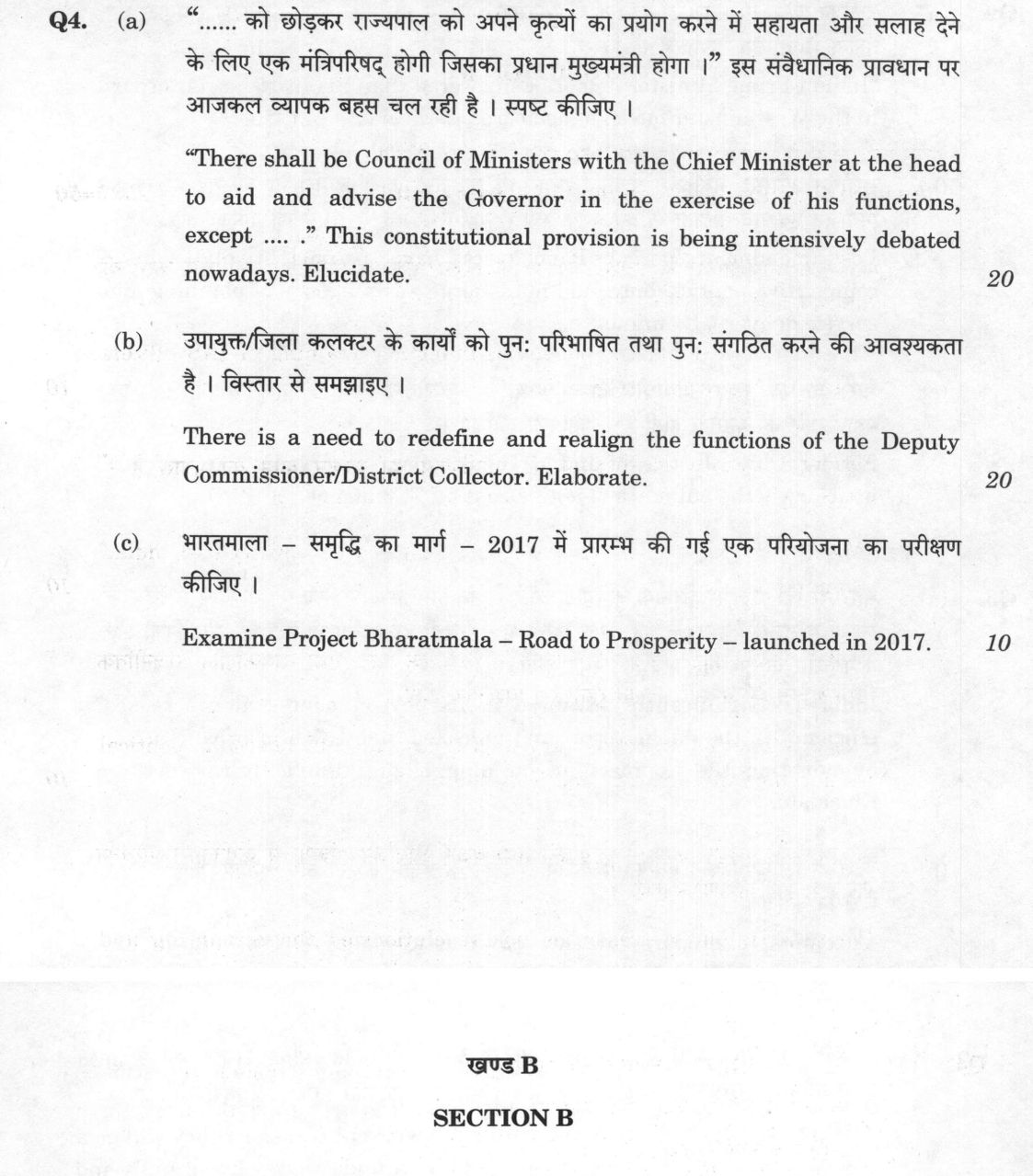
(a) "There shall be Council of Ministers with the Chief Minister at the head to aid and advise the Governor in the exercise of…
"There shall be Council of Ministers with the Chief Minister at the head to aid and advise the Governor in the exercise of his functions, except .... ." This constitutional provision is being intensively debated nowadays. Elucidate. 20 marks
There is a need to redefine and realign the functions of the Deputy Commissioner/District Collector. Elaborate. 20 marks
Examine Project Bharatmala – Road to Prosperity – launched in 2017. 10 marks
हिंदी में प्रश्न पढ़ें
"...... को छोड़कर राज्यपाल को अपने कृत्यों का प्रयोग करने में सहायता और सलाह देने के लिए एक मंत्रिपरिषद् होगी जिसका प्रधान मुख्यमंत्री होगा ।" इस संवैधानिक प्रावधान पर आजकल व्यापक बहस चल रही है । स्पष्ट कीजिए । 20
उपायुक्त/जिला कलक्टर के कार्यों को पुनः परिभाषित तथा पुनः संगठित करने की आवश्यकता है । विस्तार से समझाइए । 20
भारतमाला – समृद्धि का मार्ग – 2017 में प्रारम्भ की गई एक परियोजना का परीक्षण कीजिए । 10
Model answer
Written by UPSC Answer Check against this question's marking rubric, to the expected length. UPSC does not publish answers for Mains — this is one way to score well, not an official key.
Part (a) The Governor–CM controversy turns on a simple constitutional distinction. Article 163(1) requires a Council of Ministers with the Chief Minister at the head to aid and advise the Governor, except where the Constitution requires him to act in his discretion. Article 163(2) does not itself create discretion; it only makes the Governor’s decision on whether a matter falls within his discretion final. The discretion arises from the 163(1) exception and specific constitutional provisions. Shamsher Singh v. State of Punjab (1974) held that the Governor generally acts on ministerial advice, and Nabam Rebia v. H.P. Rajaguru reinforced that he cannot withhold assent arbitrarily except in narrow discretionary cases. Recent Supreme Court observations have cautioned that the Governor’s conduct must remain non-partisan and within constitutional limits.
The debate is intense because the Governor is a constitutional head, yet often perceived as a political appointee. Sarkaria Commission recommended that the Governor should be an independent, non-political head and act on ministerial advice except in clearly defined discretionary situations. Punchhi Commission reinforced this, urging that the Governor should not be from the state or a political appointee, and should use discretion only in narrow constitutional cases. Recent controversies in West Bengal, Kerala and Maharashtra over bills, Assembly summoning and advice to the Chief Minister show whether the Governor acts as a constitutional head or political agent. Thus, under Article 163, the elected government is the real executive unless the Constitution expressly gives the Governor discretion.
Part (b) The Deputy Commissioner/District Collector has evolved from a revenue collector into a development administrator. Historically a revenue officer and magistrate, he now coordinates development, disaster response, public order and scheme implementation. This creates a conflict between magisterial and developmental roles, as the same officer must regulate, enforce and promote growth. The L.M. Singhvi Committee and the Second ARC both recommended reorienting district governance toward development, with clearer separation of regulatory and promotional functions. The D.K. Singh Committee has also called for redefining the Collector’s role and strengthening district-level coordination.
The Collector should remain the head of district administration and the District Disaster Management Authority, but routine regulatory work should be separated from developmental coordination. This would allow the Collector to focus on disaster management, SDG localization, district planning, and monitoring of schemes, while other officers handle revenue, law and order, and regulatory functions. A redefined Collector can act as a development coordinator, ensuring state policies reach the district without administrative overload. This realignment would improve accountability and speed of scheme delivery.
Part (c) Launched in 2017, Project Bharatmala is a road-centric programme to improve connectivity, reduce logistics costs and support growth. Unlike NHDP, which focused mainly on expanding the national highway network, Bharatmala has six components: economic corridors, inter-corridor connectivity, feeder routes, border/strategic roads, coastal/port connectivity roads, and green-field expressways. It is funded through NHAI bonds, EPC contracts, which are government-funded, and HAM models, which involve private participation.
Bharatmala has improved connectivity, especially in the North-East and Himalayan regions, by promoting all-weather roads and strategic links. However, execution has faced delays due to land acquisition, clearances, funding, and implementation bottlenecks; the 2022 deadline for several projects was extended. PM Gati Shakti Master Plan has been used to integrate Bharatmala Phase-II with other ministries’ plans, reducing overlaps and improving coordination.
These parts are linked: Governor-CM friction can delay state policy and land acquisition, weakening district execution. Bharatmala needs smooth state-district coordination, clear regulatory-promotional separation and cooperative federalism. The way forward is to treat the Governor as a non-partisan constitutional head, redefine the Collector as a development coordinator with separated regulatory functions, and execute Bharatmala through Gati Shakti coordination.
What "Elucidate" is asking you to do
Make a stated proposition plain and then prove it with instances. Elucidate stems almost always carry a claim or a named concept, and very often the words “with examples” or “with suitable diagrams” — the illustration is part of the directive, not decoration.
Structure that answers it
Plain-language statement of what the proposition means → the part that is obscure, resolved → first illustration → second illustration → why the proposition holds
Where marks are lost
Adding terminology; elucidate rewards removing it. The commoner loss is a clean explanation with no example, when the stem asked for examples.
How this answer will be evaluated
Approach
Framework: UPSC Public Administration Paper II (Indian Administrative System). (a) explain: definition/context > points in order > small example > short close | (b) discuss: intro > 3-4 dimensions > example > balanced close | (c) examine: intro > how/why with reasoning > evidence > conclusion Full marks: Precise constitutional/administrative references, clear distinction between theory and field reality, and specific Indian examples.
Key points expected
- Cite Article 163 of the Constitution
- Explain the 'aid and advise' mechanism
- Identify the 'except' clause (discretionary powers)
- Discuss the current debate on Governor's discretion
- Identify the current role of DC/Collector
- Highlight the shift from development to law & order
- Discuss the need for realignment to development
- Suggest measures for redefining functions
Evaluation rubric
Each sub-part is marked on its own, against the marks and word limit printed on the paper.
- (a) Elucidate the constitutional provision on Council of Ministers and the current debate surrounding it. 20 marks
explain— definition/context → points in order → small example → short close
Must cover
- Cite Article 163 of the Constitution
- Explain the 'aid and advise' mechanism
- Identify the 'except' clause (discretionary powers)
- Discuss the current debate on Governor's discretion
Loses marks
- Treating Governor as a mere rubber stamp
- Ignoring the 'except' clause entirely
- Confusing Governor with President's role
Earns more
- Reference to Sarkaria Commission
- Mention of 73rd Amendment
- Distinction between discretionary and non-discretionary powers
- Reference to recent state-level controversies
Extra mark
- Citing specific state examples (e.g., J&K, Bihar)
- Reference to 2nd ARC recommendations
- (b) Elaborate on the need to redefine and realign the functions of the Deputy Commissioner/District Collector. 20 marks
discuss— intro → 3-4 dimensions → example → balanced close
Must cover
- Identify the current role of DC/Collector
- Highlight the shift from development to law & order
- Discuss the need for realignment to development
- Suggest measures for redefining functions
Loses marks
- Focusing only on law & order functions
- Ignoring the developmental role
- Treating DC/Collector as a mere revenue officer
Earns more
- Reference to 2nd ARC recommendations
- Mention of 'District Administration' reforms
- Discussion on 'District Collector' vs 'Deputy Commissioner' roles
- Reference to 'District Development Plan'
Extra mark
- Citing specific state reforms (e.g., Kerala, Rajasthan)
- Reference to 'District Administration' committees
- (c) Examine Project Bharatmala – Road to Prosperity – launched in 2017. 10 marks
examine— intro → how/why with reasoning → evidence → conclusion
Must cover
- Define Project Bharatmala
- Mention its launch year (2017)
- Explain its objectives (road connectivity, logistics)
- Discuss its impact on 'Road to Prosperity'
Loses marks
- Confusing with 'Bharatmala' (railway project)
- Ignoring the 'Road to Prosperity' aspect
- Focusing only on construction, not impact
Earns more
- Mention of 'National Highways' expansion
- Reference to 'Logistics' improvement
- Discussion on 'Economic Corridors'
- Mention of 'Green Highways' initiative
Extra mark
- Citing specific highway projects (e.g., Delhi-Mumbai)
- Reference to 'National Logistics Policy'
Practice this exact question
Write your answer and it is marked point by point against the model answer above — what you covered, what you missed, what you got wrong.
Evaluate my answer →More from Public Administration 2023 Paper II
- Q1 Answer the following in about 150 words each : 10×5=50 (a) "Kautilya's Arthashastra is a…
- Q2 (a) "Indian Prime Minister is more empowered than his British counterpart in the Westmins…
- Q3 (a) India has significantly advanced in its development goals, increased efficiency in th…
- Q4 (a) "There shall be Council of Ministers with the Chief Minister at the head to aid and a…
- Q5 Answer the following in about 150 words each : 10×5=50 (a) The district training componen…
- Q6 (a) "Civil Service Reforms along with a transparent transfer policy will go a long way in…
- Q7 (a) Accountability of the Executive to the Parliament in the domain of financial administ…