Paper II — Q2
(a) "Indian Prime Minister is more empowered than his British counterpart in the Westminster model of democracy." Elucidate…
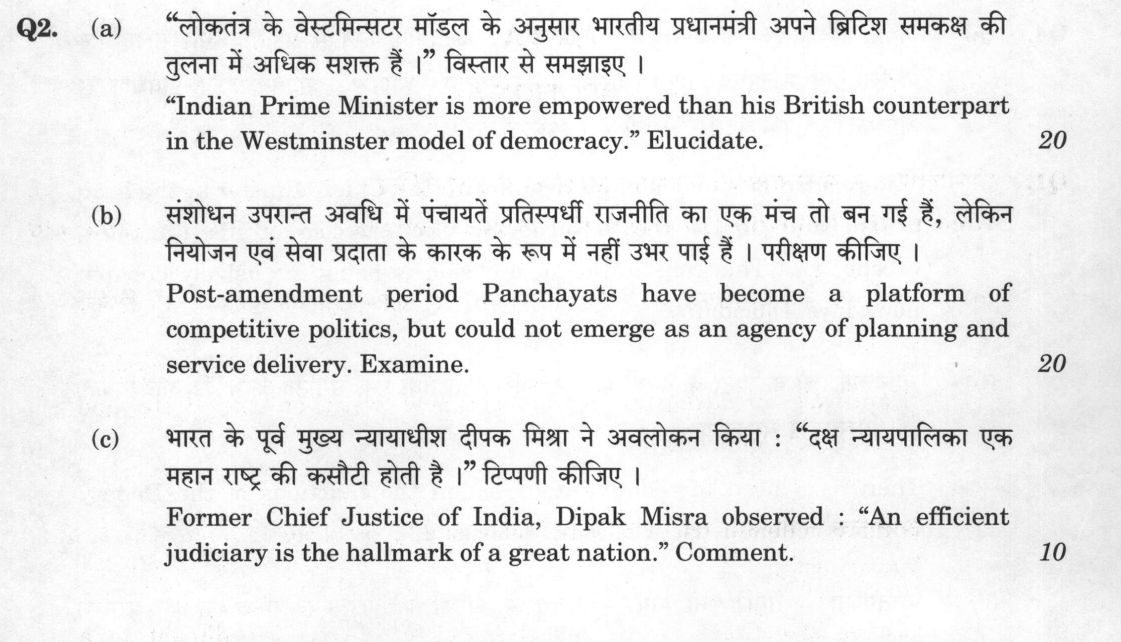
"Indian Prime Minister is more empowered than his British counterpart in the Westminster model of democracy." Elucidate. 20 marks
Post-amendment period Panchayats have become a platform of competitive politics, but could not emerge as an agency of planning and service delivery. Examine. 20 marks
Former Chief Justice of India, Dipak Misra observed : "An efficient judiciary is the hallmark of a great nation." Comment. 10 marks
हिंदी में प्रश्न पढ़ें
"लोकतंत्र के वेस्टमिन्स्टर मॉडल के अनुसार भारतीय प्रधानमंत्री अपने ब्रिटिश समकक्ष की तुलना में अधिक सशक्त हैं।" विस्तार से समझाइए । 20
संशोधन उपरांत अवधि में पंचायतें प्रतिस्पर्धी राजनीति का एक मंच तो बन गई हैं, लेकिन नियोजन एवं सेवा प्रदाता के कारक के रूप में नहीं उभर पाई हैं । परीक्षण कीजिए । 20
भारत के पूर्व मुख्य न्यायाधीश दीपक मिश्रा ने अवलोकन किया : "दक्ष न्यायपालिका एक महान राष्ट्र की कसौटी होती है।" टिप्पणी कीजिए । 10
Model answer
Written by UPSC Answer Check against this question's marking rubric, to the expected length. UPSC does not publish answers for Mains — this is one way to score well, not an official key.
Part (a) The Indian Prime Minister is more empowered than the British Prime Minister because Westminster convention is reinforced in India by constitutional and statutory levers. Article 74 makes the Council of Ministers collectively responsible to the Lok Sabha, while Article 75 enables the President to appoint ministers on the PM’s aid and advice; the PM can recommend appointment, dismissal and portfolio changes, making the cabinet his creation. The PM can also recommend dissolution of the Lok Sabha, and the Tenth Schedule anti-defection law penalises defection, making it harder for a government to fall by party switching, though it does not immunise the PM from backbench rebellion or a no-confidence motion. Single-party majorities, ordinance power when Parliament is not in session and emergency provisions under Articles 352, 356 and 360 add quasi-presidential strength. In Britain, the PM’s power is convention-based and checked by parliamentary sovereignty; Brexit showed how Parliament, the courts and party discipline can constrain the PM. Coalition compulsions also matter: even under the Fixed-term Parliaments Act 2011, which briefly made early dissolution difficult absent a two-thirds motion or no-confidence vote, a PM had to manage partners and backbenchers; after its repeal by the Dissolution and Calling of Parliament Act 2022, the formal constraint is gone, but confidence remains decisive. Thus the Indian PM has clearer constitutional levers and stronger cabinet control.
Part (b) Post-73rd Amendment Panchayats have become a platform of competitive politics, but their performance as planning and service-delivery agencies remains uneven. The 73rd Amendment gave constitutional status to panchayats, listed subjects in the 11th Schedule and provided for State Finance Commissions to recommend devolution of funds. Read with the 74th Amendment, District Planning Committees under Article 243-ZD were meant to integrate rural and urban planning, but their activation has often been weak. Party-based elections, criminalization and caste factionalism have turned many gram sabhas and panchayat meetings into arenas of local power contests rather than deliberative planning. The core problem is the absence of genuine devolution of the 3Fs—functions, functionaries and funds. Many states assign functions nominally but do not transfer staff, technical capacity or adequate resources; bureaucratic resistance limits panchayat control over implementation. Consequently, panchayats often become election machines rather than development agencies. The contrast between Kerala’s People’s Plan Campaign, where gram sabhas were involved in participatory planning and fund allocation, and Bihar’s weaker implementation, where panchayats often lack funds, staff and planning capacity, shows that constitutional status alone is insufficient. Unless states transfer real resources, activate District Planning Committees and reduce criminal-political capture, panchayats will remain competitive political platforms rather than effective agencies of planning and service delivery.
Part (c) Justice Dipak Misra’s observation links judicial efficiency to national greatness. An efficient judiciary is essential for rule of law, economic growth and social cohesion, because delayed justice undermines confidence in contracts, property rights and public administration. India’s challenge is stark: pendency has crossed 5 crore cases, the judge-population ratio is about 19 judges per million compared with the recommended 50, and infrastructure deficits persist. Reforms such as e-Courts, Lok Adalats, case management, the All India Judicial Service debate and the NJAC controversy show that efficiency can be improved without compromising independence. The NJAC debate, for example, highlighted the tension between judicial accountability and separation of powers. A great nation needs not only a large judiciary but a fast, accessible and credible one; therefore, efficiency must be pursued through structural reform, adequate resources and institutional independence. Together, these issues show that democratic governance depends on accountable executive power, effective local institutions and a credible judiciary.
What "Elucidate" is asking you to do
Make a stated proposition plain and then prove it with instances. Elucidate stems almost always carry a claim or a named concept, and very often the words “with examples” or “with suitable diagrams” — the illustration is part of the directive, not decoration.
Structure that answers it
Plain-language statement of what the proposition means → the part that is obscure, resolved → first illustration → second illustration → why the proposition holds
Where marks are lost
Adding terminology; elucidate rewards removing it. The commoner loss is a clean explanation with no example, when the stem asked for examples.
How this answer will be evaluated
Approach
Framework: Westminster Model Comparison. (a) explain: definition/context > points in order > small example > short close | (b) examine: intro > how/why with reasoning > evidence > conclusion | (c) comment: context > arguments both sides > judgment > close Full marks: Comprehensive, well-structured, with specific Indian examples and theoretical depth.
Key points expected
- Cite Article 74 (PM as Council head)
- Mention Article 163 (Govt acts on PM advice)
- Contrast with UK PM's 'First among equals' status
- Reference 73rd Amendment (State PMs)
- Cite 73rd Constitutional Amendment
- Mention 11th/12th Finance Commission grants
- Reference 2nd ARC on Panchayats
- Mention Article 243G (Powers)
Evaluation rubric
Each sub-part is marked on its own, against the marks and word limit printed on the paper.
- (a) Compare PM powers in India vs UK to show Indian PM's greater authority. 20 marks
explain— definition/context → points in order → small example → short close
Must cover
- Cite Article 74 (PM as Council head)
- Mention Article 163 (Govt acts on PM advice)
- Contrast with UK PM's 'First among equals' status
- Reference 73rd Amendment (State PMs)
Loses marks
- GS-2 style answer without theory
- Theory with no Indian anchor
- Failing to distinguish administration from politics
Earns more
- Mention 99th Amendment (GST Council)
- Reference 2nd ARC on PM's role
- Mention Article 356 (President's Rule)
Extra mark
- Cite specific 2nd ARC recommendation
- Reference recent governance reform
- (b) Analyze why Panchayats are political platforms but weak in service delivery. 20 marks
examine— intro → how/why with reasoning → evidence → conclusion
Must cover
- Cite 73rd Constitutional Amendment
- Mention 11th/12th Finance Commission grants
- Reference 2nd ARC on Panchayats
- Mention Article 243G (Powers)
Loses marks
- GS-2 style answer without theory
- Theory with no Indian anchor
- Failing to distinguish administration from politics
Earns more
- Mention 14th Finance Commission
- Reference specific state Panchayat Act
- Mention NITI Aayog's role
Extra mark
- Cite specific 2nd ARC recommendation
- Reference recent governance reform
- (c) Comment on the role of an efficient judiciary in nation-building. 10 marks
comment— context → arguments both sides → judgment → close
Must cover
- Cite Article 32 (Writs)
- Mention Article 141 (Binding nature)
- Reference 2nd ARC on Judiciary
- Mention Article 124 (Appointment)
Loses marks
- GS-2 style answer without theory
- Theory with no Indian anchor
- Failing to distinguish administration from politics
Earns more
- Mention 3rd Judge Case
- Reference specific landmark judgment
- Mention NITI Aayog's role
Extra mark
- Cite specific 2nd ARC recommendation
- Reference recent governance reform
Practice this exact question
Write your answer and it is marked point by point against the model answer above — what you covered, what you missed, what you got wrong.
Evaluate my answer →More from Public Administration 2023 Paper II
- Q1 Answer the following in about 150 words each : 10×5=50 (a) "Kautilya's Arthashastra is a…
- Q2 (a) "Indian Prime Minister is more empowered than his British counterpart in the Westmins…
- Q3 (a) India has significantly advanced in its development goals, increased efficiency in th…
- Q4 (a) "There shall be Council of Ministers with the Chief Minister at the head to aid and a…
- Q5 Answer the following in about 150 words each : 10×5=50 (a) The district training componen…