Paper I — Q1
Answer the following questions in about 150 words each: (a) "Politics-administration dichotomy debate is still alive." Comment…
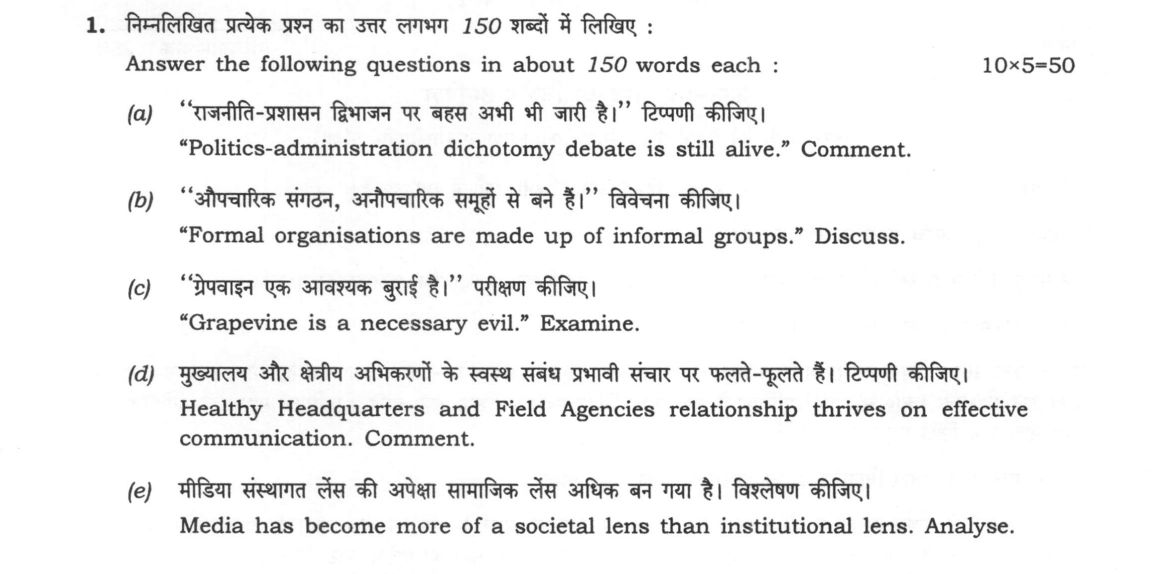
Answer the following questions in about 150 words each:
"Politics-administration dichotomy debate is still alive." Comment. 10 marks
"Formal organisations are made up of informal groups." Discuss. 10 marks
"Grapevine is a necessary evil." Examine. 10 marks
Healthy Headquarters and Field Agencies relationship thrives on effective communication. Comment. 10 marks
Media has become more of a societal lens than institutional lens. Analyse. 10 marks
हिंदी में प्रश्न पढ़ें
निम्नलिखित प्रत्येक प्रश्न का उत्तर लगभग 150 शब्दों में लिखिए :
"राजनीति-प्रशासन द्विभाजन पर बहस अभी भी जारी है।" टिप्पणी कीजिए। (10 अंक)
"औपचारिक संगठन, अनौपचारिक समूहों से बने हैं।" विवेचना कीजिए। (10 अंक)
"ग्रेपवाइन एक आवश्यक बुराई है।" परीक्षण कीजिए। (10 अंक)
मुख्यालय और क्षेत्रीय अभिकरणों के स्वस्थ संबंध प्रभावी संचार पर फलते-फूलते हैं। टिप्पणी कीजिए। (10 अंक)
मीडिया संस्थागत लेंस की अपेक्षा सामाजिक लेंस अधिक बन गया है। विश्लेषण कीजिए। (10 अंक)
Model answer
Written by UPSC Answer Check against this question's marking rubric, to the 150-word length. UPSC does not publish answers for Mains — this is one way to score well, not an official key.
(a) Politics-Administration Dichotomy
The politics-administration dichotomy, originating in Woodrow Wilson’s 1887 essay and formalised by Frank Goodnow’s distinction between the "expression of the state will" (politics) and its "execution" (administration), remains an active administrative reality. Although Dwight Waldo dismantled this strict separation by demonstrating that public administration is inherently value-laden and deeply embedded within the political process, the debate was revived by New Public Management (NPM), which insisted on decoupling policy "steering" by political executives from operational "rowing" by professional managers. In the Indian context, this dichotomy manifests continuously in the interface between the political executive and the All India Services, where frequent politically motivated transfers conflict with civil service neutrality. Similarly, the devolution under the 73rd and 74th Constitutional Amendment Acts reveals persistent operational tensions between local elected representatives asserting policy discretion and line bureaucrats managing administrative execution. Thus, the dichotomy survives not as an absolute empirical reality, but as an indispensable normative standard for balancing democratic accountability with professional competence.
(b) Formal and Informal Organisations
Formal organisations are inevitably structured by and dependent upon informal groups. Elton Mayo’s Hawthorne Studies demonstrated that informal group dynamics, social norms, and peer pressures determine shop-floor productivity far more decisively than formal managerial fiats. Chester Barnard, in The Functions of the Executive, conceptualised the formal organisation as an abstract cooperative system made viable only through informal organisation, which widens the executive's "zone of indifference" and facilitates uncoerced compliance. Blau and Scott reinforced this by viewing the formal organisation as an evolving social system where informal interactions continuously modify formal blueprints. While informal networks generate vital social cohesion and psychological security, they can also cause pathology through informal cliques and resistance to change. In Indian governance, this phenomenon is visible in informal cadre associations, bureaucratic networks, and local caste dynamics within district administration, which constantly influence, bypass, or reinforce formal administrative authority.
(c) Grapevine Dynamics
Keith Davis characterised the grapevine as a "necessary evil" that operates spontaneously through single strand, gossip, probability, and cluster chains. It is "necessary" because it functions with exceptional speed, serves as a vital safety valve for employee frustrations, enhances social cohesion, and fills structural information vacuums left by rigid administrative hierarchies. Conversely, it is an "evil" because it is highly susceptible to distortion, spreads unsubstantiated rumors, damages organizational morale, and can galvanize resistance during administrative transitions. Since the complete suppression of informal communication is impossible and counterproductive, modern public managers cannot eliminate the grapevine. Instead, administrators must manage it constructively through transparent communication, Open Door policies, Management By Walking Around (MBWA), and rapid formal releases of factual information to neutralize misinformation while tapping into informal channels for real-time organizational feedback.
(d) Headquarters-Field Agency Relationships
A functional relationship between Headquarters (HQ) and Field Agencies relies fundamentally on effective two-way communication, directly reflecting Luther Gulick’s principles on decentralisation, delegation, and span of control. HQ focuses on macro-level policy formulation and standard-setting, whereas field agencies execute operations amidst complex local realities; this division creates friction regarding administrative versus technical supervision and dual subordination. Both the Sarkaria Commission and the Punchhi Commission highlighted the danger of excessive centralisation, recommending enhanced operational autonomy for field agencies supported by institutionalised consultative mechanisms. Sustaining this balance requires robust communication channels, including systematic field inspections, structured periodic reporting, joint review conferences, and routine field visits by HQ leadership. Effective communication prevents the micromanagement of field functionaries, safeguards contextual discretion, and prevents administrative bottlenecks without compromising overall central oversight.
(e) Media: Societal versus Institutional Lens
The contemporary media environment has evolved from Walter Lippmann’s institutional model of the "manufacture of consent"—characterised by top-down state messaging through institutional outlets like Doordarshan and All India Radio—into Manuel Castells’ horizontal "network society."
Analysing this transformation reveals reciprocal interactions between state and society: First, decentralised digital platforms such as X and WhatsApp have established a societal lens where citizen journalism and crowdsourced feedback set public priorities from below, forcing institutional actors to respond to real-time public grievances. Second, institutional mechanisms like the Right to Information (RTI) Act, 2005 and Digital India platforms interact with this societal lens, turning media into a citizen-driven tool for administrative transparency and social auditing. However, this societal lens also generates administrative instability by magnifying unverified viral narratives, producing hyper-reactive policymaking, and heightening public polarisation. Consequently, public administration faces the challenge of managing fake news while safeguarding free expression, necessitating independent co-regulation models rather than direct state censorship.
What "Analyse" is asking you to do
Break the subject into its working parts and show how they act on each other. The marks are in the interconnections — which factor drives which, and what the resulting structure explains — not in the inventory of factors.
Structure that answers it
Define the whole → separate it into its parts → show which part drives which → what that interaction produces → what the structure implies
Where marks are lost
A flat list of causes with no account of which drives which. An answer of neatly separated headings, each self-contained, scores as description.
How this answer will be evaluated
Approach
Framework: Public Administration Paper 1 (Concept > Thinker > Indian Application > Reform). (a) comment: context > arguments both sides > judgment > close | (b) discuss: intro > 3-4 dimensions > example > balanced close | (c) examine: intro > how/why with reasoning > evidence > conclusion | (d) comment: context > arguments both sides > judgment > close | (e) analyse: intro > causes > effects > stakeholders/linkages > way forward Full marks: Clear conceptual framework, strong Indian institutional application, and specific reform references.
Key points expected
- Define Woodrow Wilson's politics-administration dichotomy
- Cite Luther Gulick's 'Politics is the science of ends'
- Discuss the 'New Public Administration' critique (1968)
- Provide a judgment on the debate's current relevance
- Define formal organization (structure, rules)
- Define informal groups (social needs, status)
- Explain the 'shadow organization' concept
- Provide a balanced view on their interaction
Evaluation rubric
Each sub-part is marked on its own, against the marks and word limit printed on the paper.
- (a) Contextualize the dichotomy, present arguments for/against, and provide a judgment. · 150 words
comment— context → arguments both sides → judgment → close
Must cover
- Define Woodrow Wilson's politics-administration dichotomy
- Cite Luther Gulick's 'Politics is the science of ends'
- Discuss the 'New Public Administration' critique (1968)
- Provide a judgment on the debate's current relevance
Loses marks
- Treating politics and administration as completely separate
- Ignoring the 'New Public Administration' critique
- GS-2 style answer without administrative theory
Earns more
- Reference to Indian context (e.g., 73rd/74th Amendments)
- Mention of 'New Public Management' (NPM) as a shift
- Reference to the 2nd ARC on political interference
Extra mark
- Citing specific 2nd ARC recommendations on political interference
- Reference to specific Indian administrative reforms (e.g., Lokpal Act)
- (b) Explain the co-existence of formal and informal groups within organizations. · 150 words
discuss— intro → 3-4 dimensions → example → balanced close
Must cover
- Define formal organization (structure, rules)
- Define informal groups (social needs, status)
- Explain the 'shadow organization' concept
- Provide a balanced view on their interaction
Loses marks
- Ignoring the role of informal groups in decision-making
- Treating informal groups as purely negative
- GS-2 style answer without administrative theory
Earns more
- Reference to Elton Mayo's Hawthorne studies
- Example of informal groups in Indian bureaucracy
- Mention of 'cliques' or 'factions' in administration
Extra mark
- Citing specific 2nd ARC recommendations on informal networks
- Reference to specific Indian administrative reforms (e.g., e-governance)
- (c) Analyze the nature of grapevine communication and its pros/cons. · 150 words
examine— intro → how/why with reasoning → evidence → conclusion
Must cover
- Define grapevine (informal communication network)
- Explain why it is 'necessary' (speed, social needs)
- Explain why it is an 'evil' (rumors, distortion)
- Provide a conclusion on managing grapevine
Loses marks
- Ignoring the 'necessary' aspect of grapevine
- Treating grapevine as purely negative
- GS-2 style answer without administrative theory
Earns more
- Reference to 'distortion' or 'filtering' in communication
- Example of grapevine in Indian administrative context
- Mention of 'feedback' role of grapevine
Extra mark
- Citing specific 2nd ARC recommendations on communication
- Reference to specific Indian administrative reforms (e.g., social media)
- (d) Contextualize HQ-Field relationship, present arguments for/against, and provide a judgment. · 150 words
comment— context → arguments both sides → judgment → close
Must cover
- Define Headquarters (HQ) and Field Agencies
- Explain the role of communication in their relationship
- Discuss challenges in HQ-Field communication
- Provide a judgment on effective communication
Loses marks
- Ignoring the role of communication in HQ-Field relationship
- Treating HQ and Field as separate entities
- GS-2 style answer without administrative theory
Earns more
- Reference to 'decentralization' in Indian administration
- Example of HQ-Field communication issues in India
- Mention of 'e-governance' in improving communication
Extra mark
- Citing specific 2nd ARC recommendations on HQ-Field relations
- Reference to specific Indian administrative reforms (e.g., e-governance)
- (e) Analyze the shift of media from institutional to societal lens. · 150 words
analyse— intro → causes → effects → stakeholders/linkages → way forward
Must cover
- Define 'institutional lens' (media as state tool)
- Define 'societal lens' (media as public watchdog)
- Explain the causes of this shift (liberalization, digital age)
- Provide a conclusion on the impact of this shift
Loses marks
- Ignoring the 'institutional lens' aspect of media
- Treating media as purely negative
- GS-2 style answer without administrative theory
Earns more
- Reference to 'liberalization' of media in India (1990s)
- Example of media as 'fourth estate' in India
- Mention of 'social media' as a societal lens
Extra mark
- Citing specific 2nd ARC recommendations on media
- Reference to specific Indian administrative reforms (e.g., RTI Act)
Practice this exact question
Write your answer and it is marked point by point against the model answer above — what you covered, what you missed, what you got wrong.
Evaluate my answer →More from Public Administration 2024 Paper I
- Q1 Answer the following questions in about 150 words each: (a) "Politics-administration dich…
- Q2 (a) McGregor's 'Theory X' and 'Theory Y' provide insights into human motivation at workpl…
- Q3 (a) Strengthening social audit through appropriate ways will promote inclusive government…
- Q4 (a) ERG theory of motivation attempts to reconceptualise the theory of Hierarchy of Needs…