Paper I — Q7
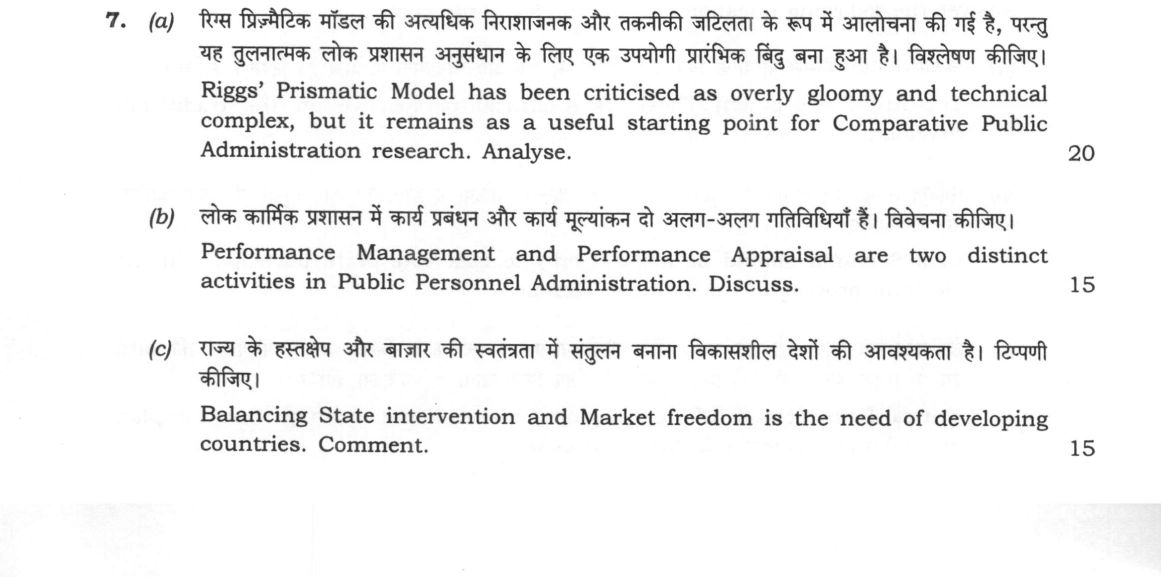
(a) Riggs' Prismatic Model has been criticised as overly gloomy and technical complex, but it remains as a useful starting point…
Riggs' Prismatic Model has been criticised as overly gloomy and technical complex, but it remains as a useful starting point for Comparative Public Administration research. Analyse. 20 marks
Performance Management and Performance Appraisal are two distinct activities in Public Personnel Administration. Discuss. 15 marks
Balancing State intervention and Market freedom is the need of developing countries. Comment. 15 marks
हिंदी में प्रश्न पढ़ें
रिग्स प्रिज्मैटिक मॉडल की अत्यधिक निराशाजनक और तकनीकी जटिलता के रूप में आलोचना की गई है, परंतु यह तुलनात्मक लोक प्रशासन अनुसंधान के लिए एक उपयोगी प्रारंभिक बिंदु बना हुआ है। विश्लेषण कीजिए। (20 अंक)
लोक कर्मिक प्रशासन में कार्य प्रबंधन और कार्य मूल्यांकन दो अलग-अलग गतिविधियां हैं। विवेचना कीजिए। (15 अंक)
राज्य के हस्तक्षेप और बाजार की स्वतंत्रता में संतुलन बनाना विकासशील देशों की आवश्यकता है। टिप्पणी कीजिए। (15 अंक)
Model answer
Written by UPSC Answer Check against this question's marking rubric, to the expected length. UPSC does not publish answers for Mains — this is one way to score well, not an official key.
Riggs’ Prismatic Model: Analytical Value and Critique
Fred Riggs, through his structural-functional approach, conceptualized societies along a fused-prismatic-diffracted continuum. Prismatic societies, representing transitional developing nations, are characterized by three core features: heterogeneity (simultaneous coexistence of modern and traditional structures), high formalism (discrepancy between prescribed legal norms and actual practice), and overlapping (formal administrative structures coexisting with informal traditional institutions).
Within this framework, Riggs detailed specific administrative and socio-economic sub-systems. Administratively, the ‘Sala model’ embodies nepotism, institutional corruption, and personalized power distribution. Economically, the ‘Bazaar-Canteen model’ demonstrates price indeterminacy where market forces are distorted by social status and administrative patronage. Socially, ‘poly-communalism’ and ‘poly-normativism’ generate competing loyalties and conflicting moral codes across fractured groups (clects).
Critics argue that the model is overly gloomy and deterministic, as it constructs prismatic societies as inherently pathological and trapped in administrative dysfunction, neglecting indigenous capacities for autonomous democratic reform and developmental resilience. Furthermore, it is criticized as technically complex and jargon-laden, utilizing obscure vocabulary (such as diffraction, clects, and kaleidoscopic assimilation) that poses severe operationalization hurdles for empirical research.
Nevertheless, Riggs’ model remains an indispensable heuristic foundation for Comparative Public Administration (CPA). By pioneering the ecological approach, it shattered the ethnocentric assumption that Western administrative techniques (Weberian bureaucracy) could be unthinkingly transplanted into post-colonial states, providing an enduring diagnostic lens to evaluate administrative realities in transitional nations.
Performance Appraisal versus Performance Management
In Public Personnel Administration, Performance Appraisal (PA) and Performance Management (PM) are distinct yet interconnected activities.
Performance Appraisal is a periodic, usually annual, retrospective exercise. It focuses primarily on the individual employee, functioning as a top-down, judgmental assessment of past performance against set benchmarks. Historically embodied in the subjective Annual Confidential Report (ACR), it often resulted in administrative box-ticking and grievances.
Conversely, Performance Management is an ongoing, continuous, and prospective system-wide process. It aligns individual performance with the strategic objectives of the public organization, emphasizing continuous feedback, competency development, and capacity building. In modern governance, PA is merely an operational component within the broader PM cycle. India’s administrative reforms reflect this shift: transitioning from the traditional ACR to the Annual Performance Appraisal Report (APAR), digitized via SPARROW, and integrated into overarching capacity-building frameworks like Mission Karmayogi and the Results Framework Document (RFD). While PA assesses individual accountability, PM enhances overall institutional capability.
State Intervention and Market Freedom in Developing Nations
Developing countries face the imperative of balancing state intervention with market freedom to ensure both growth and equity. Market mechanisms ensure allocative efficiency, capital formation, and technological innovation. However, unbridled market freedom precipitates severe market failures, including underinvestment in public goods, environmental degradation, and acute socio-economic inequality.
Conversely, unchecked state expansion leads to state failures characterized by bureaucratic red tape, allocative inefficiencies, and rent-seeking behavior. The debate has evolved from early state-led developmental models to the New Public Management (NPM) orthodoxy of market-driven governance, and finally toward the modern ‘Developmental State’ paradigm.
India’s developmental trajectory demonstrates this recalibration. Following the 1991 structural reforms, the Indian state transitioned from a direct producer to a regulatory and facilitating authority. Through strategic disinvestment and the establishment of independent statutory regulators (such as the Competition Commission of India and the Telecom Regulatory Authority of India), market competition is sustained while the public interest is guarded. Furthermore, mechanisms like Public-Private Partnerships (PPPs) bridge infrastructure deficits while channelizing public resources toward targeted welfare schemes and Sustainable Development Goals (SDGs).
Conclusion
These three themes reflect the defining administrative tensions of contemporary governance: reconciling normative ideals with contextual administrative realities (Riggs), replacing static bureaucratic control with dynamic organizational development (PPM), and harmonizing economic efficiency with distributive social justice (State-Market balance). Navigating these dualities remains central to public administration reform in developing nations.
What "Analyse" is asking you to do
Break the subject into its working parts and show how they act on each other. The marks are in the interconnections — which factor drives which, and what the resulting structure explains — not in the inventory of factors.
Structure that answers it
Define the whole → separate it into its parts → show which part drives which → what that interaction produces → what the structure implies
Where marks are lost
A flat list of causes with no account of which drives which. An answer of neatly separated headings, each self-contained, scores as description.
How this answer will be evaluated
Approach
Framework: Riggs' Prismatic Model. (a) analyse: intro > causes > effects > stakeholders/linkages > way forward | (b) discuss: intro > 3-4 dimensions > example > balanced close | (c) comment: context > arguments both sides > judgment > close Full marks: Comprehensive analysis with clear Indian anchors, specific examples, and balanced judgment.
Key points expected
- Define Prism, Parahelix, and Apex sectors
- Identify specific criticisms (gloomy, technical, static)
- Explain why it remains a useful starting point
- Link to Indian administrative context (e.g., dualism)
- Define Performance Management (holistic, continuous)
- Define Performance Appraisal (periodic, evaluative)
- Highlight key differences (process vs. event, development vs. reward)
- Provide Indian public sector examples (e.g., CPSEs, state PSCs)
Evaluation rubric
Each sub-part is marked on its own, against the marks and word limit printed on the paper.
- (a) Critique the model's limitations while validating its utility for comparative research. 20 marks
analyse— intro → causes → effects → stakeholders/linkages → way forward
Must cover
- Define Prism, Parahelix, and Apex sectors
- Identify specific criticisms (gloomy, technical, static)
- Explain why it remains a useful starting point
- Link to Indian administrative context (e.g., dualism)
Loses marks
- Describing the model without addressing the 'criticised' aspect
- Ignoring the 'useful starting point' argument
- Theory without Indian administrative anchor
Earns more
- Mention specific Indian examples of 'parahelix' (e.g., informal sector)
- Reference specific scholars who critiqued Riggs
- Discuss the 'fuzz' concept in Indian administration
Extra mark
- Reference 2nd ARC recommendations on informal sector
- Mention specific recent governance reforms addressing 'fuzz'
- (b) Distinguish between Performance Management and Performance Appraisal in public personnel administration. 15 marks
discuss— intro → 3-4 dimensions → example → balanced close
Must cover
- Define Performance Management (holistic, continuous)
- Define Performance Appraisal (periodic, evaluative)
- Highlight key differences (process vs. event, development vs. reward)
- Provide Indian public sector examples (e.g., CPSEs, state PSCs)
Loses marks
- Treating the two as identical or synonymous
- Ignoring the 'distinct activities' requirement
- Theory without Indian administrative anchor
Earns more
- Reference specific Indian performance management systems (e.g., PMY, KPIs in CPSEs)
- Mention specific appraisal forms or processes in Indian bureaucracy
- Discuss the shift from appraisal to management in recent reforms
Extra mark
- Reference 2nd ARC recommendations on performance management
- Mention specific recent governance reforms (e.g., performance-linked incentives)
- (c) Evaluate the necessity of balancing state intervention and market freedom in developing countries. 15 marks
comment— context → arguments both sides → judgment → close
Must cover
- Define state intervention and market freedom in development context
- Present arguments for state intervention (market failures, equity)
- Present arguments for market freedom (efficiency, growth)
- Provide Indian examples of balance (e.g., LPG reforms, public-private partnerships)
Loses marks
- Taking an extreme position (pure state or pure market)
- Ignoring the 'developing countries' context
- Theory without Indian administrative anchor
Earns more
- Reference specific Indian economic policies (e.g., 1991 reforms, Make in India)
- Mention specific sectors where balance is critical (e.g., infrastructure, healthcare)
- Discuss the role of regulation in balancing the two
Extra mark
- Reference 2nd ARC recommendations on public-private partnerships
- Mention specific recent governance reforms (e.g., GST, digital public infrastructure)
Practice this exact question
Write your answer and it is marked point by point against the model answer above — what you covered, what you missed, what you got wrong.
Evaluate my answer →More from Public Administration 2024 Paper I
- Q4 (a) ERG theory of motivation attempts to reconceptualise the theory of Hierarchy of Needs…
- Q5 Answer the following questions in about 150 words each: (a) The Anti-Development Thesis i…
- Q6 (a) A trend to adopt innovative practices in administrative ethics is gaining ground for…
- Q7 (a) Riggs' Prismatic Model has been criticised as overly gloomy and technical complex, bu…
- Q8 (a) Bureaucracy in developing countries faces several challenges and tackling of these wi…