Paper I — Q4
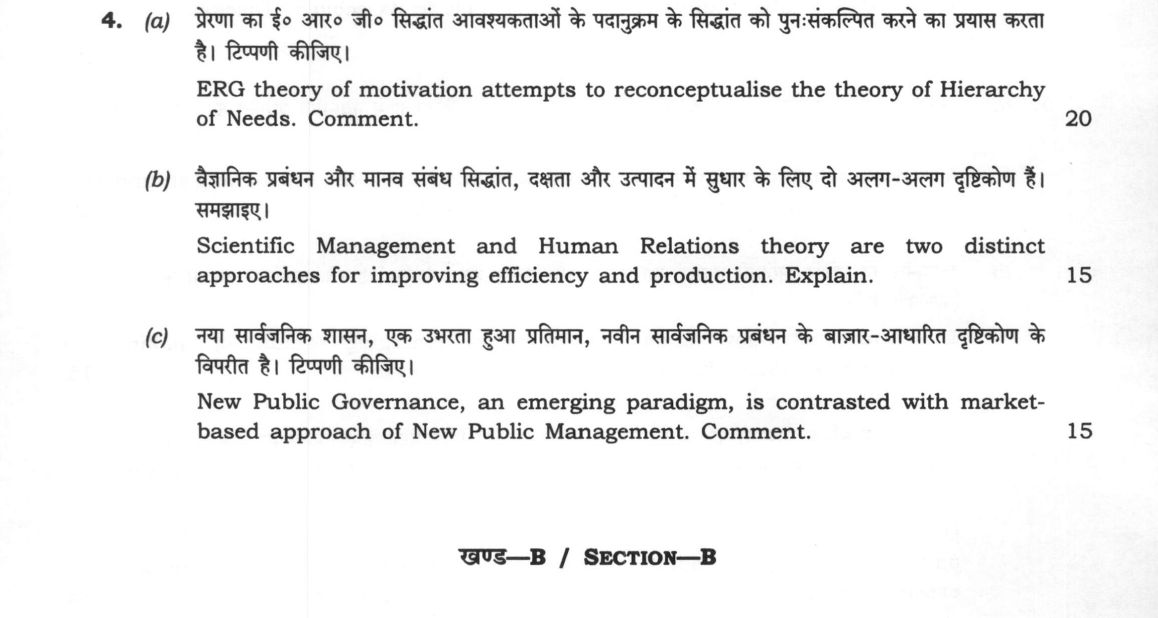
(a) ERG theory of motivation attempts to reconceptualise the theory of Hierarchy of Needs. Comment. (20 marks) (b) Scientific…
ERG theory of motivation attempts to reconceptualise the theory of Hierarchy of Needs. Comment. 20 marks
Scientific Management and Human Relations theory are two distinct approaches for improving efficiency and production. Explain. 15 marks
New Public Governance, an emerging paradigm, is contrasted with market-based approach of New Public Management. Comment. 15 marks
हिंदी में प्रश्न पढ़ें
प्रेरणा का ई० आर० जी० सिद्धांत आवश्यकताओं के पदानुक्रम के सिद्धांत को पुनःसंकल्पित करने का प्रयास करता है। टिप्पणी कीजिए। (20 अंक)
वैज्ञानिक प्रबंधन और मानव संबंध सिद्धांत, दक्षता और उत्पादन में सुधार के लिए दो अलग-अलग दृष्टिकोण हैं। समझाइए। (15 अंक)
नया सार्वजनिक शासन, एक उभरता हुआ प्रतिमान, नवीन सार्वजनिक प्रबंधन के बाजार-आधारित दृष्टिकोण के विपरीत है। टिप्पणी कीजिए। (15 अंक)
Model answer
Written by UPSC Answer Check against this question's marking rubric, to the expected length. UPSC does not publish answers for Mains — this is one way to score well, not an official key.
Part (a) ERG theory, developed by Clayton Alderfer, reconceptualises Maslow’s hierarchy of needs by making motivation less rigid and more empirically plausible. Maslow’s model arranges five needs—physiological, safety, social, esteem and self-actualisation—in a strict upward sequence, assuming lower needs must be substantially satisfied before higher needs become salient. ERG compresses these into three categories: Existence, covering material and safety needs; Relatedness, covering interpersonal and external esteem needs; and Growth, covering internal development and self-actualisation. Its key departure is frustration-regression: when a higher need is blocked, the individual may regress to a lower need. Thus, a public servant denied growth opportunities may become preoccupied with job security or office relationships. ERG also allows several needs to be active simultaneously and recognises individual differences in need priority, addressing Maslow’s methodological weakness of treating a culturally specific sequence as universal. In administrative terms, ERG is a corrective rather than a rejection: it retains the insight that needs matter, but replaces a fixed ladder with a flexible, dynamic model.
Part (b) Scientific Management and Human Relations theory are distinct because they locate the source of efficiency differently. Scientific Management, associated with Frederick Taylor and his 1911 work, treats the worker largely as an economic rational actor whose output can be increased by rationally organising the task. It relies on time-and-motion studies, standardisation of methods, division of planning from execution, differential piece-rate incentives and the search for “one best way.” Its strength is measurable productivity, but it can reduce workers to instruments of the machine, ignoring social and psychological factors. Human Relations theory, emerging from the Hawthorne studies of Elton Mayo and Fritz Roethlisberger, shifts attention from the task to the worker. The illumination experiments showed that productivity was affected not only by physical conditions but also by attention, group norms, informal organisation and the sense of being valued. It conceptualises the worker as a social man, whose satisfaction, morale and informal group influences shape performance. The two approaches are therefore complementary: Scientific Management asks how work should be designed, while Human Relations asks how people respond to that design. In India, this appears in the contrast between strict procedural control and later emphasis on employee satisfaction, training and informal communication.
Part (c) New Public Governance is best understood not as a simple rejection of New Public Management but as a response to its limitations. NPM, associated with Christopher Hood and Stephen Osborne, imports market-based logic into the state: disaggregation of functions, competition, performance contracts, customer orientation, output measurement and private-sector management techniques. In India, this logic appears in disinvestment, performance-linked contracts, e-governance and outcome-oriented budgeting. Its merit is efficiency and accountability, but it can treat citizens as customers and public services as commodities, neglecting collective action, trust and democratic legitimacy. NPG, associated with Stephen Osborne and Kirsty Strokosch on co-production, shifts the emphasis from markets to networks. It stresses partnerships, co-production, citizen engagement, collaboration and the creation of public value. Rather than asking only how services can be delivered cheaply, it asks how citizens, local bodies, private agencies and civil society can jointly define and deliver public goods. Examples include citizen participation in Swachh Bharat Mission, Gram Panchayat-level service delivery and digital platforms that enable citizens to access and shape services. NPG does not discard efficiency; it argues that efficiency is incomplete without legitimacy, participation and shared responsibility.
Taken together, these theories show a movement from mechanistic control to humanistic understanding and then to networked governance. The comment, therefore, is that administrative efficiency is not a single technical problem; it is shaped by motivation, social relations and public participation. A mature public administration must combine Taylor’s discipline, Mayo’s sensitivity to human factors, and NPG’s collaborative public value.
What "Comment" is asking you to do
Take a position on the statement and support it. Comment usually attaches to a quoted line in the short slots, so the reasoning must be compressed — an opening view, a few load-bearing reasons, and the limit of the claim.
Structure that answers it
Unpack what the statement asserts → your stance → two or three supporting reasons → the qualification that limits it
Where marks are lost
Neutral summary; a comment without a stance has not answered. Equally costly is accepting the quoted line wholesale and never testing where it fails.
How this answer will be evaluated
Approach
Framework: UPSC Public Administration Paper 1. (a) comment: context > arguments both sides > judgment > close | (b) explain: definition/context > points in order > small example > short close | (c) comment: context > arguments both sides > judgment > close Full marks: Comprehensive, well-structured, with clear distinctions, Indian context, and balanced judgment.
Key points expected
- Define ERG (Existence, Relatedness, Growth) components
- Contrast ERG's 'frustration-regression' with Maslow's 'satisfaction-progression'
- Explain the 'simultaneity' of needs in ERG vs. Maslow's strict hierarchy
- Provide a balanced judgment on the utility of ERG in administration
- Define Scientific Management (Taylorism) and its focus on efficiency
- Define Human Relations Theory (Mayo) and its focus on social factors
- Contrast the 'economic man' vs. 'social man' assumptions
- Explain how each improves production/efficiency
Evaluation rubric
Each sub-part is marked on its own, against the marks and word limit printed on the paper.
- (a) Contextualize ERG theory's reconceptualization of Maslow's Hierarchy of Needs with a balanced judgment. 20 marks
comment— context → arguments both sides → judgment → close
Must cover
- Define ERG (Existence, Relatedness, Growth) components
- Contrast ERG's 'frustration-regression' with Maslow's 'satisfaction-progression'
- Explain the 'simultaneity' of needs in ERG vs. Maslow's strict hierarchy
- Provide a balanced judgment on the utility of ERG in administration
Loses marks
- Treating ERG as identical to Maslow's theory
- Ignoring the 'frustration-regression' concept
- Lack of critical judgment or balanced view
Earns more
- Mention Clayton Alderfer as the originator
- Link to Indian industrial context (e.g., IT sector growth needs)
- Discuss the 'frustration-regression' mechanism in detail
- Reference specific administrative applications of ERG
Extra mark
- Cite a specific Indian administrative reform using ERG
- Reference a specific study or case on ERG in India
- (b) Explain the distinct approaches of Scientific Management and Human Relations theory for efficiency. 15 marks
explain— definition/context → points in order → small example → short close
Must cover
- Define Scientific Management (Taylorism) and its focus on efficiency
- Define Human Relations Theory (Mayo) and its focus on social factors
- Contrast the 'economic man' vs. 'social man' assumptions
- Explain how each improves production/efficiency
Loses marks
- Confusing the two theories
- Ignoring the 'social' aspect of Human Relations
- Lack of clear distinction between the approaches
Earns more
- Mention Frederick Taylor and Elton Mayo
- Reference the Hawthorne Experiments
- Link to Indian administrative context (e.g., industrial relations)
- Discuss the limitations of each theory
Extra mark
- Cite a specific Indian industrial case study
- Reference a specific administrative reform based on these theories
- (c) Comment on the contrast between New Public Governance and New Public Management. 15 marks
comment— context → arguments both sides → judgment → close
Must cover
- Define New Public Governance (NPG) as an emerging paradigm
- Define New Public Management (NPM) as a market-based approach
- Contrast NPG's 'networked' approach with NPM's 'hierarchical' approach
- Provide a balanced judgment on the shift from NPM to NPG
Loses marks
- Treating NPG and NPM as identical
- Ignoring the 'market-based' nature of NPM
- Lack of critical judgment or balanced view
Earns more
- Mention key thinkers (e.g., Rhodes, Denhardt)
- Reference Indian administrative context (e.g., e-governance, citizen-centric services)
- Discuss the role of stakeholders in NPG
- Explain the 'market-based' nature of NPM
Extra mark
- Cite a specific Indian governance reform (e.g., Digital India)
- Reference a specific committee or report on NPG
Practice this exact question
Write your answer and it is marked point by point against the model answer above — what you covered, what you missed, what you got wrong.
Evaluate my answer →More from Public Administration 2024 Paper I
- Q1 Answer the following questions in about 150 words each: (a) "Politics-administration dich…
- Q2 (a) McGregor's 'Theory X' and 'Theory Y' provide insights into human motivation at workpl…
- Q3 (a) Strengthening social audit through appropriate ways will promote inclusive government…
- Q4 (a) ERG theory of motivation attempts to reconceptualise the theory of Hierarchy of Needs…
- Q5 Answer the following questions in about 150 words each: (a) The Anti-Development Thesis i…
- Q6 (a) A trend to adopt innovative practices in administrative ethics is gaining ground for…
- Q7 (a) Riggs' Prismatic Model has been criticised as overly gloomy and technical complex, bu…