Paper I — Q5
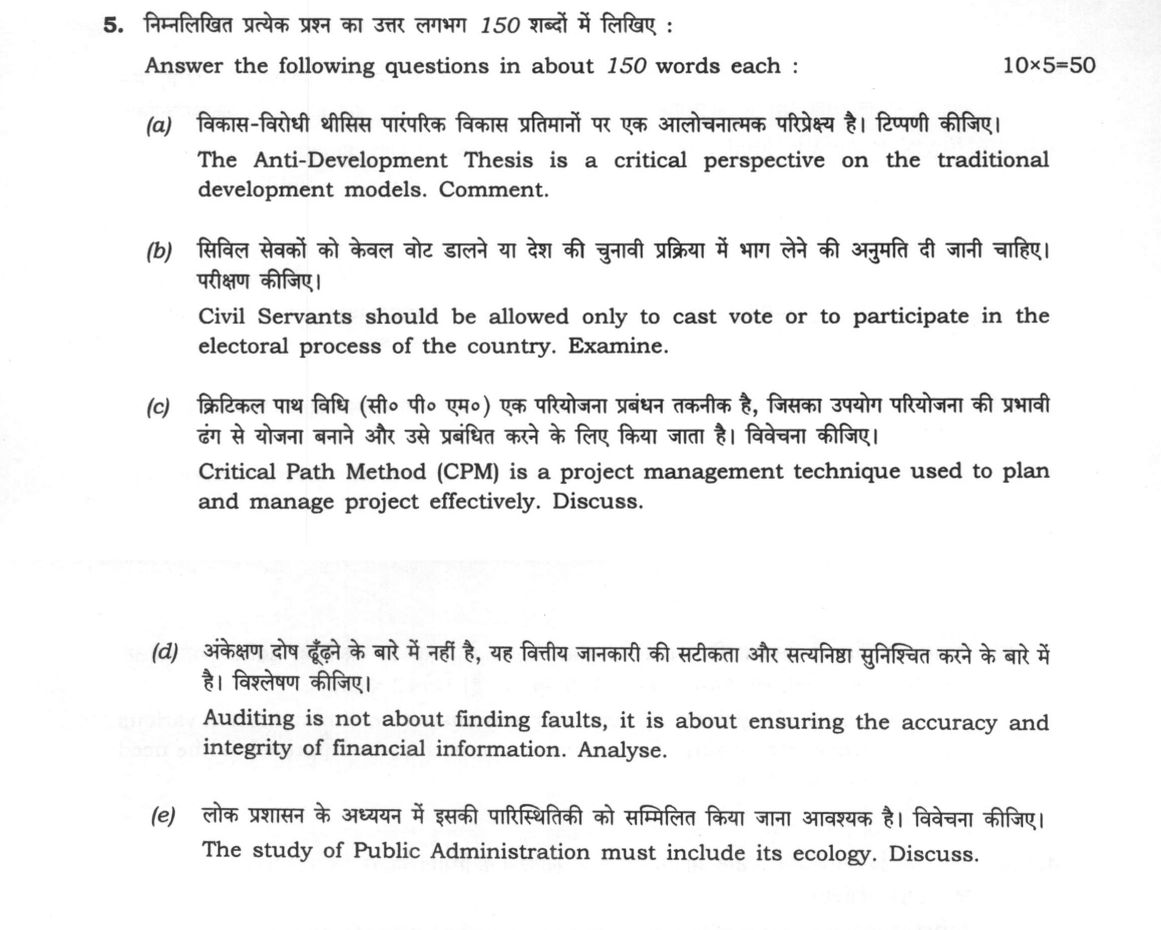
Answer the following questions in about 150 words each: (a) The Anti-Development Thesis is a critical perspective on the…
Answer the following questions in about 150 words each:
The Anti-Development Thesis is a critical perspective on the traditional development models. Comment. 10 marks
Civil Servants should be allowed only to cast vote or to participate in the electoral process of the country. Examine. 10 marks
Critical Path Method (CPM) is a project management technique used to plan and manage project effectively. Discuss. 10 marks
Auditing is not about finding faults, it is about ensuring the accuracy and integrity of financial information. Analyse. 10 marks
The study of Public Administration must include its ecology. Discuss. 10 marks
हिंदी में प्रश्न पढ़ें
निम्नलिखित प्रत्येक प्रश्न का उत्तर लगभग 150 शब्दों में लिखिए :
विकास-विरोधी थीसिस पारंपरिक विकास प्रतिमानों पर एक आलोचनात्मक परिप्रेक्ष्य है। टिप्पणी कीजिए। (10 अंक)
सिविल सेवकों को केवल वोट डालने या देश की चुनावी प्रक्रिया में भाग लेने की अनुमति दी जानी चाहिए। परीक्षण कीजिए। (10 अंक)
क्रिटिकल पाथ विधि (सी० पी० एम०) एक परियोजना प्रबंधन तकनीक है, जिसका उपयोग परियोजना की प्रभावी ढंग से योजना बनाने और उसे प्रबंधित करने के लिए किया जाता है। विवेचना कीजिए। (10 अंक)
अंकेक्षण दोष ढूंढने के बारे में नहीं है, यह वित्तीय जानकारी की सटीकता और सत्यनिष्ठा सुनिश्चित करने के बारे में है। विश्लेषण कीजिए। (10 अंक)
लोक प्रशासन के अध्ययन में इसकी पारिस्थितिकी को सम्मिलित किया जाना आवश्यक है। विवेचना कीजिए। (10 अंक)
Model answer
Written by UPSC Answer Check against this question's marking rubric, to the 150-word length. UPSC does not publish answers for Mains — this is one way to score well, not an official key.
(a) The Anti-Development Thesis emerged in the late twentieth century as a radical critique of Eurocentric modernization theories, which equated progress exclusively with Western industrialization, economic growth, and bureaucratic institutionalization. Post-development theorists such as Arturo Escobar (Encountering Development) and Wolfgang Sachs (The Development Dictionary) argue that "development" was historically constructed as a discourse of Western hegemony, systematically casting the Global South as deficient and requiring external managerial intervention. This top-down paradigm frequently resulted in cultural homogenization, environmental destruction, displacement, and the marginalization of local communities. Rather than seeking minor reforms within existing growth-centric frameworks, the anti-development thesis calls for an abandonment of the traditional model in favor of alternative development paradigms. These alternatives emphasize indigenous knowledge systems, ecological sustainability, local autonomy, and grassroots democratic self-reliance, thereby fundamentally decentering Western hegemony to redefine human well-being and social progress.
(b) The debate over whether civil servants should only cast votes or actively participate in the political process touches the core of administrative ethics and constitutional governance. In India, Rule 5 of the Central Civil Services (Conduct) Rules, 1964, permits civil servants to exercise their democratic franchise but strictly bars them from canvassing, joining political parties, or contesting elections. This restriction safeguards administrative neutrality, ensuring that the permanent executive serves alternating political regimes with impartial fidelity, upholding the spirit of Article 311 and maintaining public confidence. Conversely, critics argue that extensive prohibitions infringe upon the fundamental civil liberties of public employees, citing countries like France where limited political participation is permitted under regulated conditions. However, in deeply plural and developing democracies, unfettered political engagement risks institutional politicization and the emergence of a spoils system. Maintaining the restriction to voting alone ensures an equitable balance between basic civic rights and institutional impartiality.
(c) The Critical Path Method (CPM) is a deterministic network analysis technique developed in the late 1950s to plan, schedule, and control complex projects. CPM graphically models a project by breaking it down into distinct activities, determining dependencies, and calculating early and late start and finish times. Its central feature is the identification of the critical path—the longest continuous sequence of dependent activities through the network. Activities along this path have zero float or slack time, meaning any delay directly postpones the final project completion date. Activities off the critical path possess float, allowing project managers to strategically shift resources without affecting deadlines. Unlike the Program Evaluation and Review Technique (PERT), which uses probabilistic three-time estimates for uncertain research and development tasks, CPM utilizes single, deterministic time-cost estimates for predictable construction and engineering projects. In India, CPM is widely applied across mega-infrastructure initiatives, including the PM Gati Shakti National Master Plan and Bharatmala, to prevent time and cost overruns.
(d) Modern public auditing has transitioned from a narrow, retrospective fault-finding mechanism to a systemic tool for ensuring the accuracy, integrity, and performance of public administration. Traditionally, audit operated in an adversarial posture, focusing primarily on detecting procedural deviations, vouching arithmetic accuracy, and uncovering financial irregularities. While compliance and regularity checks remain foundational, viewing auditing solely as an inquisitorial exercise limits administrative innovation and induces policy paralysis. Contemporary auditing, guided by International Organization of Supreme Audit Institutions (INTOSAI) standards, emphasizes value addition and institutional learning. In India, the Comptroller and Auditor General (CAG) integrates comprehensive Performance Auditing, evaluating public programs through the framework of the Three Es: Economy, Efficiency, and Effectiveness. This analytical approach assesses internal financial controls, policy outcomes, and risk management systems. Consequently, auditing serves as a partner in governance, transforming financial data into reliable intelligence that reinforces transparency, fiscal discipline, and citizen trust.
(e) The ecological approach in Public Administration posits that administrative systems do not function in a vacuum but exist in constant, reciprocal interaction with their surrounding environment. Pioneered by John Gaus and comprehensively formulated by Fred W. Riggs, this perspective demonstrates that an administration is shaped by prevailing social, cultural, political, and economic forces, while simultaneously influencing them. Riggs' Agraria-Industria and Prismatic-Sala models highlighted how applying Western administrative models to developing societies generates distinct administrative dysfunctions, such as formalism and overlapping, due to differing societal ecologies. In India, the administrative apparatus continually adapts to its complex socio-political environment. The transition from a colonial law-and-order machinery to a developmental state led to innovative adaptations, including targeted affirmative action, specialized development agencies, and democratic decentralization through the 73rd and 74th Constitutional Amendment Acts. Integrating administrative ecology ensures that public administration remains contextually grounded, culturally sensitive, and structurally equipped to address evolving societal demands.
What "Discuss" is asking you to do
Lay the issue out from more than one side — how it arose, what is claimed for it, what is held against it, and where it now stands. UPSC attaches discuss to broad topics with several live dimensions, so coverage of the dimensions earns more than the strength of your opinion.
Structure that answers it
Set the issue up → the case as it is made → the case against → the dimension both sides leave out → where the balance now lies
Where marks are lost
Listing facts with no thread between them, or arguing one side throughout and calling it a discussion.
How this answer will be evaluated
Approach
Framework: Public Administration Paper 1 (Concept > Thinker > Indian Application > Reform). (a) comment: context > arguments both sides > judgment > close | (b) examine: intro > how/why with reasoning > evidence > conclusion | (c) discuss: intro > 3-4 dimensions > example > balanced close | (d) analyse: intro > causes > effects > stakeholders/linkages > way forward | (e) discuss: intro > 3-4 dimensions > example > balanced close Full marks: Clear structure, strong Indian anchors, balanced judgment, specific examples.
Key points expected
- Define Anti-Development Thesis (e.g., Sachs, Stiglitz)
- Critique traditional models (Rostow, Modernization)
- Arguments for: dependency, structural adjustment failures
- Arguments against: success stories, agency, globalization
- Reasoning: political neutrality, administrative efficiency
- Evidence for: risk of politicization, bias in implementation
- Evidence against: democratic rights, civil society participation
- Conclusion on the balance of rights vs. neutrality
Evaluation rubric
Each sub-part is marked on its own, against the marks and word limit printed on the paper.
- (a) Contextualize thesis, present arguments for/against, and offer a balanced judgment. · 150 words
comment— context → arguments both sides → judgment → close
Must cover
- Define Anti-Development Thesis (e.g., Sachs, Stiglitz)
- Critique traditional models (Rostow, Modernization)
- Arguments for: dependency, structural adjustment failures
- Arguments against: success stories, agency, globalization
Loses marks
- Treating it as a simple definition question
- Ignoring the 'traditional models' context
- No balanced judgment provided
Earns more
- Reference to 'Tragedy of Development' (Sachs)
- Mention of 'Development as Freedom' (Sen)
- Reference to IMF/World Bank structural adjustments
Extra mark
- Reference to 2nd ARC on development planning
- Mention of specific Indian policy shift (e.g., MGNREGA)
- (b) Examine the reasoning behind the restriction and the evidence for/against it. · 150 words
examine— intro → how/why with reasoning → evidence → conclusion
Must cover
- Reasoning: political neutrality, administrative efficiency
- Evidence for: risk of politicization, bias in implementation
- Evidence against: democratic rights, civil society participation
- Conclusion on the balance of rights vs. neutrality
Loses marks
- Treating it as a simple 'yes/no' question
- Ignoring the 'electoral process' context
- No evidence or reasoning provided
Earns more
- Reference to Model Code of Conduct
- Mention of 'political neutrality' as a core value
- Reference to specific instances of bias (e.g., elections)
Extra mark
- Reference to 2nd ARC on political neutrality
- Mention of specific legal provisions (e.g., Conduct Rules)
- (c) Discuss the CPM technique, its dimensions, and its application in project management. · 150 words
discuss— intro → 3-4 dimensions → example → balanced close
Must cover
- Define CPM (Critical Path Method)
- Key dimensions: network diagram, critical path, float
- Application: planning, scheduling, resource allocation
- Example: infrastructure project (e.g., dam, road)
Loses marks
- Treating it as a simple definition question
- Ignoring the 'project management' context
- No example or application provided
Earns more
- Mention of 'PERT' as a related technique
- Reference to 'float' or 'slack' time
- Mention of 'network diagram' or 'Gantt chart'
Extra mark
- Reference to specific Indian project (e.g., Delhi Metro)
- Mention of '2nd ARC' on project management
- (d) Analyse the causes, effects, and stakeholders of the auditing process. · 150 words
analyse— intro → causes → effects → stakeholders/linkages → way forward
Must cover
- Causes: need for accountability, transparency, integrity
- Effects: financial accuracy, public trust, policy effectiveness
- Stakeholders: CAG, Parliament, citizens, government
- Way forward: strengthening CAG, digital auditing
Loses marks
- Treating it as a simple definition question
- Ignoring the 'financial information' context
- No stakeholder or way forward analysis
Earns more
- Reference to 'CAG' (Comptroller and Auditor General)
- Mention of 'financial integrity' or 'accountability'
- Reference to 'public trust' or 'transparency'
Extra mark
- Reference to '2nd ARC' on auditing
- Mention of 'digital auditing' or 'e-auditing'
- (e) Discuss the importance of including ecology in the study of Public Administration. · 150 words
discuss— intro → 3-4 dimensions → example → balanced close
Must cover
- Define 'ecology' in public administration context
- Key dimensions: political, social, economic, cultural
- Application: policy formulation, implementation, evaluation
- Example: environmental policy, social welfare
Loses marks
- Treating it as a simple definition question
- Ignoring the 'ecology' context
- No example or application provided
Earns more
- Reference to 'systems approach' or 'open systems'
- Mention of 'political environment' or 'social context'
- Reference to 'policy implementation' or 'evaluation'
Extra mark
- Reference to '2nd ARC' on public administration
- Mention of 'sustainable development' or 'green governance'
Practice this exact question
Write your answer and it is marked point by point against the model answer above — what you covered, what you missed, what you got wrong.
Evaluate my answer →More from Public Administration 2024 Paper I
- Q2 (a) McGregor's 'Theory X' and 'Theory Y' provide insights into human motivation at workpl…
- Q3 (a) Strengthening social audit through appropriate ways will promote inclusive government…
- Q4 (a) ERG theory of motivation attempts to reconceptualise the theory of Hierarchy of Needs…
- Q5 Answer the following questions in about 150 words each: (a) The Anti-Development Thesis i…
- Q6 (a) A trend to adopt innovative practices in administrative ethics is gaining ground for…
- Q7 (a) Riggs' Prismatic Model has been criticised as overly gloomy and technical complex, bu…
- Q8 (a) Bureaucracy in developing countries faces several challenges and tackling of these wi…