Paper I — Q2
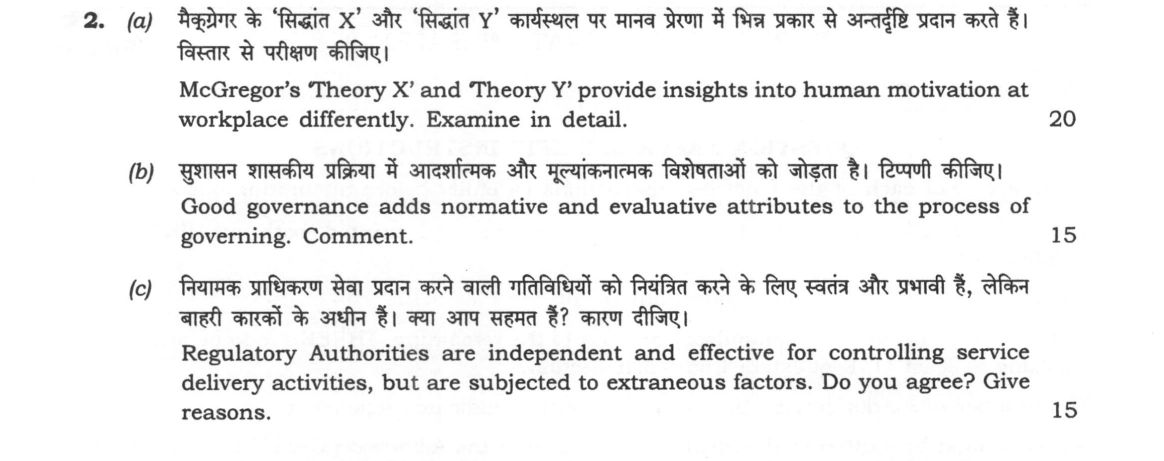
(a) McGregor's 'Theory X' and 'Theory Y' provide insights into human motivation at workplace differently. Examine in detail. (20…
McGregor's 'Theory X' and 'Theory Y' provide insights into human motivation at workplace differently. Examine in detail. 20 marks
Good governance adds normative and evaluative attributes to the process of governing. Comment. 15 marks
Regulatory Authorities are independent and effective for controlling service delivery activities, but are subjected to extraneous factors. Do you agree? Give reasons. 15 marks
हिंदी में प्रश्न पढ़ें
मैकग्रेगर के 'सिद्धांत X' और 'सिद्धांत Y' कार्यस्थल पर मानव प्रेरणा में भिन्न प्रकार से अंतर्दृष्टि प्रदान करते हैं। विस्तार से परीक्षण कीजिए। (20 अंक)
सुशासन शासकीय प्रक्रिया में आदर्शात्मक और मूल्यांकनात्मक विशेषताओं को जोड़ता है। टिप्पणी कीजिए। (15 अंक)
नियामक प्राधिकरण सेवा प्रदान करने वाली गतिविधियों को नियंत्रित करने के लिए स्वतंत्र और प्रभावी हैं, लेकिन बाहरी कारकों के अधीन हैं। क्या आप सहमत हैं? कारण दीजिए। (15 अंक)
Model answer
Written by UPSC Answer Check against this question's marking rubric, to the expected length. UPSC does not publish answers for Mains — this is one way to score well, not an official key.
Douglas McGregor in The Human Side of Enterprise posited that managerial practices are shaped by underlying assumptions about human nature, formulating two distinct paradigms: Theory X and Theory Y.
McGregor's Theory X and Theory Y
Theory X represents a traditional, mechanistic view grounded in classical administrative thought. It assumes that the average human inherently dislikes work, avoids responsibility, lacks ambition, and prioritizes security above all. Consequently, management relies on external control, authoritarian supervision, and coercive "carrot-and-stick" tactics directed at satisfying lower-order physiological and economic needs. This generates an organizational climate characterized by low trust, centralized authority, and formalistic compliance.
In contrast, Theory Y reflects a humanistic paradigm aligning with the human relations and behavioral schools. It assumes that work is as natural as play, external coercion is not the sole means of motivation, and individuals naturally exercise self-direction and self-control when committed to organizational objectives. Under Theory Y, managerial strategy shifts from control to creation of opportunities, delegation, job enrichment, and participative decision-making, appealing to higher-order needs of esteem and self-actualization.
Critically examined, Theory X and Theory Y are not absolute dichotomies but opposite ends of a behavioral continuum. While Theory Y underpins modern agile, participative work cultures, it is constrained by contextual variables such as crisis situations, low skill levels, and cultural variations. Recognizing these limitations, William Ouchi proposed Theory Z, blending individual responsibility with collective, consensual decision-making. McGregor’s enduring insight remains that organizational effectiveness depends on aligning human motivation with institutional goals rather than relying on structural coercion.
Normative and Evaluative Dimensions of Good Governance
Good governance marks a fundamental shift from state-centric "government" to an inclusive, multi-stakeholder "governance" framework. It enriches public administration by integrating normative values with evaluative performance metrics.
Normatively, good governance defines what public administration ought to be. It embodies democratic values including the rule of law, equity, social justice, transparency, and accountability, as articulated in the UNESCAP framework and Sustainable Development Goal 16 (Peace, Justice, and Strong Institutions).
Evaluatively, good governance provides objective criteria to measure administrative performance and service delivery. It shifts the administrative focus from bureaucratic inputs to measurable outcomes through frameworks such as the World Bank’s Worldwide Governance Indicators (voice and accountability, political stability, government effectiveness, regulatory quality, rule of law, and control of corruption). Through empirical instruments like Citizen’s Charters, Social Audits, and Sevottam service-delivery models, good governance enables continuous citizen feedback and empirical evaluation of state effectiveness.
Regulatory Authorities: Autonomy, Effectiveness, and Vulnerabilities
Independent Regulatory Authorities (IRAs) emerged under New Public Management (NPM) reforms to balance market efficiency with consumer protection. Endowed with statutory autonomy, security of tenure, and financial independence, regulators such as the Telecom Regulatory Authority of India (TRAI), the Central Electricity Regulatory Commission (CERC), and the Reserve Bank of India (RBI) have effectively dismantled state monopolies, standardized service delivery, and protected consumer welfare.
However, extraneous factors frequently undermine their operational independence: First, political interference persists through executive discretion in appointments, post-retirement incentives, and delays in filling vacancies. Second, regulatory capture by powerful corporate lobbies distorts policy in favor of incumbents at the expense of consumer interests. Third, judicial overreach and procedural litigation often stall regulatory determinations, overriding specialized technical expertise. Fourth, resource dependence on parent ministries for budgets and domain expertise compromises functional autonomy.
To insulate regulators, the Second Administrative Reforms Commission (2nd ARC) recommended establishing transparent, statutory search-and-selection committees, institutionalizing mandatory Regulatory Impact Assessments (RIA), and strengthening direct accountability to parliamentary standing committees rather than executive line ministries.
Administrative capability requires a coherent continuum: Theory Y provides the behavioral foundation for motivated public personnel, good governance establishes the normative and evaluative institutional framework, and insulated regulatory bodies enforce equitable service delivery across modern governance.
What "Examine" is asking you to do
Test the proposition the question puts to you and return a finding on how far it holds. Examine stems carry a claim, or ask whether something has happened, and expect evidence weighed both ways before the extent is stated — often with remedial measures attached.
Structure that answers it
Restate the claim as the question frames it → evidence that supports it → evidence that undercuts it → the conditions under which it holds → verdict on how far it stands
Where marks are lost
Stopping at description. An examination has to reach a finding, and “examine with justification” means the extent must be stated, not implied.
How this answer will be evaluated
Approach
Framework: UPSC Public Administration Paper 1. (a) examine: intro > how/why with reasoning > evidence > conclusion | (b) comment: context > arguments both sides > judgment > close | (c) justify: claim > 3-4 reasons > evidence > conclusion Full marks: Precise definitions, strong Indian anchors, clear distinction between theory and field reality, 2nd ARC references.
Key points expected
- Define Theory X (pessimistic) and Theory Y (optimistic) assumptions
- Contrast management styles: authoritarian vs participative
- Link to Indian administrative instances (e.g., bureaucracy vs NITI Aayog)
- Examine impact on workplace motivation and productivity
- Define 'good governance' (transparency, accountability, rule of law)
- Explain 'normative attributes' (values, ethics, standards)
- Explain 'evaluative attributes' (performance measurement, assessment)
- Provide Indian examples (e.g., RTI, CAG, NITI Aayog)
Evaluation rubric
Each sub-part is marked on its own, against the marks and word limit printed on the paper.
- (a) Detailed comparison of McGregor's Theory X and Y with Indian administrative context. 20 marks
examine— intro → how/why with reasoning → evidence → conclusion
Must cover
- Define Theory X (pessimistic) and Theory Y (optimistic) assumptions
- Contrast management styles: authoritarian vs participative
- Link to Indian administrative instances (e.g., bureaucracy vs NITI Aayog)
- Examine impact on workplace motivation and productivity
Loses marks
- Theory without Indian administrative anchor
- GS-2 style answer (politics over administration)
- Confusing Theory X and Y definitions
Earns more
- Reference to Maslow's hierarchy of needs
- Mention of 2nd ARC recommendations on employee motivation
- Distinction between administration and politics in application
- Reference to specific Indian schemes (e.g., PM Kisan) as Theory Y
Extra mark
- Reference to recent governance reform (e.g., PM Kisan)
- Mention of 2nd ARC on employee motivation
- (b) Comment on how good governance adds normative and evaluative attributes to governing. 15 marks
comment— context → arguments both sides → judgment → close
Must cover
- Define 'good governance' (transparency, accountability, rule of law)
- Explain 'normative attributes' (values, ethics, standards)
- Explain 'evaluative attributes' (performance measurement, assessment)
- Provide Indian examples (e.g., RTI, CAG, NITI Aayog)
Loses marks
- Vague definition of 'good governance'
- No distinction between normative and evaluative
- GS-2 style answer (politics over administration)
Earns more
- Reference to UNDP's 8 principles of good governance
- Mention of specific Indian institutions (CAG, CIC, NITI Aayog)
- Distinction between 'governing' and 'good governance'
- Reference to 2nd ARC on governance reforms
Extra mark
- Reference to recent governance reform (e.g., Digital India)
- Mention of 2nd ARC on governance reforms
- (c) Justify whether regulatory authorities are independent/effective but subject to extraneous factors. 15 marks
justify— claim → 3-4 reasons → evidence → conclusion
Must cover
- Define 'regulatory authorities' (e.g., TRAI, SEBI, RBI)
- Explain their independence and effectiveness in service delivery
- Identify 'extraneous factors' (political pressure, budget, appointments)
- Provide Indian examples (e.g., TRAI, SEBI, RBI)
Loses marks
- No specific Indian regulatory examples
- Vague identification of 'extraneous factors'
- GS-2 style answer (politics over administration)
Earns more
- Reference to specific regulatory bodies (TRAI, SEBI, RBI, CCI)
- Mention of 'extraneous factors' (political pressure, budget, appointments)
- Distinction between 'independence' and 'accountability'
- Reference to 2nd ARC on regulatory reforms
Extra mark
- Reference to recent case of political pressure on a regulator
- Mention of 2nd ARC on regulatory reforms
Practice this exact question
Write your answer and it is marked point by point against the model answer above — what you covered, what you missed, what you got wrong.
Evaluate my answer →More from Public Administration 2024 Paper I
- Q1 Answer the following questions in about 150 words each: (a) "Politics-administration dich…
- Q2 (a) McGregor's 'Theory X' and 'Theory Y' provide insights into human motivation at workpl…
- Q3 (a) Strengthening social audit through appropriate ways will promote inclusive government…
- Q4 (a) ERG theory of motivation attempts to reconceptualise the theory of Hierarchy of Needs…
- Q5 Answer the following questions in about 150 words each: (a) The Anti-Development Thesis i…