Paper I — Q3
(a) Strengthening social audit through appropriate ways will promote inclusive government. Comment. (20 marks) (b) The…
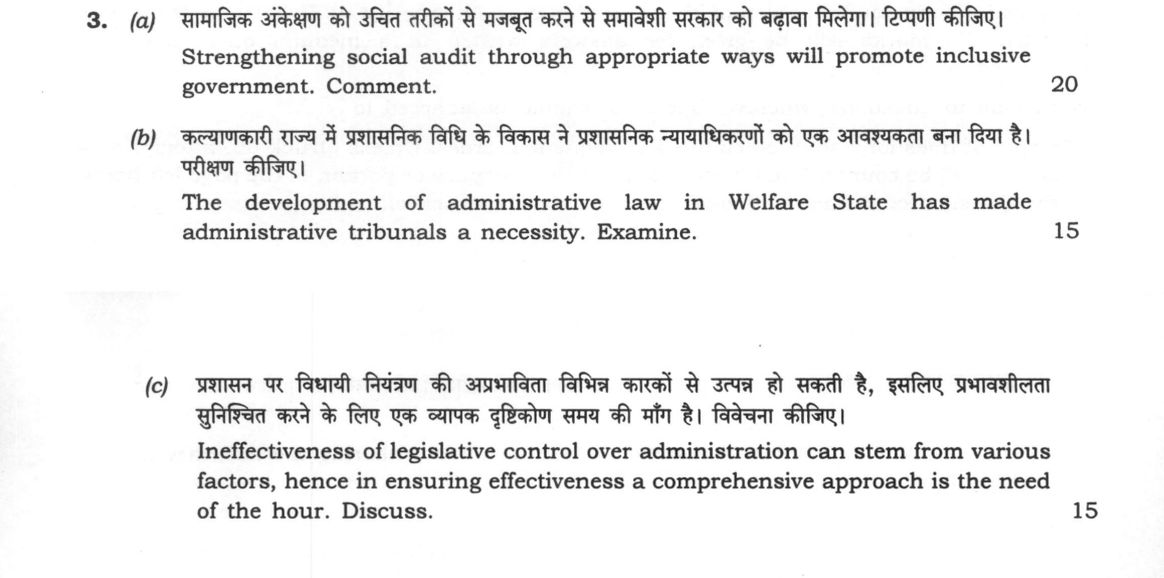
Strengthening social audit through appropriate ways will promote inclusive government. Comment. 20 marks
The development of administrative law in Welfare State has made administrative tribunals a necessity. Examine. 15 marks
Ineffectiveness of legislative control over administration can stem from various factors, hence in ensuring effectiveness a comprehensive approach is the need of the hour. Discuss. 15 marks
हिंदी में प्रश्न पढ़ें
सामाजिक अंकेक्षण को उचित तरीकों से मजबूत करने से समावेशी सरकार को बढ़ावा मिलेगा। टिप्पणी कीजिए। (20 अंक)
कल्याणकारी राज्य में प्रशासनिक विधि के विकास ने प्रशासनिक न्यायाधिकरणों को एक आवश्यकता बना दिया है। परीक्षण कीजिए। (15 अंक)
प्रशासन पर विधायी नियंत्रण की अप्रभाविता विभिन्न कारकों से उत्पन्न हो सकती है, इसलिए प्रभावशीलता सुनिश्चित करने के लिए एक व्यापक दृष्टिकोण समय की माँग है। विवेचना कीजिए। (15 अंक)
Model answer
Written by UPSC Answer Check against this question's marking rubric, to the expected length. UPSC does not publish answers for Mains — this is one way to score well, not an official key.
Democratic governance relies on multi-layered accountability mechanisms where citizen-led oversight, specialized adjudication, and legislative vigilance operate in concert to ensure state responsiveness.
Strengthening Social Audit for Inclusive Governance
Social audit transforms traditional financial auditing into a participatory, bottom-up accountability process where the community examines public schemes to verify whether outcomes match official expenditures. It promotes inclusive government by institutionalizing the voice of marginalized beneficiaries, dismantling asymmetric information, and fostering deliberative democracy. Instances like the mandatory Social Audit Units (SAUs) under MGNREGA, Meghalaya’s Community Led Monitoring through the Social Audit Act, and Kerala’s People’s Campaign for Decentralized Planning demonstrate how continuous social audit prevents leakage and empowers vulnerable groups.
Strengthening this tool requires statutory backing on the lines of Rajasthan’s initiatives, insulating SAUs from administrative interference through independent directorates, and building the capacity of citizen-auditors via dedicated civil society partnerships. Furthermore, embedding social audits within the Right to Information (RTI) framework and deploying digital tools like Social Audit Apps and geo-tagged expenditure tracking will ensure that social audit evolves from an ad-hoc exercise into an enforceable instrument of inclusive governance.
Administrative Tribunals in the Welfare State
The expansion of the state from a minimalist, night-watchman model to a proactive Welfare State led to an unprecedented increase in delegated legislation and administrative discretion. Albert Venn Dicey’s classical formulation of the Rule of Law, which strictly opposed specialized administrative tribunals in favor of ordinary courts, proved inadequate for complex socio-economic regulations. Ordinary civil courts, burdened by procedural rigidity, formal delays, and high litigation costs, lacked the technical expertise required for modern regulatory adjudication. Administrative tribunals thus emerged as a functional necessity to deliver speedy, specialized, inexpensive, and flexible justice.
Recognizing this imperatives, the 42nd Constitutional Amendment Act inserted Articles 323A and 323B, laying the foundation for specialized bodies such as the Central Administrative Tribunal (CAT), State Administrative Tribunals (SAT), National Green Tribunal (NGT), and National Company Law Tribunal (NCLT). In S.P. Sampath Kumar v. Union of India (1987), the Supreme Court affirmed that tribunals serve as effective institutional substitutes for High Courts, provided they maintain functional efficacy. Subsequently, in R.K. Jain v. Union of India (1993), the apex court emphasized the urgent need for institutional autonomy, proper infrastructure, and transparent appointments, ensuring tribunals do not become executive dependencies while discharging quasi-judicial functions.
Comprehensive Reforms for Effective Legislative Control
Legislative oversight of the executive—the bedrock of parliamentary democracy—has faced significant structural erosion. The anti-defection law under the Tenth Schedule has suppressed intra-party debate, reducing parliamentary proceedings to majoritarian voting. Executive dominance over legislative agendas, inadequate research support for legislators, fragmented committee attention, and persistent executive non-compliance with Public Accounts Committee (PAC) and Comptroller and Auditor General (CAG) findings have rendered legislative control predominantly ex-post and formalistic.
To restore parliamentary efficacy, a comprehensive approach is necessary. First, Departmentally Related Standing Committees (DRSCs) must be revitalized by making pre-legislative scrutiny mandatory for all major bills and holding committee hearings publicly. Second, introducing statutory sunset clauses will ensure periodic legislative review of executive programs and delegated rules. Third, parliamentary monitoring must shift from procedural inputs to outcome-based performance budgeting. Finally, institutionalizing a feedback loop that tables social audit reports directly before legislative committees will effectively bridge grassroots citizen oversight with parliamentary scrutiny.
Strengthening social audit frameworks, modernizing administrative tribunal architecture, and reforming legislative scrutiny mechanisms collectively establish an integrated accountability continuum, essential for upholding the constitutional promise of an ethical, responsive, and welfare-oriented administration.
What "Comment" is asking you to do
Take a position on the statement and support it. Comment usually attaches to a quoted line in the short slots, so the reasoning must be compressed — an opening view, a few load-bearing reasons, and the limit of the claim.
Structure that answers it
Unpack what the statement asserts → your stance → two or three supporting reasons → the qualification that limits it
Where marks are lost
Neutral summary; a comment without a stance has not answered. Equally costly is accepting the quoted line wholesale and never testing where it fails.
How this answer will be evaluated
Approach
Framework: Public Administration Paper I (UPSC). (a) comment: context > arguments both sides > judgment > close | (b) examine: intro > how/why with reasoning > evidence > conclusion | (c) discuss: intro > 3-4 dimensions > example > balanced close Full marks: Demonstrates deep understanding of concepts, provides specific Indian examples, and offers a balanced, well-reasoned argument.
Key points expected
- Define social audit and its link to inclusive government
- Cite specific Indian mechanisms (e.g., MGNREGA, RTI)
- Present arguments for its effectiveness in promoting inclusion
- Present arguments for its limitations or challenges
- Define the 'Welfare State' and its impact on administrative law
- Explain the limitations of ordinary courts for administrative disputes
- Identify the specific needs tribunals fulfill (speed, expertise)
- Cite specific Indian administrative tribunals (e.g., CAT, SAT)
Evaluation rubric
Each sub-part is marked on its own, against the marks and word limit printed on the paper.
- (a) Contextualize social audit, argue for/against its role in inclusive government, and provide a judgment. 20 marks
comment— context → arguments both sides → judgment → close
Must cover
- Define social audit and its link to inclusive government
- Cite specific Indian mechanisms (e.g., MGNREGA, RTI)
- Present arguments for its effectiveness in promoting inclusion
- Present arguments for its limitations or challenges
Loses marks
- Defining social audit without linking to inclusive government
- Listing benefits without providing a balanced judgment
- Ignoring the 'appropriate ways' aspect of the prompt
Earns more
- Mention specific state-level social audit initiatives
- Reference the 2nd ARC recommendations on social audit
- Discuss the role of civil society in social audit
- Link to the concept of 'participatory governance'
Extra mark
- Cite a specific Supreme Court judgment on social audit
- Reference a specific data point on MGNREGA social audit coverage
- (b) Explain how the expansion of administrative law in a welfare state necessitates administrative tribunals. 15 marks
examine— intro → how/why with reasoning → evidence → conclusion
Must cover
- Define the 'Welfare State' and its impact on administrative law
- Explain the limitations of ordinary courts for administrative disputes
- Identify the specific needs tribunals fulfill (speed, expertise)
- Cite specific Indian administrative tribunals (e.g., CAT, SAT)
Loses marks
- Failing to link the 'Welfare State' to the growth of administrative law
- Discussing tribunals without explaining why they are a 'necessity'
- Ignoring the specific context of 'administrative law' development
Earns more
- Reference the Administrative Tribunals Act, 1985
- Mention the 2nd ARC recommendations on administrative justice
- Discuss the concept of 'delegated legislation' and its control
- Reference the doctrine of 'natural justice' in tribunal proceedings
Extra mark
- Cite a specific Supreme Court case on the jurisdiction of tribunals
- Reference a specific statistic on the pendency of administrative cases
- (c) Discuss the factors causing the ineffectiveness of legislative control and propose a comprehensive approach. 15 marks
discuss— intro → 3-4 dimensions → example → balanced close
Must cover
- Identify at least 3 factors for ineffectiveness of legislative control
- Explain the 'comprehensive approach' needed for effectiveness
- Provide specific examples of legislative control mechanisms
- Discuss the role of the judiciary in supplementing legislative control
Loses marks
- Listing factors without explaining their impact on effectiveness
- Proposing a 'comprehensive approach' without specific measures
- Ignoring the 'ineffectiveness' aspect of the prompt
Earns more
- Reference the 2nd ARC recommendations on legislative control
- Mention the role of the Public Accounts Committee (PAC)
- Discuss the concept of 'delegated legislation' and its control
- Reference the role of the Comptroller and Auditor General (CAG)
Extra mark
- Cite a specific Supreme Court case on legislative control
- Reference a specific data point on the effectiveness of legislative control
Practice this exact question
Write your answer and it is marked point by point against the model answer above — what you covered, what you missed, what you got wrong.
Evaluate my answer →More from Public Administration 2024 Paper I
- Q1 Answer the following questions in about 150 words each: (a) "Politics-administration dich…
- Q2 (a) McGregor's 'Theory X' and 'Theory Y' provide insights into human motivation at workpl…
- Q3 (a) Strengthening social audit through appropriate ways will promote inclusive government…
- Q4 (a) ERG theory of motivation attempts to reconceptualise the theory of Hierarchy of Needs…
- Q5 Answer the following questions in about 150 words each: (a) The Anti-Development Thesis i…
- Q6 (a) A trend to adopt innovative practices in administrative ethics is gaining ground for…