Paper I — Q6
(a) A trend to adopt innovative practices in administrative ethics is gaining ground for improving public trust in government…
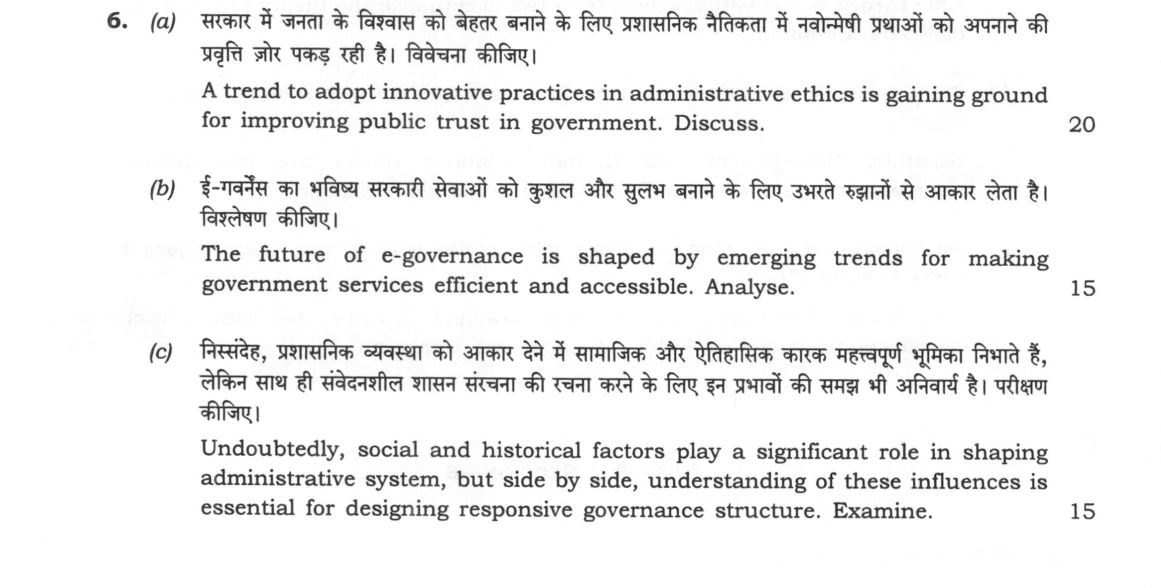
A trend to adopt innovative practices in administrative ethics is gaining ground for improving public trust in government. Discuss. 20 marks
The future of e-governance is shaped by emerging trends for making government services efficient and accessible. Analyse. 15 marks
Undoubtedly, social and historical factors play a significant role in shaping administrative system, but side by side, understanding of these influences is essential for designing responsive governance structure. Examine. 15 marks
हिंदी में प्रश्न पढ़ें
सरकार में जनता के विश्वास को बेहतर बनाने के लिए प्रशासनिक नैतिकता में नवोन्मेषी प्रथाओं को अपनाने की प्रवृत्ति जोर पकड़ रही है। विवेचना कीजिए। (20 अंक)
ई-गवर्नेंस का भविष्य सरकारी सेवाओं को कुशल और सुलभ बनाने के लिए उभरते रुझानों से आकार लेता है। विश्लेषण कीजिए। (15 अंक)
निस्संदेह, प्रशासनिक व्यवस्था को आकार देने में सामाजिक और ऐतिहासिक कारक महत्वपूर्ण भूमिका निभाते हैं, लेकिन साथ ही संवेदनशील शासन संरचना की रचना करने के लिए इन प्रभावों की समझ भी अनिवार्य है। परीक्षण कीजिए। (15 अंक)
Model answer
Written by UPSC Answer Check against this question's marking rubric, to the expected length. UPSC does not publish answers for Mains — this is one way to score well, not an official key.
Innovative administrative ethics and public trust The growing emphasis on innovative administrative ethics reflects a shift from rule-bound compliance to value-driven integrity. Traditional compliance approaches rely on codes, vigilance, punishment and post-facto accountability, while integrity-based ethics seeks to embed honesty, empathy and public service in daily administrative culture. Innovative practices such as citizen charters, RTI, social audit, integrity pacts, ethical hacking and behavioural nudges make this shift visible. Citizen charters translate rights into service standards; the RTI Act, 2005, and social audit, especially under NREGA, expose opacity and invite citizen scrutiny. Integrity pacts, promoted by CVC, reduce corruption in public procurement; ethical hacking improves transparency by testing systems against misuse; behavioural nudges, such as simplified defaults and timely reminders, can make ethical choices easier for officials and citizens. These measures address the public trust deficit caused by delay, arbitrariness and perceived corruption. Institutional mechanisms such as the Lokpal and Lokayuktas Act, 2013, CVC and civil society watchdogs reinforce accountability, but trust is built only when ethics becomes routine rather than exceptional. The trend is promising, but must avoid becoming a checklist disconnected from administrative culture.
Emerging e-governance trends The future of e-governance is being shaped by technologies that can make services faster, cheaper and more accessible. AI and machine learning can help grievance redressal, fraud detection and predictive service delivery, while data analytics can identify citizens likely to need assistance before they apply. Blockchain pilots for land records may reduce tampering and improve title clarity. Mobile-first governance, API-based interoperability and digital public infrastructure such as India Stack—Aadhaar, UPI and related interoperability layers—can bring services to citizens’ devices and reduce duplication. For efficiency to become access, interfaces must be language-friendly, disability-accessible and supported by last-mile digital literacy. These trends can lower transaction costs, improve transparency and enable anticipatory governance. However, their success depends on addressing serious challenges. The digital divide excludes many rural, elderly and low-income citizens; cybersecurity threats can undermine confidence; and data privacy concerns require strong safeguards under the DPDP Act, 2023. Thus, e-governance must be inclusive, secure and privacy-preserving, with DPI designed as a public good rather than a platform for surveillance or exclusion.
Social-historical context and responsive governance Administrative systems are not neutral technical arrangements; they are shaped by social and historical forces. Social factors such as caste, religion, regionalism and linguistic diversity influence who accesses services, how authority is perceived, and where resistance or cooperation is likely. Historical factors are equally important: the colonial legacy of the ICS created a bureaucracy oriented to control and revenue extraction, while the freedom struggle introduced Gandhian ideas of panchayati raj, local self-government and social justice. Post-independence reforms attempted to convert this inherited structure into a developmental, welfare-oriented state. Understanding these influences is essential because a uniform administrative model may fail in contexts with distinct social or historical experiences. For example, district administration in Fifth Schedule tribal areas must work within the PESA Act, 1996, and respect customary institutions, while Sixth Schedule areas in Assam, Meghalaya, Mizoram and Tripura are governed through autonomous district councils under the Constitution. Similarly, districts with significant minority populations require sensitive service delivery, language access and protection of constitutional rights. Local governance innovations, such as panchayati raj strengthening and participatory planning, become effective only when they respond to local social realities. Thus, contextual understanding helps administrators design responsive institutions rather than imposing one-size-fits-all solutions.
In sum, innovative ethics, e-governance and contextual understanding are mutually reinforcing. Ethics builds legitimacy, technology expands reach, and social-historical awareness prevents technocratic governance. A responsive state must combine integrity-based culture, inclusive DPI and context-sensitive design, so that public trust is earned through fair, accessible and locally grounded governance.
What "Discuss" is asking you to do
Lay the issue out from more than one side — how it arose, what is claimed for it, what is held against it, and where it now stands. UPSC attaches discuss to broad topics with several live dimensions, so coverage of the dimensions earns more than the strength of your opinion.
Structure that answers it
Set the issue up → the case as it is made → the case against → the dimension both sides leave out → where the balance now lies
Where marks are lost
Listing facts with no thread between them, or arguing one side throughout and calling it a discussion.
How this answer will be evaluated
Approach
Framework: Concept > Thinker > Indian institutional application > Reform. (a) discuss: intro > 3-4 dimensions > example > balanced close | (b) analyse: intro > causes > effects > stakeholders/linkages > way forward | (c) examine: intro > how/why with reasoning > evidence > conclusion Full marks: Comprehensive, well-structured, with strong Indian anchors and specific examples.
Key points expected
- Define innovative practices in administrative ethics
- Link ethics to the restoration of public trust
- Provide Indian institutional examples of these practices
- Conclude with a balanced assessment of the trend
- Identify emerging trends in e-governance
- Analyze the impact on service efficiency
- Analyze the impact on service accessibility
- Discuss the linkages between trends and outcomes
Evaluation rubric
Each sub-part is marked on its own, against the marks and word limit printed on the paper.
- (a) Examine the shift from traditional to innovative administrative ethics to restore public trust. 20 marks
discuss— intro → 3-4 dimensions → example → balanced close
Must cover
- Define innovative practices in administrative ethics
- Link ethics to the restoration of public trust
- Provide Indian institutional examples of these practices
- Conclude with a balanced assessment of the trend
Loses marks
- GS-2 style policy answers without administrative focus
- Theory without Indian administrative anchors
- Ignoring the link between ethics and trust
Earns more
- Mention specific Indian administrative reforms
- Reference the 2nd ARC recommendations
- Cite specific administrative ethics codes
- Discuss the role of transparency in trust
Extra mark
- Cite a specific Supreme Court judgment on ethics
- Reference a specific recent governance reform
- (b) Analyze how emerging trends are shaping the future of e-governance for efficiency and access. 15 marks
analyse— intro → causes → effects → stakeholders/linkages → way forward
Must cover
- Identify emerging trends in e-governance
- Analyze the impact on service efficiency
- Analyze the impact on service accessibility
- Discuss the linkages between trends and outcomes
Loses marks
- Listing trends without analyzing their impact
- Ignoring the efficiency and accessibility aspects
- GS-2 style answers without administrative analysis
Earns more
- Mention specific Indian e-governance initiatives
- Discuss the role of AI or blockchain
- Reference the Digital India mission
- Discuss the impact on citizen engagement
Extra mark
- Cite a specific e-governance project with data
- Reference a specific committee report on e-governance
- (c) Examine the role of social and historical factors in shaping administrative systems and governance. 15 marks
examine— intro → how/why with reasoning → evidence → conclusion
Must cover
- Explain the role of social factors in administration
- Explain the role of historical factors in administration
- Link these factors to responsive governance design
- Provide evidence of these influences in India
Loses marks
- Ignoring the link to responsive governance
- GS-2 style answers without administrative focus
- Theory without Indian historical or social anchors
Earns more
- Mention specific historical administrative systems
- Discuss the impact of social structures on administration
- Reference specific Indian administrative reforms
- Discuss the role of culture in governance
Extra mark
- Cite a specific historical administrative text
- Reference a specific social reform movement
Practice this exact question
Write your answer and it is marked point by point against the model answer above — what you covered, what you missed, what you got wrong.
Evaluate my answer →More from Public Administration 2024 Paper I
- Q3 (a) Strengthening social audit through appropriate ways will promote inclusive government…
- Q4 (a) ERG theory of motivation attempts to reconceptualise the theory of Hierarchy of Needs…
- Q5 Answer the following questions in about 150 words each: (a) The Anti-Development Thesis i…
- Q6 (a) A trend to adopt innovative practices in administrative ethics is gaining ground for…
- Q7 (a) Riggs' Prismatic Model has been criticised as overly gloomy and technical complex, bu…
- Q8 (a) Bureaucracy in developing countries faces several challenges and tackling of these wi…