Paper I — Q1
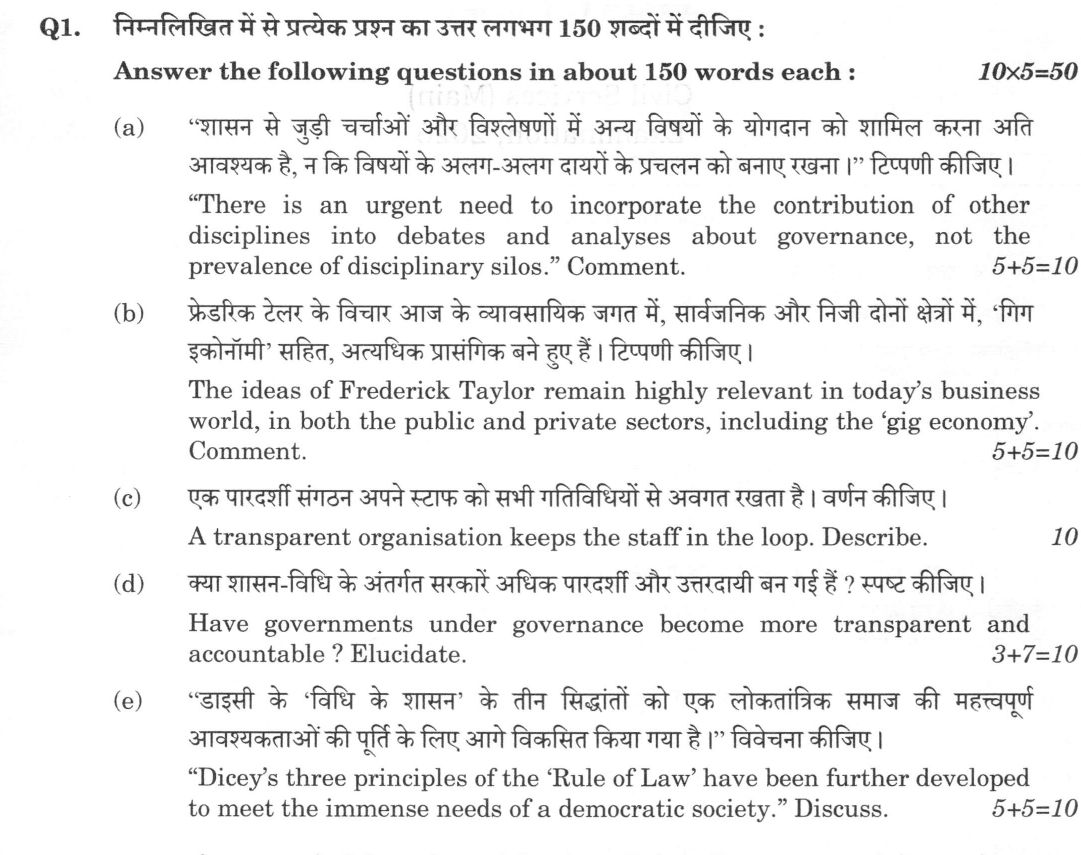
(a) “There is an urgent need to incorporate the contribution of other disciplines into debates and analyses about governance, not…
Answer the following questions in about 150 words each :
“There is an urgent need to incorporate the contribution of other disciplines into debates and analyses about governance, not the prevalence of disciplinary silos.” Comment. 10 marks
The ideas of Frederick Taylor remain highly relevant in today’s business world, in both the public and private sectors, including the ‘gig economy’. Comment. 10 marks
A transparent organisation keeps the staff in the loop. Describe. 10 marks
Have governments under governance become more transparent and accountable ? Elucidate. 10 marks
“Dicey’s three principles of the ‘Rule of Law’ have been further developed to meet the immense needs of a democratic society.” Discuss. 10 marks
हिंदी में प्रश्न पढ़ें
निम्नलिखित में से प्रत्येक प्रश्न का उत्तर लगभग 150 शब्दों में दीजिए :
“शासन से जुड़ी चर्चाओं और विश्लेषणों में अन्य विषयों के योगदान को शामिल करना अति आवश्यक है, न कि विषयों के अलग-अलग दायरों के प्रचलन को बनाए रखना।” टिप्पणी कीजिए। (10 अंक)
फ्रेडरिक टेलर के विचार आज के व्यावसायिक जगत में, सार्वजनिक और निजी दोनों क्षेत्रों में, ‘गिग इकॉनॉमी’ सहित, अत्यधिक प्रासंगिक बने हुए हैं। टिप्पणी कीजिए। (10 अंक)
एक पारदर्शी संगठन अपने स्टाफ को सभी गतिविधियों से अवगत रखता है। वर्णन कीजिए। (10 अंक)
क्या शासन-विधि के अंतर्गत सरकारें अधिक पारदर्शी और उत्तरदायी बन गई हैं ? स्पष्ट कीजिए। (10 अंक)
“डाइसी के ‘विधि के शासन’ के तीन सिद्धांतों को एक लोकतांत्रिक समाज की महत्त्वपूर्ण आवश्यकताओं की पूर्ति के लिए आगे विकसित किया गया है।” विवेचना कीजिए। (10 अंक)
Model answer
Drafted with AI by UPSC Answer Check against this question's marking rubric, to the 150-word length. UPSC does not publish answers for Mains — this is one way to score well, not an official key. How we build rubrics and answers.
(a) Interdisciplinarity versus Disciplinary Silos in Governance Governance problems do not respect disciplinary boundaries, so analysing them from within Public Administration (PA) alone gives partial answers. PA was interdisciplinary from the start: Herbert Simon drew on psychology and economics, Dwight Waldo (The Administrative State, 1948) on political theory, and Waldo's "identity crisis" (1968) arose precisely because the field borrowed so widely.
Other disciplines add distinct lenses. Economics explains incentives, market failure and fiscal federalism; sociology shows how caste, class and street-level practice shape implementation; systems and complexity theory help model "wicked problems" (Rittel and Webber, 1973) such as climate change. Behavioural economics contributed "nudges" (Thaler and Sunstein, 2008) - NITI Aayog set up a Behavioural Insights Unit in 2019 and Swachh Bharat used social norms - while Elinor Ostrom's polycentric governance of the commons joins economics, ecology and political science.
The need is real, but integration should not dissolve PA's public-interest core. PA should become a hub that synthesises law, economics and psychology into evidence-based governance rather than remain a silo.
(b) Relevance of Taylorism Today, Including the Gig Economy Frederick Taylor's The Principles of Scientific Management (1911) rested on time-and-motion study, scientific selection and training of workers, functional foremanship, separation of planning from doing, and differential piece-rates.
In the public sector, standard operating procedures, performance audits and KPIs are Taylorist tools, as in Results-Framework Documents, e-Office and dashboards such as PRAGATI. In business, the gig economy is its most extreme form: platforms such as Zomato or Uber use algorithmic management to time each task and pay per delivery, replacing the foreman with digital surveillance. This "digital Taylorism" is now being balanced by the Code on Social Security, 2020 (in force from 21 November 2025) and state laws in Rajasthan (2023) and Karnataka (2025) providing welfare boards and algorithmic transparency.
Its relevance is not absolute. Elton Mayo's Hawthorne studies exposed the social needs Taylor ignored, Harry Braverman showed how Taylorism deskills work, and public service needs discretion and equity. Taylor's efficiency logic endures, but it must be balanced with worker well-being.
(c) Internal Transparency: Keeping Staff in the Loop Internal transparency means that staff know the organisation's goals, rules and decisions, and the reasons behind them; it differs from public transparency under RTI.
A transparent organisation keeps staff in the loop through information flows (intranets, dashboards, circulated minutes), communication forums (town halls, open-door policies, upward communication) and feedback loops (360-degree feedback, open discussion of decisions). In government, the Joint Consultative Machinery (1966) and staff councils give employees a formal voice, and iGOT Karmayogi shares learning across ministries.
Theory supports this. Chester Barnard called communication the first function of the executive; Rensis Likert's participative "System 4" links open information to performance; and Amy Edmondson's research on psychological safety (1999) shows that teams speak up and learn only when informed and secure.
The loop turns staff from passive recipients of orders into participants who understand the "why" of their tasks, raising trust, morale and ownership. Leadership sustains it by acting on what staff say, not merely broadcasting information.
(d) Transparency and Accountability under Governance Governance - "governing without government" (R. A. W. Rhodes, 1996), popularised by the World Bank (1992) - works through networks of state, market and civil-society actors. Transparency is the availability of information; accountability, in Mark Bovens's sense, is the obligation to explain conduct before a forum that can impose consequences.
Transparency has clearly grown through the RTI Act, 2005, e-governance and citizen charters. Accountability has been strengthened by the CAG, the Lokpal (Act of 2013, functional from 2019), social audits and Direct Benefit Transfer.
Yet the gains are uneven. Exemptions, delays and vacancies weaken RTI; the RTI (Amendment) Act, 2019 let the Centre fix commissioners' tenure and salaries; the DPDP Act, 2023 widened the personal-information exemption in Section 8(1)(j); and the Lokpal has prosecuted few cases. Governance itself blurs accountability: with PPPs, contractors and NGOs, responsibility is spread across "many hands", and private providers generally fall outside RTI. Governments are more open in structure, but accountability in practice remains incomplete.
(e) Development of Dicey's Rule of Law A. V. Dicey (Introduction to the Study of the Law of the Constitution, 1885) gave three principles: supremacy of regular law over arbitrary power; equality before the law, with officials subject to the ordinary courts (hence his rejection of French droit administratif); and a constitution that is the result of ordinary law made by judicial decisions.
Each has been developed for a democratic society. Supremacy of law has moved from "no arbitrary power" to fair procedure: under Articles 14 and 21, as read in Maneka Gandhi (1978), even lawful action must be just, fair and reasonable. Equality before law, joined with "equal protection of the laws", has grown into substantive equality through welfare rights and tribunals, and the ICJ's Declaration of Delhi (1959) linked the rule of law to social and economic conditions. The third principle has given way to written constitutions and the basic structure doctrine; Indira Gandhi v. Raj Narain (1975) treated the rule of law as part of it, and Puttaswamy (2017) overruled ADM Jabalpur.
The rule of law is thus now a substantive guarantee of rights, not merely formal legality.
How this answer will be evaluated
Framework: Public Administration Paper 1: Concept > Thinker > Indian Application > Reform
What earns full marks: Precise application of theory to Indian context, clear structure, and strong judgment.
Evaluation rubric
Each sub-part is marked on its own, against the marks and word limit printed on the paper.
- (a) Context on disciplinary silos, arguments for interdisciplinary integration, and a judgment. 10 marks · 150 words
comment— context → arguments both sides → judgment → close
Must cover
- Define the problem of disciplinary silos in governance
- Identify at least two non-PA disciplines (e.g., sociology, economics)
- Explain the specific value of these disciplines to governance analysis
- Provide a balanced judgment on the 'urgent need' claim
Loses marks
- Listing disciplines without explaining their specific contribution
- Ignoring the 'silos' aspect of the prompt
Earns more
- Mention of specific Indian governance challenges requiring multi-disciplinary view
- Reference to systems theory or complexity theory
Extra mark
- Citation of a specific interdisciplinary framework (e.g., Ostrom's polycentric governance, Rittel and Webber's 'wicked problems', Thaler-Sunstein 'nudge')
- Reference to a specific Indian policy using multi-disciplinary data
- (b) Context on Taylorism, arguments for its relevance in public/private/gig sectors, and judgment. 10 marks · 150 words
comment— context → arguments both sides → judgment → close
Must cover
- Briefly define Taylor's core principles (scientific management)
- Link Taylorism to public sector efficiency (e.g., performance audits)
- Link Taylorism to gig economy (e.g., algorithmic management)
- Provide a judgment on its continued relevance
Loses marks
- Treating Taylorism as purely historical
- Failing to address the 'gig economy' specifically
Earns more
- Mention of 'time and motion' studies
- Reference to modern KPIs as Taylorist tools
Extra mark
- Reference to a specific gig platform's management style
- Mention of a specific Indian public sector reform using Taylorist methods
- (c) Definition of transparency, the process of keeping staff informed, and its significance. 10 marks · 150 words
describe— define → structure or process in order → labelled diagram → significance
Must cover
- Define organisational transparency in the context of staff
- Describe the mechanisms (e.g., town halls, intranet, feedback loops)
- Explain the benefits (e.g., trust, morale, alignment)
- Mention the role of leadership in maintaining this loop
Loses marks
- Confusing staff transparency with public transparency
- Listing mechanisms without explaining the 'loop' aspect
Earns more
- Reference to 'open door' policies
- Mention of psychological safety
Extra mark
- Example of a specific Indian organisation's transparency drive
- Reference to a specific communication framework
- (d) Elucidate whether the shift from government to governance has made governments more transparent and accountable, with evidence both ways and a reasoned conclusion. 10 marks · 150 words
explain— definition/context → points in order → small example → short close
Must cover
- Explain the shift from 'government' to 'governance' (networks of state, market and civil-society actors) and distinguish transparency from accountability
- Cite evidence of increased transparency (e.g., RTI, e-governance)
- Cite evidence of increased accountability (e.g., CAG, Lokpal)
- Conclude on the extent of the change
Loses marks
- Failing to distinguish between transparency and accountability
- Ignoring the 'governance' context
Earns more
- Mention of social media's role in accountability
- Reference to citizen charters
- Accountability deficit in networked governance: diffused responsibility in PPPs/outsourcing ('problem of many hands'), private providers outside RTI
Extra mark
- Citation of a specific RTI success story
- Reference to a specific CAG report finding
- (e) Intro to Dicey, the three principles, their development for democracy, and a balanced close. 10 marks · 150 words
discuss— intro → 3-4 dimensions → example → balanced close
Must cover
- State Dicey's three principles of Rule of Law
- Explain how these principles have been developed/modified
- Link the development to the needs of a democratic society
- Provide a balanced conclusion on the current state
Loses marks
- Listing principles without discussing their development
- Ignoring the 'democratic society' aspect
Earns more
- Mention of the shift from 'no arbitrary power' to 'due process'
- Reference to the role of the judiciary in development
Extra mark
- Citation of a specific Indian case law (e.g., Maneka Gandhi)
- Reference to the Delhi Declaration on Rule of Law
What "Comment" is asking you to do
Take a position on the statement and support it. Comment usually attaches to a quoted line in the short slots, so the reasoning must be compressed — an opening view, a few load-bearing reasons, and the limit of the claim.
Structure that answers it
Unpack what the statement asserts → your stance → two or three supporting reasons → the qualification that limits it
Where marks are lost
Neutral summary; a comment without a stance has not answered. Equally costly is accepting the quoted line wholesale and never testing where it fails.
Practice this exact question
Write your answer and it is marked point by point against the model answer above — what you covered, what you missed, what you got wrong.
Evaluate my answer →More from Public Administration 2026 Paper I
- Q1 Answer the following questions in about 150 words each : (a) “There is an urgent need to…
- Q2 (a) Different paradigms of public administration deal with the questions of ‘How’ and ‘Wh…
- Q3 (a) Bureaucratic features have remained constant in organisations despite the development…
- Q4 (a) Abraham Maslow propounded the theory of needs, which identified the basic needs that…