Paper I — Q4
(a) Abraham Maslow propounded the theory of needs, which identified the basic needs that human beings have in order of their…
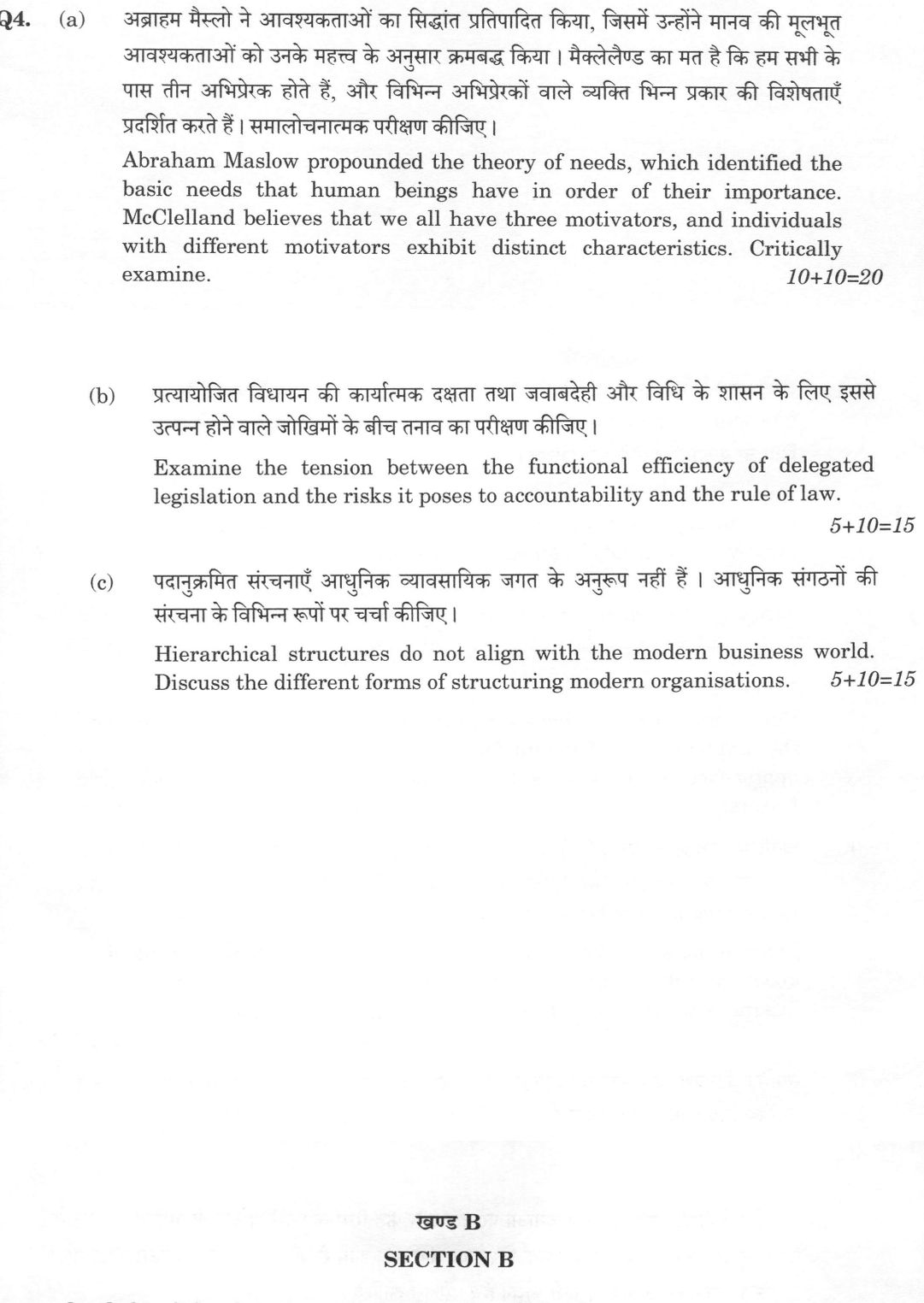
Abraham Maslow propounded the theory of needs, which identified the basic needs that human beings have in order of their importance. McClelland believes that we all have three motivators, and individuals with different motivators exhibit distinct characteristics. Critically examine. 20 marks
Examine the tension between the functional efficiency of delegated legislation and the risks it poses to accountability and the rule of law. 15 marks
Hierarchical structures do not align with the modern business world. Discuss the different forms of structuring modern organisations. 15 marks
हिंदी में प्रश्न पढ़ें
अब्राहम मैस्लो ने आवश्यकताओं का सिद्धांत प्रतिपादित किया, जिसमें उन्होंने मानव की मूलभूत आवश्यकताओं को उनके महत्त्व के अनुसार क्रमबद्ध किया । मैक्लेलैंड का मत है कि हम सभी के पास तीन अभिप्रेरक होते हैं, और विभिन्न अभिप्रेरकों वाले व्यक्ति भिन्न प्रकार की विशेषताएँ प्रदर्शित करते हैं । समालोचनात्मक परीक्षण कीजिए । (20 अंक)
प्रत्यायोजित विधायन की कार्यात्मक दक्षता तथा जवाबदेही और विधि के शासन के लिए इससे उत्पन्न होने वाले जोखिमों के बीच तनाव का परीक्षण कीजिए। (15 अंक)
पदानुक्रमित संरचनाएँ आधुनिक व्यावसायिक जगत के अनुरूप नहीं हैं। आधुनिक संगठनों की संरचना के विभिन्न रूपों पर चर्चा कीजिए। (15 अंक)
Model answer
Drafted with AI by UPSC Answer Check against this question's marking rubric, to the expected length. UPSC does not publish answers for Mains — this is one way to score well, not an official key. How we build rubrics and answers.
(a) Maslow's Need Hierarchy and McClelland's Three Motives Abraham Maslow’s A Theory of Human Motivation (1943) and Motivation and Personality (1954) posit a prepotent hierarchy of needs: physiological, safety, belongingness, esteem, and self-actualisation. According to Maslow, a lower need must be substantially satisfied before a higher one becomes a motivator. David McClelland’s The Achieving Society (1961) offers a contrasting framework of three learned, non-hierarchical motives: achievement (nAch), affiliation (nAff), and power (nPow). Individuals high in nAch prefer moderate risks and immediate feedback; those high in nAff seek social harmony; and those high in nPow seek influence, distinguished by "personalised" (self-serving) versus "socialised" (organizational) power. Measured via the Thematic Apperception Test (TAT), these motives show distinct characteristics; McClelland and Burnham (1976) identified the "leadership motive pattern" as high socialised power, moderate achievement, and low affiliation.
A critical comparison reveals Maslow’s model as innate and hierarchical, whereas McClelland’s is learned and independent. Empirically, Wahba and Bridwell (1976) found weak support for Maslow’s prepotency, and Alderfer’s ERG theory (Existence, Relatedness, Growth) introduced "frustration-regression," suggesting that blocked higher needs cause a return to lower ones. McClelland’s macro-claim linking national achievement motivation to economic growth is contested, and the Kakinada experiment (McClelland and Winter, 1969) yielded mixed results on the efficacy of motive training. Furthermore, the TAT is criticised for scorer dependence, and Geert Hofstede showed that Maslow's ordering reflects American individualism - in collectivist cultures security and belonging may rank above self-actualisation. Maslow himself later added "self-transcendence" above self-actualisation (1969). In public administration, Maslow informs job design and welfare, while McClelland guides selection and motive-job matching. Both are "content" theories that require "process" theories (e.g., Vroom’s expectancy, Adams’s equity) to fully explain behaviour.
(b) Delegated Legislation: Efficiency versus Accountability and Rule of Law Delegated legislation is a functional necessity in modern governance, allowing the executive to handle technical details and respond to emergencies with the speed that a legislature cannot. However, this creates a profound tension between administrative efficiency and the rule of law. Lord Hewart, in The New Despotism (1929), warned that the growth of delegated powers was a threat to liberty, a concern echoed by the Donoughmore Committee (1932). The primary risk is the "Henry VIII clause," which allows the executive to amend or repeal primary legislation, effectively bypassing parliamentary scrutiny.
The tension is managed through legal and procedural controls. The "essential legislative function" doctrine, established in In re Delhi Laws Act (1951), holds that while policy-making cannot be delegated, subsidiary rule-making can; delegation is valid only if the parent Act lays down a policy and guidelines (Gwalior Rayon, 1974). Indian statutes' "removal of difficulties" clauses are the local form of the Henry VIII clause, which courts have confined to giving effect to the Act without altering its essentials. Courts exercise judicial review to strike down rules that are ultra vires (substantively or procedurally), and the Harla v State of Rajasthan (1951) case mandates that unpublished rules are invalid. Parliamentary controls include the "laying" procedure—simple, negative, or affirmative resolution—and scrutiny by the Committees on Subordinate Legislation of the Lok Sabha (1953) and the Rajya Sabha (1964). In the UK, the Statutory Instruments Act 1946 and the Joint Committee on Statutory Instruments further regulate this process.
Despite these controls, the tension persists. Laying is often a formality, scrutiny committees are frequently under-resourced, and delays in framing rules can stall laws for years - the Citizenship (Amendment) Act, 2019 waited until March 2024 for its rules, and the Digital Personal Data Protection Act, 2023 until November 2025. To manage the risk to accountability, modern reforms include mandatory pre-legislative consultation, regulatory impact assessments, "sunset clauses" (automatic expiry of rules), and the creation of searchable rule databases to ensure transparency.
(c) Forms of Structuring Modern Organisations The traditional hierarchical structure, characterised by narrow spans of control and rigid chains of command, is increasingly misaligned with the modern business environment, which demands speed, innovation, and knowledge-work flexibility. However, this critique must be qualified: hierarchy remains essential in contexts requiring strict accountability, safety, and scale, such as the armed forces or revenue administration.
To address the limitations of hierarchy, several post-bureaucratic forms have emerged:
- Matrix Structure: This form uses dual reporting, where employees report to both a functional manager and a project manager, facilitating the sharing of scarce expertise.
- Flat/Delayered Structure: By increasing the span of control and removing middle-management layers, organisations reduce bureaucracy and accelerate decision-making.
- Project and Self-Managed Teams: These structures organise work around specific tasks or goals, with teams having the autonomy to manage their own processes.
- Network and Virtual Organisations: These "boundaryless" entities (a term popularised by Jack Welch) outsource non-core functions to external partners, maintaining a small core while scaling through a network.
- The Shamrock Organisation: Charles Handy (1989) described a three-part structure: a professional core of permanent staff, a contractual fringe of outside specialists and contractors, and a flexible labour force of part-time and temporary workers.
- Adhocracy and Holacracy: Mintzberg’s "adhocracy" (1979) - a term popularised by Alvin Toffler (Future Shock, 1970) after Warren Bennis forecast the decline of bureaucracy - is a professional, flexible structure for complex tasks, while "holacracy" (developed by Brian Robertson and adopted by Zappos) replaces formal hierarchy with self-organising circles. Related variants include Spotify's "squads and tribes" and Haier's network of self-governing micro-enterprises.
Governments use similar forms: mission-mode programmes, empowered groups of secretaries, and special purpose vehicles such as the Smart City SPVs cut across departmental hierarchies, while task forces and inter-ministerial teams (as during the COVID-19 response) function as temporary adhocracies.
Ultimately, the "real" answer is contingency-based hybridity; while overt hierarchy may decline, covert hierarchies often persist within these "flat" structures to ensure coordination and accountability.
How this answer will be evaluated
Evaluation rubric
Each sub-part is marked on its own, against the marks and word limit printed on the paper.
- (a) 'Critically examine' both theories: Maslow's hierarchy of needs and McClelland's three motives. The answer must state each theory accurately, bring out the distinctive characteristics McClelland attributes to individuals dominated by each motive, compare the two frameworks, and critique both with named evidence. 20 marks
Must cover
- State Maslow's hierarchy accurately ('A Theory of Human Motivation', 1943; Motivation and Personality, 1954): physiological, safety, belongingness, esteem, self-actualisation, with prepotency
- State McClelland's three learned motives (nAch, nAff, nPow; The Achieving Society, 1961) with the distinct characteristics of individuals dominated by each
- Compare the two frameworks: innate and hierarchical versus learned and non-hierarchical; measurement; managerial use
- Critique both with named evidence (e.g., Wahba and Bridwell 1976; Alderfer's ERG and frustration-regression; TAT reliability; the contested achievement-growth thesis)
- Reach a balanced verdict with an application to public administration
Loses marks
- Reversing Maslow's order — esteem comes after belongingness and before self-actualisation; safety comes second, not first
- Describing McClelland's three needs without the characteristics of each type, when the question explicitly asks for the 'distinct characteristics'
- Missing the pivotal difference that McClelland's motives are learned and non-hierarchical whereas Maslow's are innate and prepotent
- Giving no critique at all, when the directive is 'critically examine'; description alone cannot cross half marks
- Confusing McClelland with Herzberg's two-factor theory or with Alderfer's ERG, or attributing the TAT to McClelland's own invention rather than to its use by him (the TAT came from Murray's work)
Earns more
- Critiques McClelland: TAT reliability and scorer dependence, the contested macro-claim linking national achievement motivation to economic growth, mixed and hard-to-replicate results from achievement-motivation training such as the Kakinada experiment, and neglect of situational and structural factors
- Explicit comparison on named axes — innate/hierarchical versus learned/non-hierarchical, measurement method, and managerial application (job design and successive need satisfaction versus selection, motive–job matching and motive training)
- Application to public administration and a balanced verdict, including the point that process theories (Vroom's expectancy, Adams's equity, Porter and Lawler) are needed to complete these content theories
Extra mark
- McClelland and Burnham (1976) leadership motive pattern; personalised versus socialised power
- Kakinada experiment (McClelland and Winter, 1969) or Hofstede's cultural critique of Maslow's ordering
- (b) 'Examine the tension' — a two-sided analytical question. The candidate must establish why delegated legislation is functionally necessary and efficient, then set out the specific risks it poses to accountability and the rule of law, and finally assess the controls that manage the tension. 15 marks
Must cover
- Explain why delegated legislation is functionally necessary (volume and technicality of law, flexibility, emergencies)
- Set out the risks to accountability and the rule of law (excessive delegation, Henry VIII and removal-of-difficulties clauses, sub-delegation, weak publicity), with Hewart's The New Despotism (1929) or the Donoughmore Committee (1932)
- Judicial controls: essential legislative function doctrine (In re Delhi Laws Act, 1951), ultra vires review, publication requirement (Harla v. State of Rajasthan, 1951)
- Parliamentary and procedural controls (laying: simple, negative, affirmative; Committees on Subordinate Legislation), with an honest assessment of their effectiveness and reforms
Loses marks
- Listing only the merits and demerits of delegated legislation without examining the tension between efficiency and accountability, which is the actual demand
- Omitting all control mechanisms, so the answer cannot show how the tension is managed
- Confusing delegated legislation with conditional legislation, or with administrative adjudication and tribunals
- Misstating the essential-function doctrine as 'no delegation is permitted' — delegation of subsidiary rule-making is permitted; only the essential legislative function of laying down policy and standards cannot be delegated
- Getting the laying procedures wrong, particularly confusing the negative-resolution and affirmative-resolution forms
Earns more
- Describes procedural and judicial control: antecedent publicity and consultation, Gazette publication, judicial review for ultra vires; UK comparison — Statutory Instruments Act 1946, Donoughmore Committee (1932), Franks Committee (1957)
- Assesses the effectiveness of controls honestly (laying as formality, under-resourced scrutiny, skipped consultation) and offers reforms — pre-legislative consultation, regulatory impact assessment, sunset clauses, a strengthened scrutiny committee, searchable rule databases
Extra mark
- Gwalior Rayon (1974) on policy and guidelines in the parent Act; judicial limits on removal-of-difficulties clauses
- Recent Indian evidence of rule-making delay (e.g., CAA rules in March 2024; DPDP Rules in November 2025)
- (c) 'Discuss the different forms of structuring modern organisations', prefaced by the claim that hierarchy no longer fits the modern business world. The answer must briefly justify or qualify the critique of hierarchy and then describe several distinct non-hierarchical or post-bureaucratic structural forms, each with its logic and an example. 15 marks
Must cover
- Briefly justify and qualify the critique of hierarchy (speed, innovation, knowledge work versus legality, accountability, safety and scale)
- Describe several distinct forms with their coordination logic: matrix (dual authority), flat/delayered, project and self-managed teams, network/virtual/boundaryless
- Include named models with their sources, e.g., Handy's shamrock organisation (1989), Mintzberg's adhocracy (1979), holacracy
- Give examples from business and government for the forms discussed
- Conclude on contingency-based hybridity rather than the death of hierarchy
Loses marks
- Writing a general critique of bureaucracy for most of the answer and describing only one or two structural forms, when the demand is to discuss the different forms
- Naming forms as bare labels with no description of how coordination and authority actually work in each
- Accepting the premise uncritically and claiming hierarchy is obsolete, when regulators, armed forces and revenue administrations remain unavoidably hierarchical
- Confusing the matrix with the divisional structure, or describing the matrix without its defining dual-authority feature
- Giving no example at all for any form, which leaves every claim unverifiable
Earns more
- Adds at least one further named form with its source — Mintzberg's five configurations, holacracy (Brian Robertson, Zappos), Laloux's teal organisations (2014), agile squads and tribes, or divisional/SBU structures
- Qualifies the premise: hierarchy persists where legality, accountability, safety and scale require it, covert hierarchies survive inside flat organisations, and the real answer is contingency-based hybridity
Extra mark
- Bennis or Toffler (Future Shock, 1970) on the decline of bureaucracy and 'adhocracy'
- Laloux's teal organisations (2014), agile squads and tribes, or Haier's self-governing micro-enterprises
What "Critically examine" is asking you to do
Test the proposition the question puts to you and return a finding on how far it holds. Examine stems carry a claim, or ask whether something has happened, and expect evidence weighed both ways before the extent is stated — often with remedial measures attached. “Critically” is not a section added at the end: name the yardstick you are judging by — the evidence, the stated objective, a constitutional principle, a rival explanation — and let a verdict close each part of the body. Where the question quotes a claim, that verdict must land on the claim itself, accepted, qualified or rejected, and not on the theme in general.
Structure that answers it
Restate the claim as the question frames it → evidence that supports it → evidence that undercuts it → the conditions under which it holds → verdict on how far it stands
Where marks are lost
Merits in one paragraph, demerits in the next, and a conclusion calling for a balanced and holistic approach. That is a survey with the judgement left out and it holds the answer in the middle band. The opposite error is reading “critically” as permission to attack — and with the odd pairings, critically describe or critically explain, the exposition still carries most of the marks, the judgement being a layer on it rather than a substitute for it.
Practice this exact question
Write your answer and it is marked point by point against the model answer above — what you covered, what you missed, what you got wrong.
Evaluate my answer →More from Public Administration 2026 Paper I
- Q1 Answer the following questions in about 150 words each : (a) “There is an urgent need to…
- Q2 (a) Different paradigms of public administration deal with the questions of ‘How’ and ‘Wh…
- Q3 (a) Bureaucratic features have remained constant in organisations despite the development…
- Q4 (a) Abraham Maslow propounded the theory of needs, which identified the basic needs that…
- Q5 Answer the following questions in about 150 words each : (a) The objective of policy scie…
- Q6 (a) “Liberalization, Privatization and Globalization (LPG) successfully resolved the stru…
- Q7 (a) The advent of Comparative Public Administration not only widened the knowledge of Pub…