Paper I — Q7
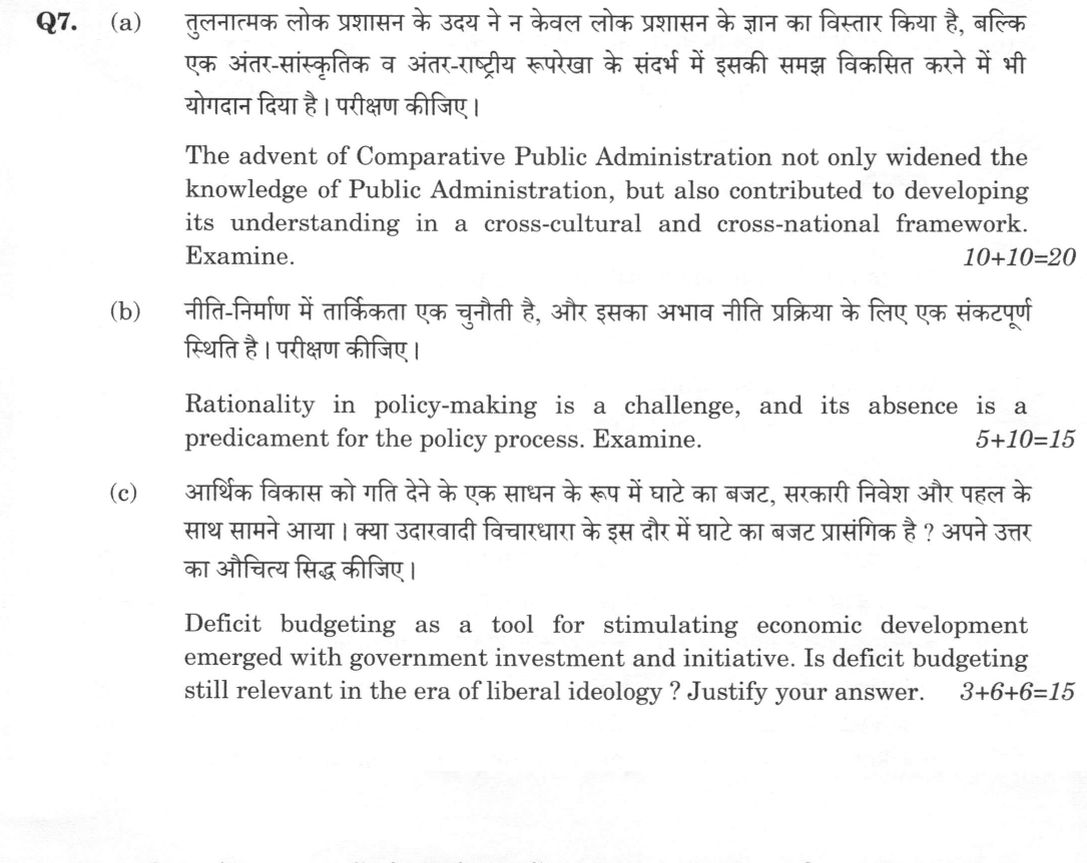
(a) The advent of Comparative Public Administration not only widened the knowledge of Public Administration, but also contributed…
The advent of Comparative Public Administration not only widened the knowledge of Public Administration, but also contributed to developing its understanding in a cross-cultural and cross-national framework. Examine. 20 marks
Rationality in policy-making is a challenge, and its absence is a predicament for the policy process. Examine. 15 marks
Deficit budgeting as a tool for stimulating economic development emerged with government investment and initiative. Is deficit budgeting still relevant in the era of liberal ideology ? Justify your answer. 15 marks
हिंदी में प्रश्न पढ़ें
तुलनात्मक लोक प्रशासन के उदय ने न केवल लोक प्रशासन के ज्ञान का विस्तार किया है, बल्कि एक अंतर-सांस्कृतिक व अंतर-राष्ट्रीय रूपरेखा के संदर्भ में इसकी समझ विकसित करने में भी योगदान दिया है। परीक्षण कीजिए। (20 अंक)
नीति-निर्माण में तार्किकता एक चुनौती है, और इसका अभाव नीति प्रक्रिया के लिए एक संकटपूर्ण स्थिति है। परीक्षण कीजिए। (15 अंक)
आर्थिक विकास को गति देने के एक साधन के रूप में घाटे का बजट, सरकारी निवेश और पहल के साथ सामने आया। क्या उदारवादी विचारधारा के इस दौर में घाटे का बजट प्रासंगिक है ? अपने उत्तर का औचित्य सिद्ध कीजिए। (15 अंक)
Model answer
Drafted with AI by UPSC Answer Check against this question's marking rubric, to the expected length. UPSC does not publish answers for Mains — this is one way to score well, not an official key. How we build rubrics and answers.
(a) Contribution of Comparative Public Administration The claim that Comparative Public Administration (CPA) widened the knowledge of Public Administration and fostered a cross-cultural framework is fundamentally accurate. The discipline emerged as a reaction to the ethnocentric, US-centric bias of early administrative studies. Robert Dahl (1947) in The Science of Public Administration: Three Problems was the seminal figure who argued for a comparative approach, identifying the need to move beyond single-country studies.
The institutionalization of CPA was driven by the Comparative Administration Group (CAG), formed in 1960 under the American Society for Public Administration (ASPA) and funded by the Ford Foundation through the 1960s. Fred Riggs, the central figure of this movement, proposed (1962) three trends in the evolution of the field: from normative to empirical, from idiographic to nomothetic, and from non-ecological to ecological. Riggs’s "prismatic" and "sala" models provided the theoretical architecture for understanding administrative systems in developing nations, moving the field beyond the polar "fused" and "diffracted" ideal types.
CPA significantly widened the knowledge base through Ferrel Heady's classification of comparative approaches (modified traditional, development-oriented, general system model-building, and middle-range theory centred on bureaucracy), through the related field of development administration (a term associated with U. L. Goswami, 1955, and developed by Edward Weidner and Riggs), and by utilizing Max Weber’s "ideal type" of bureaucracy as a comparative benchmark. It allowed scholars to understand how culture, ecology, and history shape administrative behavior. However, the movement faced a decline in the 1970s: Ford Foundation funding ended in 1971, the CAG was merged into ASPA's Section on International and Comparative Administration in 1973, and critics such as Peter Savage (1976) faulted it for grand theorising with little empirical testing or practical relevance to the countries it studied.
In the contemporary era, CPA has seen a revival through comparative public management reform research. Scholars like Pollitt and Bouckaert have utilized the "Neo-Weberian State" framework, while Hofstede’s cultural dimensions are now applied to administrative culture. Modern cross-national governance indicators - the World Bank's Worldwide Governance Indicators, the OECD's Government at a Glance - and policy transfer studies (Dolowitz and Marsh) demonstrate that the comparative lens remains essential for understanding global administrative trends.
(b) Rationality in Policy-making: Challenge and Predicament Rationality in policy-making is a challenge because the "rational-comprehensive" model—whereby a decision-maker identifies all problems, evaluates all alternatives, and selects the optimal solution—is theoretically unattainable in practice. Herbert Simon (1947) demonstrated that human cognitive capacity is limited, leading to "bounded rationality." Consequently, administrative actors do not maximize but "satisfice" (a term Simon introduced in the 1950s), choosing the first acceptable alternative.
Charles Lindblom (1959) further challenged the rational ideal in The Science of Muddling Through, arguing that policy is made through incrementalism and "partisan mutual adjustment." Amitai Etzioni (1967) proposed "mixed scanning" as a corrective, where broad scanning is used for fundamental decisions and detailed review for incremental ones. Yehezkel Dror (1968) highlighted "extra-rational" elements, Graham Allison (Essence of Decision, 1971) showed through the Cuban Missile Crisis that organisational routines and bureaucratic politics shape choices as much as rational calculation, while the "garbage-can model" (Cohen, March, and Olsen, 1972) and Kingdon’s "multiple streams" (1984) suggest that policy is often a result of chance and the convergence of problem, policy, and politics streams.
The absence of rationality creates a predicament for the policy process, leading to "policy drift," regulatory capture, and "groupthink" (Irving Janis, 1972). In India, the 2016 demonetisation and the 2020 farm laws, later repealed, have been cited by critics as decisions taken with limited consultation or evidence. When rationality is absent, governments may make uncosted promises or fail to address "wicked problems" (Rittel and Webber, 1973). To mitigate these risks, institutional correctives are necessary. These include pre-legislative consultation (India's Pre-Legislative Consultation Policy, 2014, asks ministries to publish draft bills for 30 days, though compliance is uneven), regulatory impact assessment (RIA), and the use of "pilots" and counterfactual evaluation. Furthermore, outcome budgeting and independent fiscal institutions serve as safeguards to ensure that policy decisions are grounded in evidence and procedural discipline, thereby restoring a degree of rationality to the process.
(c) Relevance of Deficit Budgeting in a Liberal Era Deficit budgeting as a tool for stimulating economic activity is associated with John Maynard Keynes and The General Theory (1936); in developing countries, including India under the Second Five-Year Plan's Mahalanobis strategy, it became a means of financing state-led investment and development. Keynes argued that during a recession, the government should run a deficit to stimulate aggregate demand, utilizing the "multiplier" effect to boost growth. In the post-liberalization era, this tool remains relevant, but its application must be nuanced.
The relevance of deficit budgeting depends on the "quality of the deficit." A "revenue deficit" (where current expenditure exceeds current revenue) is generally harmful as it leads to inflation and debt accumulation. However, a "fiscal deficit" that funds "capital expenditure" (infrastructure, health, education) is a productive investment. The "primary deficit" (fiscal deficit less interest payments) is a key indicator of a government's fiscal health.
In the era of liberal ideology, which emphasizes market efficiency, deficit spending is viewed with caution due to the "crowding out" effect, where government borrowing raises interest rates and reduces private investment. The "Ricardian equivalence" (Barro, 1974) suggests that rational taxpayers will save more to pay for future taxes, neutralizing the stimulus. India also ended the automatic monetisation of deficits through ad hoc Treasury Bills in 1997. The Fiscal Responsibility and Budget Management (FRBM) Act, 2003, and the N. K. Singh Review Committee (2017), which recommended a general government debt ceiling of 60 per cent of GDP, have established "debt-to-GDP" anchors to ensure fiscal discipline; from 2026-27 the Union Government has adopted a debt target of about 50 per cent of GDP by March 2031 as its main fiscal anchor.
However, the "escape clause" in the FRBM Act allows for higher deficits during national emergencies, as seen during the COVID-19 pandemic when the Centre's fiscal deficit reached about 9.2% of GDP in 2020-21. It has since been brought down to about 4.4 per cent in 2025-26 while capital expenditure was raised to over ₹11 lakh crore - an example of deficit spending redirected towards investment. Therefore, deficit budgeting is still relevant, but it must be counter-cyclical and focused on capital assets rather than consumption subsidies. The Maastricht reference values and the Stability and Growth Pact in the EU further illustrate that while deficits are tools, they must be governed by strict institutional frameworks to prevent structural imbalances.
How this answer will be evaluated
Evaluation rubric
Each sub-part is marked on its own, against the marks and word limit printed on the paper.
- (a) 'Examine' a two-limbed claim about Comparative Public Administration: that it widened the knowledge base of Public Administration, and that it built understanding in a cross-cultural and cross-national framework. The answer must cover CPA's origins, its approaches and thinkers, its specific contributions, its decline and its contemporary revival. 20 marks
Must cover
- Explain CPA's origins and rationale: Dahl (1947) on the need for comparative, cross-cultural study as a critique of US-centric Public Administration
- Institutionalisation and approaches: the Comparative Administration Group (1960, under Riggs, Ford Foundation funding); Riggs's three trends; Heady's classification of approaches
- Specific contributions to knowledge: the ecological approach, prismatic-sala model, Weber's ideal type as benchmark, development administration
- Examine the limits and decline (ethnocentrism, grand theory with little testing, end of funding, 1973 merger into ASPA's SICA)
- Show the contemporary revival (comparative public management reform, Neo-Weberian State, cross-national governance indicators)
Loses marks
- Reducing the answer to a description of Riggs's prismatic model, when CPA is a wider movement with several approaches and thinkers
- Omitting the decline and its causes, so the 'examine' directive is only half served
- Confusing Comparative Public Administration with development administration; development administration is an offshoot, not a synonym
- Attributing the call for cross-cultural study to Riggs alone rather than to Dahl's 1947 formulation
- Giving no contemporary relevance, leaving CPA as a purely historical episode when governance-era comparison has revived it
Earns more
- Notes the contemporary revival: comparative public management reform research (Pollitt and Bouckaert; the Neo-Weberian State), Hofstede's cultural dimensions applied to administrative culture, cross-national governance indicators, and policy transfer and benchmarking studies
Extra mark
- Peter Savage's (1976) critique of CPA's grand theorising
- Hofstede's cultural dimensions or policy-transfer studies (Dolowitz and Marsh) applied to administration
- (b) 'Examine' two linked propositions: that rationality in policy-making is a challenge, and that its absence creates a predicament for the policy process. The answer must state the rational-comprehensive ideal, explain why it is unattainable using the named decision theorists, and then show what goes wrong when rationality is absent — plus the correctives. 15 marks
Must cover
- State the rational-comprehensive ideal and explain why it is a challenge
- Use named theorists correctly: Simon's bounded rationality and satisficing; Lindblom's incrementalism (1959); Etzioni's mixed scanning (1967); Dror's optimal model (1968)
- Demonstrate the predicament of absent rationality with concrete consequences (policy failure, capture, groupthink, uncosted commitments)
- Offer institutional correctives (pre-legislative consultation, regulatory impact assessment, pilots and evaluation, outcome budgeting, independent institutions)
Loses marks
- Listing decision-making models mechanically without answering either limb — why rationality is a challenge, and what its absence costs
- Attributing satisficing to Lindblom or incrementalism to Simon; satisficing and bounded rationality are Simon's, muddling through is Lindblom's
- Describing mixed scanning as a compromise without stating its actual mechanism — broad scanning for fundamental decisions and detailed review for incremental ones
- Ignoring the second limb altogether, so the 'predicament' is never demonstrated with concrete consequences
- Treating rationality as simply 'using data', missing the procedural and institutional dimensions of rational policy-making
Earns more
- Brings in non-rational and political models: the garbage-can model (Cohen, March and Olsen, 1972), Allison's rational actor/organisational process/bureaucratic politics (1971), Kingdon's multiple streams and policy window (1984), or behavioural evidence from Kahneman and Tversky
- Offers institutional correctives: pre-legislative consultation, regulatory impact assessment, pilots and counterfactual evaluation, outcome budgeting, independent evaluation and fiscal institutions, safeguards against groupthink
Extra mark
- Janis's groupthink (1972) or Kahneman and Tversky's behavioural evidence
- India's Pre-Legislative Consultation Policy (2014) and its uneven compliance
- (c) A directed question: explain the origin of deficit budgeting as a development stimulus, then answer explicitly whether it remains relevant under liberal economic ideology, and justify the position taken. A verdict with justification is mandatory. 15 marks
Must cover
- Explain the origin: Keynes (The General Theory, 1936), the multiplier, and deficit-financed planning in developing countries (e.g., India's Second Plan)
- Distinguish revenue, fiscal and primary deficits and the quality of the deficit (capital versus revenue spending)
- Present the liberal critique: crowding out, Ricardian equivalence (Barro, 1974), inflation and debt sustainability; fiscal rules (FRBM Act 2003, N. K. Singh Committee 2017)
- Give an explicit, justified verdict on relevance today (counter-cyclical use, COVID-19 escape clause, capex-led deficits)
Loses marks
- Confusing fiscal deficit with revenue deficit or with primary deficit; the primary deficit is the fiscal deficit less interest payments
- Equating deficit financing with monetisation; borrowing from the market is not the same as printing money, and automatic monetisation through ad hoc treasury bills ended in India in 1997
- Failing to give a verdict, when the directive expressly asks the candidate to justify an answer
- Asserting without qualification that high public debt mechanically cuts growth; the widely cited threshold result was materially qualified after errors were identified in 2013, so it should be presented as contested
- Ignoring the quality of the deficit — whether it funds durable capital assets or current consumption — which is the decisive contemporary distinction
Earns more
- States the conditions under which deficits become harmful: structural deficits in good times, deficits financing consumption subsidies, interest payments pre-empting the budget, off-budget borrowing and guarantees, and open-ended monetisation
- Uses current Indian data correctly: fiscal deficit about 9.2% of GDP in 2020-21, about 4.4% in 2025-26, and the debt anchor of about 50% of GDP by March 2031
Extra mark
- End of automatic monetisation through ad hoc Treasury Bills in 1997
- International comparison: Maastricht reference values (3% deficit, 60% debt) and the EU Stability and Growth Pact
What "Examine" is asking you to do
Test the proposition the question puts to you and return a finding on how far it holds. Examine stems carry a claim, or ask whether something has happened, and expect evidence weighed both ways before the extent is stated — often with remedial measures attached.
Structure that answers it
Restate the claim as the question frames it → evidence that supports it → evidence that undercuts it → the conditions under which it holds → verdict on how far it stands
Where marks are lost
Stopping at description. An examination has to reach a finding, and “examine with justification” means the extent must be stated, not implied.
Practice this exact question
Write your answer and it is marked point by point against the model answer above — what you covered, what you missed, what you got wrong.
Evaluate my answer →More from Public Administration 2026 Paper I
- Q4 (a) Abraham Maslow propounded the theory of needs, which identified the basic needs that…
- Q5 Answer the following questions in about 150 words each : (a) The objective of policy scie…
- Q6 (a) “Liberalization, Privatization and Globalization (LPG) successfully resolved the stru…
- Q7 (a) The advent of Comparative Public Administration not only widened the knowledge of Pub…
- Q8 (a) Financial integrity, compliance with laws and performance standards, and efficient, e…