Paper I — Q5
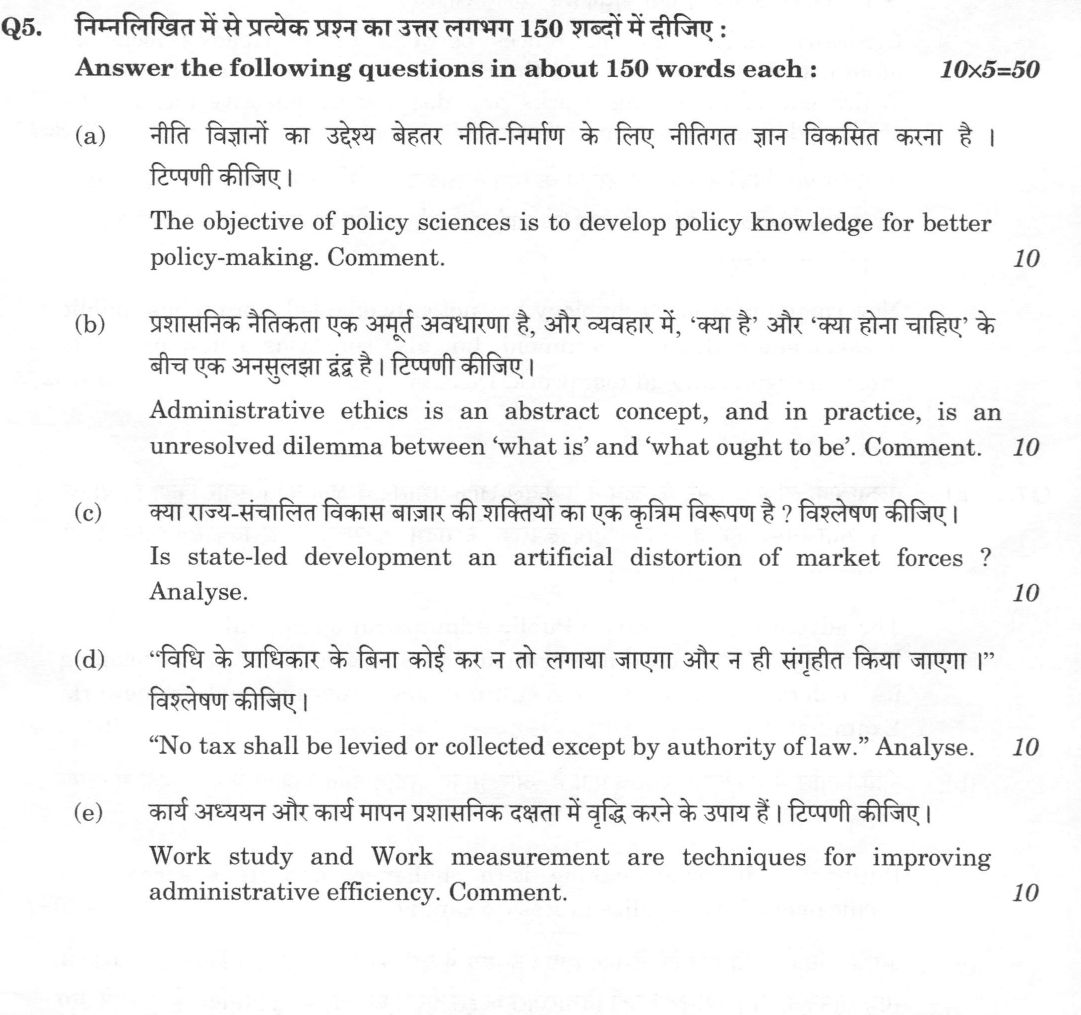
(a) The objective of policy sciences is to develop policy knowledge for better policy-making. Comment. (10 marks) (b)…
Answer the following questions in about 150 words each :
The objective of policy sciences is to develop policy knowledge for better policy-making. Comment. 10 marks
Administrative ethics is an abstract concept, and in practice, is an unresolved dilemma between ‘what is’ and ‘what ought to be’. Comment. 10 marks
Is state-led development an artificial distortion of market forces ? Analyse. 10 marks
“No tax shall be levied or collected except by authority of law.” Analyse. 10 marks
Work study and Work measurement are techniques for improving administrative efficiency. Comment. 10 marks
हिंदी में प्रश्न पढ़ें
निम्नलिखित में से प्रत्येक प्रश्न का उत्तर लगभग 150 शब्दों में दीजिए :
नीति विज्ञानों का उद्देश्य बेहतर नीति-निर्माण के लिए नीतिगत ज्ञान विकसित करना है । टिप्पणी कीजिए । (10 अंक)
प्रशासनिक नैतिकता एक अमूर्त अवधारणा है, और व्यवहार में, ‘क्या है’ और ‘क्या होना चाहिए’ के बीच एक अनसुलझा द्वंद्व है । टिप्पणी कीजिए । (10 अंक)
क्या राज्य-संचालित विकास बाजार की शक्तियों का एक कृत्रिम विरूपण है ? विश्लेषण कीजिए । (10 अंक)
“विधि के प्राधिकार के बिना कोई कर न तो लगाया जाएगा और न ही संगृहीत किया जाएगा ।” विश्लेषण कीजिए । (10 अंक)
कार्य अध्ययन और कार्य मापन प्रशासनिक दक्षता में वृद्धि करने के उपाय हैं । टिप्पणी कीजिए । (10 अंक)
Model answer
Drafted with AI by UPSC Answer Check against this question's marking rubric, to the 150-word length. UPSC does not publish answers for Mains — this is one way to score well, not an official key. How we build rubrics and answers.
(a) Policy Sciences and Policy Knowledge Harold Lasswell founded the policy sciences with "The Policy Orientation" in The Policy Sciences (1951, edited with Daniel Lerner) and A Pre-View of Policy Sciences (1971). Their purpose is knowledge of the policy process and knowledge in the process, in the service of democracy and human dignity. The field is contextual, problem-oriented and methodologically diverse. Yehezkel Dror (Public Policymaking Reexamined, 1968) extended it with an optimal model that admits extra-rational elements and with "metapolicy" - improving the policymaking system itself.
The aim is visible in evidence-based policy: in India, NITI Aayog's Development Monitoring and Evaluation Office (2015) evaluates schemes.
The claim needs qualification. A knowledge-use gap persists; Charles Lindblom's "The Science of Muddling Through" (1959) shows that real policy is incremental bargaining; analysis can slide into technocracy that sidelines democratic choice; and "wicked problems" (Rittel and Webber, 1973) resist analytic solution. Policy knowledge improves policy-making only when it is joined to political judgement and public deliberation.
(b) Administrative Ethics: 'What Is' versus 'What Ought to Be' The gap between "is" and "ought" goes back to Hume. In administration it appears as Herbert Simon's fact-value distinction (Administrative Behavior, 1947): decisions contain factual and value premises, but only factual ones can be tested scientifically. Dwight Waldo replied that efficiency is itself a value, and the earlier Friedrich-Finer debate (1940-41) asked whether ethics rests on an "inner check" of professional responsibility (Friedrich) or on external control (Finer). This is why ethics looks abstract.
In practice the dilemma is managed institutionally: the All India Services (Conduct) Rules, 1968, the Nolan Committee's Seven Principles of Public Life (1995), and the Second ARC's fourth report, Ethics in Governance (2007), which distinguished an enforceable code of conduct from an aspirational code of ethics. Its call for a statutory statement of civil service values was taken up in the draft Public Services Bill (2007) but never enacted.
Dennis Thompson (1985) and John Rohr's "regime values" show that administrative ethics is possible. The dilemma is managed rather than resolved, and needs constant institutional reinforcement.
(c) State-led Development and Market Forces State-led development is not automatically a distortion; it often responds to market failure - public goods, externalities, information asymmetry and natural monopoly - and Musgrave's allocation, distribution and stabilisation functions justify intervention. The developmental-state literature (Chalmers Johnson on Japan's MITI, 1982; Alice Amsden on South Korea, 1989; Robert Wade, Governing the Market, 1990; Peter Evans's "embedded autonomy", 1995) and Mariana Mazzucato's "entrepreneurial state" (2013) show states creating markets.
Yet intervention can distort. Public choice (Buchanan and Tullock) and Anne Krueger's rent-seeking (1974) explain government failure, as in India's licence-permit raj, and Hayek's knowledge problem warns that planners cannot gather the dispersed knowledge that markets use.
The reasoned position is that the issue is not whether but how the state intervenes. India's digital public infrastructure such as Aadhaar and UPI created markets, while Production-Linked Incentive schemes (2020) and the India Semiconductor Mission test whether targeted industrial policy can avoid licence-raj rent-seeking. Intervention that corrects failures complements markets; intervention that protects rents distorts them.
(d) Article 265: No Tax without Authority of Law This is Article 265 of the Constitution. Both the levy and the collection of a tax need "authority of law" - a valid statute of a competent legislature, not an executive order - so even a lawful tax must be recovered by lawful procedure. Competence comes from Article 246 and the Seventh Schedule, and for GST from Article 246A and the GST Council under Article 279A (101st Amendment, 2016); income tax is now levied under the Income-tax Act, 2025, in force from 1 April 2026.
Article 265 works with Article 266 (Consolidated Fund) and Article 114 (Appropriation Act) to secure parliamentary control of the purse, embodying "no taxation without representation". Judicially, a levy can be challenged for want of competence or for violating fundamental rights; a tax is distinguished from a fee (Shirur Mutt, 1954); and unauthorised collections must be refunded, subject to unjust enrichment (Mafatlal Industries, 1997).
The limit is that the legislature can itself change the law: the 2012 retrospective amendment after Vodafone showed this, and the Taxation Laws (Amendment) Act, 2021 withdrew those demands to restore confidence.
(e) Work Study and Work Measurement Work study is a systematic examination of work methods, comprising two components: method study and work measurement. Method study involves selecting, recording, examining, developing, installing, and maintaining work methods using tools like process charts, flow diagrams, and therbligs (Gilbreths). Work measurement determines the time required for a task using techniques like time study and work sampling. The standard time is calculated as: Standard Time = Normal Time + Allowances, where Normal Time = Observed Time × Rating. In government, these techniques are used by bodies like the Organisation and Methods (O&M) Division, set up in 1954 on Paul Appleby's recommendation, and the Staff Inspection Unit (SIU, 1964) of the Department of Expenditure to set staffing norms, while the Central Secretariat Manual of Office Procedure, e-Office and the annual Special Campaigns (since 2021) for disposing of pending files apply the same logic. However, their limitation is that they are difficult to apply to discretionary or policy-oriented work, and they face human-relations critiques regarding worker morale.
How this answer will be evaluated
Evaluation rubric
Each sub-part is marked on its own, against the marks and word limit printed on the paper.
- (a) 'Comment' on the defining purpose of the policy sciences — the generation of policy-relevant knowledge to improve policy-making. The answer must attribute the founding conception correctly to Lasswell, add Dror's extension, state the characteristic features of the policy sciences, and offer a brief critical judgement. 10 marks · 150 words
Must cover
- Attribute the founding conception to Lasswell ('The Policy Orientation', 1951; A Pre-View of Policy Sciences, 1971), with the distinction between knowledge of and knowledge in the policy process
- State the characteristic features: contextuality, problem orientation, methodological diversity, and the democratic, human-dignity purpose
- Add Dror's extension (Public Policymaking Reexamined, 1968; optimal model, metapolicy)
- Give a critical judgement on whether policy knowledge actually improves policy-making (knowledge-use gap, incrementalism, technocracy, wicked problems)
Loses marks
- Writing a general note on the stages of the policy process instead of on the policy sciences as a field and its purpose
- Omitting Lasswell entirely, or attributing the policy sciences to Dror alone — Dror extended and criticised Lasswell's programme
- Missing the two-branch distinction (knowledge of / knowledge in), which is the heart of Lasswell's definition
- Presenting the policy sciences as purely technical and ignoring Lasswell's explicitly democratic and value-oriented purpose
- No critical comment, when the directive is 'comment'
Earns more
- Adds Dror's contribution with correct attribution: Public Policymaking Reexamined (1968), the optimal model, megapolicy and metapolicy, extra-rational elements, and improving policymaking capacity
- Critical judgement: technocracy versus democratic choice, wicked problems (Rittel and Webber, 1973), limited analytic capacity, and the knowledge–use gap
Extra mark
- Lindblom's 'The Science of Muddling Through' (1959) as a counterpoint
- Indian illustration of evidence-based policy (e.g., NITI Aayog's DMEO, 2015)
- (b) 'Comment' on two linked claims: that administrative ethics is abstract, and that in practice it is an unresolved dilemma between the empirical 'what is' and the normative 'what ought to be'. The answer must engage the fact–value problem, name the principal debates and thinkers, and show how the dilemma is managed institutionally. 10 marks · 150 words
Must cover
- Explain why administrative ethics appears abstract and frame 'is' versus 'ought' as the fact-value problem (Simon, Administrative Behavior, 1947)
- Engage the principal debates: Waldo on efficiency as a value; Friedrich (inner check) versus Finer (external control), 1940-41
- Show how the dilemma is managed institutionally (conduct rules, Nolan's Seven Principles 1995, Second ARC's fourth report Ethics in Governance 2007)
- Reach a reasoned verdict on whether the dilemma is truly unresolved
Loses marks
- Writing a general ethics essay on honesty and integrity with no thinker, debate or instrument named
- Reversing the Friedrich–Finer positions — Friedrich argued for internal/professional responsibility, Finer for external control
- Ignoring the fact–value problem, which is the intellectual core of the 'is versus ought' phrasing
- Confusing a code of conduct (enforceable prohibitions) with a code of ethics (aspirational values), a distinction the Second ARC specifically drew
- Concluding that ethics is simply impossible in administration, without noticing Thompson's argument to the contrary
Earns more
- Shows operationalisation through named instruments: All India Services (Conduct) Rules 1968 and CCS (Conduct) Rules 1964, the Nolan Committee's Seven Principles of Public Life (1995), the Second ARC's fourth report Ethics in Governance (2007) and its code-of-ethics recommendation, CVC/Lokpal/RTI/whistle-blower machinery
- Cites at least one later ethics scholar correctly — Rohr's regime values, Cooper's responsible administrator, Thompson's 'The Possibility of Administrative Ethics' (1985) — and reaches a reasoned verdict on whether the dilemma is truly unresolved
Extra mark
- Thompson's 'The Possibility of Administrative Ethics' (1985), Rohr's regime values or Cooper's responsible administrator
- Second ARC's code of ethics versus code of conduct distinction, and the unenacted draft Public Services Bill (2007)
- (c) 'Analyse' a yes/no proposition: whether state-led development artificially distorts market forces. The answer must present the market-failure and developmental-state justification for state leadership, the government-failure and public-choice critique, and arrive at a reasoned position rather than a slogan. 10 marks · 150 words
Must cover
- Set out the market-failure case for state leadership (public goods, externalities, information asymmetry, natural monopoly; Musgrave's allocation, distribution and stabilisation functions)
- Present the developmental/entrepreneurial-state argument that the state can create markets, not merely distort them
- Present the government-failure critique: Hayek's knowledge problem, public choice (Buchanan and Tullock), rent-seeking (Krueger, 1974)
- Arrive at a reasoned position (complementarity; the quality and design of intervention matter) with Indian illustration
Loses marks
- Turning the answer into a narrative of India's Five Year Plans and 1991 reforms with no analytical framework of market or government failure
- One-sided advocacy — either 'the state always distorts' or 'the state must do everything' — when the directive is to analyse
- Attributing rent-seeking to Buchanan; the term was coined by Anne Krueger in 1974, building on Tullock's 1967 analysis
- Confusing market failure with government failure, or treating subsidies as automatically distortive without distinguishing merit goods and externality correction
- No conclusion or position, leaving a list of arguments without a verdict
Earns more
- Uses developmental-state evidence with correct attribution (Johnson 1982; Amsden 1989; Wade 1990; Evans 1995) and Mazzucato's entrepreneurial state (2013)
- Applies to India: licence-permit raj and the 1991 reforms; digital public infrastructure (Aadhaar, UPI); PLI schemes and targeted industrial policy
Extra mark
- Evans's 'embedded autonomy' as the condition that separates developmental from predatory states
- Distinguishing merit goods and externality correction from distortive subsidies
- (d) 'Analyse' the quoted constitutional text, which is Article 265 of the Constitution of India. The answer must identify the provision, unpack 'levied', 'collected' and 'authority of law', place it within the constitutional scheme of financial control, and bring out its judicial and administrative implications. 10 marks · 150 words
Must cover
- Identify the provision as Article 265 and unpack 'levied', 'collected' and 'authority of law' (a valid law by a competent legislature, not executive action)
- Place it in the constitutional scheme: Article 246 and the Seventh Schedule, Articles 246A and 279A (101st Amendment, 2016), Articles 266 and 114
- Bring out judicial implications: tax/fee distinction, challenge for want of competence or breach of fundamental rights, refund of unauthorised collections
- Explain its democratic and administrative significance (no taxation without representation, parliamentary control of the purse)
Loses marks
- Failing to identify the article, or misidentifying it — the provision is Article 265, not Article 266 or Article 300A
- Treating the provision as covering expenditure; expenditure control comes from Articles 266(3) and 114, while Article 265 governs taxation
- Ignoring the word 'collected' and so missing that even a lawful tax must be recovered by a lawful procedure
- Claiming that no delegation is possible in tax statutes; subordinate rule-making is permitted where the legislature fixes the policy and essential elements
- Omitting GST's distinct constitutional basis under Article 246A and the GST Council under Article 279A
Earns more
- Brings in judicial doctrine — the tax/fee distinction (Shirur Mutt, 1954), limits on delegation of essential taxing elements, refund of unauthorised collections, challenge for want of competence or breach of fundamental rights
- Explains the democratic and administrative significance — no taxation without representation, parliamentary control of the purse, protection against arbitrary exaction, discipline on tax administration
Extra mark
- Mafatlal Industries (1997) on refunds and unjust enrichment
- Vodafone and the 2012 retrospective amendment, withdrawn by the Taxation Laws (Amendment) Act, 2021
- (e) 'Comment' on work study and work measurement as administrative-efficiency techniques. The answer must define work study and its two components accurately, name the actual techniques of each, show their application in government, and note their limitations. 10 marks · 150 words
Must cover
- Define work study as method study plus work measurement
- Name method-study steps and tools (select, record, examine, develop, install, maintain; process charts, flow diagrams; the Gilbreths' therbligs)
- Name work-measurement techniques and the standard-time logic (time study, work sampling; standard time = normal time + allowances; normal time = observed time x rating)
- Show application in Indian government (O&M, Staff Inspection Unit staffing norms) and note limitations
Loses marks
- Treating work study and work measurement as the same thing; work measurement is one of the two branches of work study, the other being method study
- Naming no technique at all, so the note stays at the level of 'it improves efficiency'
- Confusing standard time with observed time, or omitting the rating factor and allowances
- Attributing therbligs and motion study to Taylor rather than to Frank and Lillian Gilbreth
- No limitation discussed, when the obvious one is that discretionary and policy work cannot be timed
Earns more
- Applies to Indian government practice: Organisation and Methods work, the O&M Division set up in the Cabinet Secretariat in 1954 following the Gorwala (1951) and Appleby (1953) reports, the Staff Inspection Unit's work-measurement-based staffing norms, DARPG, and modern uses in e-Office workflow and service timelines
- Notes limitations: unsuited to discretionary and policy work, quantity over quality and outcomes, worker resistance and the human-relations critique, rapid obsolescence of standards
Extra mark
- O&M Division (1954) following the Gorwala (1951) and Appleby (1953) reports; Staff Inspection Unit (1964)
- Modern uses: e-Office workflow, service timelines, Special Campaigns for disposing of pending files
What "Comment" is asking you to do
Take a position on the statement and support it. Comment usually attaches to a quoted line in the short slots, so the reasoning must be compressed — an opening view, a few load-bearing reasons, and the limit of the claim.
Structure that answers it
Unpack what the statement asserts → your stance → two or three supporting reasons → the qualification that limits it
Where marks are lost
Neutral summary; a comment without a stance has not answered. Equally costly is accepting the quoted line wholesale and never testing where it fails.
Practice this exact question
Write your answer and it is marked point by point against the model answer above — what you covered, what you missed, what you got wrong.
Evaluate my answer →More from Public Administration 2026 Paper I
- Q2 (a) Different paradigms of public administration deal with the questions of ‘How’ and ‘Wh…
- Q3 (a) Bureaucratic features have remained constant in organisations despite the development…
- Q4 (a) Abraham Maslow propounded the theory of needs, which identified the basic needs that…
- Q5 Answer the following questions in about 150 words each : (a) The objective of policy scie…
- Q6 (a) “Liberalization, Privatization and Globalization (LPG) successfully resolved the stru…
- Q7 (a) The advent of Comparative Public Administration not only widened the knowledge of Pub…
- Q8 (a) Financial integrity, compliance with laws and performance standards, and efficient, e…