Paper I — Q8
(a) Financial integrity, compliance with laws and performance standards, and efficient, economical and effective service delivery…
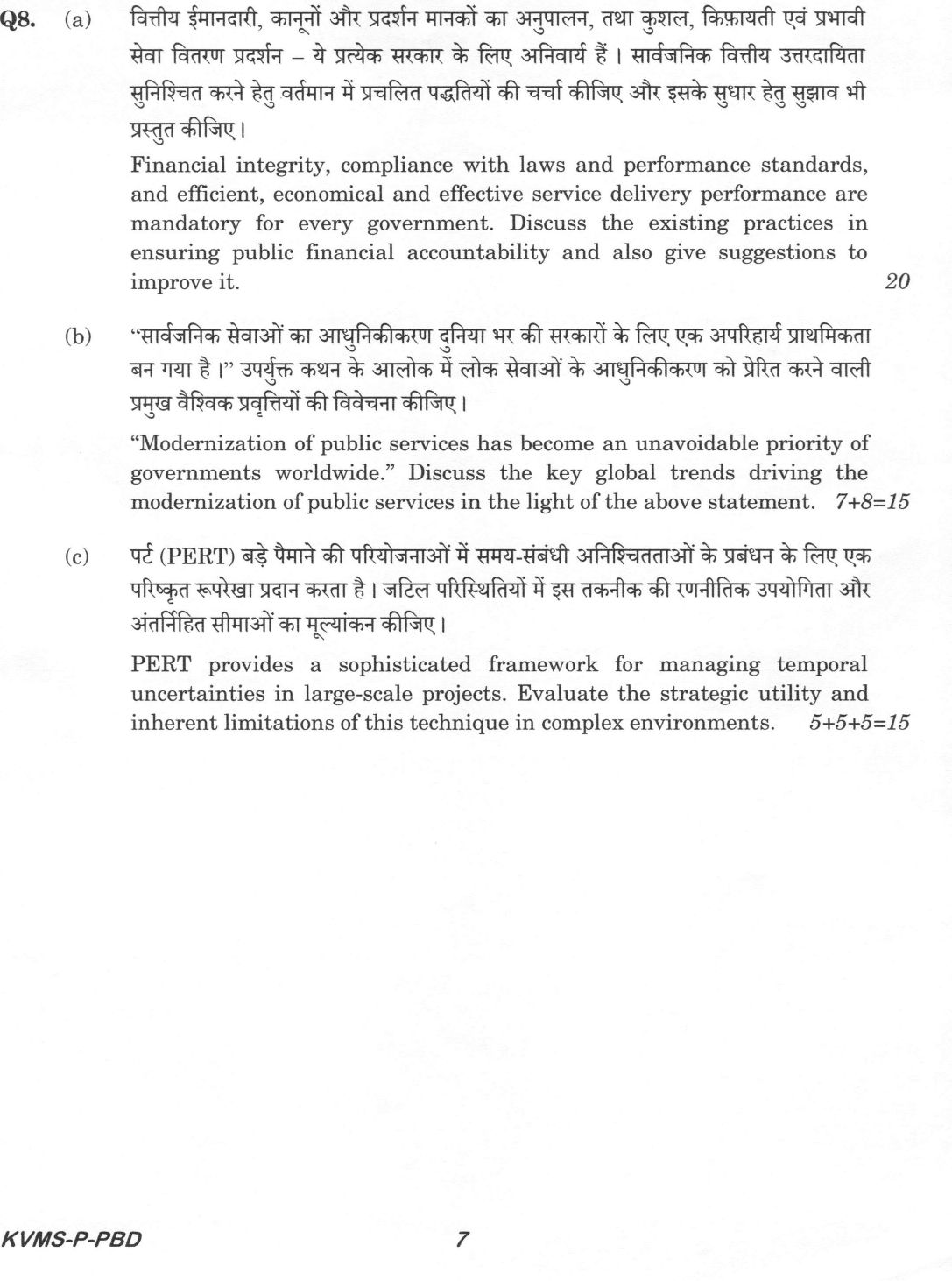
Financial integrity, compliance with laws and performance standards, and efficient, economical and effective service delivery performance are mandatory for every government. Discuss the existing practices in ensuring public financial accountability and also give suggestions to improve it. 20 marks
“Modernization of public services has become an unavoidable priority of governments worldwide.” Discuss the key global trends driving the modernization of public services in the light of the above statement. 15 marks
PERT provides a sophisticated framework for managing temporal uncertainties in large-scale projects. Evaluate the strategic utility and inherent limitations of this technique in complex environments. 15 marks
हिंदी में प्रश्न पढ़ें
वित्तीय ईमानदारी, कानूनों और प्रदर्शन मानकों का अनुपालन, तथा कुशल, किफायती एवं प्रभावी सेवा वितरण प्रदर्शन – ये प्रत्येक सरकार के लिए अनिवार्य हैं । सार्वजनिक वित्तीय उत्तरदायित्व सुनिश्चित करने हेतु वर्तमान में प्रचलित पद्धतियों की चर्चा कीजिए और इसके सुधार हेतु सुझाव भी प्रस्तुत कीजिए । (20 अंक)
“सार्वजनिक सेवाओं का आधुनिकीकरण दुनिया भर की सरकारों के लिए एक अपरिहार्य प्राथमिकता बन गया है ।” उपर्युक्त कथन के आलोक में लोक सेवाओं के आधुनिकीकरण को प्रेरित करने वाली प्रमुख वैश्विक प्रवृत्तियों की विवेचना कीजिए । (15 अंक)
पर्ट (PERT) बड़े पैमाने की परियोजनाओं में समय-संबंधी अनिश्चितताओं के प्रबंधन के लिए एक परिष्कृत रूपरेखा प्रदान करता है । जटिल परिस्थितियों में इस तकनीक की रणनीतिक उपयोगिता और अंतर्निहित सीमाओं का मूल्यांकन कीजिए । (15 अंक)
Model answer
Drafted with AI by UPSC Answer Check against this question's marking rubric, to the expected length. UPSC does not publish answers for Mains — this is one way to score well, not an official key. How we build rubrics and answers.
(a) Public Financial Accountability: Practices and Suggestions Public financial accountability in India is anchored in the Constitution and statutory frameworks that ensure financial integrity, legal compliance, and efficient service delivery. The executive is bound by Article 265 (no tax without authority of law) and Articles 112–114, which mandate the Annual Financial Statement and the Appropriation Act, ensuring that no money is withdrawn from the Consolidated Fund of India (Article 266) without parliamentary sanction (Article 114(3)); Article 267 creates the Contingency Fund for unforeseen expenditure. Legislative oversight is exercised through the Public Accounts Committee (PAC, dating from 1921 and chaired by an Opposition member since 1967), which examines CAG reports; the Estimates Committee, which scrutinizes budgetary demands for economy; the Committee on Public Undertakings; and, since 1993, the Departmentally Related Standing Committees, which examine the demands for grants of each ministry. The CAG, empowered by Articles 148–151 and the CAG (Duties, Powers and Conditions of Service) Act, 1971, conducts compliance, propriety, and performance audits to verify that public funds are used for their intended purposes.
To ensure efficient and effective delivery, the government utilizes the General Financial Rules, 2017, the Public Financial Management System (PFMS) for real-time monitoring, the SNA-SPARSH system (2022) for "just-in-time" release of funds to states so that money does not sit idle in bank accounts, Direct Benefit Transfer (DBT) to minimize leakage, and outcome budgeting to link expenditure with results. Social accountability is further reinforced by the Right to Information Act, 2005, and social audits under Section 17 of the MGNREGA Act (MGNREGA has since been succeeded by the VB-G RAM G Act, 2025).
To improve these practices, India should transition to accrual-based accounting under the Government Accounting Standards Advisory Board (GASAB, 2002) to provide a more accurate picture of liabilities, and bring off-budget borrowings into the fiscal accounts. Establishing a Fiscal Council, as the Fourteenth and Fifteenth Finance Commissions recommended, or a Parliamentary Budget Office would provide independent, technical scrutiny of fiscal policies. Furthermore, the PAC must be mandated to act on CAG recommendations within a specific timeframe, and pre-budget scrutiny by parliamentary committees should be institutionalized to enhance the deliberative quality of the budget process.
(b) Global Trends Driving Modernisation of Public Services The modernization of public services is an unavoidable global priority driven by the need to meet rising citizen expectations and address complex societal challenges. This transformation is characterized by several key global trends and administrative doctrines.
First, the shift toward Digital-Era Governance (Dunleavy et al., 2006) has moved administration from "e-government" to integrated, data-driven services. This is coupled with a move toward citizen-centricity, where citizens are viewed as co-producers of value. This aligns with the New Public Service (Denhardt and Denhardt, 2000) and New Public Governance (Osborne, 2006) doctrines, which emphasize serving the public rather than just steering it. Additionally, the concept of "Public Value" (Mark Moore, 1995) has shifted the focus from mere efficiency to the creation of shared societal value.
Second, the trend toward "joined-up government" or whole-of-government approaches is essential for tackling cross-cutting issues like climate change and public health. This is supported by Open Government initiatives, such as the Open Government Partnership (2011), which promote transparency and civic engagement - India has not joined the OGP, preferring its own open data policy (2012) and RTI regime.
Third, the modernization of the workforce is critical. Global trends emphasize competency frameworks and continuous learning, exemplified by India’s Mission Karmayogi (2020) and its iGOT platform. Finally, evidence-based policy and the use of behavioural insight units are becoming standard for designing effective interventions. A newer trend is digital public infrastructure - open, interoperable platforms for identity, payments and data, such as India's Aadhaar, UPI and DigiLocker - which India promoted during its 2023 G20 presidency, alongside the use of artificial intelligence in service delivery. Service standards are also codified through citizen charters and India's Sevottam model.
However, these trends carry risks, including the digital divide, data protection concerns, and algorithmic bias. Successful modernization requires strong political commitment, robust change management, and a focus on resilience, as highlighted by the lessons of the COVID-19 pandemic and the goals of SDG 16.
(c) PERT: Strategic Utility and Limitations The Programme Evaluation and Review Technique (PERT), developed in 1958 by the US Navy's Special Projects Office with Booz Allen Hamilton for the Polaris missile programme (while the deterministic Critical Path Method was developed at DuPont in 1957), is a probabilistic tool used to manage temporal uncertainties in large-scale projects. It operates on the premise that activity durations are uncertain and uses three time estimates: the optimistic time (a), the most likely time (m), and the pessimistic time (b).
The expected time (te) for an activity is calculated using the weighted average formula: te = (a + 4m + b) / 6. The variance (σ²) is calculated as ((b − a) / 6)². By summing the variances of activities on the critical path—the longest path through the network with zero slack—managers can determine the probability of completing the project by a specific deadline.
The strategic utility of PERT lies in its ability to quantify schedule risk and identify the critical path, allowing for better resource allocation - highly relevant in India, where the Ministry of Statistics' monitoring regularly shows a large share of central infrastructure projects running behind schedule, and where PRAGATI and the PM Gati Shakti platform aim to track critical bottlenecks. However, it has inherent limitations in complex environments. It assumes that activity durations are independent, which is often false in real-world projects. It also suffers from "merge-event bias," where the probability of a project being late is underestimated because it ignores the "near-critical" paths that can become critical if delays occur. Furthermore, PERT does not account for resource constraints.
To address these limitations, modern project management often integrates PERT with other techniques. Monte Carlo simulation can handle complex interdependencies, while Goldratt’s Critical Chain (1997) introduces project and feeding buffers to account for resource contention. In highly dynamic environments, rolling-wave planning and agile methodologies provide the flexibility that the static PERT network lacks.
How this answer will be evaluated
Evaluation rubric
Each sub-part is marked on its own, against the marks and word limit printed on the paper.
- (a) Two explicit tasks: 'discuss the existing practices' that ensure public financial accountability, and 'give suggestions to improve it'. The stated benchmarks — financial integrity, compliance with laws and performance standards, and efficient, economical and effective service delivery — should organise the answer. An answer without substantive suggestions cannot pass. 20 marks
Must cover
- Set out the constitutional framework: Articles 112-114, 265, 266, 267 and 148-151 (Annual Financial Statement, Appropriation Act, Consolidated and Contingency Funds, CAG)
- Legislative oversight: PAC, Estimates Committee, Committee on Public Undertakings, Departmentally Related Standing Committees, and budget-stage tools such as cut motions
- Audit: the CAG's compliance, propriety and performance audit under the CAG (Duties, Powers and Conditions of Service) Act, 1971
- Executive, internal and social accountability for efficient, economical and effective delivery (GFR, PFMS, DBT, outcome budgeting, RTI, social audit)
- Concrete suggestions for improvement (accrual accounting via GASAB, a fiscal council or parliamentary budget office, time-bound action on audit findings, disclosure of off-budget borrowing)
Loses marks
- Describing only the CAG and the PAC and ignoring executive, internal and social accountability mechanisms
- Omitting suggestions or offering only vague exhortations such as 'increase transparency', when the question explicitly demands improvement suggestions
- Confusing the Estimates Committee (Lok Sabha members only, examines estimates for economy) with the Public Accounts Committee (examines CAG reports and appropriation accounts, chaired by an Opposition member by convention)
- Claiming the CAG controls the withdrawal of money from the Consolidated Fund; in India the CAG audits after the event and the 'comptroller' function is nominal, unlike the United Kingdom
- Getting cut motions wrong — the policy cut reduces the demand to one rupee and the token cut reduces it by one hundred rupees
Earns more
- Covers executive, internal and social accountability instruments: Financial Adviser scheme, General Financial Rules, departmentalisation of accounts, internal audit, PFMS, DBT, GeM, outcome and gender budgeting; RTI 2005, social audit under Section 17 of MGNREGA, citizen charters and participatory budgeting
Extra mark
- SNA-SPARSH just-in-time release of funds or GeM for procurement transparency
- International models of independent fiscal scrutiny such as the UK Office for Budget Responsibility (2010) or the US Congressional Budget Office (1974)
- (b) 'Discuss the key global trends driving the modernization of public services' in the light of the statement that modernisation has become unavoidable. The answer must identify distinct global drivers and the administrative doctrines they generate, illustrate them, and close with the risks and preconditions. 15 marks
Must cover
- Identify distinct global drivers (technology, rising citizen expectations, fiscal pressure, cross-cutting problems, crises) and the doctrines they generate
- Digital-era governance (Dunleavy et al., 2006) and citizen-centric, co-produced services
- Post-NPM doctrines: public value (Moore, 1995), New Public Service (Denhardt and Denhardt, 2000), New Public Governance (Osborne, 2006), whole-of-government
- Open government and workforce-capability trends with examples (Open Government Partnership, 2011; competency frameworks, Mission Karmayogi, 2020)
- Risks and preconditions (digital divide, data protection, algorithmic bias, capacity, political commitment)
Loses marks
- Listing Indian schemes as though they were global trends, without identifying the underlying driver each illustrates
- Equating modernisation with digitisation alone and omitting doctrinal, capability, transparency and collaboration trends
- Attributing 'public value' to Osborne or 'New Public Governance' to Moore; public value is Mark Moore's (1995) and New Public Governance is Stephen Osborne's (2006)
- No mention of risks, so the answer reads as promotional rather than analytical
- Confusing New Public Management with New Public Service — the latter was formulated in explicit opposition to the former
Earns more
- Covers capability and evidence-based trends: competency frameworks, continuous and digital learning, lateral entry, leadership and diversity — with an example such as Mission Karmayogi (2020) and iGOT — plus evaluation, regulatory impact assessment, behavioural insight units and foresight
- Closes with risks and preconditions: digital divide and exclusion, data protection and algorithmic bias, capacity and financing, reform fatigue and uncritical model transfer, political commitment and change management; and includes resilience and sustainability drivers such as COVID-19 lessons and SDG 16
Extra mark
- Digital public infrastructure (Aadhaar, UPI, DigiLocker) promoted during India's 2023 G20 presidency
- Behavioural insight units and evidence-based policy (e.g., the UK Behavioural Insights Team, 2010)
- (c) 'Evaluate' both the strategic utility and the inherent limitations of PERT in complex, large-scale projects. The answer must state PERT's actual mechanics correctly, including the three time estimates and the expected-time and variance formulae, before assessing where it helps and where it fails. 15 marks
Must cover
- State PERT's origin (Polaris programme, 1958) and its three time estimates (optimistic, most likely, pessimistic)
- Give the mechanics correctly: te = (a + 4m + b)/6; variance = ((b - a)/6)^2; critical path as the longest path with zero slack; probability of meeting a deadline
- Assess strategic utility in large projects (quantifying schedule risk, focusing management attention, coordination)
- Assess inherent limitations (independence assumption, merge-event bias and near-critical paths, no resource constraints, subjective estimates)
- Evaluate with alternatives or remedies (comparison with CPM, Monte Carlo simulation, critical chain)
Loses marks
- Writing te = (a + m + b)/3 or omitting the weight of 4 on the most likely estimate; the correct expected time is (a + 4m + b)/6
- Writing the variance as (b − a)/6 rather than ((b − a)/6) squared, or confusing standard deviation with variance
- Claiming PERT is deterministic and CPM probabilistic; it is the reverse — PERT uses three probabilistic estimates, CPM a single deterministic one with a cost–time trade-off
- Defining the critical path as the shortest path; it is the longest path through the network, with zero slack
- Listing advantages and disadvantages generically without the quantitative mechanics, when the question asks for an evaluation of a 'sophisticated framework for managing temporal uncertainties'
Earns more
- Offers alternatives and remedies for complex environments: Monte Carlo simulation, GERT for loops and probabilistic branching, Goldratt's critical chain with project and feeding buffers (1997), resource-constrained scheduling and levelling, rolling-wave and agile planning, earned value management
Extra mark
- CPM (DuPont, 1957) as the deterministic counterpart with a time-cost trade-off
- Indian application: project delays tracked by MoSPI, PRAGATI and PM Gati Shakti
What "Discuss" is asking you to do
Lay the issue out from more than one side — how it arose, what is claimed for it, what is held against it, and where it now stands. UPSC attaches discuss to broad topics with several live dimensions, so coverage of the dimensions earns more than the strength of your opinion.
Structure that answers it
Set the issue up → the case as it is made → the case against → the dimension both sides leave out → where the balance now lies
Where marks are lost
Listing facts with no thread between them, or arguing one side throughout and calling it a discussion.
Practice this exact question
Write your answer and it is marked point by point against the model answer above — what you covered, what you missed, what you got wrong.
Evaluate my answer →More from Public Administration 2026 Paper I
- Q5 Answer the following questions in about 150 words each : (a) The objective of policy scie…
- Q6 (a) “Liberalization, Privatization and Globalization (LPG) successfully resolved the stru…
- Q7 (a) The advent of Comparative Public Administration not only widened the knowledge of Pub…
- Q8 (a) Financial integrity, compliance with laws and performance standards, and efficient, e…