Paper I — Q6
(a) “Liberalization, Privatization and Globalization (LPG) successfully resolved the structural crisis of the welfare state with…
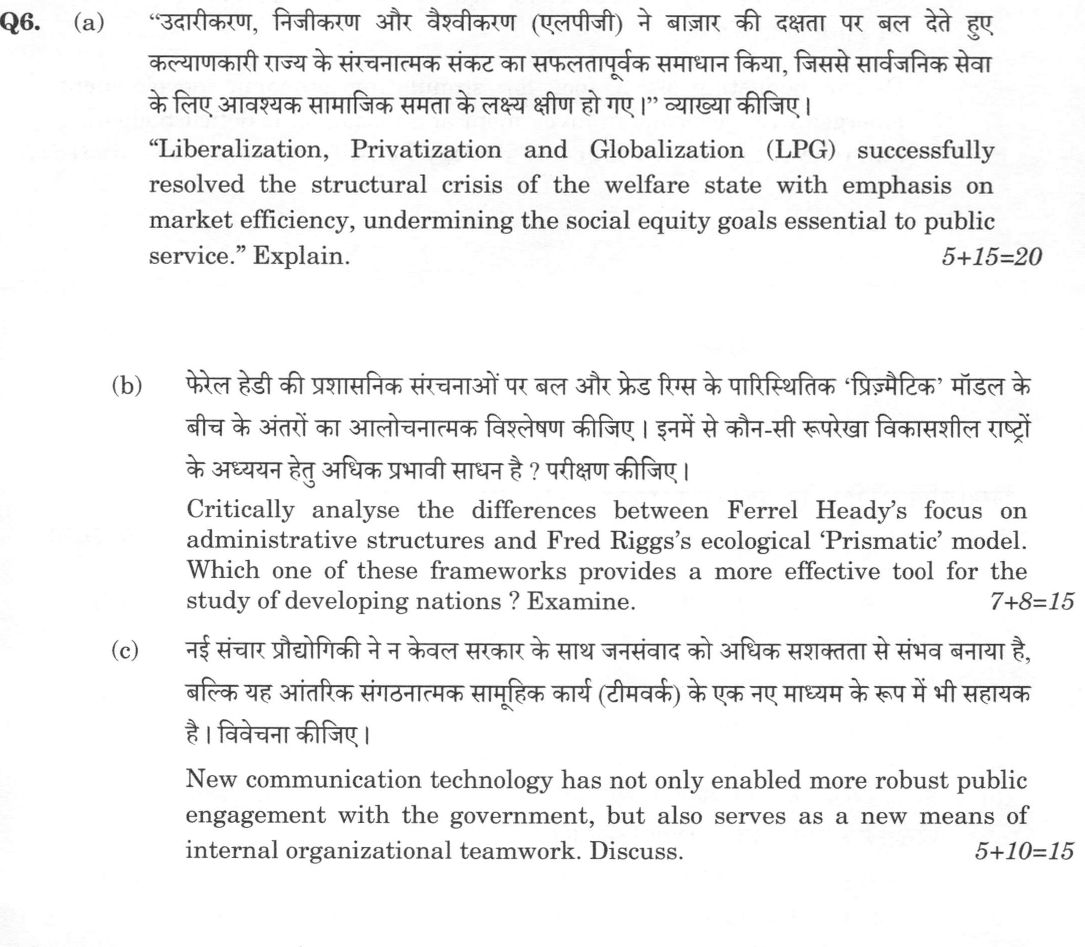
“Liberalization, Privatization and Globalization (LPG) successfully resolved the structural crisis of the welfare state with emphasis on market efficiency, undermining the social equity goals essential to public service.” Explain. 20 marks
Critically analyse the differences between Ferrel Heady’s focus on administrative structures and Fred Riggs’s ecological ‘Prismatic’ model. Which one of these frameworks provides a more effective tool for the study of developing nations ? Examine. 15 marks
New communication technology has not only enabled more robust public engagement with the government, but also serves as a new means of internal organizational teamwork. Discuss. 15 marks
हिंदी में प्रश्न पढ़ें
“उदारीकरण, निजीकरण और वैश्वीकरण (एलपीजी) ने बाजार की दक्षता पर बल देते हुए कल्याणकारी राज्य के संरचनात्मक संकट का सफलतापूर्वक समाधान किया, जिससे सार्वजनिक सेवा के लिए आवश्यक सामाजिक समता के लक्ष्य क्षीण हो गए ।” व्याख्या कीजिए । (20 अंक)
फेरेल हेडी की प्रशासनिक संरचनाओं पर बल और फ्रेड रिग्स के पारिस्थितिक ‘प्रिज्मैटिक’ मॉडल के बीच के अंतरों का आलोचनात्मक विश्लेषण कीजिए। इनमें से कौन-सी रूपरेखा विकासशील राष्ट्रों के अध्ययन हेतु अधिक प्रभावी साधन है ? परीक्षण कीजिए। (15 अंक)
नई संचार प्रौद्योगिकी ने न केवल सरकार के साथ जनसंवाद को अधिक सशक्तता से संभव बनाया है, बल्कि यह आंतरिक संगठनात्मक सामूहिक कार्य (टीमवर्क) के एक नए माध्यम के रूप में भी सहायक है। विवेचना कीजिए। (15 अंक)
Model answer
Drafted with AI by UPSC Answer Check against this question's marking rubric, to the expected length. UPSC does not publish answers for Mains — this is one way to score well, not an official key. How we build rubrics and answers.
(a) LPG, the Welfare State Crisis and Social Equity The assertion that Liberalization, Privatization, and Globalization (LPG) successfully resolved the structural crisis of the welfare state by prioritizing market efficiency, while simultaneously undermining the social equity goals essential to public service, reflects a profound shift in administrative philosophy. The "structural crisis" refers to the fiscal crisis of the welfare state, identified by J. O'Connor (1973), where escalating social expenditures outran revenues; together with the "overload" thesis of Crozier, Huntington and Watanuki (The Crisis of Democracy, 1975) and Habermas's "legitimation crisis", this framed the stagflation of the 1970s as a crisis of the welfare state. In response, the Washington Consensus (John Williamson, 1989) and New Public Management (NPM), with Osborne and Gaebler's call for government to "steer rather than row" (1992), prioritized economy, efficiency, and effectiveness. In India, where the "crisis" was less a mature welfare state's overload than the 1991 balance-of-payments and fiscal crisis, the 1991 New Industrial Policy, disinvestment, and the Foreign Exchange Management Act (FEMA, 1999) shifted the state toward market efficiency, and growth did expand the fiscal space later used for welfare.
However, the word "successfully" is contestable; the crisis was often displaced rather than resolved. The shift toward market efficiency undermined social equity, a pillar of public administration championed by H. George Frederickson and the New Public Administration movement (Minnowbrook, 1968). The move from universalism to targeting and the introduction of user charges eroded the welfare mandate. Consequently, a counter-movement emerged: New Public Service (Denhardt and Denhardt, 2000) and New Public Governance (Osborne, 2006) reasserted the need for equity. In India, this was institutionalized through rights-based legislation such as the Right to Information (RTI), MGNREGA (2005; now succeeded by the VB-G RAM G Act, 2025), RTE (2009), and NFSA (2013), which sought to restore the social equity goals essential to public service. The later "new welfarism" of Direct Benefit Transfer through the JAM trinity, PM-KISAN (2019) and free foodgrains under PMGKAY (extended for five years from January 2024) combines market-era efficiency tools with equity goals, suggesting that efficiency and equity need not be a zero-sum choice.
(b) Heady's Structural Approach versus Riggs's Prismatic Model Ferrel Heady and Fred Riggs offer distinct frameworks for comparative administration. Heady’s structural-institutional approach, detailed in Public Administration: A Comparative Perspective (1966), takes the bureaucracy itself as the unit of comparison and classifies developing polities by regime type (traditional-autocratic, bureaucratic-elite, polyarchal-competitive, dominant-party semi-competitive, dominant-party mobilisation and communist-totalitarian). He identifies five common features of administration in developing countries: it is imitative rather than indigenous; deficient in skilled manpower; oriented to non-production goals such as status; marked by a widespread discrepancy between form and reality; and enjoys substantial operational autonomy. In contrast, Fred Riggs’s ecological approach, presented in Administration in Developing Countries: The Theory of Prismatic Society (1964), analyzes society as a whole. Riggs categorizes societies into fused, prismatic, and diffracted. For developing nations, he identifies the "prismatic" stage, characterized by heterogeneity, formalism, and overlapping. His model uses specific terminology like the "sala" (administrative sub-system), "bazaar-canteen" (economic model), and "poly-normativism" to explain how traditional and modern norms coexist.
Riggs's model has its critics - its jargon, a static and somewhat negative portrayal of developing societies, and the implicit assumption that the Western "diffracted" model is the goal. Still, Riggs’s framework is a more effective tool for studying developing nations because it explains why transplanted Western structures misfire in local contexts. While Heady provides a useful classification of administrative patterns, Riggs’s ecological model captures the unique "prismatic" nature of these societies, where formal rules often coexist with informal practices. Riggs’s model is superior for understanding the transition from agraria to industria, as it accounts for the "overlapping" of functions that Heady’s structural focus might miss. Therefore, for a deep understanding of the administrative environment in the developing world, Riggs’s ecological perspective is more comprehensive, while Heady's structural comparison remains the more practical, testable tool; the best analysis combines Heady's focus on bureaucracy with Riggs's attention to its social ecology.
(c) Communication Technology: Public Engagement and Internal Teamwork New communication technology has fundamentally transformed public administration by enhancing both external public engagement and internal organizational teamwork. Externally, e-governance has facilitated "e-democracy" and "e-services." Platforms like MyGov (2014), the UMANG app (2017) and CPGRAMS allow for robust citizen participation, open data portals (data.gov.in, 2012) promote transparency, and the Bhashini AI platform makes services available in Indian languages. This aligns with Jane Fountain’s concept of the "Virtual State" (2001) and Dunleavy et al.’s "Digital-Era Governance" (2006), which emphasize the integration of technology into public service delivery.
Internally, technology serves as a medium for organizational teamwork. The e-Office system has streamlined electronic file movement, reducing bureaucratic delays. Platforms like PRAGATI (2015) use video-conferencing for real-time review of infrastructure projects, the government's own messaging app Sandes and the Government e-Marketplace (GeM) connect officials across departments, the PM Gati Shakti National Master Plan (2021) gives ministries a shared GIS platform for infrastructure planning, and Mission Karmayogi and iGOT (2020) provide a digital platform for civil service training and collaboration. These tools enhance coordination and "steering" capabilities within the government.
However, a critical assessment is necessary. The "digital divide" can lead to exclusion errors, and "consultation" via digital means does not always translate into "influence." Furthermore, concerns regarding privacy and surveillance, after the Puttaswamy (2017) recognition of privacy as a fundamental right, have led to the enactment of the Digital Personal Data Protection Act, 2023, with rules notified in November 2025. Ultimately, while technology provides the tools for better engagement and teamwork, its success depends on administrative capacity and culture rather than the tools alone.
How this answer will be evaluated
Evaluation rubric
Each sub-part is marked on its own, against the marks and word limit printed on the paper.
- (a) 'Explain' a compound and contestable claim: that LPG successfully resolved the welfare state's structural crisis by emphasising market efficiency, and in doing so undermined the social equity goals essential to public service. Both limbs must be examined — the claimed success, and the equity cost — and the word 'successfully' should be tested rather than assumed. 20 marks
Must cover
- Explain the 'structural crisis' of the welfare state (O'Connor's fiscal crisis, 1973; overload; 1970s stagflation) and India's 1991 balance-of-payments variant
- Explain how LPG and NPM responded through market efficiency (Washington Consensus, Williamson 1989; Hood 1991; Osborne and Gaebler 1992; 1991 New Industrial Policy, disinvestment)
- Test the word 'successfully': was the crisis resolved or merely displaced
- Explain the equity cost (targeting versus universalism, user charges, informalisation), attributing social equity to Frederickson and the New Public Administration (Minnowbrook 1968)
- Show the counter-movement and reach a balanced conclusion (New Public Service 2000, New Public Governance 2006; India's rights-based laws of 2005-2013)
Loses marks
- Accepting the word 'successfully' uncritically, when the strongest answers test whether the crisis was resolved or merely displaced
- Writing only about India's 1991 reforms and never addressing the welfare state, public service values or NPM
- Confusing the Washington Consensus with the Washington Convention or attributing it to the IMF alone; it was codified by John Williamson in 1989
- Naming social equity without attributing it to Frederickson and the New Public Administration movement
- Omitting one of the two limbs — either the efficiency-gain limb or the equity-erosion limb — and thereby answering half the question
Earns more
- Presents the equity counter-movement with correct attribution: Frederickson's social equity from New Public Administration (Minnowbrook 1968; Marini 1971), Denhardt and Denhardt's New Public Service (2000), Osborne's New Public Governance (2006), Moore's public value (1995), Sen's capability approach, and India's rights-based statutes of 2005–2013
Extra mark
- Habermas's legitimation crisis or the overload thesis of Crozier, Huntington and Watanuki (1975)
- 'New welfarism' through DBT and the JAM trinity as efficiency tools used for equity goals
- (b) Two directives: 'critically analyse the differences' between Ferrel Heady's structural-institutional approach and Fred Riggs's ecological prismatic model, and then 'examine' which framework is the more effective tool for studying developing nations. A reasoned choice with justification is required; a neutral summary will not satisfy the second directive. 15 marks
Must cover
- Present Heady's structural approach (Public Administration: A Comparative Perspective, 1966): bureaucracy as the unit of comparison, regime-type classification, five common features of developing-country administration
- Present Riggs's ecological prismatic model (Administration in Developing Countries: The Theory of Prismatic Society, 1964): fused-prismatic-diffracted; heterogeneity, formalism, overlapping; sala, bazaar-canteen, poly-normativism
- Critically analyse the differences: unit and level of analysis, method, explanatory versus classificatory power, strengths and weaknesses
- Examine and justify which framework is more effective for studying developing nations (a reasoned choice)
Loses marks
- Describing Riggs at length and Heady in a line, when the question is an explicit comparison of the two
- Getting Riggs's terminology wrong — the three societies are fused, prismatic and diffracted; the administrative sub-system of prismatic society is the sala, and the economic model is the bazaar-canteen
- Attributing 'formalism' or 'overlapping' to Heady instead of Riggs, or attributing the developing-country bureaucratic characteristics to Riggs instead of Heady
- Failing to answer the second directive by naming and justifying a more effective framework
- Treating prismatic society as merely a stage of economic development rather than as an analytical model of a society in transition with coexisting norms
Earns more
- Critique of Riggs (jargon, static and Western-centric with 'diffracted' as the implied goal, hard to operationalise) and of Heady (bureaucracy-centric, thin on social context)
- Illustration from Indian or developing-country administration (formalism in rule implementation, clects, gap between form and reality)
Extra mark
- Riggs's Agraria-Transitia-Industria typology and the Comparative Administration Group
- A synthesis combining Heady's structural comparison with Riggs's ecological insight
- (c) 'Discuss' a two-part claim: that new communication technology has strengthened public engagement with government, and that it is also a new medium of internal organisational teamwork. Both the external (citizen-facing) and internal (staff-facing) dimensions must be covered, with concrete platforms and a critical assessment. 15 marks
Must cover
- Show how new communication technology strengthens citizen engagement (e-services, e-participation, grievance redress, open data) with concrete platforms
- Show how it serves internal teamwork and coordination (e-Office, video-conference reviews, shared planning platforms, digital training) with concrete platforms
- Use a theoretical frame (Digital-Era Governance, Dunleavy et al. 2006; Fountain's Building the Virtual State, 2001)
- Critically assess: digital divide, consultation without influence, privacy and surveillance (DPDP Act, 2023), dependence on capacity and culture
Loses marks
- Answering only the citizen-facing half and ignoring internal organisational teamwork, which is explicitly the second half of the question
- Listing government schemes with no analysis of how they change engagement or coordination
- Treating all online presence as 'participation'; posting information is not consultation, and consultation is not co-production
- No critical note on the digital divide, privacy or capacity, leaving a purely celebratory answer
- Inventing platform launch details; where unsure, describe the function rather than assert a date
Earns more
- Uses a theoretical frame with correct attribution — Dunleavy et al.'s Digital-Era Governance (2006) or Jane Fountain's Building the Virtual State (2001) and technology enactment
- Critically assesses: digital divide and exclusion errors, consultation without influence, misinformation, surveillance and privacy (Digital Personal Data Protection Act, 2023), cybersecurity, algorithmic opacity, and dependence on capacity and culture rather than tools
Extra mark
- Distinguishing information, consultation and co-production on the engagement ladder
- Privacy anchor: Puttaswamy (2017) and the DPDP Rules notified in November 2025
What "Explain" is asking you to do
Make the working of something clear — what sets it off, what follows from what, and what it produces. Explain is the Commission's mechanism word: it dominates the technical papers and the “explain why” stems, where the marks sit in the causal chain and not in the label.
Structure that answers it
State what it is → the initiating condition → the chain of cause, step by step → an instance where it plays out → what the chain produces
Where marks are lost
Describing what something looks like instead of why it works that way. Naming the stages without linking them reads as description too.
Practice this exact question
Write your answer and it is marked point by point against the model answer above — what you covered, what you missed, what you got wrong.
Evaluate my answer →More from Public Administration 2026 Paper I
- Q3 (a) Bureaucratic features have remained constant in organisations despite the development…
- Q4 (a) Abraham Maslow propounded the theory of needs, which identified the basic needs that…
- Q5 Answer the following questions in about 150 words each : (a) The objective of policy scie…
- Q6 (a) “Liberalization, Privatization and Globalization (LPG) successfully resolved the stru…
- Q7 (a) The advent of Comparative Public Administration not only widened the knowledge of Pub…
- Q8 (a) Financial integrity, compliance with laws and performance standards, and efficient, e…