Paper I — Q3
(a) Bureaucratic features have remained constant in organisations despite the development of different forms under NPM and Public…
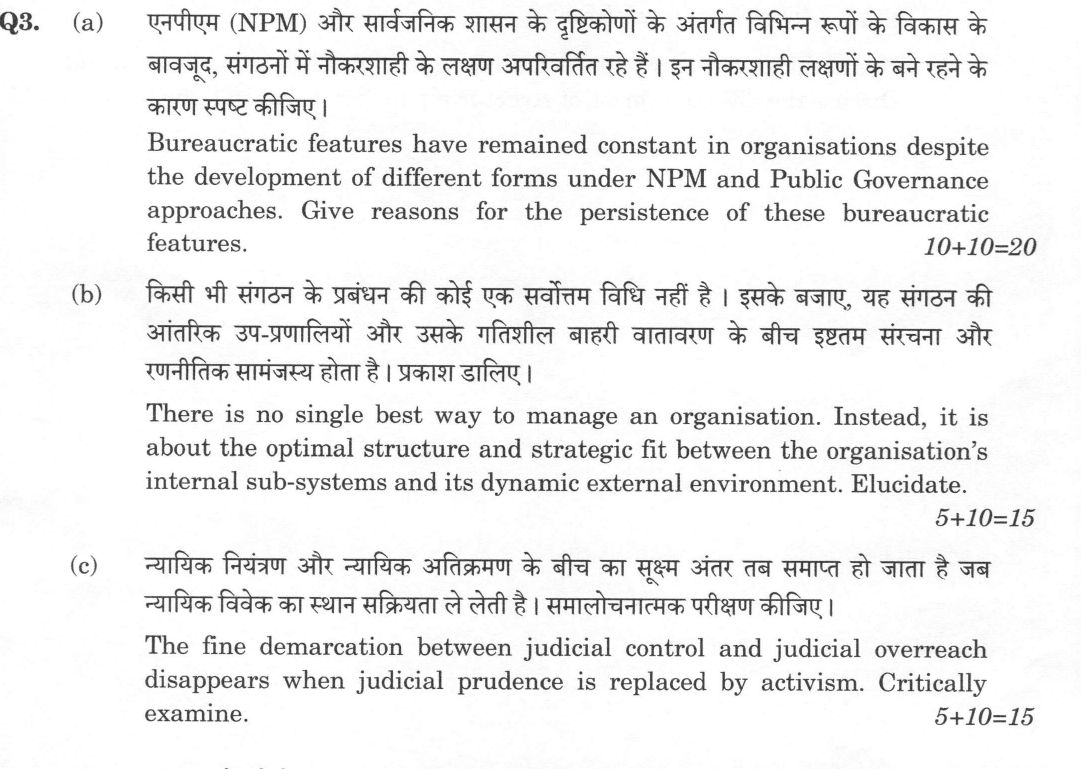
Bureaucratic features have remained constant in organisations despite the development of different forms under NPM and Public Governance approaches. Give reasons for the persistence of these bureaucratic features. 20 marks
There is no single best way to manage an organisation. Instead, it is about the optimal structure and strategic fit between the organisation's internal sub-systems and its dynamic external environment. Elucidate. 15 marks
The fine demarcation between judicial control and judicial overreach disappears when judicial prudence is replaced by activism. Critically examine. 15 marks
हिंदी में प्रश्न पढ़ें
एनपीएम (NPM) और सार्वजनिक शासन के दृष्टिकोणों के अंतर्गत विभिन्न रूपों के विकास के बावजूद, संगठनों में नौकरशाही के लक्षण अपरिवर्तित रहे हैं । इन नौकरशाही लक्षणों के बने रहने के कारण स्पष्ट कीजिए । (20 अंक)
किसी भी संगठन के प्रबंधन की कोई एक सर्वोत्तम विधि नहीं है । इसके बजाए, यह संगठन की आंतरिक उप-प्रणालियों और उसके गतिशील बाहरी वातावरण के बीच इष्टतम संरचना और रणनीतिक सामंजस्य होता है । प्रकाश डालिए । (15 अंक)
न्यायिक नियंत्रण और न्यायिक अतिक्रमण के बीच का सूक्ष्म अंतर तब समाप्त हो जाता है जब न्यायिक विवेक का स्थान सक्रियता ले लेती है । समालोचनात्मक परीक्षण कीजिए । (15 अंक)
Model answer
Drafted with AI by UPSC Answer Check against this question's marking rubric, to the expected length. UPSC does not publish answers for Mains — this is one way to score well, not an official key. How we build rubrics and answers.
(a) Why Bureaucratic Features Persist under NPM and Governance
The persistence of Weberian bureaucratic features—such as hierarchy, written rules, files, impersonality, and merit-based career service—despite the advent of New Public Management (NPM) and public governance is a result of deep-seated legal, functional, and political necessities.
First, the rule of law and accountability are the strongest reasons for persistence. In a democratic state, bureaucratic procedures are essential to ensure legality and transparency. Weber himself argued that bureaucracy's technical superiority - precision, speed, continuity and knowledge of the files - makes it indispensable, and the "Neo-Weberian State" model, as described by Pollitt and Bouckaert (2004), argues that while management styles may change, the core of legal-rational authority remains. Similarly, Charles Goodsell in The Case for Bureaucracy (1983), Paul du Gay in In Praise of Bureaucracy (2000) and Johan P. Olsen ("Maybe It Is Time to Rediscover Bureaucracy", 2006) have made the case for bureaucracy, emphasizing that its formal structures are necessary for public trust.
Second, NPM itself is internally contradictory. While NPM (Hood, 1991; Osborne and Gaebler, 1992) promotes marketization, the management of contracts and Public-Private Partnerships (PPPs) actually demands a heavy volume of rule-making and monitoring, which reinforces bureaucratic structures. Patrick Dunleavy's "digital-era governance" (2006) shows that technology has led to reintegration and centralisation after NPM's fragmentation, and "agencification" was partly reversed in the UK and New Zealand. Furthermore, "path dependence" and "blame avoidance" (Christopher Hood) drive civil servants to adhere to established files and procedures to protect themselves from political or legal liability.
Finally, the theoretical reaffirmation of bureaucracy's role in modern governance has led to a hybrid model. While Merton’s "trained incapacity" and Crozier’s "vicious circle" (1964) explain bureaucratic dysfunctions, these are often seen as issues of implementation rather than reasons to dismantle the core hierarchy. In India, reforms such as e-Office, Mission Karmayogi's competency-based training and limited lateral entry (begun in 2018, with the 2024 advertisement withdrawn after objections over reservation) have been layered onto, not substituted for, the career-based, rule-bound civil service. Thus, the core survives because it provides the essential "skeleton" of the state.
(b) Contingency Theory: No One Best Way
The proposition that there is no "single best way" to manage an organisation is the central tenet of Contingency Theory. This approach rejects the universal-principles position of classical management, arguing instead that effectiveness depends on the "strategic fit" or congruence between internal sub-systems and the external environment.
Key contingency studies provide the evidence for this. Burns and Stalker (1961) distinguished between "mechanistic" structures (suitable for stable environments) and "organic" structures (suitable for dynamic ones). Joan Woodward (1965) demonstrated that technology (unit, mass, or process production) dictates the optimal structure. Lawrence and Lorsch (1967) introduced the concepts of "differentiation" and "integration," showing that successful firms manage the tension between specialized sub-units. Additionally, James D. Thompson (1967) and Katz and Kahn (1966) viewed organizations as "open systems" subject to "equifinality" (a concept from Ludwig von Bertalanffy's general systems theory)—the idea that different paths can lead to the same successful outcome. Fred Fiedler's contingency model of leadership (1967) applied the same logic to leadership style. Alfred Chandler's Strategy and Structure (1962) added that structure follows strategy, and Trist and Bamforth's Tavistock study (1951) showed that an organisation's social and technical sub-systems must be jointly optimised.
In Public Administration, this logic is applied through Fred Riggs’s ecological approach (The Ecology of Public Administration, 1961), which suggests that administrative structures must fit their specific socio-economic environment. For instance, a revenue department may function best with a mechanistic, rule-bound design, whereas a disaster response agency requires an organic, matrix-based design for rapid adaptation.
However, the approach is descriptive rather than predictive. A major critique is the "environmental determinism" problem, countered by John Child’s "strategic choice" theory (1972), which argues that managers can actively shape their environment rather than just reacting to it. Nevertheless, the "fit" remains the primary determinant of organizational success.
(c) Judicial Control versus Judicial Overreach
The line between legitimate judicial control and judicial overreach is indeed blurred when "judicial prudence" is replaced by "activism." Judicial control refers to the review of administrative action under Articles 13, 32, 136, and 226 of the Constitution, using grounds like Wednesbury unreasonableness (1948) or the CCSU/GCHQ (1985) standards of illegality, irrationality and procedural impropriety, to which Indian courts have added proportionality (Om Kumar, 2001; Modern Dental College, 2016).
Judicial activism, pioneered by Justices Bhagwati and Krishna Iyer through Public Interest Litigation (PIL) in cases like S. P. Gupta (1981), expanded the scope of rights. Landmark cases such as Vishaka v State of Rajasthan (1997) and the use of "continuing mandamus" in Vineet Narain (1998) show the judiciary stepping into policy-making. However, this can cross into what critics call "overreach," as in the Second Judges (1993) and Third Judges (1998) cases, which established the collegium system, the NJAC judgment (2015), the 2016 ban on liquor sales within 500 metres of highways, the court-appointed Lodha Committee's restructuring of cricket administration, and the January 2021 stay on the farm laws. In State of Tamil Nadu v. Governor (April 2025) a bench fixed timelines for assent, but the November 2025 advisory opinion on a presidential reference held that courts cannot prescribe such timelines - an instance of the Court itself redrawing the line.
The demarcation disappears because of "executive and legislative default." When the government fails to act, the judiciary is forced to fill the vacuum. However, the Divisional Manager, Aravali Golf Club v Chander Hass (2008) judgment serves as a critical warning against "judges running the government." The lack of "judicially manageable standards" for complex, polycentric resource questions makes it difficult for courts to make effective policy.
To maintain the balance, the "self-restraint doctrine" is essential. Remedies include adhering to the separation of powers (Article 50 separates the judiciary from the executive), imposing "sunset clauses" on structural injunctions, and strengthening the capacity of the executive and legislature so that the judiciary can return to its traditional role of a "watchdog" rather than a "policymaker."
How this answer will be evaluated
Evaluation rubric
Each sub-part is marked on its own, against the marks and word limit printed on the paper.
- (a) 'Give reasons' — an explanatory question. The candidate must first establish which Weberian bureaucratic features have persisted, acknowledge what NPM and public governance changed, and then supply substantive reasons (legal, functional, political, organisational and theoretical) for the persistence of bureaucratic features. 20 marks
Must cover
- Identify the persisting Weberian features (hierarchy, written rules and files, impersonality, merit-based career service) rooted in legal-rational authority
- Acknowledge what NPM (Hood 1991; Osborne and Gaebler 1992) and public governance changed (markets, agencification, networks)
- Give substantive reasons for persistence: legality and accountability, functional indispensability, NPM's own need for rules and contract monitoring, path dependence and blame avoidance
- Show the theoretical reaffirmation: Neo-Weberian State (Pollitt and Bouckaert), Olsen's call to rediscover bureaucracy, Goodsell's The Case for Bureaucracy (1983)
- Conclude on a hybrid in which reforms are layered onto, not substituted for, the bureaucratic core
Loses marks
- Describing Weberian bureaucracy and its criticisms at length but never giving reasons for persistence, which is the actual demand
- Denying that anything changed under NPM and governance; the question presupposes change and asks why the core survived
- Attributing 'trained incapacity' to Weber — the phrase is Veblen's, used by Merton in his 1940 analysis of bureaucratic personality
- Confusing Weber's three types of authority (traditional, charismatic, legal-rational) or claiming Weber prescribed bureaucracy as an ideal to pursue; the 'ideal type' is an analytical construct, and Weber feared the 'iron cage'
- Ignoring legality and accountability — the two strongest reasons — and resting the whole answer on 'inertia' or 'resistance to change'
Earns more
- Reform-side reasons: NPM's internal contradictions (Hood, 1991), the heavy rule-making demanded by contract and PPP management, path dependence, risk aversion and blame avoidance, reform fatigue and vested interests
- Theoretical reaffirmation with correct attribution: Pollitt and Bouckaert's Neo-Weberian State, Olsen's call to rediscover bureaucracy, Goodsell's The Case for Bureaucracy (1983), du Gay's In Praise of Bureaucracy (2000)
- Balanced acknowledgement of dysfunctions, correctly attributed: Merton's trained incapacity and goal displacement (1940), Crozier's vicious circle (1964), Gouldner's three patterns (1954), Michels's iron law (1911), Niskanen's budget-maximising bureaucrat (1971)
Extra mark
- du Gay's In Praise of Bureaucracy (2000) or Dunleavy's digital-era governance (2006) as post-NPM reintegration
- Indian illustration of reforms layered onto the career civil service (e-Office, Mission Karmayogi, limited lateral entry)
- (b) 'Elucidate' the contingency and systems proposition — that there is no one best way to organise, and that effectiveness depends on fit between internal sub-systems and a dynamic external environment. The answer must reject the universal-principles position, present the key contingency studies with correct attribution, explain the fit/congruence idea, and evaluate the approach. 15 marks
Must cover
- Reject the universal 'one best way' of classical theory (Taylor, Fayol, Gulick) and state the contingency proposition
- Present key contingency studies with correct attribution: Burns and Stalker (1961) mechanistic/organic; Woodward (1965) technology and structure; Lawrence and Lorsch (1967) differentiation and integration
- Explain the open-systems basis of 'fit' between internal sub-systems and a dynamic environment (Katz and Kahn 1966; Thompson 1967; equifinality)
- Apply the idea to public administration (Riggs's ecological approach; mechanistic versus organic designs for different public tasks)
- Evaluate the approach: environmental determinism versus Child's strategic choice (1972), difficulty of measuring 'fit'
Loses marks
- Describing general systems theory only, with no contingency study named, so the 'strategic fit' claim is never evidenced
- Misattributing findings — mechanistic/organic is Burns and Stalker, not Lawrence and Lorsch; differentiation and integration is Lawrence and Lorsch, not Woodward; the technology typology of unit/mass/process production is Woodward's
- Treating contingency theory as an assertion that structure does not matter, rather than that the right structure is situational
- Giving no public-administration application, leaving the answer purely business-school in flavour
- No critique — the question says 'elucidate', but a strong answer still notes the determinism problem and Child's strategic choice
Earns more
- Applies the logic to public administration: mechanistic design for stable rule-bound regulatory or revenue work, organic/project/matrix design for disaster response, missions and innovation; Riggs's ecological approach as the PA version of environmental contingency
- Critically evaluates: descriptive not predictive, measurement difficulty, environmental determinism versus Child's strategic choice, difficulty of validating 'fit'
Extra mark
- Chandler's 'structure follows strategy' (Strategy and Structure, 1962) or Mintzberg's structural configurations
- Trist and Bamforth's socio-technical systems (1951) or Fiedler's contingency model of leadership (1967)
- (c) 'Critically examine' the claim that the line between legitimate judicial control of administration and judicial overreach vanishes when judicial prudence gives way to activism. The answer must define judicial control, judicial activism and overreach distinctly, give concrete instances on both sides, and reach a reasoned verdict with remedies. 15 marks
Must cover
- Define judicial control (review under Articles 13, 32, 136 and 226; writs; grounds such as Wednesbury, CCSU illegality/irrationality/procedural impropriety, proportionality) distinctly from activism and from overreach
- Give instances of legitimate activism: PIL (S. P. Gupta, 1981), Vishaka v. State of Rajasthan (1997), continuing mandamus (Vineet Narain, 1998)
- Give instances commonly cited as overreach (collegium via the Second and Third Judges cases, NJAC judgment 2015, 2016 highway liquor ban, cricket administration), presenting them as contested
- Explain why the line blurs (executive and legislative default, polycentric questions without manageable standards) and reach a reasoned verdict with remedies (self-restraint, Aravali Golf Club v. Chander Hass 2008, separation of powers)
Loses marks
- Treating judicial activism and judicial overreach as synonyms, which destroys the whole question
- Citing no case at all, or citing cases with wrong names, years or holdings — the examiner is checking precisely this
- Presenting a one-sided attack on the judiciary without acknowledging the executive and legislative default that invites judicial entry, or a one-sided defence that denies overreach exists
- Confusing judicial review with judicial control in the narrow administrative-law sense and never discussing the grounds of review
- No remedy or way forward, so the 'critically examine' directive is left half-served
Earns more
- Explains analytically why the line blurs — policy consequences of rights adjudication, executive and legislative default, continuing mandamus, absence of judicially manageable standards for polycentric resource questions, lack of expertise and democratic accountability
- Offers the self-restraint doctrine and remedies: Aravali Golf Club (2008) warning against judges running the government, Article 50, justiciability limits, sunset clauses on structural injunctions, expert commissions, and strengthening executive and legislative capacity
Extra mark
- State of Tamil Nadu v. Governor of Tamil Nadu (April 2025) fixing assent timelines, and the 20 November 2025 advisory opinion on the Presidential Reference holding that courts cannot prescribe such timelines
- Indian proportionality review (Om Kumar, 2001; Modern Dental College, 2016)
What "Discuss" is asking you to do
Lay the issue out from more than one side — how it arose, what is claimed for it, what is held against it, and where it now stands. UPSC attaches discuss to broad topics with several live dimensions, so coverage of the dimensions earns more than the strength of your opinion.
Structure that answers it
Set the issue up → the case as it is made → the case against → the dimension both sides leave out → where the balance now lies
Where marks are lost
Listing facts with no thread between them, or arguing one side throughout and calling it a discussion.
Practice this exact question
Write your answer and it is marked point by point against the model answer above — what you covered, what you missed, what you got wrong.
Evaluate my answer →More from Public Administration 2026 Paper I
- Q1 Answer the following questions in about 150 words each : (a) “There is an urgent need to…
- Q2 (a) Different paradigms of public administration deal with the questions of ‘How’ and ‘Wh…
- Q3 (a) Bureaucratic features have remained constant in organisations despite the development…
- Q4 (a) Abraham Maslow propounded the theory of needs, which identified the basic needs that…
- Q5 Answer the following questions in about 150 words each : (a) The objective of policy scie…
- Q6 (a) “Liberalization, Privatization and Globalization (LPG) successfully resolved the stru…