Paper I — Q2
(a) Different paradigms of public administration deal with the questions of ‘How’ and ‘Why’, but do not negate the centrality of…
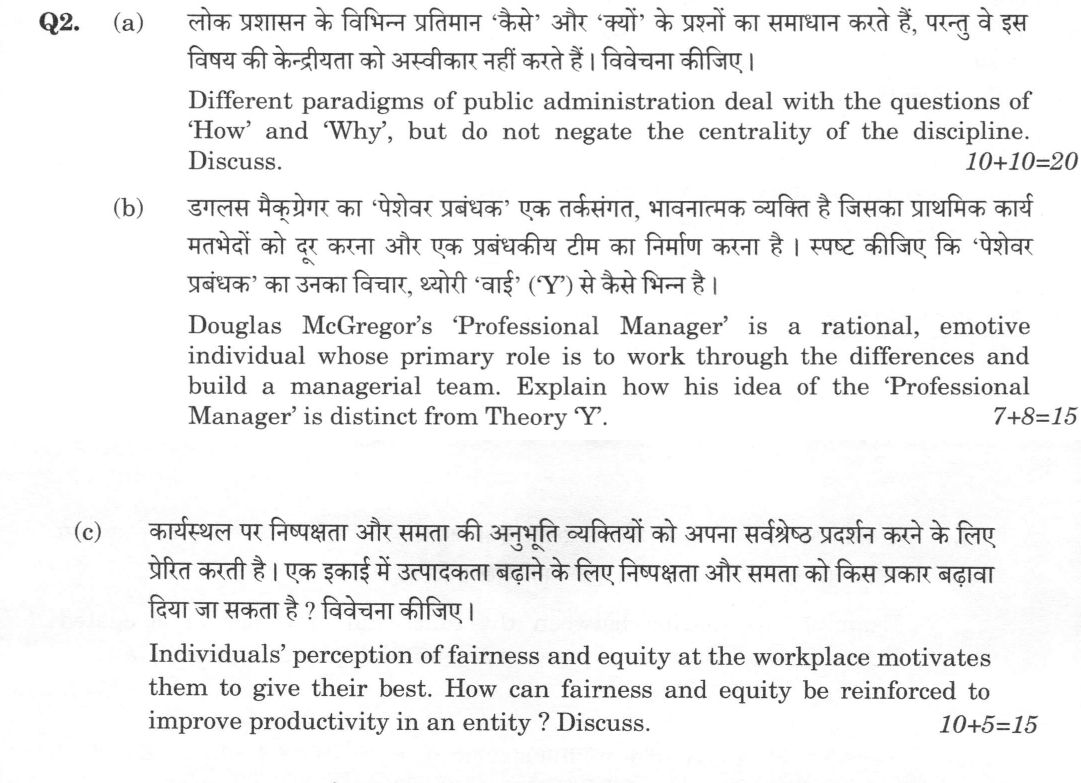
Different paradigms of public administration deal with the questions of ‘How’ and ‘Why’, but do not negate the centrality of the discipline. Discuss. 20 marks
Douglas McGregor’s ‘Professional Manager’ is a rational, emotive individual whose primary role is to work through the differences and build a managerial team. Explain how his idea of the ‘Professional Manager’ is distinct from Theory ‘Y’. 15 marks
Individuals' perception of fairness and equity at the workplace motivates them to give their best. How can fairness and equity be reinforced to improve productivity in an entity ? Discuss. 15 marks
हिंदी में प्रश्न पढ़ें
लोक प्रशासन के विभिन्न प्रतिमान ‘कैसे’ और ‘क्यों’ के प्रश्नों का समाधान करते हैं, परन्तु वे इस विषय की केन्द्रीयता को अस्वीकार नहीं करते हैं। विवेचना कीजिए। (20 अंक)
डगलस मैक्ग्रेगर का ‘पेशेवर प्रबंधक’ एक तर्कसंगत, भावनात्मक व्यक्ति है जिसका प्राथमिक कार्य मतभेदों को दूर करना और एक प्रबंधकीय टीम का निर्माण करना है। स्पष्ट कीजिए कि ‘पेशेवर प्रबंधक’ का उनका विचार, थ्योरी ‘वाई’ (‘Y’) से कैसे भिन्न है। (15 अंक)
कार्यस्थल पर निष्पक्षता और समता की अनुभूति व्यक्तियों को अपना सर्वश्रेष्ठ प्रदर्शन करने के लिए प्रेरित करती है । एक इकाई में उत्पादकता बढ़ाने के लिए निष्पक्षता और समता को किस प्रकार बढ़ावा दिया जा सकता है ? विवेचना कीजिए । (15 अंक)
Model answer
Drafted with AI by UPSC Answer Check against this question's marking rubric, to the expected length. UPSC does not publish answers for Mains — this is one way to score well, not an official key. How we build rubrics and answers.
(a) Paradigms, the 'How' and 'Why', and the Centrality of Public Administration The proposition that paradigms of public administration address the questions of ‘How’ and ‘Why’ without negating the discipline’s centrality is a fundamental characteristic of the field. The ‘How’ refers to the focus and technique of administration, while the ‘Why’ refers to the locus, purpose, and values.
The evolution of these paradigms is best understood through Nicholas Henry’s framework of locus (where administration happens) and focus (what it specialises in). Henry's five paradigms are: (1) the politics-administration dichotomy (1900-1926), rooted in Woodrow Wilson’s 1887 essay and Frank Goodnow’s Politics and Administration (1900) and consolidated in L. D. White's first textbook (1926), which fixed the locus in the bureaucracy; (2) the principles of administration (1927-1937), from W. F. Willoughby (1927) to Gulick and Urwick's POSDCORB (1937), which supplied the ‘How’ as universal principles; (3) public administration as political science (1950-1970), after Robert Dahl (1947), Herbert Simon (Administrative Behavior, 1947) and Dwight Waldo (The Administrative State, 1948) attacked the principles as unscientific and value-blind and reopened the ‘Why’; (4) public administration as management (1956-1970), which borrowed focus from business and organisation theory; and (5) public administration as public administration (from 1970), with its own locus in the public interest and focus on organisation theory and policy. Later movements continued the dialogue: the New Public Administration (Minnowbrook, 1968) emphasised social equity (Frederickson); New Public Management (Hood, 1991; Osborne and Gaebler, 1992) focused on efficiency and market mechanisms; and New Public Service (Denhardt and Denhardt, 2000) and New Public Governance (Stephen Osborne, 2006) re-centred the ‘Why’ on citizenship and public value (Mark Moore, 1995).
Despite these shifts, the centrality of the discipline remains intact because the core concerns of public organization, legitimacy, and accountability persist. These paradigms overlap rather than replace one another in a strict Kuhnian sense. In practice, India’s administrative system simultaneously runs Weberian, NPM, and governance elements, proving that the discipline’s identity is robust and adaptable.
(b) McGregor's Professional Manager versus Theory Y Douglas McGregor’s ‘Professional Manager’ is a distinct concept from his famous Theory Y, though the two are complementary. Theory Y, presented in The Human Side of Enterprise (1960), is a set of assumptions about human nature. It posits that work is as natural as play and that people seek self-control and responsibility. It is based on the principle of integration and self-control, suggesting that external control is a result of Theory X assumptions.
The ‘Professional Manager,’ discussed in the posthumous work The Professional Manager (1967, edited by Warren Bennis and Caroline McGregor), is a prescribed managerial role. The key distinctions are:
- Assumption vs. Role: Theory Y is a premise about employees; the Professional Manager is the practitioner who applies these premises.
- Dyadic vs. Team: Theory Y often focuses on the dyadic relationship between supervisor and subordinate. The Professional Manager’s primary role is to build a cohesive managerial team.
- Rational-Emotive: The Professional Manager is a rational, emotive individual. Unlike the simple application of Theory Y, this role involves working through differences and legitimate conflicts using transactional, two-way influence.
- Professionalism: The manager applies social science as a profession, treating emotions as managerial data.
In essence, Theory Y is the theoretical foundation, while the Professional Manager is the operational reality. The Professional Manager does not abdicate authority (a common misconception of Theory Y) but uses a more sophisticated, team-oriented approach to achieve integration.
(c) Reinforcing Fairness and Equity to Raise Productivity Individuals’ perception of fairness and equity at the workplace is a primary driver of productivity. This is grounded in J. Stacy Adams’s equity theory (1963), which states that individuals compare their outcome/input ratio with that of a referent other. When perceived inequity exists, motivation drops. To reinforce fairness and improve productivity, an entity must address the three dimensions of what Jerald Greenberg called organisational justice: distributive, procedural, and interactional (Bies and Moag, 1986) justice.
- Procedural Justice: This is often the most critical. Following Leventhal’s rules, the organization must ensure consistency, accuracy, and freedom from bias. This includes transparent appraisal systems (like APAR disclosure - after Dev Dutt v. Union of India (2008), all entries must be communicated to the officer, who may represent against them), online appraisal through SPARROW, and joint consultative machinery.
- Interactional Justice: This involves the interpersonal treatment of employees. Managers must provide reasoned orders and prior consultation. The POSH Act 2013 machinery is a vital institutional measure for ensuring dignified treatment.
- Distributive Justice: This relates to the fairness of rewards. Anchored in Articles 14, 16, and 39(d) of the Constitution, and recognised as a constitutional goal in Randhir Singh v. Union of India (1982), the entity must ensure equal pay for equal work, transparent promotion and posting policies, and fair distribution of resources.
- Grievance Redress: A time-bound, accessible grievance redress mechanism (for government, the CPGRAMS portal) and whistle-blower protection are essential to maintain trust, though the Whistle Blowers Protection Act, 2014 has still not been operationalised.
These measures reinforce productivity through Vroom’s expectancy theory (1964) and the Porter-Lawler model, in which rewards perceived as equitable raise satisfaction and the instrumentality of effort. While fairness is a necessary condition, it is not sufficient; it must be combined with other motivational factors to achieve peak performance.
How this answer will be evaluated
Evaluation rubric
Each sub-part is marked on its own, against the marks and word limit printed on the paper.
- (a) 'Discuss' a two-part proposition: that the successive paradigms of Public Administration answer questions of 'How' (technique/focus) and 'Why' (purpose/locus/values), and that despite their disagreements they do not destroy the centrality or identity of the discipline. Both the paradigm survey and the defence of the discipline's core must be present. 20 marks
Must cover
- Explain what 'How' (focus: techniques, structures, methods) and 'Why' (locus, purpose, values) mean in the paradigm debate
- Survey Henry's paradigms with correct attribution: dichotomy (Wilson 1887, Goodnow 1900, White 1926), principles (Willoughby 1927, Gulick and Urwick's POSDCORB 1937), the Simon (1947), Dahl (1947) and Waldo (1948) critique, PA as political science, as management, and as PA
- Cover later paradigms: New PA (Minnowbrook 1968, Frederickson), NPM (Hood 1991; Osborne and Gaebler 1992), New Public Service (Denhardt and Denhardt 2000), New Public Governance (Stephen Osborne 2006)
- Show how each shift answers the 'How' and/or the 'Why' differently
- Defend the centrality of the discipline: an enduring core of public purpose, legitimacy and accountability; paradigms overlap rather than replace one another
Loses marks
- Reciting Henry's five paradigms chronologically without ever answering the 'How'/'Why'/centrality proposition in the question
- Misattributing POSDCORB to Fayol — POSDCORB is Gulick's (1937); Fayol gave five functions and fourteen principles
- Dating errors: Wilson's essay is 1887, Simon's Administrative Behavior 1947, Waldo's The Administrative State 1948, Minnowbrook 1968, Hood's article 1991
- Treating NPM as a 'paradigm of Henry' — Henry's fifth paradigm precedes NPM; NPM is a later reform movement
- Omitting the second half — the defence of the discipline's centrality and identity — and so answering only half the question
Earns more
- Carries the story to contemporary paradigms with correct attribution: New Public Administration (Minnowbrook 1968; Marini 1971; Frederickson's social equity), NPM (Hood 1991; Osborne and Gaebler 1992), New Public Service (Denhardt and Denhardt, 2000), New Public Governance (Stephen Osborne, 2006), public value (Mark Moore, 1995), Digital-Era Governance (Dunleavy et al., 2006)
- Evaluative balance: paradigms overlap rather than replace one another in Kuhn's strict sense; India's practice simultaneously runs Weberian, NPM and governance elements
Extra mark
- Waldo's 'identity crisis' or Vincent Ostrom's The Intellectual Crisis in American Public Administration (1973) as debates that sharpened rather than dissolved the field
- Indian illustration of coexisting paradigms (Weberian civil service alongside NPM tools and participatory governance)
- (b) 'Explain how' — a directed comparison. The candidate must state McGregor's Theory Y accurately, then set out the conception of the 'Professional Manager' from his posthumous The Professional Manager (1967), and specify the points of difference: assumptions about human nature versus a prescribed managerial role, dyadic supervision versus building a managerial team, and the manager as a rational-emotive professional who works through differences. 15 marks
Must cover
- State Theory Y correctly (The Human Side of Enterprise, 1960): assumptions about human nature, principle of integration and self-control
- Set out the Professional Manager (The Professional Manager, 1967, posthumous; edited by Warren Bennis and Caroline McGregor): a rational-emotive manager who works through differences and builds a managerial team
- Specify the differences: assumptions about people versus a prescribed managerial role; superior-subordinate relation versus building a managerial team; transactional, two-way influence and working through conflict
- Conclude on the relationship: complementary, with the Professional Manager operationalising Theory Y
Loses marks
- Writing a Theory X versus Theory Y comparison, which is not what the question asks — the comparison demanded is Theory Y versus the Professional Manager
- Treating Theory Y as 'be nice to workers' and so missing the principle of integration and self-control, and McGregor's own warning that Theory Y is not abdication
- Attributing Theory Y assumptions to Maslow — Maslow supplied the need hierarchy McGregor drew on, but the Theory X/Y formulation is McGregor's
- Confusing McGregor's Theory Y with Ouchi's Theory Z (1981) or with Argyris's immaturity–maturity continuum
- Getting the publication facts wrong — The Professional Manager appeared in 1967, after McGregor's death in 1964, not as a companion volume issued by him
Earns more
- Brings out the rational-emotive and conflict-working character — differences of interest are legitimate and must be worked through; influence is transactional and two-way; emotions are managerial data; McGregor's own clarification that Theory Y is not soft management or abdication of authority
- Management as a profession applying social-science knowledge, with emotions treated as legitimate managerial data
Extra mark
- Reference to related ideas such as Likert's linking-pin team structure or Argyris's interpersonal competence
- A concrete (preferably Indian) example of team-building leadership that works through differences
- (c) 'Discuss' a prescriptive question: given that perceived fairness and equity drive effort, how can they be reinforced in an organisation to raise productivity? The answer must ground the link in motivation theory (equity and organisational justice) and then prescribe concrete, workable institutional measures. 15 marks
Must cover
- Ground the fairness-productivity link in Adams's equity theory (outcome/input ratio, referent other, responses to perceived inequity)
- Use the dimensions of organisational justice: distributive, procedural and interactional
- Prescribe concrete institutional measures for each dimension (transparent appraisal and APAR disclosure, rule-based promotion and posting, consultation, grievance redress)
- Link the measures to productivity through a motivation mechanism and note limits
Loses marks
- Writing a general motivation essay on Maslow and Herzberg without ever using equity or justice theory, which is what the question is about
- Confining the answer to distributive fairness (pay) and ignoring procedural and interactional justice, where most perceived unfairness actually arises
- Giving only platitudes ('be fair to all, avoid favouritism') with no institutional mechanism that a manager could actually install
- Missing the 'how to reinforce' half — theory without prescription cannot score above half marks
- Misattributing equity theory to Vroom or to Porter and Lawler; the equity formulation is Adams's
Earns more
- Prescribes procedural-voice measures: reasoned orders, prior consultation, joint consultative machinery, time-bound grievance redress, whistle-blower protection, published and consistently applied rules
- Prescribes interpersonal/informational and anti-discrimination measures: explaining decisions, dignified treatment, POSH Act 2013 machinery, diversity and equal access to training and postings; anchors in Articles 14, 16 and 39(d)
- Links fairness to productivity through a named mechanism — Vroom's expectancy/instrumentality (1964) or Porter and Lawler's perceived equitable rewards — and notes the caveats (perception is relative, over-formalisation, fairness necessary but not sufficient)
Extra mark
- Leventhal's procedural-justice rules; Greenberg (1987) coining 'organisational justice'; Bies and Moag (1986) on interactional justice
- Indian anchors: Articles 14, 16 and 39(d); Dev Dutt v. Union of India (2008) on APAR; Randhir Singh (1982) on equal pay for equal work; SPARROW, CPGRAMS
What "Discuss" is asking you to do
Lay the issue out from more than one side — how it arose, what is claimed for it, what is held against it, and where it now stands. UPSC attaches discuss to broad topics with several live dimensions, so coverage of the dimensions earns more than the strength of your opinion.
Structure that answers it
Set the issue up → the case as it is made → the case against → the dimension both sides leave out → where the balance now lies
Where marks are lost
Listing facts with no thread between them, or arguing one side throughout and calling it a discussion.
Practice this exact question
Write your answer and it is marked point by point against the model answer above — what you covered, what you missed, what you got wrong.
Evaluate my answer →More from Public Administration 2026 Paper I
- Q1 Answer the following questions in about 150 words each : (a) “There is an urgent need to…
- Q2 (a) Different paradigms of public administration deal with the questions of ‘How’ and ‘Wh…
- Q3 (a) Bureaucratic features have remained constant in organisations despite the development…
- Q4 (a) Abraham Maslow propounded the theory of needs, which identified the basic needs that…
- Q5 Answer the following questions in about 150 words each : (a) The objective of policy scie…