Paper II — Q1
(a) Learnings from Arthasastra could make governance effective even today. Explore the potential. (10 marks) (b) The reforms in…
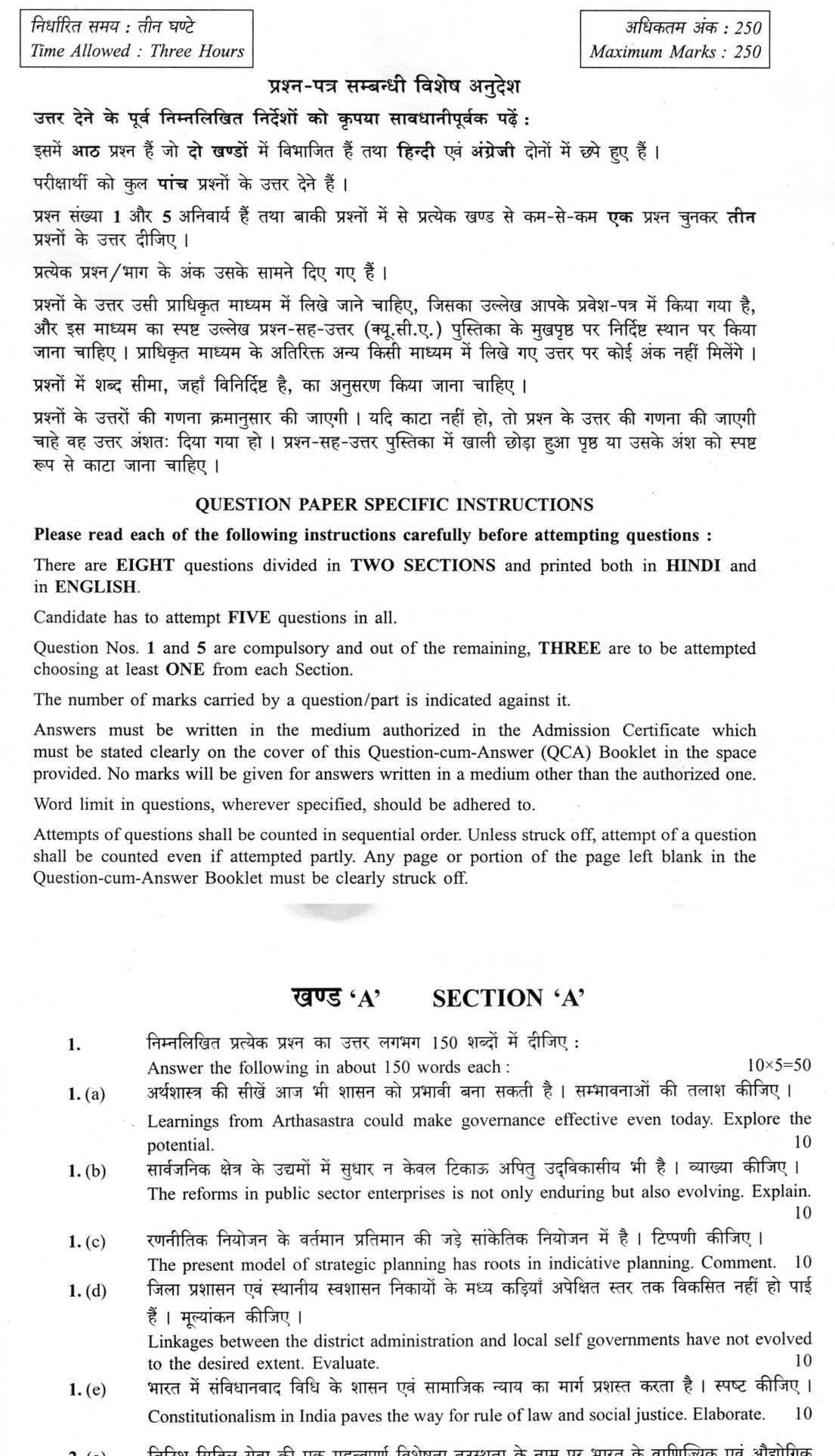
Answer the following in about 150 words each :
Learnings from Arthasastra could make governance effective even today. Explore the potential. 10 marks
The reforms in public sector enterprises is not only enduring but also evolving. Explain. 10 marks
The present model of strategic planning has roots in indicative planning. Comment. 10 marks
Linkages between the district administration and local self governments have not evolved to the desired extent. Evaluate. 10 marks
Constitutionalism in India paves the way for rule of law and social justice. Elaborate. 10 marks
हिंदी में प्रश्न पढ़ें
निम्नलिखित प्रत्येक प्रश्न का उत्तर लगभग 150 शब्दों में दीजिए :
अर्थशास्त्र की सीखें आज भी शासन को प्रभावी बना सकती है । सम्भावनाओं की तलाश कीजिए । (10 अंक)
सार्वजनिक क्षेत्र के उद्यमों में सुधार न केवल टिकाऊ अपितु उद्विकासीय भी है । व्याख्या कीजिए । (10 अंक)
रणनीतिक नियोजन के वर्तमान प्रतिमान की जड़ें सांकेतिक नियोजन में हैं । टिप्पणी कीजिए । (10 अंक)
जिला प्रशासन एवं स्थानीय स्वशासन निकायों के मध्य कड़ियाँ अपेक्षित स्तर तक विकसित नहीं हो पाई हैं । मूल्यांकन कीजिए । (10 अंक)
भारत में संविधानवाद विधि के शासन एवं सामाजिक न्याय का मार्ग प्रशस्त करता है । स्पष्ट कीजिए । (10 अंक)
Model answer
Drafted with AI by UPSC Answer Check against this question's marking rubric, to the 150-word length. UPSC does not publish answers for Mains — this is one way to score well, not an official key. How we build rubrics and answers.
(a) Learnings from the Arthasastra for Governance Today Kautilya's Arthasastra (discovered by R. Shamasastry and published in 1909; its date and single authorship are debated) offers administrative ideas that map onto present problems. The Saptanga theory treats the state as an integrated system, and Book II (Adhyaksha Prachara) sets out a specialised bureaucracy of superintendents - a model for departmental organisation. The Samaharta (collector-general) and Sannidhata (treasurer) anticipate revenue and treasury management. The "forty ways of embezzlement", audit and the use of gudhapurusha (spies) mirror preventive vigilance and social audit, and the warning that an official can no more avoid tasting revenue than honey on the tongue anticipates principal-agent theory. The maxim prajasukhe sukham rajnah and the ideal of yogakshema point to citizen-centric welfare; the Indian Army's Project Udbhav (2023) draws on such texts.
The limits are real: reliance on danda, espionage and monarchical centralisation cannot be transplanted into a rights-based constitutional order. Its fiscal and administrative insights are useful only when filtered through democratic accountability.
(b) Enduring and Evolving Reform of Public Sector Enterprises PSE reform is enduring because it has run for four decades across governments: the Arjun Sengupta Committee (1984) and the MoU system (1987-88), the Industrial Policy Statement (1991), the Disinvestment Commission (1996), Navratna and Miniratna status (1997), Maharatna (2009-10) and DIPAM (2016).
It is evolving because its aims and instruments change. The first phase sought board autonomy and performance contracts; the second, minority disinvestment; the third, strategic sale - Air India to Tata Sons in January 2022 - and market listing such as the LIC IPO (May 2022). The New PSE Policy (2021) keeps a bare-minimum presence in four strategic sectors and envisages privatising or closing enterprises elsewhere, though the BPCL sale was called off in 2022. The National Monetisation Pipeline (2021) and the second asset-monetisation plan for 2025-30 shifted the focus to assets, while strong PSEs are now pressed for dividends and capital expenditure.
Constraints - labour resistance, valuation disputes and market conditions - remain, but the reform trajectory itself has proved durable.
(c) Strategic Planning and Its Roots in Indicative Planning The present model of strategic planning, led by NITI Aayog (established 1 January 2015), indeed has roots in indicative planning. Indicative planning, inspired by the Jean Monnet Plan (1947), relies on persuasion and coordination rather than the command-and-control of imperative planning. India transitioned to this model during the Eighth Five Year Plan (1992-97), moving away from the directive Mahalanobis-era plans. The continuity is seen in the shared DNA of non-mandatory targets and market-led allocation. NITI Aayog’s "Three Year Action Agenda" (2017-20), "Strategy for New India @75" (December 2018) and the Viksit Bharat @2047 vision reflect this indicative spirit. However, the analogy has limits. Unlike the Planning Commission (created by executive resolution in 1950), NITI Aayog has no resource allocation power. The five-year cycle ended with the Twelfth Plan in March 2017, the Plan/Non-Plan distinction was abolished from the 2017-18 budget, and NITI instead focuses on cooperative and competitive federalism, SDG localisation, and index-based ranking. Thus, while strategic planning is a descendant of indicative planning, it is a distinct instrument of modern governance.
(d) District Administration and Local Self-Government Linkages The 73rd and 74th Amendments (1992) envisaged devolving functions, functionaries and funds to elected local bodies under Articles 243G and 243W, with District Planning Committees (Article 243ZD) integrating rural and urban plans. The linkage has not evolved as desired.
Devolution is enabling rather than mandatory, so it is uneven. Parallel bodies long bypassed elected bodies - the DRDA until its merger with Zila Parishads in April 2022 - and centrally sponsored schemes still run through separate district societies and MPLADS. DPCs are weak or non-functional in many states, and State Finance Commissions are irregular. The Collector keeps undiminished roles as District Magistrate, chair of the District Disaster Management Authority and District Election Officer, without accountability to the elected district body.
There are successes: Kerala's People's Plan Campaign (1996) showed genuine convergence. The Second ARC's report Local Governance (2007) proposed a District Council with the Collector as its Chief Officer. On balance, the linkage remains incomplete, with district administration acting more as a superior than a partner of local governments.
(e) Constitutionalism, Rule of Law and Social Justice Constitutionalism is limited government under law, distinct from merely having a constitution; as C. H. McIlwain put it, its essential quality is "a legal limitation on government".
It paves the way for the rule of law by subjecting state power to judicial review under Articles 13, 14, 21 and 32. Kesavananda Bharati (1973) protected the basic structure, Maneka Gandhi (1978) demanded fair procedure, and Puttaswamy (2017) recognised privacy.
It also drives social justice through substantive equality. Articles 15(4), 16(4), 38, 39 and 46 empower the state to uplift disadvantaged groups, as upheld in Indra Sawhney (1992); Article 21A (86th Amendment, 2002) made education a right; and Article 39A with the National Legal Services Authority brings legal aid to the poor.
Gaps remain: the ADM Jabalpur judgment (1976), overruled in Puttaswamy, and a pendency of over five crore cases show the distance between formal and substantive constitutionalism. Still, the framework supplies the legal architecture of a just society.
How this answer will be evaluated
Evaluation rubric
Each sub-part is marked on its own, against the marks and word limit printed on the paper.
- (a) 'Explore the potential' asks the candidate to identify specific, named administrative ideas in Kautilya's Arthasastra and map each to a contemporary Indian governance problem. A list of Arthasastra features without the present-day application, or present-day reform talk without textual anchors, answers only half the demand. 10 marks · 150 words
Must cover
- Identify specific administrative ideas in the Arthasastra (Saptanga; Adhyaksha Prachara in Book II; Samaharta and Sannidhata; forty modes of embezzlement; spies; prajasukhe sukham rajnah and yogakshema)
- Map each idea to a present-day governance problem (fiscal management, vigilance and anti-corruption, welfare orientation, bureaucratic organisation)
- Assess the limits: danda, espionage and monarchical centralisation cannot be transplanted into a rights-based constitutional order
- Reach a balanced conclusion on the potential
Loses marks
- Writing a history-of-ancient-India answer (Mauryan empire, Chandragupta, Megasthenes) instead of an administration answer.
- Asserting a firm date of composition; the text's dating (c. 2nd century BCE to 3rd century CE) and single authorship are disputed among scholars.
- Listing Arthasastra concepts with no contemporary mapping, so the directive 'explore the potential' is unaddressed.
- Confusing Kautilyan officials with Ashokan ones (rajukas, dhamma mahamatras) or with Gupta-era posts.
- Uncritical glorification with no mention of the text's authoritarian and espionage-based premises.
Earns more
- Cites the forty modes of embezzlement and the surveillance/audit apparatus, linking it to modern vigilance, preventive vigilance and social audit
- Offers a critical caveat that espionage, danda and monarchical centralisation cannot be transplanted into a rights-based constitutional order
Extra mark
- Shamasastry's discovery (1905) and publication (1909) of the text, noting that its dating and authorship are disputed
- The honey-tasting analogy on official corruption as an anticipation of principal-agent theory
- (b) Two claims must be separately sustained: that PSE reform is 'enduring' (a continuous, four-decade trajectory across governments) and that it is 'evolving' (its objectives and instruments keep changing - from autonomy to disinvestment to strategic sale to asset monetisation). A single-period description fails the question. 10 marks · 150 words
Must cover
- Sustain the 'enduring' limb: a continuous reform trajectory across governments (Arjun Sengupta Committee 1984, MoU system 1987-88, 1991 policy, Disinvestment Commission 1996, DIPAM 2016)
- Sustain the 'evolving' limb: changing objectives and instruments (autonomy via Navratna and Miniratna 1997 and Maharatna 2009-10, disinvestment, strategic sale, asset monetisation)
- Cite current instruments: New PSE Policy 2021 (four strategic sectors), Air India strategic sale (January 2022), National Monetisation Pipeline (2021)
- Note continuing constraints and give a verdict
Loses marks
- Treating 1991 as the start of PSE reform and ignoring the MoU/performance-contracting phase of the late 1980s.
- Confusing disinvestment (sale of equity) with privatisation (transfer of management control) and with corporatisation (change of legal form, ownership retained).
- Naming the Navratna/Maharatna categories without saying what they confer - graded financial and investment autonomy to the boards.
- Getting the New PSE Policy's four strategic sectors wrong or inventing a number of sectors.
- Writing only a critique of disinvestment without demonstrating the 'enduring and evolving' character the question asserts.
Earns more
- Names the institutional chain - Rangarajan Committee 1993, Disinvestment Commission 1996 under G.V. Ramakrishna, Department of Disinvestment 1999, National Investment Fund 2005, BRPSE 2004, DIPAM (2016)
- Explains the evolution of objective (self-reliance and employment to value-creation, competition and fiscal consolidation) and notes continuing constraints - labour resistance, valuation and asset-stripping criticism, and the National Monetisation Pipeline debate
Extra mark
- LIC IPO (May 2022) and the called-off BPCL sale (2022) as evidence of mixed progress
- The second asset-monetisation plan for 2025-30, or the shift to dividend and capex expectations from strong CPSEs
- (c) 'Comment' requires the candidate to accept, qualify or reject the proposition that today's strategic planning (NITI Aayog's vision-strategy-action documents) descends from indicative planning. The answer must define indicative planning, show the Indian transition to it, and then establish and delimit the continuity with strategic planning. 10 marks · 150 words
Must cover
- Define indicative planning as against imperative planning (French Monnet Plan, 1947)
- Show India's transition to indicative planning in the Eighth Plan (1992-97)
- Describe the present strategic planning model: NITI Aayog (1 January 2015), Three Year Action Agenda, Strategy for New India @75 (2018), Viksit Bharat @2047
- Establish the continuity and state where the analogy breaks (end of five-year plans in 2017, no allocative power, competitive federalism and indices)
Loses marks
- Calling the Second Five Year Plan indicative; the Mahalanobis-era plans were directive in intent with heavy public-sector allocation.
- Dating the shift to indicative planning to 1991 or to the Ninth Plan rather than to the Eighth Plan (1992-97).
- Confusing NITI Aayog's Governing Council with the National Development Council (set up 6 August 1952), which was attached to the Planning Commission.
- Presenting strategic planning as merely a renaming exercise, and so failing to 'comment' - i.e. failing to state where the analogy breaks down.
- Asserting that the Planning Commission was a constitutional or statutory body; it was created by executive resolution.
Earns more
- Identifies the shared features that support the 'roots' claim: non-mandatory targets, market-led allocation, persuasion and coordination rather than command, state consultation
- Notes the discontinuities - competitive federalism and index-based ranking, SDG localisation, DMEO-led evaluation, end of the five-year cycle and of the Plan/Non-Plan distinction from 2017-18
Extra mark
- End of the Plan/Non-Plan distinction from 2017-18
- NITI Aayog's DMEO-led evaluation and SDG localisation
- (d) 'Evaluate' requires a judgement, not a description: the candidate must set out what the desired linkage between district administration and panchayati raj/urban local bodies was meant to be after the 73rd and 74th Amendments, show with evidence where it has failed, concede where it has worked, and close with a reasoned verdict. 10 marks · 150 words
Must cover
- State the desired linkage after the 73rd and 74th Amendments (1992): devolution of the 3Fs under Articles 243G and 243W, Eleventh and Twelfth Schedules, District Planning Committee (Article 243ZD)
- Give evidence of the shortfall: enabling rather than mandatory devolution, parallel bodies and schemes, weak DPCs, weak State Finance Commissions (Article 243I)
- Explain the Collector's continuing roles and lack of accountability to elected bodies
- Offer counter-examples and an explicit verdict with a way forward (e.g., 2nd ARC 6th Report, Local Governance, 2007)
Loses marks
- Reversing the Schedules - the Eleventh Schedule (29 subjects) is for panchayats, the Twelfth (18 subjects) for municipalities.
- Treating Article 243G as mandatory devolution; it empowers the state legislature to endow panchayats, which is precisely why devolution is uneven.
- Confusing the District Planning Committee (Article 243ZD) with the Metropolitan Planning Committee (Article 243ZE) or with the DRDA.
- Writing an essay on panchayati raj's history without addressing the district administration end of the linkage at all.
- Describing problems without delivering the evaluative verdict the directive demands.
Earns more
- Notes the Collector's undiminished regulatory roles (District Magistrate; DDMA chairperson under Section 25 of the Disaster Management Act, 2005; District Election Officer) with no accountability to the elected district body
- Gives at least one positive/counter-example - Kerala's People's Plan Campaign (1996), Karnataka's 1983 legislation, or MGNREGA/GPDP convergence - and closes with an explicit verdict
Extra mark
- DRDA merged with Zila Parishads from April 2022
- The 2nd ARC's proposal of a District Council with the Collector as its Chief Officer
- (e) 'Elaborate' requires the candidate first to define constitutionalism (limited government under law) as distinct from having a constitution, and then to show two distinct causal chains: constitutionalism producing rule of law, and constitutionalism producing social justice - each supported by named Articles and decided cases. 10 marks · 150 words
Must cover
- Define constitutionalism as limited government under law, distinct from merely having a constitution
- Rule-of-law limb: Articles 13, 14, 21, 32 and judicial review; Kesavananda Bharati (1973), Maneka Gandhi (1978), Puttaswamy (2017)
- Social-justice limb: Preamble, Articles 15(4), 16(4), 38, 39, 46, 21A (86th Amendment, 2002); Indra Sawhney (1992)
- Qualify with the gaps (ADM Jabalpur 1976, pendency, formal versus substantive equality) and conclude
Loses marks
- Equating constitutionalism with the Constitution and so never establishing the 'limited government' idea the question rests on.
- Misdating landmark cases - Kesavananda Bharati is 1973, Maneka Gandhi 1978, Indra Sawhney 1992, Minerva Mills 1980, Puttaswamy 2017.
- Claiming Directive Principles are judicially enforceable; they are not (Article 37) but are fundamental in governance and used to read Part III purposively.
- Discussing only rule of law and ignoring the social justice half, or vice versa.
- Attributing the basic structure doctrine to Golaknath (1967), which instead held that Parliament could not abridge Fundamental Rights.
Earns more
- Establishes the social-justice limb with named provisions - Preamble, Articles 15(4), 16(4), 38, 39, 46 - and Indra Sawhney v. Union of India (1992)
- Offers a qualification: ordinance/emergency excesses, A.D.M. Jabalpur (1976), pendency, or the formal-versus-substantive equality gap
Extra mark
- McIlwain's definition of constitutionalism as a legal limitation on government
- Article 39A and legal aid through NALSA making the rule of law accessible
What "Explore" is asking you to do
Open a question that has no settled answer — set out the plausible factors or angles, say what each rests on, and identify which the evidence actually supports while leaving the rest honestly open.
Structure that answers it
Frame the open question → possible factor one → possible factor two → possible factor three → which the evidence supports, and what remains unresolved
Where marks are lost
Settling on one angle in the opening paragraph and dismissing the rest in a line, which is exactly what explore asks you not to do.
Practice this exact question
Write your answer and it is marked point by point against the model answer above — what you covered, what you missed, what you got wrong.
Evaluate my answer →More from Public Administration 2026 Paper II
- Q1 Answer the following in about 150 words each : (a) Learnings from Arthasastra could make…
- Q2 (a) An important characteristic of the British Civil Service was its open refusal to be i…
- Q3 (a) Planning Commission planned for economic development and social justice, but NITI Aay…
- Q4 (a) Doctrine of Pith and Substance, and the Doctrine of severability in the legislative r…