Paper II — Q2
(a) An important characteristic of the British Civil Service was its open refusal to be influenced by commercial and industrial…
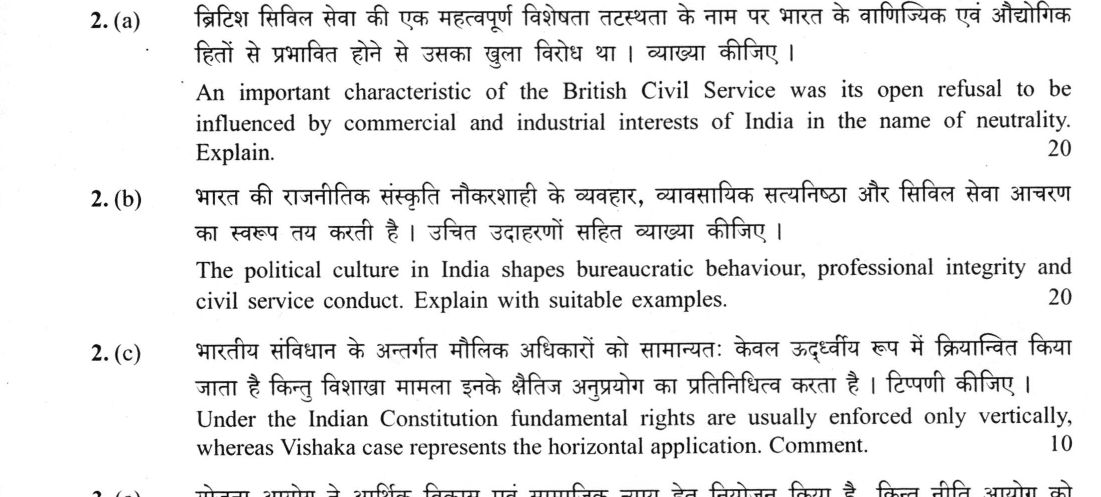
An important characteristic of the British Civil Service was its open refusal to be influenced by commercial and industrial interests of India in the name of neutrality. Explain. 20 marks
The political culture in India shapes bureaucratic behaviour, professional integrity and civil service conduct. Explain with suitable examples. 20 marks
Under the Indian Constitution fundamental rights are usually enforced only vertically, whereas Vishaka case represents the horizontal application. Comment. 10 marks
हिंदी में प्रश्न पढ़ें
ब्रिटिश सिविल सेवा की एक महत्वपूर्ण विशेषता तटस्थता के नाम पर भारत के वाणिज्यिक एवं औद्योगिक हितों से प्रभावित होने से उसका खुला विरोध था । व्याख्या कीजिए । (20 अंक)
भारत की राजनीतिक संस्कृति नौकरशाही के व्यवहार, व्यावसायिक सत्यनिष्ठा और सिविल सेवा आचरण का स्वरूप तय करती है । उचित उदाहरणों सहित व्याख्या कीजिए । (20 अंक)
भारतीय संविधान के अन्तर्गत मौलिक अधिकारों को सामान्यतः केवल ऊर्ध्वाधर रूप में क्रियान्वित किया जाता है किन्तु विशाखा मामले इनके क्षैतिज अनुप्रयोग का प्रतिनिधित्व करता है । टिप्पणी कीजिए । (10 अंक)
Model answer
Drafted with AI by UPSC Answer Check against this question's marking rubric, to the expected length. UPSC does not publish answers for Mains — this is one way to score well, not an official key. How we build rubrics and answers.
(a) ICS Neutrality and Indian Commercial Interests The British Civil Service in India was characterized by a doctrine of "neutrality" that functioned as a shield for colonial economic interests. This neutrality was institutionalized through the Cornwallis reforms (1786-93), which ended the Company servants' private trade that had bred corruption under Clive, paid them high salaries instead, and barred them from commercial dealings, and the Charter Act 1793, which reserved senior posts for a covenanted service insulated from local influence. The Aitchison Commission (1886-87) further entrenched this by creating a rigid classification of Imperial, Provincial, and Subordinate services, while the Islington Commission (1912-15) and Lee Commission (1923-24) maintained the service's elite, non-partisan character. Before 1855, covenanted servants were nominated by the Company's Directors and trained at Haileybury College (1806); the Macaulay Committee Report (1854) replaced patronage with the first open competitive examination in London in 1855, producing a homogeneous, British-educated cadre that was socially and ideologically distant from Indian society - the "steel frame" that Lloyd George praised in 1922.
This "neutrality" was, however, selective. While the service refused to be influenced by Indian commercial interests, it was demonstrably responsive to British capital. The imposition of the Cotton excise duty (1894-96) and the general free-trade bias of the colonial state served British industrialists while stifling Indian manufacturing. Nationalist economists like Dadabhai Naoroji (Drain Theory) and R.C. Dutt critiqued this, and a remark often attributed to Jawaharlal Nehru held that the ICS was "neither Indian, nor civil, nor a service." Nationalist critics saw the refusal to accommodate Indian industrialists as a way of protecting British commercial dominance; only after the Fiscal Autonomy Convention (1919) and the policy of "discriminating protection" (for steel from 1924) did the colonial state begin, reluctantly, to shield Indian industry. This legacy persists in independent India through Article 312 and the All India Services, where the tension between bureaucratic neutrality and developmental commitment remains a central administrative debate.
(b) Political Culture and Bureaucratic Behaviour in India India's political culture - read through Almond and Verba's typology of parochial, subject and participant cultures (1963) and Fred W. Riggs's analysis of transitional societies (1964) - significantly shapes bureaucratic behavior. Riggs’ prismatic-sala model highlights "formalism," where the gap between formal rules and informal practices leads to inconsistent administrative conduct. This cultural context influences three key areas:
- Bureaucratic Behaviour: The political culture of patronage often leads to the "committed bureaucracy" debate, which arose around 1969-70 when some Congress leaders demanded a bureaucracy committed to the ruling party's programmes. For example, the Vohra Committee (1993) identified the nexus between criminal-politician-bureaucrat, where bureaucratic behavior is shaped by political pressure rather than merit.
- Professional Integrity: The Santhanam Committee (1962-64) addressed the erosion of integrity, leading to the CVC (1964) and the CVC Act 2003. The **2nd ARC's 4th Report, Ethics in Governance (2007), and 10th Report, Refurbishing of Personnel Administration (2008)**, recommended a statutory code of ethics, fixed tenure and protection from arbitrary transfers to shield integrity from political pressure.
- Civil Service Conduct: Conduct is governed by the All India Services (Conduct) Rules, 1968 and CCS (Conduct) Rules, 1964. However, the T.S.R. Subramanian v. Union of India (2013) case, noting the damage done by political interference, directed fixed minimum tenure, Civil Services Boards for transfers and postings, and that officers act on written rather than oral instructions.
Concrete examples include the frequent transfers of officers as a tool of political control (behavior), caste and regional networks influencing postings, and the implementation of MGNREGA social audits (MGNREGA is now succeeded by the VB-G RAM G Act, 2025), which reflect a participant political culture that demands transparency (conduct).
(c) Vertical and Horizontal Application of Fundamental Rights: Vishaka Fundamental Rights in India are ordinarily enforced vertically against the "State" as defined in Article 12. However, the Vishaka v. State of Rajasthan (1997) case represents a landmark instance of horizontal application. In Vishaka, the Supreme Court held that sexual harassment violates Articles 14, 15, 19(1)(g), and 21, and, drawing on CEDAW (which India ratified in 1993) in the absence of domestic law, laid down guidelines binding on all employers, public and private, until Parliament legislated. The Court thus effectively extended these rights to non-State actors.
This horizontal application is not unique to Vishaka; the Constitution already contains horizontal provisions in Articles 15(2), 17, 23, and 24. The Vishaka judgment, under Article 141, became law of the land, eventually leading to the Sexual Harassment of Women at Workplace (Prevention, Prohibition and Redressal) Act, 2013. This trajectory, further extended by the Constitution Bench in Kaushal Kishor v. State of U.P. (2023), which held that rights under Articles 19 and 21 can be enforced even against non-State actors (with Justice Nagarathna dissenting on this point), demonstrates the judiciary's role in expanding the reach of fundamental rights to the private sphere.
How this answer will be evaluated
Evaluation rubric
Each sub-part is marked on its own, against the marks and word limit printed on the paper.
- (a) 'Explain' the statement that the British civil service in India openly refused, in the name of neutrality, to be influenced by Indian commercial and industrial interests. A high-scoring answer explains the doctrine and machinery of that 'neutrality', then tests it - showing that the same service was demonstrably responsive to British commercial interests, so neutrality was selective rather than absolute. 20 marks
Must cover
- Explain the doctrine and machinery of ICS 'neutrality': Cornwallis reforms (1786-93) ending private trade, the covenanted service (Charter Act 1793), Haileybury (1806), open competition after the Macaulay Report (1854; first examination 1855)
- Explain how the service kept its distance from Indian commercial and industrial interests (social and racial exclusiveness, laissez-faire and free-trade doctrine)
- Test the claim: neutrality was selective and responsive to British commercial interests (cotton excise duties 1894-96, free trade, the drain)
- Trace later change and the legacy (Fiscal Autonomy Convention 1919, discriminating protection from 1924; Article 312 and the All India Services; neutrality-versus-commitment debate)
Loses marks
- Accepting the statement uncritically and producing a eulogy of ICS impartiality without testing it against colonial economic policy.
- Confusing the commissions: Aitchison (1886-87) created the Imperial/Provincial/Subordinate classification; Islington (1912-15) was the Royal Commission on the Public Services in India; Lee (1923-24) gave the 50:50 formula and led to the 1926 Public Service Commission.
- Saying Indians could not sit the examination after 1833 or 1853; they could, but the London venue, the age limit (reduced to 19 in 1878) and the syllabus made success rare - Satyendranath Tagore succeeded in 1863.
- Attributing the 'steel frame' phrase to Curzon or to the Simon Commission rather than to Lloyd George in 1922.
- Writing a general history of the ICS with no reference to commercial and industrial interests, which is the specific subject of the question.
Earns more
- Cites the nationalist critique - Dadabhai Naoroji's drain theory (1901) and R.C. Dutt - and the charge that the ICS was 'neither Indian, nor civil, nor a service'
- Traces the legacy into independent India: Article 312, the All India Services, and the neutrality-versus-commitment debate
Extra mark
- Lloyd George's 'steel frame' speech (1922) and the Lee Commission (1923-24) leading to the Public Service Commission (1926)
- Aitchison (1886-87) and Islington (1912-15) Commissions correctly distinguished
- (b) 'Explain with suitable examples' asks for a causal account running from India's political culture to three named outputs - bureaucratic behaviour, professional integrity and civil service conduct - each illustrated. Examples are marked, so an answer without concrete, accurate instances loses substantial credit. 20 marks
Must cover
- Define political culture as an analytical category (Almond and Verba, 1963: parochial, subject, participant) and relate it to administration (e.g., Riggs's formalism)
- Show its effect on bureaucratic behaviour with examples (patronage, transfers as control, the committed-bureaucracy debate, Vohra Committee 1993)
- Show its effect on professional integrity with examples (Santhanam Committee 1962-64, CVC 1964 and CVC Act 2003, 2nd ARC 4th Report 2007)
- Show its effect on civil service conduct (AIS Conduct Rules 1968, CCS Conduct Rules 1964; T.S.R. Subramanian v. Union of India 2013; Articles 311 and 312)
- Balance with positive examples of a participant culture (RTI, social audits) and conclude
Loses marks
- Writing about corruption generally without ever defining or using 'political culture' as an analytical category.
- Omitting examples although the question expressly asks for them, or using examples that are asserted but factually wrong.
- Attributing the prismatic-sala model to Weber or Dwight Waldo instead of Fred W. Riggs, or mis-stating what 'formalism' means.
- Confusing the Santhanam Committee (which led to the CVC) with the Vohra Committee (on the criminal-politician nexus) or with the Administrative Reforms Commissions.
- Treating political neutrality as an absolute constitutional requirement; it is a conduct-rule and convention-based norm, and the 'committed bureaucracy' debate is precisely a dispute over it.
Earns more
- Grounds civil service conduct in the actual rules - All India Services (Conduct) Rules, 1968 and CCS (Conduct) Rules, 1964 - and in Articles 311 and 312, noting where protection becomes insulation from accountability
- Supplies at least two concrete, accurately stated examples (e.g. frequent transfers of individual officers, state-level variation in delivery, RTI and MGNREGA social audit as products of a participant culture)
Extra mark
- 2nd ARC 10th Report, Refurbishing of Personnel Administration (2008), on tenure and protection from arbitrary transfer
- The committed-bureaucracy debate of 1969-70 correctly placed
- (c) 'Comment' on a two-part proposition: that Fundamental Rights in India are ordinarily enforceable vertically (against the State as defined in Article 12), and that Vishaka is an instance of horizontal application. The candidate must define both terms, justify the general rule with the constitutional text, and then show precisely what in Vishaka made it horizontal. 10 marks
Must cover
- Define vertical and horizontal application, with the Article 12 definition of 'State'
- Show the constitutional basis of the general rule and its textual exceptions (Articles 15(2), 17, 23, 24)
- Explain what made Vishaka (1997) horizontal: Articles 14, 15, 19(1)(g), 21; CEDAW; guidelines binding on all employers, public and private, as law under Article 141
- Comment on the trajectory and its limits (POSH Act 2013; Kaushal Kishor 2023; concerns about judicial legislation)
Loses marks
- Dating Vishaka to 1992 or 2013; the judgment is of 1997 and the Act is of 2013.
- Saying Vishaka created a new fundamental right; it enforced existing rights under Articles 14, 15, 19(1)(g) and 21 by framing interim guidelines.
- Missing Articles 15(2), 17, 23 and 24, and so wrongly presenting horizontality as wholly judge-made.
- Describing the facts of the Bhanwari Devi case at length instead of analysing the constitutional point.
- Confusing horizontal application with horizontal federal relations between states, a wholly different concept.
Earns more
- Notes the statutory sequel: the Sexual Harassment of Women at Workplace (Prevention, Prohibition and Redressal) Act, 2013, with Internal Committees, and/or Medha Kotwal Lele v. Union of India (2012)
- Comments on the wider trajectory, e.g. Kaushal Kishor v. State of U.P. (2023) extending Articles 19 and 21 against non-State actors, or the risk of judicial legislation
Extra mark
- Medha Kotwal Lele v. Union of India (2012) on enforcing the Vishaka guidelines
- Justice Nagarathna's dissent in Kaushal Kishor on horizontal enforcement of Articles 19 and 21
What "Explain" is asking you to do
Make the working of something clear — what sets it off, what follows from what, and what it produces. Explain is the Commission's mechanism word: it dominates the technical papers and the “explain why” stems, where the marks sit in the causal chain and not in the label.
Structure that answers it
State what it is → the initiating condition → the chain of cause, step by step → an instance where it plays out → what the chain produces
Where marks are lost
Describing what something looks like instead of why it works that way. Naming the stages without linking them reads as description too.
Practice this exact question
Write your answer and it is marked point by point against the model answer above — what you covered, what you missed, what you got wrong.
Evaluate my answer →More from Public Administration 2026 Paper II
- Q1 Answer the following in about 150 words each : (a) Learnings from Arthasastra could make…
- Q2 (a) An important characteristic of the British Civil Service was its open refusal to be i…
- Q3 (a) Planning Commission planned for economic development and social justice, but NITI Aay…
- Q4 (a) Doctrine of Pith and Substance, and the Doctrine of severability in the legislative r…
- Q5 Answer the following in about 150 words each : (a) Lateral Entry in Government of India h…